Opti with debugging and low-level access. More...
#include <optistack.hpp>
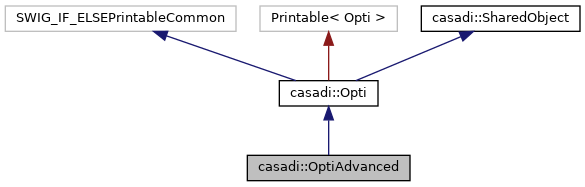
Obtained through Opti::debug or Opti::advanced; it is a deep copy of the Opti instance with the methods below added. No API stability is guaranteed for these methods. Most of them bake the problem (flatten variables and constraints) on the fly, so they also work on a copy that has not been solved.
Extra doc: https://github.com/casadi/casadi/wiki/L_2mz
Definition at line 2786 of file optistack.hpp.
Public Types | |
| using | internal_base_type = SharedObjectInternal |
| using | base_type = SharedObject |
Public Member Functions | |
| OptiAdvanced (const Opti &x) | |
| ~OptiAdvanced () | |
| Destructor. More... | |
| Function | casadi_solver () const |
| Get the underlying nlpsol/qpsol Function. More... | |
| bool | is_parametric (const MX &expr) const |
| Check whether an expression depends on parameters only. More... | |
| MetaCon | canon_expr (const MX &expr) const |
| Classify a constraint expression (for internal use only) More... | |
| MetaVar | get_meta (const MX &m) const |
| Get meta-data of symbol (for internal use only) More... | |
| MetaCon | get_meta_con (const MX &m) const |
| Get meta-data of symbol (for internal use only) More... | |
| void | set_meta (const MX &m, const MetaVar &meta) |
| Set meta-data of an expression. More... | |
| void | set_meta_con (const MX &m, const MetaCon &meta) |
| Set meta-data of an expression. More... | |
| void | assert_active_symbol (const MX &m) const |
Raise an error unless m is a symbol of this instance that appears in the problem. More... | |
| std::vector< MX > | active_symvar (VariableType type) const |
| Get the symbols of a given type that appear in the problem. More... | |
| std::vector< DM > | active_values (VariableType type) const |
| Initial guesses (or parameter values) of the symbols returned by active_symvar. More... | |
| MX | x_lookup (casadi_index i) const |
| Get the variable that owns entry i of the flattened x vector. More... | |
| MX | g_lookup (casadi_index i) const |
| Get the constraint expression that owns row i of g. More... | |
| casadi_index | g_index_reduce_g (casadi_index i) const |
| Row of the reduced g for row i of g when "detect_simple_bounds" is active (-1 if moved) More... | |
| casadi_index | g_index_reduce_x (casadi_index i) const |
| Index into x when row i of g was reduced to a simple bound (-1 otherwise) More... | |
| casadi_index | g_index_unreduce_g (casadi_index i) const |
| Row of g for row i of the reduced g. More... | |
| std::string | x_describe (casadi_index i, const Dict &opts=Dict()) const |
| Describe entry i of the flattened x vector. More... | |
| std::string | g_describe (casadi_index i, const Dict &opts=Dict()) const |
| Describe row i of the constraint vector g. More... | |
| std::string | describe (const MX &x, casadi_index indent=0, const Dict &opts=Dict()) const |
| Describe an expression in terms of this instance. More... | |
| void | show_infeasibilities (double tol=0, const Dict &opts=Dict()) const |
| Print the constraints violated at the latest iterate. More... | |
| void | solve_prepare () |
| Prepare the solver arguments (first half of solve) More... | |
| DMDict | solve_actual (const DMDict &args) |
| Run the solver on an argument dict (see solve_prepare) More... | |
| DMDict | arg () const |
| Solver arguments prepared by solve_prepare (x0, p, lam_g0, lbg, ubg) More... | |
| void | res (const DMDict &res) |
| Store a solver result dict as the latest values (marks the instance solved) More... | |
| DMDict | res () const |
| Result dict of the latest solve (x, f, g, lam_x, lam_g, lam_p) More... | |
| std::vector< MX > | constraints () const |
| Get the constraint expressions as passed to subject_to. More... | |
| MX | objective () const |
| Objective expression; same as f() More... | |
| OptiAdvanced | baked_copy () const |
| Copy of the instance with the problem baked (see bake) More... | |
| void | assert_empty () const |
| Raise an error if an objective or constraints are present. More... | |
| void | bake () |
| Fix the structure of the optimization problem. More... | |
| void | mark_problem_dirty (bool flag=true) |
| Flag that the problem structure changed since the last bake. More... | |
| bool | problem_dirty () const |
| True when the problem must be baked again before solving. More... | |
| void | mark_solver_dirty (bool flag=true) |
| Flag that the solver must be reconstructed (solver() was called) More... | |
| bool | solver_dirty () const |
| True when the solver must be reconstructed. More... | |
| void | mark_solved (bool flag=true) |
| Set or clear the solved state. More... | |
| bool | solved () const |
| True when a solver result is available for value() More... | |
| void | assert_solved () const |
| Raise an error unless solved() More... | |
| void | assert_baked () const |
| Raise an error when the problem is dirty. More... | |
| casadi_int | instance_number () const |
| Sequence number of this Opti instance in the process; prefixes the symbol names. More... | |
| MX | variable (casadi_int n=1, casadi_int m=1, const std::string &attribute="full") |
| Create a decision variable (symbol) More... | |
| MX | variable (const Sparsity &sp, const std::string &attribute="full") |
| Create a decision variable with a given sparsity pattern; only "full" is supported. More... | |
| MX | variable (const MX &symbol, const std::string &attribute="full") |
| Register an existing MX symbol as a decision variable of this instance. More... | |
| MX | parameter (casadi_int n=1, casadi_int m=1, const std::string &attribute="full") |
| Create a parameter (symbol); fixed during optimization. More... | |
| MX | parameter (const Sparsity &sp, const std::string &attribute="full") |
| Create a parameter with a given sparsity pattern. More... | |
| MX | parameter (const MX &symbol, const std::string &attribute="full") |
| Register an existing MX symbol as a parameter of this instance. More... | |
| void | minimize (const MX &f, double linear_scale=1) |
| Set the objective. More... | |
| void | subject_to () |
| Clear all constraints. More... | |
| void | solver (const std::string &solver, const Dict &plugin_options=Dict(), const Dict &solver_options=Dict()) |
| Select the numerical solver and its options. More... | |
| void | set_domain (const MX &x, const std::string &domain) |
| Set the domain of a decision variable. More... | |
| void | set_linear_scale (const MX &x, const DM &scale, const DM &offset=0) |
| Set the linear scaling of a decision variable. More... | |
| OptiSol | solve () |
| Solve the problem. More... | |
| OptiSol | solve_limited () |
| Solve the problem, accepting a limit as outcome. More... | |
| Dict | stats () const |
| Get the statistics of the last solve. More... | |
| std::string | return_status () const |
| Get the return status of the last solve. More... | |
| std::vector< MX > | initial () const |
| Get assignment expressions for the initial guesses. More... | |
| std::vector< MX > | value_variables () const |
| Get assignment expressions for the latest values. More... | |
| std::vector< MX > | value_parameters () const |
| Function | scale_helper (const Function &h) const |
| Scale a helper function constructed via opti.x, opti.g, ... More... | |
| MX | dual (const MX &m) const |
| Get the dual variable (Lagrange multiplier) of a constraint. More... | |
| casadi_int | nx () const |
| Number of (scalarised) decision variables. More... | |
| casadi_int | np () const |
| Number of (scalarised) parameters. More... | |
| casadi_int | ng () const |
| Number of (scalarised) constraints. More... | |
| MX | x () const |
| Get all (scalarised) decision variables as a symbolic column vector. More... | |
| MX | p () const |
| Get all (scalarised) parameters as a symbolic column vector. More... | |
| MX | g () const |
| Get all (scalarised) constraint expressions as a column vector. More... | |
| MX | f () const |
| Get the objective expression. More... | |
| MX | lbg () const |
| Get all (scalarised) bounds on constraints as a column vector. More... | |
| MX | ubg () const |
| DM | x_linear_scale () const |
| Per-entry scale of x (see set_linear_scale); a Python property. More... | |
| DM | x_linear_scale_offset () const |
| Per-entry offset of x (see set_linear_scale); a Python property. More... | |
| DM | g_linear_scale () const |
| Per-row scale of g (see subject_to); a Python property. More... | |
| double | f_linear_scale () const |
| Scale of the objective (see minimize); a Python property. More... | |
| MX | lam_g () const |
| Get all (scalarised) dual variables as a symbolic column vector. More... | |
| OptiAdvanced | debug () const |
| Get a copy with advanced (debugging) functionality. More... | |
| OptiAdvanced | advanced () const |
| Get a copy with advanced functionality. More... | |
| Opti | copy () const |
| Get a deep copy of the Opti instance. More... | |
| void | update_user_dict (const MX &m, const Dict &meta) |
| Add user data to a symbol or constraint. More... | |
| void | update_user_dict (const std::vector< MX > &m, const Dict &meta) |
| Dict | user_dict (const MX &m) const |
| Get the user data of a symbol or constraint. More... | |
| std::string | type_name () const |
| Readable name of the class. More... | |
| void | disp (std::ostream &stream, bool more=false) const |
| Print a summary of the instance. More... | |
| std::string | get_str (bool more=false) const |
| Get string representation. More... | |
| std::string | class_name () const |
| Get class name. More... | |
| std::string | debug_repr () const |
| bool | is_null () const |
| Is a null pointer? More... | |
| casadi_int | __hash__ () const |
| Returns a number that is unique for a given Node. More... | |
| std::vector< MX > | symvar () const |
| Get the symbols of this instance. More... | |
| std::vector< MX > | symvar (const MX &expr) const |
| Get the symbols of this instance. More... | |
| std::vector< MX > | symvar (const MX &expr, VariableType type) const |
| Get the symbols of this instance. More... | |
| void | subject_to (const MX &g, const Dict &options=Dict()) |
| Add constraints. More... | |
| void | subject_to (const std::vector< MX > &g, const Dict &options=Dict()) |
| Add constraints. More... | |
| void | subject_to (const MX &g, const DM &linear_scale, const Dict &options=Dict()) |
| Add constraints. More... | |
| void | subject_to (const std::vector< MX > &g, const DM &linear_scale, const Dict &options=Dict()) |
| Add constraints. More... | |
| void | set_initial (const MX &x, const DM &v) |
| Set the initial guess of decision variables or dual variables. More... | |
| void | set_initial (const std::vector< MX > &assignments) |
| Set the initial guess of decision variables or dual variables. More... | |
| void | set_value (const MX &x, const DM &v) |
| Set the value of a parameter. More... | |
| void | set_value (const std::vector< MX > &assignments) |
| Set the value of a parameter. More... | |
| native_DM | value (const MX &x, const std::vector< MX > &values=std::vector< MX >()) const |
| Evaluate an expression at the current values. More... | |
| native_DM | value (const DM &x, const std::vector< MX > &values=std::vector< MX >()) const |
| Evaluate an expression at the current values. More... | |
| native_DM | value (const SX &x, const std::vector< MX > &values=std::vector< MX >()) const |
| Evaluate an expression at the current values. More... | |
| Function | to_function (const std::string &name, const std::vector< MX > &args, const std::vector< MX > &res, const Dict &opts=Dict()) |
| Create a CasADi Function from the Opti solver. More... | |
| Function | to_function (const std::string &name, const std::vector< MX > &args, const std::vector< MX > &res, const std::vector< std::string > &name_in, const std::vector< std::string > &name_out, const Dict &opts=Dict()) |
| Create a CasADi Function from the Opti solver. More... | |
| Function | to_function (const std::string &name, const std::map< std::string, MX > &dict, const std::vector< std::string > &name_in, const std::vector< std::string > &name_out, const Dict &opts=Dict()) |
| Same, with inputs and outputs picked by name from a dict of expressions. More... | |
| void | callback_class (OptiCallback *callback) |
| Helper methods for callback() More... | |
| void | callback_class () |
| Helper methods for callback() More... | |
Static Public Member Functions | |
| static MX | bounded (const MX &lb, const MX &expr, const MX &ub) |
| Construct a double inequality. More... | |
Public Attributes | |
| bool | problem_dirty_ |
| bool | solver_dirty_ |
| bool | solved_ |
Protected Member Functions | |
| OptiAdvanced () | |
Friends | |
| class | InternalOptiCallback |
|
inherited |
Definition at line 103 of file shared_object.hpp.
|
inherited |
Definition at line 102 of file shared_object.hpp.
| casadi::OptiAdvanced::OptiAdvanced | ( | const Opti & | x | ) |
|
inline |
Extra doc: https://github.com/casadi/casadi/wiki/L_1t
Definition at line 2795 of file optistack.hpp.
|
inlineprotected |
Definition at line 3503 of file optistack.hpp.
|
inherited |
If the Object does not point to any node, "0" is returned.
Extra doc: https://github.com/casadi/casadi/wiki/L_av
Definition at line 123 of file generic_shared_impl.hpp.
| std::vector<MX> casadi::OptiAdvanced::active_symvar | ( | VariableType | type | ) | const |
Empty before the problem has been baked (solve, or any method that bakes).
>>> opti = Opti()
>>> x = opti.variable()
>>> y = opti.variable()
>>> opti.minimize(x**2)
>>> d = opti.debug
>>> d.active_symvar(OPTI_VAR)
[]
>>> d.bake()
>>> print(d.active_symvar(OPTI_VAR), d.active_values(OPTI_VAR))
[MX(opti..._x_1)] [DM(0)]
>> opti = Opti(); x = opti.variable(); y = opti.variable(); opti.minimize(x^2);
>> d = opti.debug; disp(isempty(d.active_symvar(OPTI_VAR)))
1
>> d.bake(); a = d.active_symvar(OPTI_VAR); v = d.active_values(OPTI_VAR);
>> a{1}, v{1}
opti..._x_1
0
julia> opti = ca.Opti();
julia> x = ca.variable(opti);
julia> y = ca.variable(opti);
julia> ca.minimize(opti, x^2)
julia> d = ca.debug(opti);
julia> ca.active_symvar(d, ca.OPTI_VAR)
MX[]
julia> ca.bake(d)
julia> print(ca.active_symvar(d, ca.OPTI_VAR), " ", ca.active_values(d, ca.OPTI_VAR))
MX[opti..._x_1] DM[0]
Extra doc: https://github.com/casadi/casadi/wiki/L_2n3
| std::vector<DM> casadi::OptiAdvanced::active_values | ( | VariableType | type | ) | const |
|
inherited |
Same as debug(); the name signals use of the unstable OptiAdvanced API rather than debugging. In Python this is a read-only property.
>>> opti = Opti()
>>> x = opti.variable()
>>> opti.minimize(x**2)
>>> print(opti.advanced.symvar())
[MX(opti..._x_1)]
>> opti = Opti(); x = opti.variable(); opti.minimize(x^2);
>> sv = opti.advanced.symvar(); disp(numel(sv)), disp(sv{1})
1
opti..._x_1
julia> opti = ca.Opti();
julia> x = ca.variable(opti);
julia> ca.minimize(opti, x^2)
julia> print(ca.symvar(ca.advanced(opti)))
MX[opti..._x_1]
Extra doc: https://github.com/casadi/casadi/wiki/L_1m
| DMDict casadi::OptiAdvanced::arg | ( | ) | const |
| void casadi::OptiAdvanced::assert_active_symbol | ( | const MX & | m | ) | const |
| void casadi::OptiAdvanced::assert_baked | ( | ) | const |
| void casadi::OptiAdvanced::assert_empty | ( | ) | const |
| void casadi::OptiAdvanced::assert_solved | ( | ) | const |
| void casadi::OptiAdvanced::bake | ( | ) |
Flattens the active variables, parameters and constraints into the x, p, g, lbg and ubg vectors and builds the bounds function. Called automatically by solve() and the accessors; raises an error when neither an objective nor a constraint is set.
Extra doc: https://github.com/casadi/casadi/wiki/L_2nc
| OptiAdvanced casadi::OptiAdvanced::baked_copy | ( | ) | const |
|
inlinestaticinherited |
Returns the expression (lb <= expr) <= ub, which subject_to() recognizes as a double-bounded constraint lb <= expr <= ub when lb and ub are free of decision variables. Identical to writing lb <= (expr <= ub) by hand; provided because Python's chained comparison lb <= expr <= ub raises an error for MX. A static method; the instance is not needed.
>>> opti = Opti()
>>> x = opti.variable(2)
>>> opti.subject_to(opti.bounded(-1, x, 1))
>>> opti.subject_to(Opti.bounded(0, x[0] + x[1], 1))
>>> opti.ng, opti.lbg, opti.ubg
(3, MX(vertcat(all_-1(2x1), 0)), MX(ones(3x1)))
julia> opti = ca.Opti();
julia> x = ca.variable(opti, 2);
julia> ca.subject_to(opti, ca.bounded(-1, x, 1))
julia> ca.subject_to(opti, ca.Opti.bounded(0, x[1] + x[2], 1))
julia> ca.ng(opti), ca.lbg(opti), ca.ubg(opti)
(3, vertcat(all_-1(2x1), 0), ones(3x1))
Extra doc: https://github.com/casadi/casadi/wiki/L_1k
Definition at line 2353 of file optistack.hpp.
|
inherited |
Do not use directly; use opti.callback(fh) in Python/MATLAB, which wraps a callable in an OptiCallback and registers it here. The no-argument form removes the callback.
Extra doc: https://github.com/casadi/casadi/wiki/L_1p
|
inherited |
Do not use directly; use opti.callback(fh) in Python/MATLAB, which wraps a callable in an OptiCallback and registers it here. The no-argument form removes the callback.
Extra doc: https://github.com/casadi/casadi/wiki/L_1p
Returns the MetaCon that subject_to() would store: the constraint type, canonical expression and bounds.
>>> opti = Opti()
>>> x = opti.variable()
>>> c = opti.debug.canon_expr(0 <= (x <= 1))
>>> print(c.type == OPTI_DOUBLE_INEQUALITY, c.lb, c.ub, c.canon)
True 0 1 opti..._x_1
>>> opti.debug.canon_expr(x + 1).type == OPTI_UNKNOWN
True
>> opti = Opti(); x = opti.variable();
>> c = opti.debug.canon_expr(0 <= x <= 1);
>> c.type == OPTI_DOUBLE_INEQUALITY, c.lb, c.ub, c.canon
1
0
1
opti..._x_1
>> c = opti.debug.canon_expr(x + 1); disp(c.type == OPTI_UNKNOWN)
1
julia> opti = ca.Opti();
julia> x = opti.variable();
julia> c = ca.canon_expr(opti.debug, 0 <= (x <= 1));
julia> println(c.type == ca.OPTI_DOUBLE_INEQUALITY, " ", c.lb, " ", c.ub, " ", c.canon)
true 0 1 opti..._x_1
julia> ca.canon_expr(opti.debug, x + 1).type == ca.OPTI_UNKNOWN
true
Extra doc: https://github.com/casadi/casadi/wiki/L_2n2
| Function casadi::OptiAdvanced::casadi_solver | ( | ) | const |
The solver Function constructed at the last solve() (null before that). Its inputs follow the nlpsol convention (x0, p, lbx, ubx, lbg, ubg, lam_x0, lam_g0), and its get_function() gives access to the derivative functions. In Python this is a read-only property.
>>> opti = Opti()
>>> x = opti.variable(2)
>>> opti.minimize(sumsqr(x))
>>> opti.subject_to(x[0] >= 1)
>>> opti.solver("ipopt", {"print_time": False}, {"print_level": 0, "sb": "yes"})
>>> sol = opti.solve()
>>> S = opti.debug.casadi_solver
>>> S.name(), S.class_name(), S.name_in()
('solver', 'IpoptInterface', ['x0', 'p', 'lbx', 'ubx', 'lbg', 'ubg', 'lam_x0', 'lam_g0'])
>> opti = Opti(); x = opti.variable(2);
>> opti.minimize(sumsqr(x)); opti.subject_to(x(1) >= 1);
>> opti.solver('ipopt', struct('print_time', false), struct('print_level', 0, 'sb', 'yes'));
>> sol = opti.solve(); S = opti.debug.casadi_solver();
>> S.name(), S.class_name(), strjoin(cellstr(S.name_in()), ' ')
solver
IpoptInterface
x0 p lbx ubx lbg ubg lam_x0 lam_g0
julia> opti = ca.Opti();
julia> x = ca.variable(opti, 2);
julia> ca.minimize(opti, ca.sumsqr(x))
julia> ca.subject_to(opti, x[1] >= 1)
julia> ca.solver(opti, "ipopt", Dict("print_time" => false),
                  Dict("print_level" => 0, "sb" => "yes"))
julia> sol = ca.solve(opti);
julia> S = opti.debug.casadi_solver;
julia> ca.name(S), ca.class_name(S)
("solver", "IpoptInterface")
julia> print(ca.name_in(S))
["x0", "p", "lbx", "ubx", "lbg", "ubg", "lam_x0", "lam_g0"]
Extra doc: https://github.com/casadi/casadi/wiki/L_2n0
|
inherited |
Extra doc: https://github.com/casadi/casadi/wiki/L_au
| std::vector<MX> casadi::OptiAdvanced::constraints | ( | ) | const |
>>> opti = Opti()
>>> x = opti.variable()
>>> opti.subject_to(x >= 0)
>>> opti.subject_to(1 <= (x**2 <= 4))
>>> print(opti.debug.constraints())
[MX((0<=opti..._x_1)), MX((1<=(sq(opti..._x_1)<=4)))]
>> opti = Opti(); x = opti.variable();
>> opti.subject_to(x >= 0); opti.subject_to(1 <= x^2 <= 4);
>> c = opti.debug.constraints(); disp(c{1}), disp(c{2})
(0<=opti..._x_1)
((1<=sq(opti..._x_1))<=4)
julia> opti = ca.Opti();
julia> x = ca.variable(opti);
julia> ca.subject_to(opti, x >= 0)
julia> ca.subject_to(opti, 1 <= (x^2 <= 4))
julia> print(ca.constraints(ca.debug(opti)))
MX[(0<=opti..._x_1), (1<=(sq(opti..._x_1)<=4))]
Extra doc: https://github.com/casadi/casadi/wiki/L_2nb
|
inherited |
The copy shares the symbols (so expressions in them stay valid for both) but has its own constraints, values, initial guesses and solver state. Updating the copy does not update the original.
>>> opti = Opti()
>>> x = opti.variable()
>>> opti.minimize(x**2)
>>> opti2 = opti.copy()
>>> opti2.subject_to(x >= 2)
>>> opti.ng, opti2.ng
(0, 1)
>> opti = Opti(); x = opti.variable(); opti.minimize(x^2);
>> opti2 = opti.copy(); opti2.subject_to(x >= 2); fprintf('%d %d\n', opti.ng, opti2.ng)
0 1
julia> opti = ca.Opti();
julia> x = ca.variable(opti);
julia> ca.minimize(opti, x^2)
julia> opti2 = opti.copy();
julia> ca.subject_to(opti2, x >= 2)
julia> ca.ng(opti), ca.ng(opti2)
(0, 1)
Extra doc: https://github.com/casadi/casadi/wiki/L_1n
|
inherited |
Returns an OptiAdvanced deep copy of the current state: same symbols, constraints, values and latest solver result, with extra methods such as value() at a non-converged iterate, show_infeasibilities(), x_describe()/g_describe() and casadi_solver(). Changes to the copy do not affect the original. No API stability is guaranteed for the extra methods. In Python this is a read-only property: opti.debug.value(x).
>>> opti = Opti()
>>> x = opti.variable()
>>> opti.minimize((x-1)**6)
>>> opti.solver("ipopt", {"print_time": False},
...             {"print_level": 0, "max_iter": 2, "sb": "yes"})
>>> try:
...   opti.solve()
... except Exception as e:
...   pass
>>> opti.debug.value(x)
0.36
>>> print(opti.debug.x_describe(0))
Opti decision variable 'opti..._x_1' of shape 1x1, called from ...
>> opti = Opti(); x = opti.variable(); opti.minimize((x-1)^6);
>> ipopt = struct('print_level', 0, 'max_iter', 2, 'sb', 'yes');
>> opti.solver('ipopt', struct('print_time', false), ipopt);
>> try, opti.solve(); catch e, end
>> opti.debug.value(x)
0.36
>> opti.debug.x_describe(1)
Opti decision variable 'opti..._x_1' of shape 1x1, called from ...
julia> opti = ca.Opti();
julia> x = ca.variable(opti);
julia> ca.minimize(opti, (x - 1)^6)
julia> ca.solver(opti, "ipopt", Dict("print_time" => false),
                  Dict("print_level" => 0, "max_iter" => 2, "sb" => "yes"))
julia> try
           ca.solve(opti)
       catch e
       end
julia> ca.value(ca.debug(opti), x)
0.36
julia> print(ca.x_describe(ca.debug(opti), 0))
Opti decision variable 'opti..._x_1' of shape 1x1, called from ...
Extra doc: https://github.com/casadi/casadi/wiki/L_1l
|
inherited |
Definition at line 112 of file generic_shared_impl.hpp.
| std::string casadi::OptiAdvanced::describe | ( | const MX & | x, |
| casadi_index | indent = 0, |
||
| const Dict & | opts = Dict() |
||
| ) | const |
For a symbol: its kind, name, shape and origin, or a note that it belongs to another Opti instance or was declared outside of Opti. For a constraint: its shape and origin. For another expression: the symbols it depends on.
>>> opti = Opti()
>>> x = opti.variable()
>>> p = opti.parameter()
>>> opti.debug.describe(MX.sym("w"))
"MX symbol 'w' of shape 1x1, declared outside of Opti."
>>> print(opti.debug.describe(x*p))
General expression, dependent on 2 symbols:
  Opti decision variable 'opti..._x_1' of shape 1x1, called from ...
  Opti parameter 'opti..._p_1' of shape 1x1, called from ...
>> opti = Opti(); x = opti.variable(); p = opti.parameter();
>> opti.debug.describe(MX.sym('w'))
MX symbol 'w' of shape 1x1, declared outside of Opti.
>> opti.debug.describe(x*p)
General expression, dependent on 2 symbols:
  Opti decision variable 'opti..._x_1' of shape 1x1, called from ...
  Opti parameter 'opti..._p_1' of shape 1x1, called from ...
julia> opti = ca.Opti();
julia> x = ca.variable(opti);
julia> p = ca.parameter(opti);
julia> ca.describe(ca.debug(opti), ca.MX.sym("w"))
"MX symbol 'w' of shape 1x1, declared outside of Opti."
julia> print(ca.describe(ca.debug(opti), x*p))
General expression, dependent on 2 symbols:
  Opti decision variable 'opti..._x_1' of shape 1x1, called from ...
  Opti parameter 'opti..._p_1' of shape 1x1, called from ...
Extra doc: https://github.com/casadi/casadi/wiki/L_2n8
|
inherited |
Shows the instance number, the number of variables, parameters and constraints that appear in the problem, whether the solver is up to date and the last return status.
>>> opti = Opti()
>>> x = opti.variable(2)
>>> opti.minimize(sumsqr(x))
>>> opti.subject_to(x[0] >= 1)
>>> print(opti)
Opti {
  instance #...
  #variables: 1 (nx = 2)
  #parameters: 0 (np = 0)
  #constraints: 1 (ng = 1)
  CasADi solver needs updating.
}
>> opti = Opti(); x = opti.variable(2);
>> opti.minimize(sumsqr(x)); opti.subject_to(x(1) >= 1); disp(opti)
Opti {
  instance #...
  #variables: 1 (nx = 2)
  #parameters: 0 (np = 0)
  #constraints: 1 (ng = 1)
  CasADi solver needs updating.
}
julia> opti = ca.Opti();
julia> x = ca.variable(opti, 2);
julia> ca.minimize(opti, ca.sumsqr(x))
julia> ca.subject_to(opti, x[1] >= 1)
julia> opti
Opti(Opti {
  instance #45
  #variables: 1 (nx = 2)
  #parameters: 0 (np = 0)
  #constraints: 1 (ng = 1)
  CasADi solver needs updating.
})
Extra doc: https://github.com/casadi/casadi/wiki/L_2mx
m must be the exact expression object that was passed to subject_to(). The result is symbolic; evaluate it with value(). For inequality constraints the dual is nonnegative (the sign of lam_g is removed); for equality constraints it equals the corresponding entries of lam_g. Keep a reference to the constraint expression when you need its dual later.
>>> opti = Opti()
>>> x = opti.variable()
>>> opti.minimize((x-3)**2)
>>> con = x <= 1
>>> opti.subject_to(con)
>>> opti.solver("ipopt", {"print_time": False}, {"print_level": 0, "sb": "yes"})
>>> sol = opti.solve()
>>> sol.value(opti.dual(con)), sol.value(opti.lam_g)
(4.0, 4.0)
>>> opti.subject_to()
>>> con = x >= 4
>>> opti.subject_to(con)
>>> sol = opti.solve()
>>> sol.value(opti.dual(con)), sol.value(opti.lam_g)
(2.0, -2.0)
>>> try:
...   opti.dual(x >= 4)
... except Exception as e:
...   print(str(e).splitlines()[-1])
Constraint not present in Opti stack.
>> opti = Opti(); x = opti.variable(); opti.minimize((x-3)^2);
>> con = x <= 1; opti.subject_to(con);
>> opti.solver('ipopt', struct('print_time', false), struct('print_level', 0, 'sb', 'yes'));
>> sol = opti.solve();
>> sol.value(opti.dual(con)), sol.value(opti.lam_g)
4
4
>> opti.subject_to(); con = x >= 4; opti.subject_to(con); sol = opti.solve();
>> sol.value(opti.dual(con)), sol.value(opti.lam_g)
2
-2
>> try, opti.dual(x >= 4); catch e, disp(contains(e.message, 'Constraint not present')); end
1
julia> opti = ca.Opti();
julia> x = ca.variable(opti);
julia> ca.minimize(opti, (x - 3)^2)
julia> con = x <= 1;
julia> ca.subject_to(opti, con)
julia> ca.solver(opti, "ipopt", Dict("print_time" => false),
                  Dict("print_level" => 0, "sb" => "yes"))
julia> sol = ca.solve(opti);
julia> ca.value(sol, ca.dual(opti, con))
4.0
julia> ca.value(sol, ca.lam_g(opti))
4.0
julia> ca.subject_to(opti)
julia> con = x >= 4;
julia> ca.subject_to(opti, con)
julia> sol = ca.solve(opti);
julia> ca.value(sol, ca.dual(opti, con))
2.0
julia> ca.value(sol, ca.lam_g(opti))
-2.0
julia> try
           ca.dual(opti, x >= 4)
       catch e
           println(last(split(sprint(showerror, e), "\n")))
       end
Constraint not present in Opti stack.
Extra doc: https://github.com/casadi/casadi/wiki/L_1h
|
inherited |
In Python this is a read-only property.
>>> opti = Opti()
>>> x = opti.variable()
>>> opti.f
MX(0)
>>> opti.minimize(x**2)
>>> print(opti.f)
sq(opti..._x_1)
>> opti = Opti(); x = opti.variable(); disp(opti.f)
0
>> opti.minimize(x^2); disp(opti.f)
sq(opti..._x_1)
julia> opti = ca.Opti();
julia> x = ca.variable(opti);
julia> ca.f(opti)
MX(0)
julia> ca.minimize(opti, x^2)
julia> ca.f(opti)
MX(sq(opti34_x_1))
Extra doc: https://github.com/casadi/casadi/wiki/L_26e
|
inherited |
|
inherited |
The expression g passed to the solver, with lbg <= g <= ubg. In Python this is a read-only property.
>>> opti = Opti()
>>> x = opti.variable()
>>> opti.subject_to(x >= 1)
>>> opti.subject_to(x**2 == 4)
>>> opti.minimize(x)
>>> print(opti.g)
vertcat(opti..._x_1, sq(opti..._x_1))
>> opti = Opti(); x = opti.variable();
>> opti.subject_to(x >= 1); opti.subject_to(x^2 == 4); opti.minimize(x);
>> opti.g
vertcat(opti..._x_1, sq(opti..._x_1))
julia> opti = ca.Opti();
julia> x = ca.variable(opti);
julia> ca.subject_to(opti, x >= 1)
julia> ca.subject_to(opti, x^2 == 4)
julia> ca.minimize(opti, x)
julia> ca.g(opti)
MX(vertcat(opti33_x_1, sq(opti33_x_1)))
Extra doc: https://github.com/casadi/casadi/wiki/L_26d
>>> opti = Opti()
>>> x = opti.variable(3)
>>> opti.subject_to(x >= 0)
>>> print(opti.debug.g_describe(1))
Opti constraint of shape 3x1, called from ...
At nonzero 1, part 0.
>> opti = Opti(); x = opti.variable(3); opti.subject_to(x >= 0);
>> opti.debug.g_describe(2)
Opti constraint of shape 3x1, called from ...
At nonzero 2, part 0.
julia> opti = ca.Opti();
julia> x = ca.variable(opti, 3);
julia> ca.subject_to(opti, x >= 0)
julia> print(ca.g_describe(ca.debug(opti), 1))
Opti constraint of shape 3x1, called from ...
At nonzero 1, part 0.
Extra doc: https://github.com/casadi/casadi/wiki/L_2n7
| casadi_index casadi::OptiAdvanced::g_index_reduce_g | ( | casadi_index | i | ) | const |
| casadi_index casadi::OptiAdvanced::g_index_reduce_x | ( | casadi_index | i | ) | const |
| casadi_index casadi::OptiAdvanced::g_index_unreduce_g | ( | casadi_index | i | ) | const |
|
inherited |
| MX casadi::OptiAdvanced::g_lookup | ( | casadi_index | i | ) | const |
>>> opti = Opti()
>>> x = opti.variable(2)
>>> opti.subject_to(x >= 0)
>>> opti.subject_to(x[0] + x[1] == 1)
>>> print(opti.debug.g_lookup(2))
(1==(opti..._x_1[0]+opti..._x_1[1]))
>> opti = Opti(); x = opti.variable(2);
>> opti.subject_to(x >= 0); opti.subject_to(x(1) + x(2) == 1);
>> opti.debug.g_lookup(3)
(1==(opti..._x_1[0]+opti..._x_1[1]))
julia> opti = ca.Opti();
julia> x = ca.variable(opti, 2);
julia> ca.subject_to(opti, x >= 0)
julia> ca.subject_to(opti, x[1] + x[2] == 1)
julia> ca.g_lookup(ca.debug(opti), 2)
MX((1==(opti52_x_1[0]+opti52_x_1[1])))
Extra doc: https://github.com/casadi/casadi/wiki/L_2n5
|
inherited |
|
inherited |
One expression value==var per variable and dual variable, holding the current initial guess. Pass the list to value() to evaluate an expression at the initial guess, or to set_initial() of another Opti instance with the same symbols.
>>> opti = Opti()
>>> x = opti.variable()
>>> opti.set_initial(x, 2)
>>> opti.minimize(x**2)
>>> print(opti.initial())
[MX((2==opti..._x_1))]
>>> opti.value(x**2+1, opti.initial())
5.0
>> opti = Opti(); x = opti.variable(); opti.set_initial(x, 2); opti.minimize(x^2);
>> ini = opti.initial(); disp(ini{1})
(2==opti..._x_1)
>> opti.value(x^2+1, opti.initial())
5
julia> opti = ca.Opti();
julia> x = ca.variable(opti);
julia> ca.set_initial(opti, x, 2)
julia> ca.minimize(opti, x^2)
julia> print(ca.initial(opti))
MX[(2==opti..._x_1)]
julia> opti.value(x^2 + 1, ca.initial(opti))
5.0
Extra doc: https://github.com/casadi/casadi/wiki/L_266
| casadi_int casadi::OptiAdvanced::instance_number | ( | ) | const |
|
inherited |
Definition at line 116 of file generic_shared_impl.hpp.
| bool casadi::OptiAdvanced::is_parametric | ( | const MX & | expr | ) | const |
True when no decision variable of this instance appears in expr (constants count as parametric).
>>> opti = Opti()
>>> x = opti.variable()
>>> p = opti.parameter()
>>> opti.debug.is_parametric(2*p), opti.debug.is_parametric(x*p)
(True, False)
>> opti = Opti(); x = opti.variable(); p = opti.parameter();
>> fprintf('%d %d\n', opti.debug.is_parametric(2*p), opti.debug.is_parametric(x*p))
1 0
julia> opti = ca.Opti();
julia> x = ca.variable(opti);
julia> p = ca.parameter(opti);
julia> d = ca.debug(opti);
julia> ca.is_parametric(d, 2*p), ca.is_parametric(d, x*p)
(true, false)
Extra doc: https://github.com/casadi/casadi/wiki/L_2n1
|
inherited |
One multiplier per row of g(), as the solver reports them: with Lagrangian f + lam_g'*g, an entry is positive when the upper bound is active and negative when the lower bound is active, and -lam_g is the sensitivity of the optimal objective to the active bound. Useful for the Lagrangian Hessian, warm starting (set_initial) and as input or output of to_function(). In Python this is a read-only property.
>>> opti = Opti()
>>> x = opti.variable()
>>> p = opti.parameter()
>>> opti.minimize(x**2)
>>> opti.subject_to(x >= p)
>>> opti.set_value(p, 1)
>>> opti.solver("ipopt", {"print_time": False}, {"print_level": 0, "sb": "yes"})
>>> sol = opti.solve()
>>> sol.value(opti.lam_g)
-2.0
>>> sol.value(hessian(opti.f + dot(opti.lam_g, opti.g), opti.x)[0])
2.0
>> opti = Opti(); x = opti.variable(); p = opti.parameter();
>> opti.minimize(x^2); opti.subject_to(x >= p); opti.set_value(p, 1);
>> opti.solver('ipopt', struct('print_time', false), struct('print_level', 0, 'sb', 'yes'));
>> sol = opti.solve(); disp(sol.value(opti.lam_g))
-2
>> H = hessian(opti.f + dot(opti.lam_g, opti.g), opti.x); disp(sol.value(H))
2
julia> opti = ca.Opti();
julia> x = ca.variable(opti);
julia> p = ca.parameter(opti);
julia> ca.minimize(opti, x^2)
julia> ca.subject_to(opti, x >= p)
julia> ca.set_value(opti, p, 1)
julia> ca.solver(opti, "ipopt", Dict("print_time" => false),
                  Dict("print_level" => 0, "sb" => "yes"))
julia> sol = ca.solve(opti);
julia> ca.value(sol, ca.lam_g(opti))
-2.0
julia> L = ca.f(opti) + ca.dot(ca.lam_g(opti), ca.g(opti));
julia> ca.value(sol, ca.hessian(L, ca.x(opti))[1])
2.0
Extra doc: https://github.com/casadi/casadi/wiki/L_1i
|
inherited |
lbg() and ubg() are the lower and upper bounds matching g(); they are expressions in the parameters (constants otherwise), with -inf/inf for one-sided constraints. In Python these are read-only properties.
>>> opti = Opti()
>>> x = opti.variable()
>>> p = opti.parameter()
>>> opti.subject_to(x >= 1)
>>> opti.subject_to(x <= p)
>>> opti.subject_to(x**2 == 4)
>>> opti.minimize(x)
>>> print(opti.lbg, opti.ubg)
vertcat(1, -inf, 4) vertcat(inf, opti..._p_1, 4)
>> opti = Opti(); x = opti.variable(); p = opti.parameter();
>> opti.subject_to(x >= 1); opti.subject_to(x <= p); opti.subject_to(x^2 == 4);
>> opti.minimize(x); disp(opti.lbg), disp(opti.ubg)
vertcat(1, -inf, 4)
vertcat(inf, opti..._p_1, 4)
julia> opti = ca.Opti();
julia> x = ca.variable(opti);
julia> p = ca.parameter(opti);
julia> ca.subject_to(opti, x >= 1)
julia> ca.subject_to(opti, x <= p)
julia> ca.subject_to(opti, x^2 == 4)
julia> ca.minimize(opti, x)
julia> print(ca.lbg(opti), " ", ca.ubg(opti))
vertcat(1, -inf, 4) vertcat(inf, opti..._p_1, 4)
Extra doc: https://github.com/casadi/casadi/wiki/L_26f
| void casadi::OptiAdvanced::mark_problem_dirty | ( | bool | flag = true | ) |
| void casadi::OptiAdvanced::mark_solved | ( | bool | flag = true | ) |
| void casadi::OptiAdvanced::mark_solver_dirty | ( | bool | flag = true | ) |
|
inherited |
The objective must be a scalar expression in the variables and parameters of this instance; a non-scalar raises an error. The default objective is 0. Each call replaces the previous objective. Dual variables (opti.dual, opti.lam_g) may not appear in it.
| f | Scalar MX expression to minimize |
| linear_scale | The solver sees f divided by this factor (default 1) |
>>> opti = Opti()
>>> x = opti.variable(2)
>>> opti.minimize(sumsqr(x))
>>> opti.minimize(x[0]**2, 2)
>>> print(opti.f, opti.f_linear_scale)
sq(opti..._x_1[0]) 2.0
>>> try:
...   opti.minimize(x)
... except Exception as e:
...   print(str(e).splitlines()[-1])
Objective must be scalar, got 2x1.
>> opti = Opti(); x = opti.variable(2);
>> opti.minimize(sumsqr(x)); opti.minimize(x(1)^2, 2);
>> opti.f, opti.f_linear_scale
sq(opti..._x_1[0])
2
>> try, opti.minimize(x); catch e, disp(contains(e.message, 'Objective must be scalar')); end
1
julia> opti = ca.Opti();
julia> x = ca.variable(opti, 2);
julia> ca.minimize(opti, ca.sumsqr(x))
julia> opti.minimize(x[1]^2, 2)
julia> print(ca.f(opti), " ", ca.f_linear_scale(opti))
sq(opti..._x_1[0]) 2.0
julia> try
           ca.minimize(opti, x)
       catch e
           println(last(split(sprint(showerror, e), "\n")))
       end
Objective must be scalar, got 2x1.
Extra doc: https://github.com/casadi/casadi/wiki/L_1a
|
inherited |
Total number of constraint rows; a double-bounded constraint counts once. In Python this is a read-only property.
>>> opti = Opti()
>>> x = opti.variable(2)
>>> opti.subject_to(0 <= (x <= 1))
>>> opti.subject_to(x[0] == x[1])
>>> opti.ng
3
>> opti = Opti(); x = opti.variable(2);
>> opti.subject_to(0 <= x <= 1); opti.subject_to(x(1) == x(2)); disp(opti.ng)
3
julia> opti = ca.Opti();
julia> x = ca.variable(opti, 2);
julia> ca.subject_to(opti, 0 <= (x <= 1))
julia> ca.subject_to(opti, x[1] == x[2])
julia> ca.ng(opti)
3
Extra doc: https://github.com/casadi/casadi/wiki/L_26a
|
inherited |
Counts the nonzeros of all parameters that appear in the problem. In Python this is a read-only property.
>>> opti = Opti()
>>> x = opti.variable()
>>> p = opti.parameter(2, 2)
>>> opti.minimize(x*sum1(vec(p)))
>>> opti.np
4
>> opti = Opti(); x = opti.variable(); p = opti.parameter(2, 2);
>> opti.minimize(x*sum1(vec(p))); disp(opti.np)
4
julia> opti = ca.Opti();
julia> x = ca.variable(opti);
julia> p = ca.parameter(opti, 2, 2);
julia> ca.minimize(opti, x*sum(vec(p)))
julia> ca.np(opti)
4
Extra doc: https://github.com/casadi/casadi/wiki/L_269
|
inherited |
Counts the nonzeros of all variables that appear in the objective or constraints. In Python this is a read-only property.
>>> opti = Opti()
>>> x = opti.variable(3)
>>> y = opti.variable()
>>> opti.minimize(sumsqr(x))
>>> opti.nx
3
>> opti = Opti(); x = opti.variable(3); y = opti.variable();
>> opti.minimize(sumsqr(x)); disp(opti.nx)
3
julia> opti = ca.Opti();
julia> x = ca.variable(opti, 3);
julia> y = ca.variable(opti);
julia> ca.minimize(opti, ca.sumsqr(x))
julia> ca.nx(opti)
3
Extra doc: https://github.com/casadi/casadi/wiki/L_268
| MX casadi::OptiAdvanced::objective | ( | ) | const |
|
inherited |
Restricted to the parameters that appear in the problem. In Python this is a read-only property.
>>> opti = Opti()
>>> x = opti.variable()
>>> p = opti.parameter(2)
>>> opti.minimize(x*p[0])
>>> opti.p.shape
(2, 1)
>> opti = Opti(); x = opti.variable(); p = opti.parameter(2);
>> opti.minimize(x*p(1)); disp(size(opti.p))
2 1
julia> opti = ca.Opti();
julia> x = ca.variable(opti);
julia> p = ca.parameter(opti, 2);
julia> ca.minimize(opti, x*p[1])
julia> size(ca.p(opti))
(2, 1)
Extra doc: https://github.com/casadi/casadi/wiki/L_26c
|
inherited |
Returns an MX symbol that is held constant by the solver. Each parameter that appears in the problem must be given a numerical value with set_value() before solve(), otherwise solve() raises an error naming the parameter. The order of creation does not matter for the result.
| n | Number of rows (default 1) |
| m | Number of columns (default 1) |
| attribute | "full" (default) or "symmetric" |
>>> opti = Opti()
>>> x = opti.variable()
>>> p = opti.parameter(2)
>>> opti.minimize(sumsqr(x-p))
>>> opti.solver("ipopt", {"print_time": False}, {"print_level": 0, "sb": "yes"})
>>> try:
...   opti.solve()
... except Exception as e:
...   print(str(e).splitlines()[-2])
You have forgotten to assign a value to a parameter ('set_value'), or have set it to NaN/Inf:
>>> opti.set_value(p, [1, 3])
>>> opti.solve().value(x)
2.0
>> opti = Opti(); x = opti.variable(); p = opti.parameter(2);
>> opti.minimize(sumsqr(x-p));
>> opti.solver('ipopt', struct('print_time', false), struct('print_level', 0, 'sb', 'yes'));
>> try, opti.solve(); catch e, disp(contains(e.message, 'forgotten to assign a value')); end
1
>> opti.set_value(p, [1; 3]); sol = opti.solve(); disp(sol.value(x))
2
julia> opti = ca.Opti();
julia> x = ca.variable(opti);
julia> p = ca.parameter(opti, 2);
julia> ca.minimize(opti, ca.sumsqr(x - p))
julia> ca.solver(opti, "ipopt", Dict("print_time" => false),
                  Dict("print_level" => 0, "sb" => "yes"))
julia> try
           ca.solve(opti)
       catch e
           println(split(sprint(showerror, e), "\n")[end-1])
       end
You have forgotten to assign a value to a parameter ('set_value'), or have set it to NaN/Inf:
julia> ca.set_value(opti, p, [1, 3])
julia> ca.value(ca.solve(opti), x)
2.0
Extra doc: https://github.com/casadi/casadi/wiki/L_19
|
inherited |
| bool casadi::OptiAdvanced::problem_dirty | ( | ) | const |
| DMDict casadi::OptiAdvanced::res | ( | ) | const |
| void casadi::OptiAdvanced::res | ( | const DMDict & | res | ) |
|
inherited |
The plugin's "return_status" string (e.g. "Solve_Succeeded" or "Infeasible_Problem_Detected" for Ipopt), or "unknown" when no solve has happened. No stability is guaranteed for the strings.
>>> opti = Opti()
>>> x = opti.variable()
>>> opti.minimize(x**2)
>>> opti.return_status()
'unknown'
>>> opti.subject_to(x >= 1)
>>> opti.subject_to(x <= -1)
>>> opti.solver("ipopt", {"print_time": False}, {"print_level": 0, "sb": "yes"})
>>> try:
...   opti.solve()
... except Exception as e:
...   print(opti.return_status())
Infeasible_Problem_Detected
>> opti = Opti(); x = opti.variable(); opti.minimize(x^2);
>> opti.return_status()
unknown
>> opti.subject_to(x >= 1); opti.subject_to(x <= -1);
>> opti.solver('ipopt', struct('print_time', false), struct('print_level', 0, 'sb', 'yes'));
>> try, opti.solve(); catch e, disp(opti.return_status()); end
Infeasible_Problem_Detected
julia> opti = ca.Opti();
julia> x = ca.variable(opti);
julia> ca.minimize(opti, x^2)
julia> ca.return_status(opti)
"unknown"
julia> ca.subject_to(opti, x >= 1)
julia> ca.subject_to(opti, x <= -1)
julia> ca.solver(opti, "ipopt", Dict("print_time" => false),
                  Dict("print_level" => 0, "sb" => "yes"))
julia> try
           ca.solve(opti)
       catch e
           println(ca.return_status(opti))
       end
Infeasible_Problem_Detected
Extra doc: https://github.com/casadi/casadi/wiki/L_1g
Wraps a user-written derivative function so that it operates in the scaled space the solver sees (set_linear_scale(), minimize()/subject_to() scales). h must be named "nlp_jac_g" (inputs x, p; outputs g, jac_g_x) or "nlp_hess_l" (inputs x, p, lam_f, lam_g; output the Lagrangian Hessian); other names raise an error. The result can be handed to a solver that accepts custom derivative functions.
>>> opti = Opti()
>>> x = opti.variable()
>>> p = opti.parameter()
>>> opti.set_linear_scale(x, 2, 1)
>>> opti.minimize((x-p)**2)
>>> opti.subject_to(x >= 0)
>>> h = Function("nlp_jac_g", [opti.x, opti.p], [opti.g, jacobian(opti.g, opti.x)],
...              ["x", "p"], ["g", "jac_g_x"])
>>> hs = opti.scale_helper(h)
>>> hs(x=3, p=0)
{'g': DM(7), 'jac_g_x': DM(2)}
>> opti = Opti(); x = opti.variable(); p = opti.parameter();
>> opti.set_linear_scale(x, 2, 1); opti.minimize((x-p)^2); opti.subject_to(x >= 0);
>> J = jacobian(opti.g, opti.x);
>> h = Function('nlp_jac_g', {opti.x, opti.p}, {opti.g, J}, {'x', 'p'}, {'g', 'jac_g_x'});
>> hs = opti.scale_helper(h); r = hs('x', 3, 'p', 0); disp(r.g), disp(r.jac_g_x)
7
2
julia> opti = ca.Opti();
julia> x = ca.variable(opti);
julia> p = ca.parameter(opti);
julia> ca.set_linear_scale(opti, x, 2, 1)
julia> ca.minimize(opti, (x - p)^2)
julia> ca.subject_to(opti, x >= 0)
julia> g, X = ca.g(opti), ca.x(opti);
julia> h = ca.Function("nlp_jac_g", [X, ca.p(opti)], [g, ca.jacobian(g, X)],
                       ["x", "p"], ["g", "jac_g_x"]);
julia> hs = ca.scale_helper(opti, h);
julia> hs(x=3, p=0)
Dict{String, DM} with 2 entries:
  "g" => 7
  "jac_g_x" => 2
Extra doc: https://github.com/casadi/casadi/wiki/L_2ci
|
inherited |
Marks all scalars of x as integer or real (default). The information is passed to the solver as the nlpsol/qpsol option "discrete"; a solver without integer support raises an error at solve().
| x | A decision variable (pure symbol, not an expression) |
| domain | "real" or "integer"; anything else raises an error |
>>> opti = Opti()
>>> x = opti.variable()
>>> opti.set_domain(x, "integer")
>>> opti.minimize((x-1.4)**2)
>>> opti.solver("ipopt", {"print_time": False}, {"print_level": 0, "sb": "yes"})
>>> try:
...   opti.solve()
... except Exception as e:
...   print(str(e).splitlines()[-1])
Discrete variables require a solver with integer support
>>> try:
...   opti.set_domain(x, "binary")
... except Exception as e:
...   print("Unknown domain 'binary'. Known values are 'real', 'integer'." in str(e))
True
>> opti = Opti(); x = opti.variable(); opti.set_domain(x, 'integer');
>> opti.minimize((x-1.4)^2);
>> opti.solver('ipopt', struct('print_time', false), struct('print_level', 0, 'sb', 'yes'));
>> try, opti.solve(); catch e, disp(contains(e.message, 'solver with integer support')); end
1
>> try, opti.set_domain(x, 'binary'); catch e, disp(contains(e.message, 'Unknown')); end
1
julia> opti = ca.Opti();
julia> x = ca.variable(opti);
julia> ca.set_domain(opti, x, "integer")
julia> ca.minimize(opti, (x - 1.4)^2)
julia> ca.solver(opti, "ipopt", Dict("print_time" => false),
                  Dict("print_level" => 0, "sb" => "yes"))
julia> try
           ca.solve(opti)
       catch e
           println(last(split(sprint(showerror, e), "\n")))
       end
Discrete variables require a solver with integer support
julia> try
           ca.set_domain(opti, x, "binary")
       catch e
           msg = "Unknown domain 'binary'. Known values are 'real', 'integer'."
           println(occursin(msg, sprint(showerror, e)))
       end
true
Extra doc: https://github.com/casadi/casadi/wiki/L_27t
The guess is used as x0 (and lam_g0 for opti.lam_g or opti.dual(con)) at the next solve(); the default is 0. x may be a variable, a slice of one, or a linear mapping of variables such as 10*x[0]; a nonlinear expression raises an error. Parameters are refused with a hint to use set_value(). The list form takes assignment expressions var==value, as returned by value_variables() or initial(), which makes warm starting a one-liner. Calling this method invalidates value() until the next solve().
| x | Variable (or linear mapping of variables) to initialize |
| v | Numerical value; scalars are broadcast to the shape of x |
>>> opti = Opti()
>>> x = opti.variable(2)
>>> p = opti.parameter()
>>> opti.set_initial(x, 1)
>>> opti.set_initial(10*x[0], 2)
>>> print(opti.initial())
[MX(([0.2, 1]==opti..._x_1))]
>>> try:
...   opti.set_initial(p, 1)
... except Exception as e:
...   print(str(e).splitlines()[-1])
You cannot set an initial value for a parameter. Did you mean 'set_value'?
>>> try:
...   opti.set_initial(x[0]*x[1], 1)
... except Exception as e:
...   print("Use symbols or simple mappings of symbols" in str(e))
True
>> opti = Opti(); x = opti.variable(2); p = opti.parameter();
>> opti.set_initial(x, 1); opti.set_initial(10*x(1), 2);
>> ini = opti.initial(); disp(ini{1})
([0.2, 1]==opti..._x_1)
>> try, opti.set_initial(p, 1); catch e, disp(contains(e.message, 'mean ''set_value''')); end
1
>> try, opti.set_initial(x(1)*x(2), 1); catch e, disp(contains(e.message, 'simple')); end
1
julia> opti = ca.Opti();
julia> x = ca.variable(opti, 2);
julia> p = ca.parameter(opti);
julia> ca.set_initial(opti, x, 1)
julia> ca.set_initial(opti, 10*x[1], 2)
julia> print(ca.initial(opti))
MX[([0.2, 1]==opti..._x_1)]
julia> try
           ca.set_initial(opti, p, 1)
       catch e
           println(last(split(sprint(showerror, e), "\n")))
       end
You cannot set an initial value for a parameter. Did you mean 'set_value'?
julia> try
           ca.set_initial(opti, x[1]*x[2], 1)
       catch e
           msg = "Use symbols or simple mappings of symbols"
           println(occursin(msg, sprint(showerror, e)))
       end
true
Warm start from a previous solution:
>>> opti = Opti()
>>> x = opti.variable()
>>> y = opti.variable()
>>> opti.minimize((y-x**2)**2)
>>> opti.subject_to(x**2+y**2==1)
>>> opti.subject_to(x+y>=1)
>>> opti.solver("ipopt", {"print_time": False}, {"print_level": 0, "sb": "yes"})
>>> sol = opti.solve()
>>> opti.set_initial(sol.value_variables())
>>> opti.set_initial(opti.lam_g, sol.value(opti.lam_g))
>>> opti.solve().stats()["iter_count"] < sol.stats()["iter_count"]
True
>> opti = Opti(); x = opti.variable(); y = opti.variable();
>> opti.minimize((y-x^2)^2); opti.subject_to(x^2+y^2==1); opti.subject_to(x+y>=1);
>> opti.solver('ipopt', struct('print_time', false), struct('print_level', 0, 'sb', 'yes'));
>> sol = opti.solve();
>> opti.set_initial(sol.value_variables());
>> opti.set_initial(opti.lam_g, sol.value(opti.lam_g));
>> sol2 = opti.solve(); s1 = sol.stats(); s2 = sol2.stats();
>> s2.iter_count < s1.iter_count
1
julia> opti = ca.Opti();
julia> x = ca.variable(opti);
julia> y = ca.variable(opti);
julia> ca.minimize(opti, (y - x^2)^2)
julia> ca.subject_to(opti, x^2 + y^2 == 1)
julia> ca.subject_to(opti, x + y >= 1)
julia> ca.solver(opti, "ipopt", Dict("print_time" => false),
                  Dict("print_level" => 0, "sb" => "yes"))
julia> sol = ca.solve(opti);
julia> opti.set_initial(ca.value_variables(sol))
julia> ca.set_initial(opti, ca.lam_g(opti), ca.value(sol, ca.lam_g(opti)))
julia> ca.stats(ca.solve(opti))["iter_count"] < ca.stats(sol)["iter_count"]
true
Extra doc: https://github.com/casadi/casadi/wiki/L_2mt
|
inherited |
The solver works with (x-offset)/scale instead of x; all user-facing values (value(), initial guesses, duals) stay in the original units. Useful when variables differ by orders of magnitude.
| x | Decision variable or linear mapping of variables |
| scale | Scalar or matrix of the shape of x (default 1) |
| offset | Scalar or matrix of the shape of x (default 0) |
>>> opti = Opti()
>>> T = opti.variable()
>>> opti.set_linear_scale(T, 20, 273.15)
>>> opti.minimize((T-300)**2)
>>> opti.solver("ipopt", {"print_time": False}, {"print_level": 0, "sb": "yes"})
>>> sol = opti.solve()
>>> sol.value(T), opti.x_linear_scale, opti.x_linear_scale_offset
(300.0, DM(20), DM(273.15))
>>> opti.debug.arg()["x0"]
DM(-13.6575)
>> opti = Opti(); T = opti.variable();
>> opti.set_linear_scale(T, 20, 273.15); opti.minimize((T-300)^2);
>> opti.solver('ipopt', struct('print_time', false), struct('print_level', 0, 'sb', 'yes'));
>> sol = opti.solve();
>> sol.value(T), opti.x_linear_scale, opti.x_linear_scale_offset
300
20
273.15
>> a = opti.debug.arg(); disp(a.x0)
-13.6575
julia> opti = ca.Opti();
julia> T = ca.variable(opti);
julia> ca.set_linear_scale(opti, T, 20, 273.15)
julia> ca.minimize(opti, (T - 300)^2)
julia> ca.solver(opti, "ipopt", Dict("print_time" => false),
                  Dict("print_level" => 0, "sb" => "yes"))
julia> sol = ca.solve(opti);
julia> ca.value(sol, T)
300.0
julia> ca.x_linear_scale(opti), ca.x_linear_scale_offset(opti)
(20, 273.15)
Extra doc: https://github.com/casadi/casadi/wiki/L_2bs
Every parameter that appears in the problem must have a value before solve(); the value stays until changed, so re-solving with new data only needs set_value() and solve(). x may be a parameter, a slice, or a linear mapping of parameters. Decision variables are refused with a hint to use set_initial(). The list form accepts assignment expressions par==value, as returned by value_parameters(). Calling this method invalidates value() of variables until the next solve().
| x | Parameter (or linear mapping of parameters) |
| v | Numerical value; scalars are broadcast |
>>> opti = Opti()
>>> x = opti.variable()
>>> p = opti.parameter(2)
>>> opti.set_value(p, [1, 2])
>>> opti.set_value(p[1], 5)
>>> opti.value(p)
array([1., 5.])
>>> try:
...   opti.set_value(x, 1)
... except Exception as e:
...   print(str(e).splitlines()[-1])
You cannot set a value for a variable. Did you mean 'set_initial'?
>>> opti.set_value([p==7])
>>> opti.value(p)
array([7., 7.])
>> opti = Opti(); x = opti.variable(); p = opti.parameter(2);
>> opti.set_value(p, [1; 2]); opti.set_value(p(2), 5); disp(opti.value(p)')
1 5
>> try, opti.set_value(x, 1); catch e, disp(contains(e.message, 'mean ''set_initial''')); end
1
>> opti.set_value({p==7}); disp(opti.value(p)')
7 7
julia> opti = ca.Opti();
julia> x = ca.variable(opti);
julia> p = ca.parameter(opti, 2);
julia> ca.set_value(opti, p, [1, 2])
julia> ca.set_value(opti, p[2], 5)
julia> ca.value(opti, p)
2-element Vector{Float64}:
 1.0
 5.0
julia> try
           ca.set_value(opti, x, 1)
       catch e
           println(last(split(sprint(showerror, e), "\n")))
       end
You cannot set a value for a variable. Did you mean 'set_initial'?
julia> ca.set_value(opti, [p == 7])
julia> ca.value(opti, p)
2-element Vector{Float64}:
 7.0
 7.0
Extra doc: https://github.com/casadi/casadi/wiki/L_1d
|
inherited |
Every parameter that appears in the problem must have a value before solve(); the value stays until changed, so re-solving with new data only needs set_value() and solve(). x may be a parameter, a slice, or a linear mapping of parameters. Decision variables are refused with a hint to use set_initial(). The list form accepts assignment expressions par==value, as returned by value_parameters(). Calling this method invalidates value() of variables until the next solve().
| x | Parameter (or linear mapping of parameters) |
| v | Numerical value; scalars are broadcast |
>>> opti = Opti()
>>> x = opti.variable()
>>> p = opti.parameter(2)
>>> opti.set_value(p, [1, 2])
>>> opti.set_value(p[1], 5)
>>> opti.value(p)
array([1., 5.])
>>> try:
...   opti.set_value(x, 1)
... except Exception as e:
...   print(str(e).splitlines()[-1])
You cannot set a value for a variable. Did you mean 'set_initial'?
>>> opti.set_value([p==7])
>>> opti.value(p)
array([7., 7.])
>> opti = Opti(); x = opti.variable(); p = opti.parameter(2);
>> opti.set_value(p, [1; 2]); opti.set_value(p(2), 5); disp(opti.value(p)')
1 5
>> try, opti.set_value(x, 1); catch e, disp(contains(e.message, 'mean ''set_initial''')); end
1
>> opti.set_value({p==7}); disp(opti.value(p)')
7 7
julia> opti = ca.Opti();
julia> x = ca.variable(opti);
julia> p = ca.parameter(opti, 2);
julia> ca.set_value(opti, p, [1, 2])
julia> ca.set_value(opti, p[2], 5)
julia> ca.value(opti, p)
2-element Vector{Float64}:
 1.0
 5.0
julia> try
           ca.set_value(opti, x, 1)
       catch e
           println(last(split(sprint(showerror, e), "\n")))
       end
You cannot set a value for a variable. Did you mean 'set_initial'?
julia> ca.set_value(opti, [p == 7])
julia> ca.value(opti, p)
2-element Vector{Float64}:
 7.0
 7.0
Extra doc: https://github.com/casadi/casadi/wiki/L_1d
| void casadi::OptiAdvanced::show_infeasibilities | ( | double | tol = 0, |
| const Dict & | opts = Dict() |
||
| ) | const |
For every row of g whose violation max(g-ubg, lbg-g) is at least tol, prints the bounds, the value, the violation and the description of the constraint (also in scaled units when scaling is active). Requires a solve; typically called after an infeasible solve through opti.debug.
| tol | Violation threshold (default 0, which also lists rounding-level violations) |
| opts | Passed to g_describe |
>>> opti = Opti()
>>> x = opti.variable()
>>> opti.minimize(x**2)
>>> opti.subject_to(x >= 1)
>>> opti.subject_to(x <= -1)
>>> opti.solver("ipopt", {"print_time": False}, {"print_level": 0, "sb": "yes"})
>>> try:
...   opti.solve()
... except Exception as e:
...   pass
>>> opti.debug.show_infeasibilities(1e-6)
Violated constraints (tol 1e-06), in order of declaration:
------- i = 0/2 ------
1 <= ... <= inf (viol ...)
Opti constraint of shape 1x1, called from ...
------- i = 1/2 ------
-inf <= ... <= -1 (viol ...)
Opti constraint of shape 1x1, called from ...
>> opti = Opti(); x = opti.variable(); opti.minimize(x^2);
>> opti.subject_to(x >= 1); opti.subject_to(x <= -1);
>> opti.solver('ipopt', struct('print_time', false), struct('print_level', 0, 'sb', 'yes'));
>> try, opti.solve(); catch e, end
>> opti.debug.show_infeasibilities(1e-6)
Violated constraints (tol 1e-06), in order of declaration:
------- i = 1/2 ------
1 <= ... <= inf (viol ...)
Opti constraint of shape 1x1, called from ...
------- i = 2/2 ------
-inf <= ... <= -1 (viol ...)
Opti constraint of shape 1x1, called from ...
julia> opti = ca.Opti();
julia> x = ca.variable(opti);
julia> ca.minimize(opti, x^2)
julia> ca.subject_to(opti, x >= 1)
julia> ca.subject_to(opti, x <= -1)
julia> ca.solver(opti, "ipopt", Dict("print_time" => false),
                  Dict("print_level" => 0, "sb" => "yes"))
julia> try
           ca.solve(opti)
       catch e
       end
julia> ca.show_infeasibilities(ca.debug(opti), 1e-6)
Violated constraints (tol 1e-06), in order of declaration:
------- i = 0/2 ------
1 <= ... <= inf (viol ...)
Opti constraint of shape 1x1, called from ...
------- i = 1/2 ------
-inf <= ... <= -1 (viol ...)
Opti constraint of shape 1x1, called from ...
Extra doc: https://github.com/casadi/casadi/wiki/L_2n9
|
inherited |
Builds (or reuses) the solver, evaluates the bounds for the current parameter values, runs the solver from the current initial guess and returns an OptiSol snapshot. Raises an error when the solver does not report success (including iteration or time limits, see solve_limited()); the latest iterate then remains available through opti.debug.value() and opti.value(). Calling solve() again without changing anything repeats the same solve from the same initial guess.
>>> opti = Opti()
>>> x = opti.variable()
>>> opti.minimize((x-1)**6)
>>> opti.solver("ipopt", {"print_time": False},
...             {"print_level": 0, "max_iter": 2, "sb": "yes"})
>>> try:
...   opti.solve()
... except Exception as e:
...   print("Solver failed" in str(e), "'Maximum_Iterations_Exceeded'" in str(e))
True True
>>> opti.debug.value(x), opti.return_status()
(0.36, 'Maximum_Iterations_Exceeded')
>>> opti.solver("ipopt", {"print_time": False}, {"print_level": 0, "sb": "yes"})
>>> sol = opti.solve()
>>> sol.value(x), sol.stats()["success"]
(1.0, True)
>> opti = Opti(); x = opti.variable(); opti.minimize((x-1)^6);
>> ipopt = struct('print_level', 0, 'max_iter', 2, 'sb', 'yes');
>> opti.solver('ipopt', struct('print_time', false), ipopt);
>> try, opti.solve(); catch e, disp(contains(e.message, 'Maximum_Iterations_Exceeded')); end
1
>> opti.debug.value(x), opti.return_status()
0.36
Maximum_Iterations_Exceeded
>> opti.solver('ipopt', struct('print_time', false), struct('print_level', 0, 'sb', 'yes'));
>> sol = opti.solve(); s = sol.stats(); disp(sol.value(x)), disp(s.success)
1.0
1
julia> opti = ca.Opti();
julia> x = ca.variable(opti);
julia> ca.minimize(opti, (x - 1)^6)
julia> ca.solver(opti, "ipopt", Dict("print_time" => false),
                  Dict("print_level" => 0, "max_iter" => 2, "sb" => "yes"))
julia> try
           ca.solve(opti)
       catch e
           msg = sprint(showerror, e)
           println(occursin("Solver failed", msg), " ",
                   occursin("'Maximum_Iterations_Exceeded'", msg))
       end
true true
julia> ca.value(ca.debug(opti), x), ca.return_status(opti)
(0.36, "Maximum_Iterations_Exceeded")
julia> ca.solver(opti, "ipopt", Dict("print_time" => false),
                  Dict("print_level" => 0, "sb" => "yes"))
julia> sol = ca.solve(opti);
julia> ca.value(sol, x), ca.stats(sol)["success"]
(1.0, true)
Extra doc: https://github.com/casadi/casadi/wiki/L_2mu
|
inherited |
Same as solve(), but does not raise when the solver stopped because of an iteration or time limit (unified_return_status "SOLVER_RET_LIMITED"); other failures such as infeasibility still raise.
>>> opti = Opti()
>>> x = opti.variable()
>>> opti.minimize((x-1)**6)
>>> opti.solver("ipopt", {"print_time": False},
...             {"print_level": 0, "max_iter": 2, "sb": "yes"})
>>> sol = opti.solve_limited()
>>> sol.stats()["unified_return_status"], sol.value(x)
('SOLVER_RET_LIMITED', 0.36)
>> opti = Opti(); x = opti.variable(); opti.minimize((x-1)^6);
>> ipopt = struct('print_level', 0, 'max_iter', 2, 'sb', 'yes');
>> opti.solver('ipopt', struct('print_time', false), ipopt);
>> sol = opti.solve_limited(); s = sol.stats();
>> s.unified_return_status, sol.value(x)
SOLVER_RET_LIMITED
0.36
julia> opti = ca.Opti();
julia> x = ca.variable(opti);
julia> ca.minimize(opti, (x - 1)^6)
julia> ca.solver(opti, "ipopt", Dict("print_time" => false),
                  Dict("print_level" => 0, "max_iter" => 2, "sb" => "yes"))
julia> sol = ca.solve_limited(opti);
julia> ca.stats(sol)["unified_return_status"], ca.value(sol, x)
("SOLVER_RET_LIMITED", 0.36)
Extra doc: https://github.com/casadi/casadi/wiki/L_1e
| void casadi::OptiAdvanced::solve_prepare | ( | ) |
Checks the constraints and parameter values and fills arg() with x0, p, lam_g0, lbg and ubg. solve_actual() then runs the solver on such a dict, and res() stores its result so that value() works. Together they allow custom solver invocations.
>>> opti = Opti()
>>> x = opti.variable()
>>> p = opti.parameter()
>>> opti.minimize((x-p)**2)
>>> opti.subject_to(x <= 1)
>>> opti.set_value(p, 3)
>>> opti.solver("ipopt", {"print_time": False}, {"print_level": 0, "sb": "yes"})
>>> sol = opti.solve()
>>> d = opti.debug
>>> d.solve_prepare()
>>> d.arg()
{'lam_g0': DM(0), 'lbg': DM(-inf), 'p': DM(3), 'ubg': DM(1), 'x0': DM(0)}
>>> r = d.solve_actual(d.arg())
>>> d.res(r)
>>> d.value(x), sorted(d.res().keys())
(1.0, ['f', 'g', 'lam_g', 'lam_p', 'lam_x', 'x'])
>> opti = Opti(); x = opti.variable(); p = opti.parameter();
>> opti.minimize((x-p)^2); opti.subject_to(x <= 1); opti.set_value(p, 3);
>> opti.solver('ipopt', struct('print_time', false), struct('print_level', 0, 'sb', 'yes'));
>> sol = opti.solve(); d = opti.debug; d.solve_prepare();
>> a = d.arg(); disp(fieldnames(a)'), disp(a.lbg), disp(a.ubg), disp(a.x0)
{'lam_g0'} {'lbg'} {'p'} {'ubg'} {'x0'}
-inf
1
0
>> r = d.solve_actual(d.arg()); d.res(r);
>> d.value(x), sort(fieldnames(d.res()))'
1
{'f'} {'g'} {'lam_g'} {'lam_p'} {'lam_x'} {'x'}
julia> opti = ca.Opti();
julia> x = opti.variable();
julia> p = opti.parameter();
julia> opti.minimize((x - p)^2)
julia> opti.subject_to(x <= 1)
julia> opti.set_value(p, 3)
julia> opti.solver("ipopt", Dict("print_time" => false), Dict("print_level" => 0, "sb" => "yes"))
julia> sol = opti.solve();
julia> d = opti.debug;
julia> ca.solve_prepare(d)
julia> sort(collect(ca.arg(d)), by=first)
5-element Vector{Pair{String, DM}}:
 "lam_g0" => 0
    "lbg" => -inf
      "p" => 3
    "ubg" => 1
     "x0" => 0
julia> r = ca.solve_actual(d, ca.arg(d));
julia> ca.res(d, r)
julia> ca.value(d, x), sort(collect(keys(ca.res(d))))
(1.0, ["f", "g", "lam_g", "lam_p", "lam_x", "x"])
Extra doc: https://github.com/casadi/casadi/wiki/L_2na
| bool casadi::OptiAdvanced::solved | ( | ) | const |
|
inherited |
Must be called before solve(). The solver is (re)constructed lazily at the next solve() when this method or the problem structure changed.
| solver | Name of an nlpsol plugin ("ipopt", "sqpmethod", "bonmin", ...) or, for a "conic" Opti, of a qpsol plugin ("qrqp", "qpoases", "osqp", ...) |
| plugin_options | Dict passed as-is to nlpsol/qpsol: CasADi-level options such as "print_time", "expand", "detect_simple_bounds", "error_on_fail", "iteration_callback", and plugin options that are registered as CasADi options (e.g. "qpsol" and "print_iteration" of sqpmethod, "print_iter" of qrqp) |
| solver_options | Dict of the back-end's native options; it is nested under the key solver, so {"max_iter": 50} here equals {"ipopt": {"max_iter": 50}} in plugin_options. Opti also sets the nlpsol options "equality" and "discrete" unless given explicitly. |
No stability is guaranteed for option names; they belong to the plugins.
>>> opti = Opti()
>>> x = opti.variable()
>>> opti.minimize((x-2)**2)
>>> try:
...   opti.solve()
... except Exception as e:
...   print("You must call 'solver' on the Opti stack" in str(e))
True
>>> opti.solver("ipopt", {"print_time": False}, {"print_level": 0, "sb": "yes"})
>>> opti.solve().value(x)
2.0
>>> opti.solver("sqpmethod", {"print_time": False, "print_header": False,
...   "print_iteration": False, "print_status": False, "qpsol": "qrqp",
...   "qpsol_options": {"print_iter": False, "print_header": False, "print_info": False}})
>>> opti.solve().value(x)
2.0
>> opti = Opti(); x = opti.variable(); opti.minimize((x-2)^2);
>> try, opti.solve(); catch e, disp(contains(e.message, 'You must call ''solver''')); end
1
>> opti.solver('ipopt', struct('print_time', false), struct('print_level', 0, 'sb', 'yes'));
>> sol = opti.solve(); disp(sol.value(x))
2
>> qp = struct('print_iter', false, 'print_header', false, 'print_info', false);
>> opts = struct('print_time', false, 'print_header', false, 'print_iteration', false);
>> opts.print_status = false; opts.qpsol = 'qrqp'; opts.qpsol_options = qp;
>> opti.solver('sqpmethod', opts); sol = opti.solve(); disp(sol.value(x))
2
julia> opti = ca.Opti();
julia> x = ca.variable(opti);
julia> ca.minimize(opti, (x - 2)^2)
julia> try
           ca.solve(opti)
       catch e
           println(occursin("You must call 'solver' on the Opti stack", sprint(showerror, e)))
       end
true
julia> ca.solver(opti, "ipopt", Dict("print_time" => false),
                  Dict("print_level" => 0, "sb" => "yes"))
julia> ca.value(ca.solve(opti), x)
2.0
julia> qp_opts = Dict("print_iter" => false, "print_header" => false, "print_info" => false);
julia> ca.solver(opti, "sqpmethod", Dict("print_time" => false, "print_header" => false,
           "print_iteration" => false, "print_status" => false, "qpsol" => "qrqp",
           "qpsol_options" => qp_opts))
julia> ca.value(ca.solve(opti), x)
2.0
Extra doc: https://github.com/casadi/casadi/wiki/L_1c
| bool casadi::OptiAdvanced::solver_dirty | ( | ) | const |
|
inherited |
The dict returned by the nlpsol/qpsol plugin, passed as-is: always "success", "return_status" and "unified_return_status", plus plugin-specific entries such as "iter_count". Raises an error before the first solve(). No stability is guaranteed for the plugin-specific entries.
>>> opti = Opti()
>>> x = opti.variable()
>>> opti.minimize((x-1)**2)
>>> opti.solver("ipopt", {"print_time": False}, {"print_level": 0, "sb": "yes"})
>>> sol = opti.solve()
>>> s = sol.stats()
>>> s["success"], s["return_status"], s["unified_return_status"], s["iter_count"]
(True, 'Solve_Succeeded', 'SOLVER_RET_SUCCESS', 1)
>> opti = Opti(); x = opti.variable(); opti.minimize((x-1)^2);
>> opti.solver('ipopt', struct('print_time', false), struct('print_level', 0, 'sb', 'yes'));
>> sol = opti.solve(); s = sol.stats();
>> s.success, s.return_status, s.unified_return_status, s.iter_count
1
Solve_Succeeded
SOLVER_RET_SUCCESS
1
julia> opti = ca.Opti();
julia> x = ca.variable(opti);
julia> ca.minimize(opti, (x - 1)^2)
julia> ca.solver(opti, "ipopt", Dict("print_time" => false),
                  Dict("print_level" => 0, "sb" => "yes"))
julia> sol = ca.solve(opti);
julia> s = ca.stats(sol);
julia> s["success"], s["return_status"], s["unified_return_status"], s["iter_count"]
(true, "Solve_Succeeded", "SOLVER_RET_SUCCESS", 1)
Extra doc: https://github.com/casadi/casadi/wiki/L_1f
|
inherited |
Removes every constraint added so far, including their dual variables, so the problem can be restated (typical when the constraint set changes between solves). The objective, variables, parameters, values and initial guesses are kept.
>>> opti = Opti()
>>> x = opti.variable()
>>> con = x >= 1
>>> opti.subject_to(con)
>>> opti.minimize(x**2)
>>> opti.ng
1
>>> opti.subject_to()
>>> opti.ng
0
>>> opti.solver("ipopt", {"print_time": False}, {"print_level": 0, "sb": "yes"})
>>> sol = opti.solve()
>>> try:
...   sol.value(opti.dual(con))
... except Exception as e:
...   print(str(e).splitlines()[-2])
This expression has a dual for a constraint that is not given to Opti:
>> opti = Opti(); x = opti.variable(); con = x >= 1;
>> opti.subject_to(con); opti.minimize(x^2); disp(opti.ng)
1
>> opti.subject_to(); disp(opti.ng)
0
>> opti.solver('ipopt', struct('print_time', false), struct('print_level', 0, 'sb', 'yes'));
>> sol = opti.solve();
>> try, sol.value(opti.dual(con)); catch e, disp(contains(e.message, 'not given')); end
1
julia> opti = ca.Opti();
julia> x = ca.variable(opti);
julia> con = x >= 1;
julia> ca.subject_to(opti, con)
julia> ca.minimize(opti, x^2)
julia> ca.ng(opti)
1
julia> ca.subject_to(opti)
julia> ca.ng(opti)
0
julia> ca.solver(opti, "ipopt", Dict("print_time" => false),
                  Dict("print_level" => 0, "sb" => "yes"))
julia> sol = ca.solve(opti);
julia> try
           ca.value(sol, ca.dual(opti, con))
       catch e
           println(split(sprint(showerror, e), "\n")[end-1])
       end
This expression has a dual for a constraint that is not given to Opti:
Extra doc: https://github.com/casadi/casadi/wiki/L_2ms
g is a comparison expression built with ==, <=, >= (< and > behave as <= and >=). Vector expressions give one constraint per element; both sides may be vectors of the same shape or a scalar that is broadcast. Each call appends to the constraint set.
Recognized forms and how they reach the solver:
Errors: a constant comparison, an empty or fully sparse expression, a symbol not declared by this instance, and dual variables all raise an error immediately. A square matrix comparison A >= B is interpreted as a semidefinite constraint, which "nlp" does not support: vectorize the matrix with vec(A) for an elementwise constraint. An expression without comparison operator is accepted but rejected at solve().
| g | Constraint expression, or a list of them (each added in turn) |
| linear_scale | Scalar or same-shape matrix; the solver sees g divided by it |
| options | Dict with optional entries "meta" (dict stored in the user_dict of the constraint) and "stacktrace"; any other key raises an error |
>>> opti = Opti()
>>> x = opti.variable(3)
>>> y = opti.variable()
>>> p = opti.parameter()
>>> opti.subject_to(x >= 0)
>>> opti.subject_to(x[0] + x[1] == p)
>>> opti.subject_to(-1 <= (y <= 1))
>>> opti.subject_to([y >= x[2], y*x[0] >= 1])
>>> opti.ng
7
>>> print(opti.lbg, opti.ubg)
vertcat(zeros(3x1), opti..._p_1, -1, -inf, 1) vertcat(inf(3x1), opti..._p_1, 1, 0, inf)
>>> try:
...   opti.subject_to(0 <= y <= 1)
... except Exception as e:
...   print("Can only determine truth value of a numeric MX" in str(e))
True
>>> try:
...   opti.subject_to(MX(2) <= 3)
... except Exception as e:
...   print(str(e).splitlines()[-1])
You passed a constant to `subject_to`. You need a symbol to form a constraint.
>>> try:
...   opti.subject_to(MX.sym("w") <= 3)
... except Exception as e:
...   print("MX symbol 'w' of shape 1x1, declared outside of Opti" in str(e))
True
>> opti = Opti(); x = opti.variable(3); y = opti.variable(); p = opti.parameter();
>> opti.subject_to(x >= 0);
>> opti.subject_to(x(1) + x(2) == p);
>> opti.subject_to(-1 <= y <= 1);
>> opti.subject_to({y >= x(3), y*x(1) >= 1});
>> opti.ng
7
>> opti.lbg, opti.ubg
vertcat(zeros(3x1), opti..._p_1, -1, -inf, 1)
vertcat(inf(3x1), opti..._p_1, 1, 0, inf)
>> try, opti.subject_to(MX(2) <= 3); catch e, disp(contains(e.message, 'a constant')); end
1
>> w = MX.sym('w');
>> try, opti.subject_to(w <= 3); catch e, disp(contains(e.message, 'outside of Opti')); end
1
julia> opti = ca.Opti();
julia> x = ca.variable(opti, 3);
julia> y = ca.variable(opti);
julia> p = ca.parameter(opti);
julia> ca.subject_to(opti, x >= 0)
julia> ca.subject_to(opti, x[1] + x[2] == p)
julia> ca.subject_to(opti, -1 <= (y <= 1))
julia> ca.subject_to(opti, [y >= x[3], y*x[1] >= 1])
julia> ca.ng(opti)
7
julia> print(ca.lbg(opti), " ", ca.ubg(opti))
vertcat(zeros(3x1), opti..._p_1, -1, -inf, 1) vertcat(inf(3x1), opti..._p_1, 1, 0, inf)
julia> try
           ca.subject_to(opti, 0 <= y <= 1)
       catch e
           println(typeof(e))
       end
TypeError
julia> try
           ca.subject_to(opti, ca.MX(2) <= 3)
       catch e
           println(last(split(sprint(showerror, e), "\n")))
       end
You passed a constant to `subject_to`. You need a symbol to form a constraint.
julia> try
           ca.subject_to(opti, ca.MX.sym("w") <= 3)
       catch e
           msg = "MX symbol 'w' of shape 1x1, declared outside of Opti"
           println(occursin(msg, sprint(showerror, e)))
       end
true
Elementwise constraints on matrices need vec(); options attach metadata:
>>> opti = Opti()
>>> A = opti.variable(2, 2)
>>> opti.subject_to(A >= 0)
>>> opti.minimize(sumsqr(A))
>>> opti.solver("ipopt", {"print_time": False}, {"print_level": 0, "sb": "yes"})
>>> try:
...   opti.solve()
... except Exception as e:
...   print("Psd constraints not implemented yet" in str(e))
True
>>> opti.subject_to()
>>> con = vec(A) >= 0
>>> opti.subject_to(con, {"meta": {"label": "nonneg"}})
>>> opti.ng, opti.user_dict(con)["label"]
(4, 'nonneg')
>> opti = Opti(); A = opti.variable(2, 2);
>> opti.subject_to(A >= 0); opti.minimize(sumsqr(A));
>> opti.solver('ipopt', struct('print_time', false), struct('print_level', 0, 'sb', 'yes'));
>> try, opti.solve(); catch e, disp(contains(e.message, 'Psd constraints')); end
1
>> opti.subject_to(); con = vec(A) >= 0;
>> opti.subject_to(con, struct('meta', struct('label', 'nonneg')));
>> d = opti.user_dict(con); fprintf('%d %s\n', opti.ng, d.label)
4 nonneg
julia> opti = ca.Opti();
julia> A = ca.variable(opti, 2, 2);
julia> ca.subject_to(opti, A >= 0)
julia> ca.minimize(opti, ca.sumsqr(A))
julia> ca.solver(opti, "ipopt", Dict("print_time" => false),
                  Dict("print_level" => 0, "sb" => "yes"))
julia> try
           ca.solve(opti)
       catch e
           println(occursin("Psd constraints not implemented yet", sprint(showerror, e)))
       end
true
julia> ca.subject_to(opti)
julia> con = vec(A) >= 0;
julia> ca.subject_to(opti, con, Dict("meta" => Dict("label" => "nonneg")))
julia> ca.ng(opti), ca.user_dict(opti, con)["label"]
(4, "nonneg")
Extra doc: https://github.com/casadi/casadi/wiki/L_1b
|
inherited |
g is a comparison expression built with ==, <=, >= (< and > behave as <= and >=). Vector expressions give one constraint per element; both sides may be vectors of the same shape or a scalar that is broadcast. Each call appends to the constraint set.
Recognized forms and how they reach the solver:
Errors: a constant comparison, an empty or fully sparse expression, a symbol not declared by this instance, and dual variables all raise an error immediately. A square matrix comparison A >= B is interpreted as a semidefinite constraint, which "nlp" does not support: vectorize the matrix with vec(A) for an elementwise constraint. An expression without comparison operator is accepted but rejected at solve().
| g | Constraint expression, or a list of them (each added in turn) |
| linear_scale | Scalar or same-shape matrix; the solver sees g divided by it |
| options | Dict with optional entries "meta" (dict stored in the user_dict of the constraint) and "stacktrace"; any other key raises an error |
>>> opti = Opti()
>>> x = opti.variable(3)
>>> y = opti.variable()
>>> p = opti.parameter()
>>> opti.subject_to(x >= 0)
>>> opti.subject_to(x[0] + x[1] == p)
>>> opti.subject_to(-1 <= (y <= 1))
>>> opti.subject_to([y >= x[2], y*x[0] >= 1])
>>> opti.ng
7
>>> print(opti.lbg, opti.ubg)
vertcat(zeros(3x1), opti..._p_1, -1, -inf, 1) vertcat(inf(3x1), opti..._p_1, 1, 0, inf)
>>> try:
...   opti.subject_to(0 <= y <= 1)
... except Exception as e:
...   print("Can only determine truth value of a numeric MX" in str(e))
True
>>> try:
...   opti.subject_to(MX(2) <= 3)
... except Exception as e:
...   print(str(e).splitlines()[-1])
You passed a constant to `subject_to`. You need a symbol to form a constraint.
>>> try:
...   opti.subject_to(MX.sym("w") <= 3)
... except Exception as e:
...   print("MX symbol 'w' of shape 1x1, declared outside of Opti" in str(e))
True
>> opti = Opti(); x = opti.variable(3); y = opti.variable(); p = opti.parameter();
>> opti.subject_to(x >= 0);
>> opti.subject_to(x(1) + x(2) == p);
>> opti.subject_to(-1 <= y <= 1);
>> opti.subject_to({y >= x(3), y*x(1) >= 1});
>> opti.ng
7
>> opti.lbg, opti.ubg
vertcat(zeros(3x1), opti..._p_1, -1, -inf, 1)
vertcat(inf(3x1), opti..._p_1, 1, 0, inf)
>> try, opti.subject_to(MX(2) <= 3); catch e, disp(contains(e.message, 'a constant')); end
1
>> w = MX.sym('w');
>> try, opti.subject_to(w <= 3); catch e, disp(contains(e.message, 'outside of Opti')); end
1
julia> opti = ca.Opti();
julia> x = ca.variable(opti, 3);
julia> y = ca.variable(opti);
julia> p = ca.parameter(opti);
julia> ca.subject_to(opti, x >= 0)
julia> ca.subject_to(opti, x[1] + x[2] == p)
julia> ca.subject_to(opti, -1 <= (y <= 1))
julia> ca.subject_to(opti, [y >= x[3], y*x[1] >= 1])
julia> ca.ng(opti)
7
julia> print(ca.lbg(opti), " ", ca.ubg(opti))
vertcat(zeros(3x1), opti..._p_1, -1, -inf, 1) vertcat(inf(3x1), opti..._p_1, 1, 0, inf)
julia> try
           ca.subject_to(opti, 0 <= y <= 1)
       catch e
           println(typeof(e))
       end
TypeError
julia> try
           ca.subject_to(opti, ca.MX(2) <= 3)
       catch e
           println(last(split(sprint(showerror, e), "\n")))
       end
You passed a constant to `subject_to`. You need a symbol to form a constraint.
julia> try
           ca.subject_to(opti, ca.MX.sym("w") <= 3)
       catch e
           msg = "MX symbol 'w' of shape 1x1, declared outside of Opti"
           println(occursin(msg, sprint(showerror, e)))
       end
true
Elementwise constraints on matrices need vec(); options attach metadata:
>>> opti = Opti()
>>> A = opti.variable(2, 2)
>>> opti.subject_to(A >= 0)
>>> opti.minimize(sumsqr(A))
>>> opti.solver("ipopt", {"print_time": False}, {"print_level": 0, "sb": "yes"})
>>> try:
...   opti.solve()
... except Exception as e:
...   print("Psd constraints not implemented yet" in str(e))
True
>>> opti.subject_to()
>>> con = vec(A) >= 0
>>> opti.subject_to(con, {"meta": {"label": "nonneg"}})
>>> opti.ng, opti.user_dict(con)["label"]
(4, 'nonneg')
>> opti = Opti(); A = opti.variable(2, 2);
>> opti.subject_to(A >= 0); opti.minimize(sumsqr(A));
>> opti.solver('ipopt', struct('print_time', false), struct('print_level', 0, 'sb', 'yes'));
>> try, opti.solve(); catch e, disp(contains(e.message, 'Psd constraints')); end
1
>> opti.subject_to(); con = vec(A) >= 0;
>> opti.subject_to(con, struct('meta', struct('label', 'nonneg')));
>> d = opti.user_dict(con); fprintf('%d %s\n', opti.ng, d.label)
4 nonneg
julia> opti = ca.Opti();
julia> A = ca.variable(opti, 2, 2);
julia> ca.subject_to(opti, A >= 0)
julia> ca.minimize(opti, ca.sumsqr(A))
julia> ca.solver(opti, "ipopt", Dict("print_time" => false),
                  Dict("print_level" => 0, "sb" => "yes"))
julia> try
           ca.solve(opti)
       catch e
           println(occursin("Psd constraints not implemented yet", sprint(showerror, e)))
       end
true
julia> ca.subject_to(opti)
julia> con = vec(A) >= 0;
julia> ca.subject_to(opti, con, Dict("meta" => Dict("label" => "nonneg")))
julia> ca.ng(opti), ca.user_dict(opti, con)["label"]
(4, "nonneg")
Extra doc: https://github.com/casadi/casadi/wiki/L_1b
| std::vector<MX> casadi::OptiAdvanced::symvar | ( | ) | const |
Without argument: every symbol created so far (variables, parameters and the dual variables of constraints), whether or not it appears in the problem. With expr: the symbols of this instance that expr depends on, optionally filtered by type. The result is ordered by creation.
>>> opti = Opti()
>>> x = opti.variable()
>>> p = opti.parameter()
>>> y = opti.variable()
>>> print(opti.debug.symvar())
[MX(opti..._x_1), MX(opti..._p_1), MX(opti..._x_2)]
>>> print(opti.debug.symvar(y*p + 1), opti.debug.symvar(y*p, OPTI_PAR))
[MX(opti..._p_1), MX(opti..._x_2)] [MX(opti..._p_1)]
>> opti = Opti(); x = opti.variable(); p = opti.parameter(); y = opti.variable();
>> sv = opti.debug.symvar(); disp(numel(sv)), disp(sv{2})
3
opti..._p_1
>> sv = opti.debug.symvar(y*p + 1); disp(sv{1}), disp(sv{2})
opti..._p_1
opti..._x_2
>> sv = opti.debug.symvar(y*p, OPTI_PAR); disp(numel(sv)), disp(sv{1})
1
opti..._p_1
julia> opti = ca.Opti();
julia> x = ca.variable(opti);
julia> p = ca.parameter(opti);
julia> y = ca.variable(opti);
julia> d = ca.debug(opti);
julia> print(ca.symvar(d))
MX[opti..._x_1, opti..._p_1, opti..._x_2]
julia> print(ca.symvar(d, y*p + 1), " ", ca.symvar(d, y*p, ca.OPTI_PAR))
MX[opti..._p_1, opti..._x_2] MX[opti..._p_1]
Extra doc: https://github.com/casadi/casadi/wiki/L_1u
| std::vector<MX> casadi::OptiAdvanced::symvar | ( | const MX & | expr, |
| VariableType | type | ||
| ) | const |
Without argument: every symbol created so far (variables, parameters and the dual variables of constraints), whether or not it appears in the problem. With expr: the symbols of this instance that expr depends on, optionally filtered by type. The result is ordered by creation.
>>> opti = Opti()
>>> x = opti.variable()
>>> p = opti.parameter()
>>> y = opti.variable()
>>> print(opti.debug.symvar())
[MX(opti..._x_1), MX(opti..._p_1), MX(opti..._x_2)]
>>> print(opti.debug.symvar(y*p + 1), opti.debug.symvar(y*p, OPTI_PAR))
[MX(opti..._p_1), MX(opti..._x_2)] [MX(opti..._p_1)]
>> opti = Opti(); x = opti.variable(); p = opti.parameter(); y = opti.variable();
>> sv = opti.debug.symvar(); disp(numel(sv)), disp(sv{2})
3
opti..._p_1
>> sv = opti.debug.symvar(y*p + 1); disp(sv{1}), disp(sv{2})
opti..._p_1
opti..._x_2
>> sv = opti.debug.symvar(y*p, OPTI_PAR); disp(numel(sv)), disp(sv{1})
1
opti..._p_1
julia> opti = ca.Opti();
julia> x = ca.variable(opti);
julia> p = ca.parameter(opti);
julia> y = ca.variable(opti);
julia> d = ca.debug(opti);
julia> print(ca.symvar(d))
MX[opti..._x_1, opti..._p_1, opti..._x_2]
julia> print(ca.symvar(d, y*p + 1), " ", ca.symvar(d, y*p, ca.OPTI_PAR))
MX[opti..._p_1, opti..._x_2] MX[opti..._p_1]
Extra doc: https://github.com/casadi/casadi/wiki/L_1u
|
inherited |
|
inherited |
Packs bounds evaluation, the solver call and the evaluation of res into one Function, which is much cheaper to call repeatedly than set_value/solve/value. Inputs corresponding to parameters supply their values; inputs corresponding to variables or dual variables supply the initial guess; anything not listed keeps the value stored in the Opti at the time of the call. Outputs are evaluated at the solution.
A solver failure does not raise by default: the last iterate is returned and the Function's stats() report success False. Pass "error_on_fail": True in the plugin_options of solver() to raise instead. Function options in opts are applied to the result; the entry "helper_options" is applied to the internal evaluation function.
| name | Name of the resulting Function |
| args | List of parameters, decision variables and dual variables (or vertcat of them); each must be purely symbolic and independent, else an error is raised |
| res | List of expressions evaluated at the solution |
| name_in | Optional input names (same length as args) |
| name_out | Optional output names (same length as res) |
| opts | Function options |
>>> opti = Opti()
>>> x = opti.variable()
>>> y = opti.variable()
>>> p = opti.parameter()
>>> opti.minimize((x-p)**2 + (y-x)**2)
>>> opti.subject_to(x >= 0)
>>> opti.solver("ipopt", {"print_time": False}, {"print_level": 0, "sb": "yes"})
>>> F = opti.to_function("F", [p, x], [vertcat(x, y), opti.lam_g],
...                      ["p", "x0"], ["xy", "lam"])
>>> F
Function(F:(p,x0)->(xy[2],lam) MXFunction)
>>> r = F(p=2, x0=1)
>>> r["xy"], r["lam"]
(DM([2, 2]), DM(0.0000))
>>> F.stats()["success"]
True
>>> F = opti.to_function("F", {"p": p, "x": x}, ["p"], ["x"])
>>> F(3)
DM(3)
>>> try:
...   opti.to_function("F", [p+1], [x])
... except Exception as e:
...   print(str(e).splitlines()[-1])
Argument 0 is not purely symbolic.
>> opti = Opti(); x = opti.variable(); y = opti.variable(); p = opti.parameter();
>> opti.minimize((x-p)^2 + (y-x)^2); opti.subject_to(x >= 0);
>> opti.solver('ipopt', struct('print_time', false), struct('print_level', 0, 'sb', 'yes'));
>> F = opti.to_function('F', {p, x}, {vertcat(x, y), opti.lam_g}, {'p', 'x0'}, {'xy', 'lam'});
>> F
F:(p,x0)->(xy[2],lam) MXFunction
>> r = F('p', 2, 'x0', 1); disp(r.xy), disp(r.lam)
[2, 2]
0.0000
>> s = F.stats(); disp(s.success)
1
>> F = opti.to_function('F', struct('p', p, 'x', x), {'p'}, {'x'}); disp(F(3))
3
>> try, opti.to_function('F', {p+1}, {x}); catch e, disp(contains(e.message, 'symbolic')); end
1
julia> opti = ca.Opti();
julia> x = ca.variable(opti);
julia> y = ca.variable(opti);
julia> p = ca.parameter(opti);
julia> ca.minimize(opti, (x - p)^2 + (y - x)^2)
julia> ca.subject_to(opti, x >= 0)
julia> ca.solver(opti, "ipopt", Dict("print_time" => false),
                  Dict("print_level" => 0, "sb" => "yes"))
julia> F = ca.to_function(opti, "F", [p, x], [[x; y], ca.lam_g(opti)],
                          ["p", "x0"], ["xy", "lam"])
Function(F:(p,x0)->(xy[2],lam) MXFunction)
julia> r = F(p=2, x0=1);
julia> r["xy"], r["lam"]
([2, 2], 0.0000)
julia> ca.stats(F)["success"]
true
julia> F = ca.to_function(opti, "F", Dict("p" => p, "x" => x), ["p"], ["x"]);
julia> F(3)
DM(3)
julia> try
           ca.to_function(opti, "F", [p + 1], [x])
       catch e
           println(last(split(sprint(showerror, e), "\n")))
       end
Argument 0 is not purely symbolic.
Extra doc: https://github.com/casadi/casadi/wiki/L_1j
|
inlineinherited |
Definition at line 2600 of file optistack.hpp.
|
inherited |
Merges meta into the dict attached to a variable, parameter, dual variable (or every symbol of an expression) or to a constraint expression passed to subject_to(). Opti itself stores a "stacktrace" entry there in Python and MATLAB, which is what describe()/x_describe() print as "called from".
| m | Symbol, expression of symbols, or constraint expression |
| meta | Dict entries to add (existing keys are overwritten) |
>>> opti = Opti()
>>> x = opti.variable()
>>> opti.update_user_dict(x, {"name": "speed", "unit": "m/s"})
>>> d = opti.user_dict(x)
>>> d["name"], d["unit"], "stacktrace" in d
('speed', 'm/s', True)
>>> con = x >= 0
>>> opti.subject_to(con)
>>> opti.update_user_dict(con, {"name": "nonneg"})
>>> opti.user_dict(con)["name"]
'nonneg'
>> opti = Opti(); x = opti.variable();
>> opti.update_user_dict(x, struct('name', 'speed', 'unit', 'm/s'));
>> d = opti.user_dict(x); fprintf('%s %s %d\n', d.name, d.unit, isfield(d, 'stacktrace'))
speed m/s 1
>> con = x >= 0; opti.subject_to(con); opti.update_user_dict(con, struct('name', 'nonneg'));
>> d = opti.user_dict(con); disp(d.name)
nonneg
julia> opti = ca.Opti();
julia> x = ca.variable(opti);
julia> ca.update_user_dict(opti, x, Dict("name" => "speed", "unit" => "m/s"))
julia> d = ca.user_dict(opti, x);
julia> d["name"], d["unit"], haskey(d, "stacktrace")
("speed", "m/s", true)
julia> con = x >= 0;
julia> ca.subject_to(opti, con)
julia> ca.update_user_dict(opti, con, Dict("name" => "nonneg"))
julia> ca.user_dict(opti, con)["name"]
"nonneg"
Extra doc: https://github.com/casadi/casadi/wiki/L_1o
| m | A single symbol or a constraint expression; other expressions raise an error |
>>> opti = Opti()
>>> x = opti.variable()
>>> sorted(opti.user_dict(x).keys())
['stacktrace']
>>> try:
...   opti.user_dict(x+1)
... except Exception as e:
...   print(str(e).splitlines()[-1])
Symbol expected, got expression.
>> opti = Opti(); x = opti.variable(); disp(fieldnames(opti.user_dict(x)))
{'stacktrace'}
>> try, opti.user_dict(x+1); catch e, disp(contains(e.message, 'Symbol expected')); end
1
julia> opti = ca.Opti();
julia> x = ca.variable(opti);
julia> sort(collect(keys(ca.user_dict(opti, x))))
1-element Vector{String}:
 "stacktrace"
julia> try
           ca.user_dict(opti, x + 1)
       catch e
           println(last(split(sprint(showerror, e), "\n")))
       end
Symbol expected, got expression.
Extra doc: https://github.com/casadi/casadi/wiki/L_2mw
|
inherited |
Variables take the latest solver result, parameters their set_value(), dual variables the latest multipliers. Before the first solve(), or after set_initial()/set_value() changed the state, an expression involving variables raises an error unless every variable in it is overruled through values; parameter-only expressions always work. After a failed solve() the latest iterate is returned (the same holds for opti.debug.value()). A variable that does not appear in the problem raises an error.
| x | Expression in the symbols of this instance (an MX). A DM is returned as is. SX expressions are not supported: a NaN matrix of the same sparsity is returned. |
| values | Optional list of assignments var==value (e.g. opti.initial()) that overrule the stored values for this evaluation only |
>>> opti = Opti()
>>> x = opti.variable()
>>> p = opti.parameter()
>>> opti.minimize((x-p)**2)
>>> opti.set_value(p, 3)
>>> opti.value(2*p)
6.0
>>> try:
...   opti.value(x)
... except Exception as e:
...   print(str(e).splitlines()[-1])
This action is forbidden since you have not solved the Opti stack yet (with calling 'solve').
>>> opti.value(x+p, [x==1]), opti.value(x**2, opti.initial())
(4.0, 0.0)
>>> opti.solver("ipopt", {"print_time": False}, {"print_level": 0, "sb": "yes"})
>>> sol = opti.solve()
>>> opti.value(x), sol.value(x), sol.value(x+p, [p==10])
(3.0, 3.0, 13.0)
>>> type(sol.value(vertcat(x, p))).__name__, sol.value(DM([1, 2]))
('ndarray', array([1., 2.]))
>> opti = Opti(); x = opti.variable(); p = opti.parameter();
>> opti.minimize((x-p)^2); opti.set_value(p, 3);
>> opti.value(2*p)
6
>> try, opti.value(x); catch e, disp(contains(e.message, 'not solved the Opti stack')); end
1
>> opti.value(x+p, {x==1}), opti.value(x^2, opti.initial())
4
0
>> opti.solver('ipopt', struct('print_time', false), struct('print_level', 0, 'sb', 'yes'));
>> sol = opti.solve();
>> opti.value(x), sol.value(x), sol.value(x+p, {p==10})
3
3
13
>> v = sol.value(vertcat(x, p)); disp(class(v)), disp(size(v)), disp(sol.value(DM([1; 2]))')
double
2 1
1 2
julia> opti = ca.Opti();
julia> x = ca.variable(opti);
julia> p = ca.parameter(opti);
julia> ca.minimize(opti, (x - p)^2)
julia> ca.set_value(opti, p, 3)
julia> ca.value(opti, 2*p)
6.0
julia> try
           ca.value(opti, x)
       catch e
           println(last(split(sprint(showerror, e), "\n")))
       end
This action is forbidden since you have not solved the Opti stack yet (with calling 'solve').
julia> opti.value(x + p, [x == 1]), opti.value(x^2, ca.initial(opti))
(4.0, 0.0)
julia> ca.solver(opti, "ipopt", Dict("print_time" => false),
                  Dict("print_level" => 0, "sb" => "yes"))
julia> sol = ca.solve(opti);
julia> ca.value(opti, x), ca.value(sol, x)
(3.0, 3.0)
julia> sol.value(x + p, [p == 10])
13.0
julia> ca.value(sol, [x; p]), ca.value(sol, ca.DM([1, 2]))
([3.0, 3.0], [1.0, 2.0])
Extra doc: https://github.com/casadi/casadi/wiki/L_2mv
|
inherited |
|
inherited |
value_variables() gives value==var for every variable with its latest solver result; value_parameters() gives value==par for every parameter with its set value. Both feed set_initial()/set_value() to transfer a solution to the next solve or to another Opti.
>>> opti = Opti()
>>> x = opti.variable()
>>> p = opti.parameter()
>>> opti.minimize((x-p)**2)
>>> opti.set_value(p, 2)
>>> opti.solver("ipopt", {"print_time": False}, {"print_level": 0, "sb": "yes"})
>>> sol = opti.solve()
>>> print(opti.value_variables(), opti.value_parameters())
[MX((2==opti..._x_1))] [MX((2==opti..._p_1))]
>>> opti.set_initial(sol.value_variables())
>>> opti.value(x, opti.initial())
2.0
>> opti = Opti(); x = opti.variable(); p = opti.parameter();
>> opti.minimize((x-p)^2); opti.set_value(p, 2);
>> opti.solver('ipopt', struct('print_time', false), struct('print_level', 0, 'sb', 'yes'));
>> sol = opti.solve();
>> vv = opti.value_variables(); vp = opti.value_parameters(); disp(vv{1}), disp(vp{1})
(2==opti..._x_1)
(2==opti..._p_1)
>> opti.set_initial(sol.value_variables()); disp(opti.value(x, opti.initial()))
2
julia> opti = ca.Opti();
julia> x = ca.variable(opti);
julia> p = ca.parameter(opti);
julia> ca.minimize(opti, (x - p)^2)
julia> ca.set_value(opti, p, 2)
julia> ca.solver(opti, "ipopt", Dict("print_time" => false),
                  Dict("print_level" => 0, "sb" => "yes"))
julia> sol = ca.solve(opti);
julia> print(ca.value_variables(opti), " ", ca.value_parameters(opti))
MX[(2==opti..._x_1)] MX[(2==opti..._p_1)]
julia> opti.set_initial(ca.value_variables(sol))
julia> opti.value(x, ca.initial(opti))
2.0
Extra doc: https://github.com/casadi/casadi/wiki/L_267
|
inherited |
Returns an MX symbol of the requested shape, registered with this Opti instance. Variables are stacked into the solver's x vector in order of creation, so the order of variable() calls determines the layout of x and of lam_x. A variable that does not appear in the objective or the constraints is simply left out of the problem, but asking for its value after solve() raises an error.
With attribute "symmetric" (square shapes only) the returned expression is a symmetric matrix built from n*(n+1)/2 underlying scalars.
The default initial guess is 0; change it with set_initial().
| n | Number of rows (default 1) |
| m | Number of columns (default 1) |
| attribute | "full" (default) or "symmetric"; anything else raises an error |
>>> opti = Opti()
>>> x = opti.variable()
>>> X = opti.variable(3, 2)
>>> x.shape, X.shape, X.is_symbolic()
((1, 1), (3, 2), True)
>>> S = opti.variable(2, 2, "symmetric")
>>> S.shape, S.is_symbolic()
((2, 2), False)
>>> opti.minimize(sumsqr(X) + x**2 + sumsqr(S))
>>> opti.nx
10
>>> try:
...   opti.variable(2, 3, "symmetric")
... except Exception as e:
...   print(str(e).splitlines()[-1])
You specified attribute 'symmetric', while matrix is not even square, but 2-by-3.
>> opti = Opti(); x = opti.variable(); X = opti.variable(3, 2);
>> size(x), size(X), X.is_symbolic()
1 1
3 2
1
>> S = opti.variable(2, 2, 'symmetric'); disp(size(S)), disp(S.is_symbolic())
2 2
0
>> opti.minimize(sumsqr(X) + x^2 + sumsqr(S)); disp(opti.nx)
10
>> try, opti.variable(2, 3, 'symmetric'); catch e, disp(contains(e.message, 'not even')); end
1
julia> opti = ca.Opti();
julia> x = ca.variable(opti);
julia> X = ca.variable(opti, 3, 2);
julia> size(x), size(X), ca.is_symbolic(X)
((1, 1), (3, 2), true)
julia> S = ca.variable(opti, 2, 2, "symmetric");
julia> size(S), ca.is_symbolic(S)
((2, 2), false)
julia> ca.minimize(opti, ca.sumsqr(X) + x^2 + ca.sumsqr(S))
julia> ca.nx(opti)
10
julia> try
           ca.variable(opti, 2, 3, "symmetric")
       catch e
           println(last(split(sprint(showerror, e), "\n")))
       end
You specified attribute 'symmetric', while matrix is not even square, but 2-by-3.
Extra doc: https://github.com/casadi/casadi/wiki/L_18
|
inherited |
The vector the solver optimizes over, in order of variable() creation, restricted to the variables that appear in the problem. Use it with jacobian(), hessian() or to_function(). In Python this is a read-only property.
>>> opti = Opti()
>>> x = opti.variable(2)
>>> y = opti.variable()
>>> opti.minimize(sumsqr(x) + y**2)
>>> opti.x.shape
(3, 1)
>>> opti.solver("ipopt", {"print_time": False}, {"print_level": 0, "sb": "yes"})
>>> sol = opti.solve()
>>> sol.value(jacobian(opti.f, opti.x))
array([0., 0., 0.])
>> opti = Opti(); x = opti.variable(2); y = opti.variable();
>> opti.minimize(sumsqr(x) + y^2); disp(size(opti.x))
3 1
>> opti.solver('ipopt', struct('print_time', false), struct('print_level', 0, 'sb', 'yes'));
>> sol = opti.solve(); disp(sol.value(jacobian(opti.f, opti.x)))
0 0 0
julia> opti = ca.Opti();
julia> x = ca.variable(opti, 2);
julia> y = ca.variable(opti);
julia> ca.minimize(opti, ca.sumsqr(x) + y^2)
julia> size(ca.x(opti))
(3, 1)
julia> ca.solver(opti, "ipopt", Dict("print_time" => false),
                  Dict("print_level" => 0, "sb" => "yes"))
julia> sol = ca.solve(opti);
julia> ca.value(sol, ca.jacobian(ca.f(opti), ca.x(opti)))
3-element Vector{Float64}:
 0.0
 0.0
 0.0
Extra doc: https://github.com/casadi/casadi/wiki/L_26b
Human-readable description of the variable owning xi, plus the position inside the variable. Use it to trace NaN/Inf reports of a solver back to the source.
| opts | "max_stacktrace_depth" (default 1) |
>>> opti = Opti()
>>> x = opti.variable(3)
>>> opti.minimize(sumsqr(x))
>>> print(opti.debug.x_describe(2))
Opti decision variable 'opti..._x_1' of shape 3x1, called from ...
At nonzero 2.
>> opti = Opti(); x = opti.variable(3); opti.minimize(sumsqr(x));
>> opti.debug.x_describe(3)
Opti decision variable 'opti..._x_1' of shape 3x1, called from ...
At nonzero 3.
julia> opti = ca.Opti();
julia> x = ca.variable(opti, 3);
julia> ca.minimize(opti, ca.sumsqr(x))
julia> print(ca.x_describe(ca.debug(opti), 2))
Opti decision variable 'opti..._x_1' of shape 3x1, called from ...
At nonzero 2.
Extra doc: https://github.com/casadi/casadi/wiki/L_2n6
|
inherited |
|
inherited |
| MX casadi::OptiAdvanced::x_lookup | ( | casadi_index | i | ) | const |
>>> opti = Opti()
>>> x = opti.variable(2)
>>> y = opti.variable()
>>> opti.minimize(sumsqr(x) + y**2)
>>> print(opti.debug.x_lookup(1), opti.debug.x_lookup(2))
opti..._x_1 opti..._x_2
>> opti = Opti(); x = opti.variable(2); y = opti.variable();
>> opti.minimize(sumsqr(x) + y^2);
>> opti.debug.x_lookup(2), opti.debug.x_lookup(3)
opti..._x_1
opti..._x_2
julia> opti = ca.Opti();
julia> x = ca.variable(opti, 2);
julia> y = ca.variable(opti);
julia> ca.minimize(opti, ca.sumsqr(x) + y^2)
julia> d = ca.debug(opti);
julia> print(ca.x_lookup(d, 1), " ", ca.x_lookup(d, 2))
opti..._x_1 opti..._x_2
Extra doc: https://github.com/casadi/casadi/wiki/L_2n4
|
friend |
Definition at line 2787 of file optistack.hpp.
| bool casadi::OptiAdvanced::problem_dirty_ |
Definition at line 3476 of file optistack.hpp.
| bool casadi::OptiAdvanced::solved_ |
Definition at line 3488 of file optistack.hpp.
| bool casadi::OptiAdvanced::solver_dirty_ |
Definition at line 3482 of file optistack.hpp.