#include <function.hpp>
A Function instance is a general multiple-input, multiple-output function where each input and output can be a sparse matrix.
For an introduction to this class, see the CasADi user guide.
Function is a reference counted and immutable class; copying a class instance is very cheap and its behavior (with some exceptions) is not affected by calling its member functions.
Each input and output has a name (name_in, name_out) and a fixed sparsity pattern (sparsity_in, sparsity_out). The same object can be evaluated numerically (DM arguments) or symbolically (SX or MX arguments), differentiated (jacobian, forward, reverse, factory), transformed (map, mapaccum, fold, expand), code-generated (generate), serialized (serialize, save) and inspected (print_dimensions, stats, info).
Instances are created from expressions (the SX and MX constructors), from a C body (jit), by combining other functions (conditional, if_else, map, mapaccum) or by the solver constructors nlpsol, qpsol, rootfinder, integrator, external. Printing shows the signature and the class name, e.g. f:(x,y[2])->(r[2],s) SXFunction.
The exceptions to immutability are options changed with change_option and the cache of derivative functions.
>>> x = SX.sym("x"); y = SX.sym("y", 2)
>>> f = Function("f", [x, y], [x*y, sin(x)], ["x", "y"], ["r", "s"])
>>> f
Function(f:(x,y[2])->(r[2],s) SXFunction)
>>> r, s = f(2, [3, 4])
>>> r, s
(DM([6, 8]), DM(0.909297))
>>> f(x=2, y=[3, 4])
{'r': DM([6, 8]), 's': DM(0.909297)}
>>> z = MX.sym("z")
>>> f(z, [3, 4])
(MX(f(z, [3, 4]){0}), MX(f(z, [3, 4]){1}))
>> x = SX.sym('x'); y = SX.sym('y', 2);
>> f = Function('f', {x, y}, {x*y, sin(x)}, {'x', 'y'}, {'r', 's'});
>> f
f:(x,y[2])->(r[2],s) SXFunction
>> [r, s] = f(2, [3; 4]); disp(r), disp(s)
[6, 8]
0.909297
>> res = f('x', 2, 'y', [3; 4]); disp(res.r), disp(res.s)
[6, 8]
0.909297
>> z = MX.sym('z'); [r, s] = f(z, [3; 4]); disp(r), disp(s)
f(z, [3, 4]){0}
f(z, [3, 4]){1}
julia> x = ca.SX.sym("x"); y = ca.SX.sym("y", 2);
julia> f = ca.Function("f", [x, y], [x*y, sin(x)], ["x", "y"], ["r", "s"])
Function(f:(x,y[2])->(r[2],s) SXFunction)
julia> r, s = f(2, [3, 4])
([6, 8], 0.909297)
julia> f(x=2, y=[3, 4])
Dict{String, DM} with 2 entries:
  "r" => [6, 8]
  "s" => 0.909297
julia> z = ca.MX.sym("z");
julia> f(z, [3, 4])
(f(z, [3, 4]){0}, f(z, [3, 4]){1})
Extra doc: https://github.com/casadi/casadi/wiki/L_1uw
| Id | Type | Description | Used in |
|---|---|---|---|
| ad_weight | OT_DOUBLE | Weighting factor for derivative calculation.When there is an option of either using forward or reverse mode directional derivatives, the condition ad_weight*nf<=(1-ad_weight)*na is used where nf and na are estimates of the number of forward/reverse mode directional derivatives needed. By default, ad_weight is calculated automatically, but this can be overridden by setting this option. In particular, 0 means forcing forward mode and 1 forcing reverse mode. Leave unset for (class specific) heuristics. | casadi::FunctionInternal |
| ad_weight_sp | OT_DOUBLE | Weighting factor for sparsity pattern calculation calculation.Overrides default behavior. Set to 0 and 1 to force forward and reverse mode respectively. Cf. option "ad_weight". When set to -1, sparsity is completely ignored and dense matrices are used. | casadi::FunctionInternal |
| always_inline | OT_BOOL | Force inlining. | casadi::FunctionInternal |
| cache | OT_DICT | Prepopulate the function cache. Default: empty | casadi::FunctionInternal |
| codegen_options | OT_DICT | Options to be passed to the code generator of jit, e.g. {"stats": true} to record statistics inside the compiled code. Default: none | casadi::FunctionInternal |
| compiler | OT_STRING | Just-in-time compiler plugin to be used. | casadi::FunctionInternal |
| custom_jacobian | OT_FUNCTION | Override CasADi's AD. Use together with 'jac_penalty': 0. Note: Highly experimental. Syntax may break often. | casadi::FunctionInternal |
| der_options | OT_DICT | Default options to be used to populate forward_options, reverse_options, and jacobian_options before those options are merged in. | casadi::FunctionInternal |
| derivative_of | OT_FUNCTION | The function is a derivative of another function. The type of derivative (directional derivative, Jacobian) is inferred from the function name. | casadi::FunctionInternal |
| dump | OT_BOOL | Dump function to file upon first evaluation. [false] | casadi::FunctionInternal |
| dump_dir | OT_STRING | Directory to dump inputs/outputs and traces to. Make sure the directory exists [.] | casadi::FunctionInternal |
| dump_format | OT_STRING | Choose file format to dump matrices. See DM.from_file [mtx] | casadi::FunctionInternal |
| dump_in | OT_BOOL | Dump numerical values of inputs to file (readable with DM.from_file) [default: false] A counter is used to generate unique names. The counter may be reset using reset_dump_count. | casadi::FunctionInternal |
| dump_out | OT_BOOL | Dump numerical values of outputs to file (readable with DM.from_file) [default: false] A counter is used to generate unique names. The counter may be reset using reset_dump_count. | casadi::FunctionInternal |
| enable_fd | OT_BOOL | Enable derivative calculation by finite differencing. [default: false]] | casadi::FunctionInternal |
| enable_forward | OT_BOOL | Enable derivative calculation using generated functions for Jacobian-times-vector products - typically using forward mode AD - if available. [default: true] | casadi::FunctionInternal |
| enable_jacobian | OT_BOOL | Enable derivative calculation using generated functions for Jacobians of all differentiable outputs with respect to all differentiable inputs - if available. [default: true] | casadi::FunctionInternal |
| enable_reverse | OT_BOOL | Enable derivative calculation using generated functions for transposed Jacobian-times-vector products - typically using reverse mode AD - if available. [default: true] | casadi::FunctionInternal |
| error_on_fail | OT_BOOL | Throw exceptions when function evaluation fails (default true). | casadi::ProtoFunction |
| external_transform | OT_VECTORVECTOR | List of external_transform instruction arguments. Default: empty | casadi::FunctionInternal |
| fd_method | OT_STRING | Method for finite differencing [default 'central'] | casadi::FunctionInternal |
| fd_options | OT_DICT | Options to be passed to the finite difference instance | casadi::FunctionInternal |
| forward_options | OT_DICT | Options to be passed to a forward mode constructor | casadi::FunctionInternal |
| gather_stats | OT_BOOL | Deprecated option (ignored): Statistics are now always collected. | casadi::FunctionInternal |
| inputs_check | OT_BOOL | Throw exceptions when the numerical values of the inputs don't make sense | casadi::FunctionInternal |
| is_diff_in | OT_BOOLVECTOR | Indicate for each input if it should be differentiable. | casadi::FunctionInternal |
| is_diff_out | OT_BOOLVECTOR | Indicate for each output if it should be differentiable. | casadi::FunctionInternal |
| jac_penalty | OT_DOUBLE | When requested for a number of forward/reverse directions, it may be cheaper to compute first the full jacobian and then multiply with seeds, rather than obtain the requested directions in a straightforward manner. Casadi uses a heuristic to decide which is cheaper. A high value of 'jac_penalty' makes it less likely for the heurstic to chose the full Jacobian strategy. The special value -1 indicates never to use the full Jacobian strategy | casadi::FunctionInternal |
| jacobian_options | OT_DICT | Options to be passed to a Jacobian constructor | casadi::FunctionInternal |
| jit | OT_BOOL | Use just-in-time compiler to speed up the evaluation | casadi::FunctionInternal |
| jit_cleanup | OT_BOOL | Cleanup up the temporary source file that jit creates. Default: true | casadi::FunctionInternal |
| jit_name | OT_STRING | The file name used to write out code. The actual file names used depend on 'jit_temp_suffix' and include extensions. Default: 'jit_tmp' | casadi::FunctionInternal |
| jit_options | OT_DICT | Options to be passed to the jit compiler. | casadi::FunctionInternal |
| jit_serialize | OT_STRING | Specify behaviour when serializing a jitted function: SOURCE|link|embed. | casadi::FunctionInternal |
| jit_temp_suffix | OT_BOOL | Use a temporary (seemingly random) filename suffix for generated code and libraries. This is desired for thread-safety. This behaviour may defeat caching compiler wrappers. Default: true | casadi::FunctionInternal |
| max_io | OT_INT | Acceptable number of inputs and outputs. Warn if exceeded. | casadi::FunctionInternal |
| max_num_dir | OT_INT | Specify the maximum number of directions for derivative functions. Overrules the builtin optimized_num_dir. | casadi::FunctionInternal |
| never_inline | OT_BOOL | Forbid inlining. | casadi::FunctionInternal |
| post_expand | OT_BOOL | After construction, expand this Function. Default: False | casadi::FunctionInternal |
| post_expand_options | OT_DICT | Options to be passed to post-construction expansion. Default: empty | casadi::FunctionInternal |
| print_canonical | OT_BOOL | When printing numerical matrices, use a format that is exact and reproducible in generated C code. | casadi::FunctionInternal |
| print_in | OT_BOOL | Print numerical values of inputs [default: false] | casadi::FunctionInternal |
| print_out | OT_BOOL | Print numerical values of outputs [default: false] | casadi::FunctionInternal |
| print_time | OT_BOOL | print information about execution time. Implies record_time. | casadi::ProtoFunction |
| record_time | OT_BOOL | record information about execution time, for retrieval with stats(). | casadi::ProtoFunction |
| regularity_check | OT_BOOL | Throw exceptions when NaN or Inf appears during evaluation | casadi::ProtoFunction |
| reverse_options | OT_DICT | Options to be passed to a reverse mode constructor | casadi::FunctionInternal |
| user_data | OT_VOIDPTR | A user-defined field that can be used to identify the function or pass additional information | casadi::FunctionInternal |
| verbose | OT_BOOL | Verbose evaluation – for debugging | casadi::ProtoFunction |
Definition at line 124 of file function.hpp.
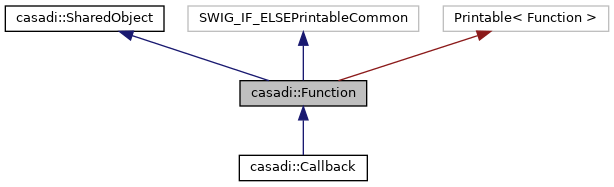
Public Types | |
| typedef std::map< std::string, std::vector< std::string > > | AuxOut |
| using | internal_base_type = SharedObjectInternal |
| using | base_type = SharedObject |
Public Member Functions | |
| Function () | |
| Default constructor, creates a null object. More... | |
| ~Function () | |
| Destructor. More... | |
| casadi_int | n_in () const |
| Get the number of function inputs. More... | |
| casadi_int | n_out () const |
| Get the number of function outputs. More... | |
| std::vector< bool > | activity (const std::vector< bool > &arg) const |
| Output signal activity induced by a given input activity. More... | |
| const std::vector< std::string > & | name_in () const |
| Get the names of all inputs, in order. More... | |
| const std::vector< std::string > & | name_out () const |
| Get the names of all outputs, in order. More... | |
| const std::string & | name_in (casadi_int ind) const |
Get the name of input ind; out of range raises an error. More... | |
| const std::string & | name_out (casadi_int ind) const |
Get the name of output ind; out of range raises an error. More... | |
| casadi_int | index_in (const std::string &name) const |
| Get the index of the input with a given name. More... | |
| casadi_int | index_out (const std::string &name) const |
| Get the index of the output with a given name; unknown names raise an error. More... | |
| bool | has_in (const std::string &name) const |
| Check whether an input with the given name exists. More... | |
| bool | has_out (const std::string &name) const |
| Check whether an output with the given name exists. More... | |
| double | default_in (casadi_int ind) const |
Get the value used for input ind when a call by name omits it. More... | |
| double | max_in (casadi_int ind) const |
Get the largest admissible value of input ind (inf unless a solver. More... | |
| double | min_in (casadi_int ind) const |
Get the smallest admissible value of input ind (-inf unless a solver. More... | |
| std::vector< double > | nominal_in (casadi_int ind) const |
Get the nominal value of each nonzero of input ind. More... | |
| std::vector< double > | nominal_out (casadi_int ind) const |
Get the nominal value of each nonzero of output ind; all ones by default. More... | |
| Function | factory (const std::string &name, const std::vector< std::string > &s_in, const std::vector< std::string > &s_out, const AuxOut &aux=AuxOut(), const Dict &opts=Dict()) const |
| Build a function computing derivatives by naming inputs and outputs. More... | |
| Function | oracle () const |
| Get the user-supplied problem function behind a solver object. More... | |
| std::vector< bool > | which_depends (const std::string &s_in, const std::vector< std::string > &s_out, casadi_int order=1, bool tr=false) const |
| Find which entries of an input the outputs depend on, linearly or not. More... | |
| void | print_dimensions (std::ostream &stream=casadi::uout()) const |
| Print the name and shape of every input and output. More... | |
| void | print_options (std::ostream &stream=casadi::uout()) const |
| Print the name, type and description of every option of this class. More... | |
| void | print_option (const std::string &name, std::ostream &stream=casadi::uout()) const |
| Print the type and description of one option; unknown names print a. More... | |
| bool | has_option (const std::string &option_name) const |
| Check whether this class accepts an option with the given name. More... | |
| void | change_option (const std::string &option_name, const GenericType &option_value) |
| Change a debugging option on an existing object. More... | |
| void | reset_dump_count () |
| Reset to zero the counter that numbers the files written by dump_in,. More... | |
| bool | uses_output () const |
| Check whether the derivative functions read the nondifferentiated outputs. More... | |
| Function | jacobian_old (casadi_int iind, casadi_int oind) const |
[DEPRECATED] Jacobian of output oind w.r.t. input iind, followed by More... | |
| Function | hessian_old (casadi_int iind, casadi_int oind) const |
[DEPRECATED] Hessian and gradient of scalar output oind w.r.t. input More... | |
| Function | jacobian () const |
| Get a function computing all Jacobian blocks at once. More... | |
| std::vector< MX > | mapsum (const std::vector< MX > &x, const std::string ¶llelization="serial") const |
| Evaluate on horizontally stacked MX arguments and sum the results. More... | |
| Function | map (casadi_int n, const std::string ¶llelization="serial") const |
| Create a function that evaluates this function n times on stacked arguments. More... | |
| Function | map (casadi_int n, const std::string ¶llelization, casadi_int max_num_threads) const |
| Function | slice (const std::string &name, const std::vector< casadi_int > &order_in, const std::vector< casadi_int > &order_out, const Dict &opts=Dict()) const |
| Create a function with a subset or reordering of the inputs and outputs. More... | |
| Function | forward (casadi_int nfwd) const |
Get a function computing nfwd forward directional derivatives. More... | |
| Function | reverse (casadi_int nadj) const |
Get a function computing nadj reverse (adjoint) directional derivatives. More... | |
| const std::vector< Sparsity > & | jac_sparsity (bool compact=false) const |
| Get the sparsity patterns of all Jacobian blocks. More... | |
| Sparsity | jac_sparsity (casadi_int oind, casadi_int iind, bool compact=false) const |
Get the sparsity pattern of the Jacobian of output oind w.r.t. input. More... | |
| std::string | generate (const std::string &fname, const Dict &opts=Dict()) const |
| Generate self-contained C code for the function. More... | |
| std::string | generate (const Dict &opts=Dict()) const |
| Generate C code into a file named after the function (name() + ".c") More... | |
| std::string | generate_dependencies (const std::string &fname, const Dict &opts=Dict()) const |
| Generate C code for the problem functions of a solver object. More... | |
| Dict | stats (int mem=0) const |
| Get the statistics recorded by the last numerical evaluation. More... | |
| bool | has_free () const |
| Check whether the outputs contain symbols that are not inputs. More... | |
| std::vector< std::string > | get_free () const |
| Get the names of the free variables; empty when there are none. More... | |
| std::vector< SX > | free_sx () const |
| Get the free variables of an SXFunction as SX symbols; other classes raise. More... | |
| std::vector< MX > | free_mx () const |
| Get the free variables of an MXFunction as MX symbols; other classes raise. More... | |
| void | generate_lifted (Function &vdef_fcn, Function &vinit_fcn) const |
| Extract the functions needed for the Lifted Newton method (MXFunction only) More... | |
| casadi_int | n_nodes () const |
| Get the number of nodes in the expression graph (SXFunction and MXFunction) More... | |
| casadi_int | n_instructions () const |
| Get the number of instructions of the algorithm (SXFunction and MXFunction) More... | |
| casadi_int | instruction_id (casadi_int k) const |
Get the operation code of instruction k (SXFunction and MXFunction) More... | |
| std::vector< casadi_int > | instruction_input (casadi_int k) const |
Get the work-vector locations read by instruction k. More... | |
| double | instruction_constant (casadi_int k) const |
| Get the value of a constant instruction (OP_CONST) of an SXFunction. More... | |
| std::vector< casadi_int > | instruction_output (casadi_int k) const |
Get the work-vector locations written by instruction k. More... | |
| MX | instruction_MX (casadi_int k) const |
Get the MX expression computed by instruction k of an MXFunction. More... | |
| SX | instructions_sx () const |
| Get the SX expression of every instruction of an SXFunction, as one vector. More... | |
| size_t | sz_arg () const |
| Get the length of the input pointer array needed to evaluate (at least n_in) More... | |
| size_t | sz_res () const |
| Get the length of the output pointer array needed to evaluate (at least. More... | |
| size_t | sz_iw () const |
| Get the length of the integer work vector needed to evaluate. More... | |
| size_t | sz_w () const |
| Get the length of the real work vector needed to evaluate. More... | |
| const std::string & | name () const |
| Get the name given at construction ("null" for a null object) More... | |
| bool | is_a (const std::string &type, bool recursive=true) const |
| Check whether the function is of a given class. More... | |
| void | assert_size_in (casadi_int i, casadi_int nrow, casadi_int ncol) const |
Raise an error unless input i is nrow-by- More... | |
| void | assert_size_out (casadi_int i, casadi_int nrow, casadi_int ncol) const |
Raise an error unless output i is nrow-by- More... | |
| void | assert_sparsity_out (casadi_int i, const Sparsity &sp, casadi_int n=1, bool allow_all_zero_sparse=true) const |
Raise an error unless output i has the sparsity sp repeated n. More... | |
| casadi_int | checkout () const |
| Reserve a memory object for evaluation and return its index. More... | |
| void | release (int mem) const |
| Give back a memory object obtained with checkout. More... | |
| Dict | cache () const |
| Get the derivative and map functions currently cached for this function. More... | |
| std::vector< std::string > | get_function () const |
| Get the names of the functions this function directly owns. More... | |
| Function | get_function (const std::string &name) const |
| Get a directly owned function by name; unknown names raise an error. More... | |
| bool | has_function (const std::string &fname) const |
| Check if a particular dependency exists. More... | |
| std::vector< Function > | find_functions (casadi_int max_depth=-1) const |
| Get all functions embedded in this function, recursively. More... | |
| Function | find_function (const std::string &name, casadi_int max_depth=-1) const |
| Get an embedded function by name, searching recursively. More... | |
| Dict | info () const |
| Get class-specific information as a dict. More... | |
| std::string | class_name () const |
| Get class name. More... | |
| void | disp (std::ostream &stream, bool more=false) const |
| Print a description of the object. More... | |
| std::string | get_str (bool more=false) const |
| Get string representation. More... | |
| std::string | debug_repr () const |
| bool | is_null () const |
| Is a null pointer? More... | |
| casadi_int | __hash__ () const |
| Returns a number that is unique for a given Node. More... | |
| Function (const std::string &name, const std::vector< SX > &ex_in, const std::vector< SX > &ex_out, const Dict &opts=Dict()) | |
| Construct a function from SX input and output expressions. More... | |
| Function (const std::string &name, const std::vector< SX > &ex_in, const std::vector< SX > &ex_out, const std::vector< std::string > &name_in, const std::vector< std::string > &name_out, const Dict &opts=Dict()) | |
| Construct a function from SX input and output expressions. More... | |
| Function (const std::string &name, const std::map< std::string, SX > &dict, const std::vector< std::string > &name_in, const std::vector< std::string > &name_out, const Dict &opts=Dict()) | |
| Construct a function from SX input and output expressions. More... | |
| Function (const std::string &name, const std::vector< MX > &ex_in, const std::vector< MX > &ex_out, const Dict &opts=Dict()) | |
| Construct a function from MX input and output expressions. More... | |
| Function (const std::string &name, const std::vector< MX > &ex_in, const std::vector< MX > &ex_out, const std::vector< std::string > &name_in, const std::vector< std::string > &name_out, const Dict &opts=Dict()) | |
| Construct a function from MX input and output expressions. More... | |
| Function (const std::string &name, const std::map< std::string, MX > &dict, const std::vector< std::string > &name_in, const std::vector< std::string > &name_out, const Dict &opts=Dict()) | |
| Construct a function from MX input and output expressions. More... | |
| Function | expand () const |
| Convert an MXFunction into an equivalent SXFunction. More... | |
| Function | expand (const std::string &name, const Dict &opts=Dict()) const |
| Convert an MXFunction into an equivalent SXFunction. More... | |
| Function | transform (const Dict &opts=Dict()) const |
| Rebuild the function after graph simplification or other passes. More... | |
| Function | transform (const std::string &fname, const Dict &opts=Dict()) const |
| Rebuild the function after graph simplification or other passes. More... | |
| Function | transform (const std::vector< std::vector< GenericType > > &passes, const Dict &opts=Dict()) const |
| Rebuild the function after graph simplification or other passes. More... | |
| Function | transform (const std::string &fname, const std::vector< std::vector< GenericType > > &passes, const Dict &opts=Dict()) const |
| Rebuild the function after graph simplification or other passes. More... | |
| casadi_int | size1_in (casadi_int ind) const |
| Get the shape of an input: rows, columns or both. More... | |
| casadi_int | size1_in (const std::string &iname) const |
| Get the shape of an input: rows, columns or both. More... | |
| casadi_int | size2_in (casadi_int ind) const |
| Get the shape of an input: rows, columns or both. More... | |
| casadi_int | size2_in (const std::string &iname) const |
| Get the shape of an input: rows, columns or both. More... | |
| std::pair< casadi_int, casadi_int > | size_in (casadi_int ind) const |
| Get the shape of an input: rows, columns or both. More... | |
| std::pair< casadi_int, casadi_int > | size_in (const std::string &iname) const |
| Get the shape of an input: rows, columns or both. More... | |
| casadi_int | size1_out (casadi_int ind) const |
| Get the shape of an output: rows, columns or both. More... | |
| casadi_int | size1_out (const std::string &oname) const |
| Get the shape of an output: rows, columns or both. More... | |
| casadi_int | size2_out (casadi_int ind) const |
| Get the shape of an output: rows, columns or both. More... | |
| casadi_int | size2_out (const std::string &oname) const |
| Get the shape of an output: rows, columns or both. More... | |
| std::pair< casadi_int, casadi_int > | size_out (casadi_int ind) const |
| Get the shape of an output: rows, columns or both. More... | |
| std::pair< casadi_int, casadi_int > | size_out (const std::string &oname) const |
| Get the shape of an output: rows, columns or both. More... | |
| casadi_int | nnz_in () const |
| Get the number of structural nonzeros of one input, or of all inputs. More... | |
| casadi_int | nnz_in (casadi_int ind) const |
| Get the number of structural nonzeros of one input, or of all inputs. More... | |
| casadi_int | nnz_in (const std::string &iname) const |
| Get the number of structural nonzeros of one input, or of all inputs. More... | |
| casadi_int | nnz_out () const |
| Get the number of structural nonzeros of one output, or of all outputs. More... | |
| casadi_int | nnz_out (casadi_int ind) const |
| Get the number of structural nonzeros of one output, or of all outputs. More... | |
| casadi_int | nnz_out (const std::string &oname) const |
| Get the number of structural nonzeros of one output, or of all outputs. More... | |
| casadi_int | numel_in () const |
| Get the number of elements (rows times columns) of one input, or of all. More... | |
| casadi_int | numel_in (casadi_int ind) const |
| Get the number of elements (rows times columns) of one input, or of all. More... | |
| casadi_int | numel_in (const std::string &iname) const |
| Get the number of elements (rows times columns) of one input, or of all. More... | |
| casadi_int | numel_out () const |
| Get the number of elements (rows times columns) of one output, or of all. More... | |
| casadi_int | numel_out (casadi_int ind) const |
| Get the number of elements (rows times columns) of one output, or of all. More... | |
| casadi_int | numel_out (const std::string &oname) const |
| Get the number of elements (rows times columns) of one output, or of all. More... | |
| const Sparsity & | sparsity_in (casadi_int ind) const |
| Get the sparsity pattern of an input, by index or name. More... | |
| const Sparsity & | sparsity_in (const std::string &iname) const |
| Get the sparsity pattern of an input, by index or name. More... | |
| const Sparsity & | sparsity_out (casadi_int ind) const |
| Get the sparsity pattern of an output, by index or name. More... | |
| const Sparsity & | sparsity_out (const std::string &iname) const |
| Get the sparsity pattern of an output, by index or name. More... | |
| bool | is_diff_in (casadi_int ind) const |
| Check which inputs or outputs are marked differentiable. More... | |
| bool | is_diff_out (casadi_int ind) const |
| Check which inputs or outputs are marked differentiable. More... | |
| std::vector< bool > | is_diff_in () const |
| Check which inputs or outputs are marked differentiable. More... | |
| std::vector< bool > | is_diff_out () const |
| Check which inputs or outputs are marked differentiable. More... | |
| Function | wrap () const |
| Wrap in an MXFunction whose graph is a single call to this function. More... | |
| Function | wrap (const std::string &name) const |
| Wrap in an MXFunction whose graph is a single call to this function. More... | |
| Function | wrap_as_needed (const Dict &opts) const |
| Wrap in an MXFunction constructed with the given options. More... | |
| Function | wrap_as_needed (const std::string &name, const Dict &opts) const |
| Wrap in an MXFunction constructed with the given options. More... | |
| const Sparsity | sparsity_jac (casadi_int iind, casadi_int oind, bool compact=false, bool symmetric=false) const |
| const Sparsity | sparsity_jac (const std::string &iind, casadi_int oind=0, bool compact=false, bool symmetric=false) const |
| const Sparsity | sparsity_jac (casadi_int iind, const std::string &oind, bool compact=false, bool symmetric=false) const |
| const Sparsity | sparsity_jac (const std::string &iind, const std::string &oind, bool compact=false, bool symmetric=false) const |
| void | call (const std::vector< DM > &arg, std::vector< DM > &res, bool always_inline=false, bool never_inline=false) const |
| Evaluate with a list or a dict of arguments; the result has the same form. More... | |
| void | call (const std::vector< SX > &arg, std::vector< SX > &res, bool always_inline=false, bool never_inline=false) const |
| Evaluate with a list or a dict of arguments; the result has the same form. More... | |
| void | call (const std::vector< MX > &arg, std::vector< MX > &res, bool always_inline=false, bool never_inline=false) const |
| Evaluate with a list or a dict of arguments; the result has the same form. More... | |
| void | call (const DMDict &arg, DMDict &res, bool always_inline=false, bool never_inline=false) const |
| Evaluate with a list or a dict of arguments; the result has the same form. More... | |
| void | call (const SXDict &arg, SXDict &res, bool always_inline=false, bool never_inline=false) const |
| Evaluate with a list or a dict of arguments; the result has the same form. More... | |
| void | call (const MXDict &arg, MXDict &res, bool always_inline=false, bool never_inline=false) const |
| Evaluate with a list or a dict of arguments; the result has the same form. More... | |
| Function | mapaccum (const std::string &name, casadi_int N, const Dict &opts=Dict()) const |
| Create a function that applies this function N times, feeding outputs back. More... | |
| Function | mapaccum (const std::string &name, casadi_int N, casadi_int n_accum, const Dict &opts=Dict()) const |
| Create a function that applies this function N times, feeding outputs back. More... | |
| Function | mapaccum (const std::string &name, casadi_int n, const std::vector< casadi_int > &accum_in, const std::vector< casadi_int > &accum_out, const Dict &opts=Dict()) const |
| Create a function that applies this function N times, feeding outputs back. More... | |
| Function | mapaccum (const std::string &name, casadi_int n, const std::vector< std::string > &accum_in, const std::vector< std::string > &accum_out, const Dict &opts=Dict()) const |
| Create a function that applies this function N times, feeding outputs back. More... | |
| Function | mapaccum (casadi_int N, const Dict &opts=Dict()) const |
| Create a function that applies this function N times, feeding outputs back. More... | |
| Function | fold (casadi_int N, const Dict &opts=Dict()) const |
| Create a function that applies this function N times, feeding outputs back. More... | |
| Function | map (const std::string &name, const std::string ¶llelization, casadi_int n, const std::vector< casadi_int > &reduce_in, const std::vector< casadi_int > &reduce_out, const Dict &opts=Dict()) const |
| Map where some inputs are shared and some outputs are summed. More... | |
| Function | map (const std::string &name, const std::string ¶llelization, casadi_int n, const std::vector< std::string > &reduce_in, const std::vector< std::string > &reduce_out, const Dict &opts=Dict()) const |
| Map where some inputs are shared and some outputs are summed. More... | |
| Function | map (casadi_int n, const std::vector< bool > &reduce_in, const std::vector< bool > &reduce_out=std::vector< bool >(), const Dict &opts=Dict()) const |
| Map where some inputs are shared and some outputs are summed. More... | |
| void | generate_in (const std::string &fname, const std::vector< DM > &arg) |
| Write or read a text file with the nonzeros of all inputs. More... | |
| std::vector< DM > | generate_in (const std::string &fname) |
| Write or read a text file with the nonzeros of all inputs. More... | |
| void | generate_out (const std::string &fname, const std::vector< DM > &arg) |
| Write or read a text file with the nonzeros of all outputs. More... | |
| std::vector< DM > | generate_out (const std::string &fname) |
| Write or read a text file with the nonzeros of all outputs. More... | |
| void | export_code (const std::string &lang, const std::string &fname, const Dict &options=Dict()) const |
| Export the algorithm as source code in another language. More... | |
| std::string | serialize (const Dict &opts=Dict()) const |
| Serialize to a string that deserialize turns back into an equal function. More... | |
| void | export_graph (const std::string &fname, const Dict &opts=Dict()) const |
| Export a Function graph as .html, .dot, or .casadi_viz. More... | |
| std::string | export_graph (const Dict &opts=Dict()) const |
| Return the .casadi_viz JSON bundle without writing a file. More... | |
| void | save (const std::string &fname, const Dict &opts=Dict()) const |
| Save the function to a file that load reads back. More... | |
| std::string | export_code (const std::string &lang, const Dict &options=Dict()) const |
| Export the algorithm as source code in another language. More... | |
| const SX | sx_in (casadi_int iind) const |
| Create fresh symbols with the names and sparsity patterns of the inputs. More... | |
| const SX | sx_in (const std::string &iname) const |
| Create fresh symbols with the names and sparsity patterns of the inputs. More... | |
| const std::vector< SX > | sx_in () const |
| Create fresh symbols with the names and sparsity patterns of the inputs. More... | |
| const MX | mx_in (casadi_int ind) const |
| Create fresh symbols with the names and sparsity patterns of the inputs. More... | |
| const MX | mx_in (const std::string &iname) const |
| Create fresh symbols with the names and sparsity patterns of the inputs. More... | |
| const std::vector< MX > | mx_in () const |
| Create fresh symbols with the names and sparsity patterns of the inputs. More... | |
| const SX | sx_out (casadi_int oind) const |
| Create fresh symbols with the names and sparsity patterns of the outputs. More... | |
| const SX | sx_out (const std::string &oname) const |
| Create fresh symbols with the names and sparsity patterns of the outputs. More... | |
| const std::vector< SX > | sx_out () const |
| Create fresh symbols with the names and sparsity patterns of the outputs. More... | |
| const MX | mx_out (casadi_int ind) const |
| Create fresh symbols with the names and sparsity patterns of the outputs. More... | |
| const MX | mx_out (const std::string &oname) const |
| Create fresh symbols with the names and sparsity patterns of the outputs. More... | |
| const std::vector< MX > | mx_out () const |
| Create fresh symbols with the names and sparsity patterns of the outputs. More... | |
| std::vector< double > | nz_from_in (const std::vector< DM > &arg) const |
| Convert between a list of input/output matrices and one flat list of. More... | |
| std::vector< double > | nz_from_out (const std::vector< DM > &arg) const |
| Convert between a list of input/output matrices and one flat list of. More... | |
| std::vector< DM > | nz_to_in (const std::vector< double > &arg) const |
| Convert between a list of input/output matrices and one flat list of. More... | |
| std::vector< DM > | nz_to_out (const std::vector< double > &arg) const |
| Convert between a list of input/output matrices and one flat list of. More... | |
| DMDict | convert_in (const std::vector< DM > &arg) const |
| Convert between a list and a dict of inputs or outputs. More... | |
| std::vector< DM > | convert_in (const DMDict &arg) const |
| Convert between a list and a dict of inputs or outputs. More... | |
| DMDict | convert_out (const std::vector< DM > &arg) const |
| Convert between a list and a dict of inputs or outputs. More... | |
| std::vector< DM > | convert_out (const DMDict &arg) const |
| Convert between a list and a dict of inputs or outputs. More... | |
| SXDict | convert_in (const std::vector< SX > &arg) const |
| Convert between a list and a dict of inputs or outputs. More... | |
| std::vector< SX > | convert_in (const SXDict &arg) const |
| Convert between a list and a dict of inputs or outputs. More... | |
| SXDict | convert_out (const std::vector< SX > &arg) const |
| Convert between a list and a dict of inputs or outputs. More... | |
| std::vector< SX > | convert_out (const SXDict &arg) const |
| Convert between a list and a dict of inputs or outputs. More... | |
| MXDict | convert_in (const std::vector< MX > &arg) const |
| Convert between a list and a dict of inputs or outputs. More... | |
| std::vector< MX > | convert_in (const MXDict &arg) const |
| Convert between a list and a dict of inputs or outputs. More... | |
| MXDict | convert_out (const std::vector< MX > &arg) const |
| Convert between a list and a dict of inputs or outputs. More... | |
| std::vector< MX > | convert_out (const MXDict &arg) const |
| Convert between a list and a dict of inputs or outputs. More... | |
| bool | has_spfwd () const |
| Check whether the class supports forward (has_spfwd) or reverse (has_sprev) More... | |
| bool | has_sprev () const |
| Check whether the class supports forward (has_spfwd) or reverse (has_sprev) More... | |
Static Public Member Functions | |
| static std::string | type_name () |
| Get the type name, always "Function". More... | |
| static Function | conditional (const std::string &name, const std::vector< Function > &f, const Function &f_def, const Dict &opts=Dict()) |
| Create a function that selects one of several functions by an index input. More... | |
| static Function | conditional (const std::string &name, const Function &f, const Dict &opts=Dict()) |
Create a function that calls f when its first input is nonzero and. More... | |
| static Function | bspline (const std::string &name, const std::vector< std::vector< double > > &knots, const std::vector< double > &coeffs, const std::vector< casadi_int > °ree, casadi_int m=1, const Dict &opts=Dict()) |
| Create a function evaluating a B-spline with known coefficients. More... | |
| static Function | if_else (const std::string &name, const Function &f_true, const Function &f_false, const Dict &opts=Dict()) |
Create a function that evaluates f_true or f_false depending on. More... | |
| static bool | check_name (const std::string &name) |
| Check whether a string is a valid function name. More... | |
| static std::string | fix_name (const std::string &name) |
| Turn any string into a valid function name as defined by check_name. More... | |
| static Function | deserialize (std::istream &stream) |
| Build a function from a serialization stream. More... | |
| static Function | deserialize (const std::string &s) |
| Build a function from a string produced by serialize. More... | |
| static Function | load (const std::string &filename) |
| Read a function from a file written by save. More... | |
| static Function | deserialize (DeserializingStream &s) |
| Build a function from a DeserializingStream (C++ serialization API) More... | |
| static Function | jit (const std::string &name, const std::string &body, const std::vector< std::string > &name_in, const std::vector< std::string > &name_out, const Dict &opts=Dict()) |
| To resolve ambiguity on some compilers. More... | |
| static Function | jit (const std::string &name, const std::string &body, const std::vector< std::string > &name_in, const std::vector< std::string > &name_out, const std::vector< Sparsity > &sparsity_in, const std::vector< Sparsity > &sparsity_out, const Dict &opts=Dict()) |
| To resolve ambiguity on some compilers. More... | |
| typedef std::map<std::string, std::vector<std::string> > casadi::Function::AuxOut |
Definition at line 1546 of file function.hpp.
|
inherited |
Definition at line 103 of file shared_object.hpp.
|
inherited |
Definition at line 102 of file shared_object.hpp.
| casadi::Function::Function | ( | ) |
A null Function has name "null", is_null() is true, and any other member function raises an error. Use it only as a placeholder to be assigned later.
>>> f = Function()
>>> f.is_null(), f.name()
(True, 'null')
>> f = Function(); disp(f.is_null()), disp(f.name())
1
null
julia> f = ca.Function();
julia> ca.is_null(f), ca.name(f)
(true, "null")
Extra doc: https://github.com/casadi/casadi/wiki/L_1uy
| casadi::Function::Function | ( | const std::string & | name, |
| const std::vector< SX > & | ex_in, | ||
| const std::vector< SX > & | ex_out, | ||
| const Dict & | opts = Dict() |
||
| ) |
The result is an SXFunction: a flat list of scalar instructions that is cheap to evaluate but has no notion of matrix structure (see expand for the difference with an MXFunction).
Every symbolic primitive that appears in ex_out must be present in ex_in, otherwise construction fails with "Initialization failed since variables [...] are
free" (the symbol was forgotten in the input list). Pass option "allow_free": true to construct anyway; such a function can only be called symbolically. Each input must be a purely symbolic matrix (symbols or a concatenation of symbols); an output may be any expression, including constants and empty matrices. The sparsity patterns of the expressions become sparsity_in and sparsity_out.
| name | Display name, used in error messages and generated code. Must start with a letter and contain only letters, digits and non-consecutive underscores (see check_name); otherwise an error is raised. |
| ex_in | List of input expressions, each a symbolic SX |
| ex_out | List of output expressions |
| name_in | Names of the inputs; defaults to i0, i1, ...; duplicates raise an error unless option "allow_duplicate_io_names" is set |
| name_out | Names of the outputs; defaults to o0, o1, ... |
| opts | Options, see the table below. The common ones are "cse" (eliminate common subexpressions), "live_variables", "is_diff_in"/"is_diff_out", "default_in", "allow_free", "jit" |
The dict overload takes a single map from name to expression; name_in and name_out select which keys are inputs and outputs, in that order. A key that is in neither list raises "Unknown dictionary entry". A missing key gives an empty (0-by-0) input or output.
>>> x = SX.sym("x"); y = SX.sym("y", 2)
>>> f = Function("f", [x, y], [x*y, sin(x)])
>>> f
Function(f:(i0,i1[2])->(o0[2],o1) SXFunction)
>>> f = Function("f", [x, y], [x*y, sin(x)], ["x", "y"], ["r", "s"])
>>> f.name_in(), f.name_out()
(['x', 'y'], ['r', 's'])
>>> g = Function("g", {"x": x, "y": y, "r": x*y}, ["x", "y"], ["r"])
>>> g
Function(g:(x,y[2])->(r[2]) SXFunction)
>>> p = SX.sym("p")
>>> try:
...   Function("h", [x], [x*p])
... except RuntimeError as e:
...   print("Initialization failed" in str(e), "[p] are free" in str(e))
True True
>>> h = Function("h", [x], [x*p], {"allow_free": True})
>>> h.get_free()
['p']
>>> try:
...   Function("my func", [x], [x])
... except RuntimeError as e:
...   print("Function name is not valid" in str(e))
True
>> x = SX.sym('x'); y = SX.sym('y', 2);
>> f = Function('f', {x, y}, {x*y, sin(x)}); disp(f)
f:(i0,i1[2])->(o0[2],o1) SXFunction
>> f = Function('f', {x, y}, {x*y, sin(x)}, {'x', 'y'}, {'r', 's'});
>> f.name_in(), f.name_out()
x
y
r
s
>> g = Function('g', struct('x', x, 'y', y, 'r', x*y), {'x', 'y'}, {'r'}); disp(g)
g:(x,y[2])->(r[2]) SXFunction
>> p = SX.sym('p');
>> try, Function('h', {x}, {x*p}); catch e, disp(contains(e.message, '[p] are free')); end
1
>> h = Function('h', {x}, {x*p}, struct('allow_free', true)); disp(h.get_free())
p
>> try, Function('my func', {x}, {x}); catch e, disp(contains(e.message, 'not valid')); end
1
julia> x = ca.SX.sym("x"); y = ca.SX.sym("y", 2);
julia> f = ca.Function("f", [x, y], [x*y, sin(x)])
Function(f:(i0,i1[2])->(o0[2],o1) SXFunction)
julia> f = ca.Function("f", [x, y], [x*y, sin(x)], ["x", "y"], ["r", "s"]);
julia> ca.name_in(f), ca.name_out(f)
(["x", "y"], ["r", "s"])
julia> g = ca.Function("g", Dict("x" => x, "y" => y, "r" => x*y), ["x", "y"], ["r"])
Function(g:(x,y[2])->(r[2]) SXFunction)
julia> p = ca.SX.sym("p");
julia> try
           ca.Function("h", [x], [x*p])
       catch e
           msg = sprint(showerror, e)
           println(occursin("Initialization failed", msg), " ",
                   occursin("[p] are free", msg))
       end
true true
julia> h = ca.Function("h", [x], [x*p], Dict("allow_free" => true));
julia> ca.get_free(h)
1-element Vector{String}:
 "p"
julia> try
           ca.Function("my func", [x], [x])
       catch e
           println(occursin("Function name is not valid", sprint(showerror, e)))
       end
true
Extra doc: https://github.com/casadi/casadi/wiki/L_1v0
| casadi::Function::Function | ( | const std::string & | name, |
| const std::vector< SX > & | ex_in, | ||
| const std::vector< SX > & | ex_out, | ||
| const std::vector< std::string > & | name_in, | ||
| const std::vector< std::string > & | name_out, | ||
| const Dict & | opts = Dict() |
||
| ) |
The result is an SXFunction: a flat list of scalar instructions that is cheap to evaluate but has no notion of matrix structure (see expand for the difference with an MXFunction).
Every symbolic primitive that appears in ex_out must be present in ex_in, otherwise construction fails with "Initialization failed since variables [...] are
free" (the symbol was forgotten in the input list). Pass option "allow_free": true to construct anyway; such a function can only be called symbolically. Each input must be a purely symbolic matrix (symbols or a concatenation of symbols); an output may be any expression, including constants and empty matrices. The sparsity patterns of the expressions become sparsity_in and sparsity_out.
| name | Display name, used in error messages and generated code. Must start with a letter and contain only letters, digits and non-consecutive underscores (see check_name); otherwise an error is raised. |
| ex_in | List of input expressions, each a symbolic SX |
| ex_out | List of output expressions |
| name_in | Names of the inputs; defaults to i0, i1, ...; duplicates raise an error unless option "allow_duplicate_io_names" is set |
| name_out | Names of the outputs; defaults to o0, o1, ... |
| opts | Options, see the table below. The common ones are "cse" (eliminate common subexpressions), "live_variables", "is_diff_in"/"is_diff_out", "default_in", "allow_free", "jit" |
The dict overload takes a single map from name to expression; name_in and name_out select which keys are inputs and outputs, in that order. A key that is in neither list raises "Unknown dictionary entry". A missing key gives an empty (0-by-0) input or output.
>>> x = SX.sym("x"); y = SX.sym("y", 2)
>>> f = Function("f", [x, y], [x*y, sin(x)])
>>> f
Function(f:(i0,i1[2])->(o0[2],o1) SXFunction)
>>> f = Function("f", [x, y], [x*y, sin(x)], ["x", "y"], ["r", "s"])
>>> f.name_in(), f.name_out()
(['x', 'y'], ['r', 's'])
>>> g = Function("g", {"x": x, "y": y, "r": x*y}, ["x", "y"], ["r"])
>>> g
Function(g:(x,y[2])->(r[2]) SXFunction)
>>> p = SX.sym("p")
>>> try:
...   Function("h", [x], [x*p])
... except RuntimeError as e:
...   print("Initialization failed" in str(e), "[p] are free" in str(e))
True True
>>> h = Function("h", [x], [x*p], {"allow_free": True})
>>> h.get_free()
['p']
>>> try:
...   Function("my func", [x], [x])
... except RuntimeError as e:
...   print("Function name is not valid" in str(e))
True
>> x = SX.sym('x'); y = SX.sym('y', 2);
>> f = Function('f', {x, y}, {x*y, sin(x)}); disp(f)
f:(i0,i1[2])->(o0[2],o1) SXFunction
>> f = Function('f', {x, y}, {x*y, sin(x)}, {'x', 'y'}, {'r', 's'});
>> f.name_in(), f.name_out()
x
y
r
s
>> g = Function('g', struct('x', x, 'y', y, 'r', x*y), {'x', 'y'}, {'r'}); disp(g)
g:(x,y[2])->(r[2]) SXFunction
>> p = SX.sym('p');
>> try, Function('h', {x}, {x*p}); catch e, disp(contains(e.message, '[p] are free')); end
1
>> h = Function('h', {x}, {x*p}, struct('allow_free', true)); disp(h.get_free())
p
>> try, Function('my func', {x}, {x}); catch e, disp(contains(e.message, 'not valid')); end
1
julia> x = ca.SX.sym("x"); y = ca.SX.sym("y", 2);
julia> f = ca.Function("f", [x, y], [x*y, sin(x)])
Function(f:(i0,i1[2])->(o0[2],o1) SXFunction)
julia> f = ca.Function("f", [x, y], [x*y, sin(x)], ["x", "y"], ["r", "s"]);
julia> ca.name_in(f), ca.name_out(f)
(["x", "y"], ["r", "s"])
julia> g = ca.Function("g", Dict("x" => x, "y" => y, "r" => x*y), ["x", "y"], ["r"])
Function(g:(x,y[2])->(r[2]) SXFunction)
julia> p = ca.SX.sym("p");
julia> try
           ca.Function("h", [x], [x*p])
       catch e
           msg = sprint(showerror, e)
           println(occursin("Initialization failed", msg), " ",
                   occursin("[p] are free", msg))
       end
true true
julia> h = ca.Function("h", [x], [x*p], Dict("allow_free" => true));
julia> ca.get_free(h)
1-element Vector{String}:
 "p"
julia> try
           ca.Function("my func", [x], [x])
       catch e
           println(occursin("Function name is not valid", sprint(showerror, e)))
       end
true
Extra doc: https://github.com/casadi/casadi/wiki/L_1v0
| casadi::Function::Function | ( | const std::string & | name, |
| const std::map< std::string, SX > & | dict, | ||
| const std::vector< std::string > & | name_in, | ||
| const std::vector< std::string > & | name_out, | ||
| const Dict & | opts = Dict() |
||
| ) |
The result is an SXFunction: a flat list of scalar instructions that is cheap to evaluate but has no notion of matrix structure (see expand for the difference with an MXFunction).
Every symbolic primitive that appears in ex_out must be present in ex_in, otherwise construction fails with "Initialization failed since variables [...] are
free" (the symbol was forgotten in the input list). Pass option "allow_free": true to construct anyway; such a function can only be called symbolically. Each input must be a purely symbolic matrix (symbols or a concatenation of symbols); an output may be any expression, including constants and empty matrices. The sparsity patterns of the expressions become sparsity_in and sparsity_out.
| name | Display name, used in error messages and generated code. Must start with a letter and contain only letters, digits and non-consecutive underscores (see check_name); otherwise an error is raised. |
| ex_in | List of input expressions, each a symbolic SX |
| ex_out | List of output expressions |
| name_in | Names of the inputs; defaults to i0, i1, ...; duplicates raise an error unless option "allow_duplicate_io_names" is set |
| name_out | Names of the outputs; defaults to o0, o1, ... |
| opts | Options, see the table below. The common ones are "cse" (eliminate common subexpressions), "live_variables", "is_diff_in"/"is_diff_out", "default_in", "allow_free", "jit" |
The dict overload takes a single map from name to expression; name_in and name_out select which keys are inputs and outputs, in that order. A key that is in neither list raises "Unknown dictionary entry". A missing key gives an empty (0-by-0) input or output.
>>> x = SX.sym("x"); y = SX.sym("y", 2)
>>> f = Function("f", [x, y], [x*y, sin(x)])
>>> f
Function(f:(i0,i1[2])->(o0[2],o1) SXFunction)
>>> f = Function("f", [x, y], [x*y, sin(x)], ["x", "y"], ["r", "s"])
>>> f.name_in(), f.name_out()
(['x', 'y'], ['r', 's'])
>>> g = Function("g", {"x": x, "y": y, "r": x*y}, ["x", "y"], ["r"])
>>> g
Function(g:(x,y[2])->(r[2]) SXFunction)
>>> p = SX.sym("p")
>>> try:
...   Function("h", [x], [x*p])
... except RuntimeError as e:
...   print("Initialization failed" in str(e), "[p] are free" in str(e))
True True
>>> h = Function("h", [x], [x*p], {"allow_free": True})
>>> h.get_free()
['p']
>>> try:
...   Function("my func", [x], [x])
... except RuntimeError as e:
...   print("Function name is not valid" in str(e))
True
>> x = SX.sym('x'); y = SX.sym('y', 2);
>> f = Function('f', {x, y}, {x*y, sin(x)}); disp(f)
f:(i0,i1[2])->(o0[2],o1) SXFunction
>> f = Function('f', {x, y}, {x*y, sin(x)}, {'x', 'y'}, {'r', 's'});
>> f.name_in(), f.name_out()
x
y
r
s
>> g = Function('g', struct('x', x, 'y', y, 'r', x*y), {'x', 'y'}, {'r'}); disp(g)
g:(x,y[2])->(r[2]) SXFunction
>> p = SX.sym('p');
>> try, Function('h', {x}, {x*p}); catch e, disp(contains(e.message, '[p] are free')); end
1
>> h = Function('h', {x}, {x*p}, struct('allow_free', true)); disp(h.get_free())
p
>> try, Function('my func', {x}, {x}); catch e, disp(contains(e.message, 'not valid')); end
1
julia> x = ca.SX.sym("x"); y = ca.SX.sym("y", 2);
julia> f = ca.Function("f", [x, y], [x*y, sin(x)])
Function(f:(i0,i1[2])->(o0[2],o1) SXFunction)
julia> f = ca.Function("f", [x, y], [x*y, sin(x)], ["x", "y"], ["r", "s"]);
julia> ca.name_in(f), ca.name_out(f)
(["x", "y"], ["r", "s"])
julia> g = ca.Function("g", Dict("x" => x, "y" => y, "r" => x*y), ["x", "y"], ["r"])
Function(g:(x,y[2])->(r[2]) SXFunction)
julia> p = ca.SX.sym("p");
julia> try
           ca.Function("h", [x], [x*p])
       catch e
           msg = sprint(showerror, e)
           println(occursin("Initialization failed", msg), " ",
                   occursin("[p] are free", msg))
       end
true true
julia> h = ca.Function("h", [x], [x*p], Dict("allow_free" => true));
julia> ca.get_free(h)
1-element Vector{String}:
 "p"
julia> try
           ca.Function("my func", [x], [x])
       catch e
           println(occursin("Function name is not valid", sprint(showerror, e)))
       end
true
Extra doc: https://github.com/casadi/casadi/wiki/L_1v0
| casadi::Function::Function | ( | const std::string & | name, |
| const std::vector< MX > & | ex_in, | ||
| const std::vector< MX > & | ex_out, | ||
| const Dict & | opts = Dict() |
||
| ) |
The result is an MXFunction: a graph of matrix-valued nodes that may embed calls to other Function objects (solvers, integrators, SX functions, ...). Compared with an SXFunction it uses less memory and supports every operation, but is slower per node to evaluate; call expand to convert when all nodes are expandable.
The rules on free variables, naming and the dict overload are the same as for the SX constructor. Additional MX-only options: "post_expand" (expand right after construction) and "post_expand_options".
| name | Display name, must satisfy check_name |
| ex_in | List of symbolic MX inputs |
| ex_out | List of MX output expressions |
| name_in | Input names; defaults to i0, i1, ... |
| name_out | Output names; defaults to o0, o1, ... |
| opts | Options, see the table below |
>>> x = MX.sym("x", 2); A = MX.sym("A", 2, 2)
>>> f = Function("f", [A, x], [A @ x, norm_2(x)], ["A", "x"], ["Ax", "nrm"])
>>> f
Function(f:(A[2x2],x[2])->(Ax[2],nrm) MXFunction)
>>> f.class_name(), f.n_instructions()
('MXFunction', 7)
>>> f.expand()
Function(f:(A[2x2],x[2])->(Ax[2],nrm) SXFunction)
>>> g = Function("g", [x], [x], {"post_expand": True})
>>> g.class_name()
'SXFunction'
>> x = MX.sym('x', 2); A = MX.sym('A', 2, 2);
>> f = Function('f', {A, x}, {A*x, norm_2(x)}, {'A', 'x'}, {'Ax', 'nrm'}); disp(f)
f:(A[2x2],x[2])->(Ax[2],nrm) MXFunction
>> f.class_name(), f.n_instructions()
MXFunction
7
>> f.expand()
f:(A[2x2],x[2])->(Ax[2],nrm) SXFunction
>> g = Function('g', {x}, {x}, struct('post_expand', true)); disp(g.class_name())
SXFunction
julia> x = ca.MX.sym("x", 2); A = ca.MX.sym("A", 2, 2);
julia> f = ca.Function("f", [A, x], [A * x, ca.norm_2(x)], ["A", "x"], ["Ax", "nrm"])
Function(f:(A[2x2],x[2])->(Ax[2],nrm) MXFunction)
julia> ca.class_name(f), ca.n_instructions(f)
("MXFunction", 7)
julia> ca.expand(f)
Function(f:(A[2x2],x[2])->(Ax[2],nrm) SXFunction)
julia> g = ca.Function("g", [x], [x], Dict("post_expand" => true));
julia> ca.class_name(g)
"SXFunction"
Extra doc: https://github.com/casadi/casadi/wiki/L_1v1
| casadi::Function::Function | ( | const std::string & | name, |
| const std::vector< MX > & | ex_in, | ||
| const std::vector< MX > & | ex_out, | ||
| const std::vector< std::string > & | name_in, | ||
| const std::vector< std::string > & | name_out, | ||
| const Dict & | opts = Dict() |
||
| ) |
The result is an MXFunction: a graph of matrix-valued nodes that may embed calls to other Function objects (solvers, integrators, SX functions, ...). Compared with an SXFunction it uses less memory and supports every operation, but is slower per node to evaluate; call expand to convert when all nodes are expandable.
The rules on free variables, naming and the dict overload are the same as for the SX constructor. Additional MX-only options: "post_expand" (expand right after construction) and "post_expand_options".
| name | Display name, must satisfy check_name |
| ex_in | List of symbolic MX inputs |
| ex_out | List of MX output expressions |
| name_in | Input names; defaults to i0, i1, ... |
| name_out | Output names; defaults to o0, o1, ... |
| opts | Options, see the table below |
>>> x = MX.sym("x", 2); A = MX.sym("A", 2, 2)
>>> f = Function("f", [A, x], [A @ x, norm_2(x)], ["A", "x"], ["Ax", "nrm"])
>>> f
Function(f:(A[2x2],x[2])->(Ax[2],nrm) MXFunction)
>>> f.class_name(), f.n_instructions()
('MXFunction', 7)
>>> f.expand()
Function(f:(A[2x2],x[2])->(Ax[2],nrm) SXFunction)
>>> g = Function("g", [x], [x], {"post_expand": True})
>>> g.class_name()
'SXFunction'
>> x = MX.sym('x', 2); A = MX.sym('A', 2, 2);
>> f = Function('f', {A, x}, {A*x, norm_2(x)}, {'A', 'x'}, {'Ax', 'nrm'}); disp(f)
f:(A[2x2],x[2])->(Ax[2],nrm) MXFunction
>> f.class_name(), f.n_instructions()
MXFunction
7
>> f.expand()
f:(A[2x2],x[2])->(Ax[2],nrm) SXFunction
>> g = Function('g', {x}, {x}, struct('post_expand', true)); disp(g.class_name())
SXFunction
julia> x = ca.MX.sym("x", 2); A = ca.MX.sym("A", 2, 2);
julia> f = ca.Function("f", [A, x], [A * x, ca.norm_2(x)], ["A", "x"], ["Ax", "nrm"])
Function(f:(A[2x2],x[2])->(Ax[2],nrm) MXFunction)
julia> ca.class_name(f), ca.n_instructions(f)
("MXFunction", 7)
julia> ca.expand(f)
Function(f:(A[2x2],x[2])->(Ax[2],nrm) SXFunction)
julia> g = ca.Function("g", [x], [x], Dict("post_expand" => true));
julia> ca.class_name(g)
"SXFunction"
Extra doc: https://github.com/casadi/casadi/wiki/L_1v1
| casadi::Function::Function | ( | const std::string & | name, |
| const std::map< std::string, MX > & | dict, | ||
| const std::vector< std::string > & | name_in, | ||
| const std::vector< std::string > & | name_out, | ||
| const Dict & | opts = Dict() |
||
| ) |
The result is an MXFunction: a graph of matrix-valued nodes that may embed calls to other Function objects (solvers, integrators, SX functions, ...). Compared with an SXFunction it uses less memory and supports every operation, but is slower per node to evaluate; call expand to convert when all nodes are expandable.
The rules on free variables, naming and the dict overload are the same as for the SX constructor. Additional MX-only options: "post_expand" (expand right after construction) and "post_expand_options".
| name | Display name, must satisfy check_name |
| ex_in | List of symbolic MX inputs |
| ex_out | List of MX output expressions |
| name_in | Input names; defaults to i0, i1, ... |
| name_out | Output names; defaults to o0, o1, ... |
| opts | Options, see the table below |
>>> x = MX.sym("x", 2); A = MX.sym("A", 2, 2)
>>> f = Function("f", [A, x], [A @ x, norm_2(x)], ["A", "x"], ["Ax", "nrm"])
>>> f
Function(f:(A[2x2],x[2])->(Ax[2],nrm) MXFunction)
>>> f.class_name(), f.n_instructions()
('MXFunction', 7)
>>> f.expand()
Function(f:(A[2x2],x[2])->(Ax[2],nrm) SXFunction)
>>> g = Function("g", [x], [x], {"post_expand": True})
>>> g.class_name()
'SXFunction'
>> x = MX.sym('x', 2); A = MX.sym('A', 2, 2);
>> f = Function('f', {A, x}, {A*x, norm_2(x)}, {'A', 'x'}, {'Ax', 'nrm'}); disp(f)
f:(A[2x2],x[2])->(Ax[2],nrm) MXFunction
>> f.class_name(), f.n_instructions()
MXFunction
7
>> f.expand()
f:(A[2x2],x[2])->(Ax[2],nrm) SXFunction
>> g = Function('g', {x}, {x}, struct('post_expand', true)); disp(g.class_name())
SXFunction
julia> x = ca.MX.sym("x", 2); A = ca.MX.sym("A", 2, 2);
julia> f = ca.Function("f", [A, x], [A * x, ca.norm_2(x)], ["A", "x"], ["Ax", "nrm"])
Function(f:(A[2x2],x[2])->(Ax[2],nrm) MXFunction)
julia> ca.class_name(f), ca.n_instructions(f)
("MXFunction", 7)
julia> ca.expand(f)
Function(f:(A[2x2],x[2])->(Ax[2],nrm) SXFunction)
julia> g = ca.Function("g", [x], [x], Dict("post_expand" => true));
julia> ca.class_name(g)
"SXFunction"
Extra doc: https://github.com/casadi/casadi/wiki/L_1v1
| casadi::Function::~Function | ( | ) |
Extra doc: https://github.com/casadi/casadi/wiki/L_1v4
|
inherited |
If the Object does not point to any node, "0" is returned.
Extra doc: https://github.com/casadi/casadi/wiki/L_av
Definition at line 123 of file generic_shared_impl.hpp.
| std::vector<bool> casadi::Function::activity | ( | const std::vector< bool > & | arg | ) | const |
arg is a flat activity mask over all input nonzeros (size nnz_in(), true = active = possibly nonzero); the result is the corresponding mask over all output nonzeros (size nnz_out()). An output that comes out inactive (false) is guaranteed zero for any value of the active inputs. Unlike sparsity propagation this exploits annihilation: an inactive operand of a multiply kills the product.
Extra doc: https://github.com/casadi/casadi/wiki/L_2ih
| void casadi::Function::assert_size_in | ( | casadi_int | i, |
| casadi_int | nrow, | ||
| casadi_int | ncol | ||
| ) | const |
>>> f = Function("f", [SX.sym("x", 2)], [SX(1, 3)])
>>> f.assert_size_in(0, 2, 1)
>>> try:
...   f.assert_size_out(0, 2, 1)
... except RuntimeError as e:
...   print("Expected 2-by-1 but got 1-by-3" in str(e))
True
>> f = Function('f', {SX.sym('x', 2)}, {SX(1, 3)});
>> f.assert_size_in(0, 2, 1)
>> try, f.assert_size_out(0, 2, 1); catch e, msg = e.message; end
>> contains(msg, 'Expected 2-by-1 but got 1-by-3')
1
julia> f = ca.Function("f", [ca.SX.sym("x", 2)], [ca.SX(1, 3)]);
julia> ca.assert_size_in(f, 0, 2, 1)
julia> try
           ca.assert_size_out(f, 0, 2, 1)
       catch e
           println(occursin("Expected 2-by-1 but got 1-by-3", sprint(showerror, e)))
       end
true
Extra doc: https://github.com/casadi/casadi/wiki/L_2mk
| void casadi::Function::assert_size_out | ( | casadi_int | i, |
| casadi_int | nrow, | ||
| casadi_int | ncol | ||
| ) | const |
| void casadi::Function::assert_sparsity_out | ( | casadi_int | i, |
| const Sparsity & | sp, | ||
| casadi_int | n = 1, |
||
| bool | allow_all_zero_sparse = true |
||
| ) | const |
times horizontally
With allow_all_zero_sparse, an output without nonzeros of the right shape passes. Used to check derivative functions.
Extra doc: https://github.com/casadi/casadi/wiki/L_2ml
|
static |
The result maps a point of dimension len(knots) (one column vector input) to the m-dimensional spline value. Coefficients are stored flat in coeffs with the value dimension m fastest, then the first spline dimension, etc.; the number of coefficients per dimension is len(knots[d]) - degree[d] - 1. A mismatch between the lengths of knots and degree raises an error. For data-driven splines or general interpolation see interpolant.
| name | Name of the result |
| knots | Knot vector per dimension, non-decreasing, with repeated end knots |
| coeffs | Flat coefficient list |
| degree | Polynomial degree per dimension |
| m | Dimension of the spline value |
| opts | "lookup_mode" (per dimension: "linear", "exact", "binary") and Function options |
>>> f = Function.bspline("f", [[0, 0, 0, 1, 2, 2, 2]], [0, 1, 2, 3], [2])
>>> f
Function(f:(i0)->(o0) MXFunction)
>>> f(0), f(0.5), f(2)
(DM(0), DM(0.875), DM(3))
>>> g = Function.bspline("g", [[0, 0, 1, 1], [0, 0, 1, 1]], [0, 1, 2, 3], [1, 1])
>>> g([0.5, 0.5])
DM(1.5)
>>> try:
...   Function.bspline("f", [[0, 0, 0, 1, 2, 2, 2]], [0, 1, 2, 3], [2, 2])
... except RuntimeError as e:
...   print("must match knot list length" in str(e))
True
>> knots = {[0, 0, 0, 1, 2, 2, 2]};
>> f = Function.bspline('f', knots, [0, 1, 2, 3], 2); disp(f)
f:(i0)->(o0) MXFunction
>> [f(0), f(0.5), f(2)]
[[0, 0.875, 3]]
>> g = Function.bspline('g', {[0, 0, 1, 1], [0, 0, 1, 1]}, [0, 1, 2, 3], [1, 1]);
>> g([0.5; 0.5])
1.5
>> try, Function.bspline('f', knots, [0, 1, 2, 3], [2, 2]); catch e, msg = e.message; end
>> contains(msg, 'must match knot list length')
1
julia> f = ca.Function.bspline("f", [[0, 0, 0, 1, 2, 2, 2]], [0, 1, 2, 3], [2]);
julia> f
Function(f:(i0)->(o0) MXFunction)
julia> f(0), f(0.5), f(2)
(0, 0.875, 3)
julia> g = ca.Function.bspline("g", [[0, 0, 1, 1], [0, 0, 1, 1]], [0, 1, 2, 3], [1, 1]);
julia> g([0.5, 0.5])
DM(1.5)
julia> try
           ca.Function.bspline("f", [[0, 0, 0, 1, 2, 2, 2]], [0, 1, 2, 3], [2, 2])
       catch e
           println(occursin("must match knot list length", sprint(showerror, e)))
       end
true
Extra doc: https://github.com/casadi/casadi/wiki/L_1wo
| Dict casadi::Function::cache | ( | ) | const |
jacobian, forward, reverse, wrap and serial map store their result in a cache keyed by name (jac_f, fwd1_f, adj1_f, wrap_f, map3_f, ...). The cache holds weak references: an entry stays only while some other reference keeps the function alive. Option "cache" prepopulates it, e.g. with a hand-written Jacobian.
>>> x = SX.sym("x")
>>> f = Function("f", [x], [sin(x)])
>>> f.cache()
{}
>>> J = f.jacobian()
>>> list(f.cache().keys())
['jac_f']
>> x = SX.sym('x');
>> f = Function('f', {x}, {sin(x)});
>> isempty(fieldnames(f.cache()))
1
>> J = f.jacobian(); disp(strjoin(fieldnames(f.cache()), ' '))
jac_f
julia> x = ca.SX.sym("x");
julia> f = ca.Function("f", [x], [sin(x)]);
julia> ca.cache(f)
Dict{String, Any}()
julia> J = ca.jacobian(f);
julia> collect(keys(ca.cache(f)))
1-element Vector{String}:
 "jac_f"
Extra doc: https://github.com/casadi/casadi/wiki/L_26i
| void casadi::Function::call | ( | const DMDict & | arg, |
| DMDict & | res, | ||
| bool | always_inline = false, |
||
| bool | never_inline = false |
||
| ) | const |
This is the general evaluation entry point; the call operator (f(...) in Python, C++ and MATLAB) is a shorthand for it. Argument lists must have exactly n_in() entries. A dict maps input names to values; missing inputs take default_in, unknown names raise an error. The result is a list of n_out() values, or a dict keyed by output name.
The argument type selects the evaluation mode:
Shapes: each argument must have the input shape, or be a scalar (broadcast to all entries), a transposed vector, an empty matrix (treated as all zeros), or N-by-(P*M) for an N-by-M input (P evaluations, outputs stacked horizontally; other arguments are repeated). Anything else raises an error that lists these rules. Sparsity is projected: entries outside sparsity_in are ignored. When all inputs are scalar and the arguments are matrices of one common shape, the function is applied elementwise. Numerical evaluation of a function with free variables raises "Cannot evaluate ... since variables [...] are free".
| arg | List or dict of arguments, all of the same type |
| res | Output: list or dict of results |
| always_inline | MX only: expand the call into the caller's graph instead of creating a call node (SX functions are then inlined as scalar operations); combined with never_inline raises an error |
| never_inline | SX only: keep the call as an opaque call node inside the SX expression instead of inlining it |
>>> x = SX.sym("x"); y = SX.sym("y", 2)
>>> f = Function("f", [x, y], [x*y, sin(x)], ["x", "y"], ["r", "s"])
>>> f.call([2, [3, 4]])
[DM([6, 8]), DM(0.909297)]
>>> f.call({"x": 2})
{'r': DM([0, 0]), 's': DM(0.909297)}
>>> f(2, [3, 4])
(DM([6, 8]), DM(0.909297))
>>> f(x=2, y=[3, 4])
{'r': DM([6, 8]), 's': DM(0.909297)}
>>> f(2, DM([[3, 5], [4, 6]]))
(DM(
[[6, 10],
 [8, 12]]), DM([[0.909297, 0.909297]]))
>>> f(DM(0, 0), 3)
(DM([0, 0]), DM(0))
>>> z = MX.sym("z"); w = MX.sym("w", 2)
>>> f.call([z, w])
[MX(f(z, w){0}), MX(f(z, w){1})]
>>> f.call([z, w], True)
[MX(vertcat((z*w[0]), (z*w[1]))), MX(sin(z))]
>>> a = SX.sym("a")
>>> f.call([a, [1, 2]])
[SX([a, (2.*a)]), SX(sin(a))]
>>> try:
...   f(1)
... except RuntimeError as e:
...   print("Incorrect number of inputs: Expected 2, got 1" in str(e))
True
>>> try:
...   f(1, [1, 2, 3])
... except RuntimeError as e:
...   print("Input 1 (y) has mismatching shape. Got 3-by-1" in str(e))
True
>> x = SX.sym('x'); y = SX.sym('y', 2);
>> f = Function('f', {x, y}, {x*y, sin(x)}, {'x', 'y'}, {'r', 's'});
>> res = f.call({2, [3; 4]}); disp(res{1}), disp(res{2})
[6, 8]
0.909297
>> res = f.call(struct('x', 2)); disp(res.r), disp(res.s)
[0, 0]
0.909297
>> [r, s] = f(2, [3; 4]); disp(r), disp(s)
[6, 8]
0.909297
>> res = f('x', 2, 'y', [3; 4]); disp(res.r), disp(res.s)
[6, 8]
0.909297
>> [r, s] = f(2, DM([3, 5; 4, 6])); disp(r), disp(s)
[[6, 10],
 [8, 12]]
[[0.909297, 0.909297]]
>> [r, s] = f(DM(0, 0), 3); disp(r), disp(s)
[0, 0]
0
>> z = MX.sym('z'); w = MX.sym('w', 2);
>> res = f.call({z, w}); disp(res{1}), disp(res{2})
f(z, w){0}
f(z, w){1}
>> res = f.call({z, w}, true); disp(res{1}), disp(res{2})
vertcat((z*w[0]), (z*w[1]))
sin(z)
>> a = SX.sym('a'); res = f.call({a, [1; 2]}); disp(res{1}), disp(res{2})
[a, (2.*a)]
sin(a)
>> try, f(1); catch e, disp(contains(e.message, 'Expected 2, got 1')); end
1
>> try, f(1, [1; 2; 3]); catch e, disp(contains(e.message, 'Got 3-by-1')); end
1
julia> x = ca.SX.sym("x"); y = ca.SX.sym("y", 2);
julia> f = ca.Function("f", [x, y], [x*y, sin(x)], ["x", "y"], ["r", "s"]);
julia> ca.call(f, [2, [3, 4]])
2-element Vector{DM}:
 DM([6, 8])
 DM(0.909297)
julia> ca.call(f, Dict("x" => 2))
Dict{String, DM} with 2 entries:
  "r" => [0, 0]
  "s" => 0.909297
julia> f(2, [3, 4])
([6, 8], 0.909297)
julia> f(x=2, y=[3, 4])
Dict{String, DM} with 2 entries:
  "r" => [6, 8]
  "s" => 0.909297
julia> r, s = f(2, [3 5; 4 6]);
julia> r
DM(
[[6, 10],
 [8, 12]])
julia> s
DM([[0.909297, 0.909297]])
julia> f(ca.DM(0, 0), 3)
([0, 0], 0)
julia> z = ca.MX.sym("z"); w = ca.MX.sym("w", 2);
julia> ca.call(f, [z, w])
2-element Vector{MX}:
 MX(f(z, w){0})
 MX(f(z, w){1})
julia> ca.call(f, [z, w], true)
2-element Vector{MX}:
 MX(vertcat((z*w[0]), (z*w[1])))
 MX(sin(z))
julia> a = ca.SX.sym("a");
julia> ca.call(f, [a, [1, 2]])
2-element Vector{SX}:
 SX([a, (2.*a)])
 SX(sin(a))
julia> try
           f(1)
       catch e
           msg = sprint(showerror, e)
           println(occursin("Incorrect number of inputs: Expected 2, got 1", msg))
       end
true
julia> try
           f(1, [1, 2, 3])
       catch e
           msg = sprint(showerror, e)
           println(occursin("Input 1 (y) has mismatching shape. Got 3-by-1", msg))
       end
true
Extra doc: https://github.com/casadi/casadi/wiki/L_1w7
| void casadi::Function::call | ( | const MXDict & | arg, |
| MXDict & | res, | ||
| bool | always_inline = false, |
||
| bool | never_inline = false |
||
| ) | const |
This is the general evaluation entry point; the call operator (f(...) in Python, C++ and MATLAB) is a shorthand for it. Argument lists must have exactly n_in() entries. A dict maps input names to values; missing inputs take default_in, unknown names raise an error. The result is a list of n_out() values, or a dict keyed by output name.
The argument type selects the evaluation mode:
Shapes: each argument must have the input shape, or be a scalar (broadcast to all entries), a transposed vector, an empty matrix (treated as all zeros), or N-by-(P*M) for an N-by-M input (P evaluations, outputs stacked horizontally; other arguments are repeated). Anything else raises an error that lists these rules. Sparsity is projected: entries outside sparsity_in are ignored. When all inputs are scalar and the arguments are matrices of one common shape, the function is applied elementwise. Numerical evaluation of a function with free variables raises "Cannot evaluate ... since variables [...] are free".
| arg | List or dict of arguments, all of the same type |
| res | Output: list or dict of results |
| always_inline | MX only: expand the call into the caller's graph instead of creating a call node (SX functions are then inlined as scalar operations); combined with never_inline raises an error |
| never_inline | SX only: keep the call as an opaque call node inside the SX expression instead of inlining it |
>>> x = SX.sym("x"); y = SX.sym("y", 2)
>>> f = Function("f", [x, y], [x*y, sin(x)], ["x", "y"], ["r", "s"])
>>> f.call([2, [3, 4]])
[DM([6, 8]), DM(0.909297)]
>>> f.call({"x": 2})
{'r': DM([0, 0]), 's': DM(0.909297)}
>>> f(2, [3, 4])
(DM([6, 8]), DM(0.909297))
>>> f(x=2, y=[3, 4])
{'r': DM([6, 8]), 's': DM(0.909297)}
>>> f(2, DM([[3, 5], [4, 6]]))
(DM(
[[6, 10],
 [8, 12]]), DM([[0.909297, 0.909297]]))
>>> f(DM(0, 0), 3)
(DM([0, 0]), DM(0))
>>> z = MX.sym("z"); w = MX.sym("w", 2)
>>> f.call([z, w])
[MX(f(z, w){0}), MX(f(z, w){1})]
>>> f.call([z, w], True)
[MX(vertcat((z*w[0]), (z*w[1]))), MX(sin(z))]
>>> a = SX.sym("a")
>>> f.call([a, [1, 2]])
[SX([a, (2.*a)]), SX(sin(a))]
>>> try:
...   f(1)
... except RuntimeError as e:
...   print("Incorrect number of inputs: Expected 2, got 1" in str(e))
True
>>> try:
...   f(1, [1, 2, 3])
... except RuntimeError as e:
...   print("Input 1 (y) has mismatching shape. Got 3-by-1" in str(e))
True
>> x = SX.sym('x'); y = SX.sym('y', 2);
>> f = Function('f', {x, y}, {x*y, sin(x)}, {'x', 'y'}, {'r', 's'});
>> res = f.call({2, [3; 4]}); disp(res{1}), disp(res{2})
[6, 8]
0.909297
>> res = f.call(struct('x', 2)); disp(res.r), disp(res.s)
[0, 0]
0.909297
>> [r, s] = f(2, [3; 4]); disp(r), disp(s)
[6, 8]
0.909297
>> res = f('x', 2, 'y', [3; 4]); disp(res.r), disp(res.s)
[6, 8]
0.909297
>> [r, s] = f(2, DM([3, 5; 4, 6])); disp(r), disp(s)
[[6, 10],
 [8, 12]]
[[0.909297, 0.909297]]
>> [r, s] = f(DM(0, 0), 3); disp(r), disp(s)
[0, 0]
0
>> z = MX.sym('z'); w = MX.sym('w', 2);
>> res = f.call({z, w}); disp(res{1}), disp(res{2})
f(z, w){0}
f(z, w){1}
>> res = f.call({z, w}, true); disp(res{1}), disp(res{2})
vertcat((z*w[0]), (z*w[1]))
sin(z)
>> a = SX.sym('a'); res = f.call({a, [1; 2]}); disp(res{1}), disp(res{2})
[a, (2.*a)]
sin(a)
>> try, f(1); catch e, disp(contains(e.message, 'Expected 2, got 1')); end
1
>> try, f(1, [1; 2; 3]); catch e, disp(contains(e.message, 'Got 3-by-1')); end
1
julia> x = ca.SX.sym("x"); y = ca.SX.sym("y", 2);
julia> f = ca.Function("f", [x, y], [x*y, sin(x)], ["x", "y"], ["r", "s"]);
julia> ca.call(f, [2, [3, 4]])
2-element Vector{DM}:
 DM([6, 8])
 DM(0.909297)
julia> ca.call(f, Dict("x" => 2))
Dict{String, DM} with 2 entries:
  "r" => [0, 0]
  "s" => 0.909297
julia> f(2, [3, 4])
([6, 8], 0.909297)
julia> f(x=2, y=[3, 4])
Dict{String, DM} with 2 entries:
  "r" => [6, 8]
  "s" => 0.909297
julia> r, s = f(2, [3 5; 4 6]);
julia> r
DM(
[[6, 10],
 [8, 12]])
julia> s
DM([[0.909297, 0.909297]])
julia> f(ca.DM(0, 0), 3)
([0, 0], 0)
julia> z = ca.MX.sym("z"); w = ca.MX.sym("w", 2);
julia> ca.call(f, [z, w])
2-element Vector{MX}:
 MX(f(z, w){0})
 MX(f(z, w){1})
julia> ca.call(f, [z, w], true)
2-element Vector{MX}:
 MX(vertcat((z*w[0]), (z*w[1])))
 MX(sin(z))
julia> a = ca.SX.sym("a");
julia> ca.call(f, [a, [1, 2]])
2-element Vector{SX}:
 SX([a, (2.*a)])
 SX(sin(a))
julia> try
           f(1)
       catch e
           msg = sprint(showerror, e)
           println(occursin("Incorrect number of inputs: Expected 2, got 1", msg))
       end
true
julia> try
           f(1, [1, 2, 3])
       catch e
           msg = sprint(showerror, e)
           println(occursin("Input 1 (y) has mismatching shape. Got 3-by-1", msg))
       end
true
Extra doc: https://github.com/casadi/casadi/wiki/L_1w7
| void casadi::Function::call | ( | const std::vector< DM > & | arg, |
| std::vector< DM > & | res, | ||
| bool | always_inline = false, |
||
| bool | never_inline = false |
||
| ) | const |
This is the general evaluation entry point; the call operator (f(...) in Python, C++ and MATLAB) is a shorthand for it. Argument lists must have exactly n_in() entries. A dict maps input names to values; missing inputs take default_in, unknown names raise an error. The result is a list of n_out() values, or a dict keyed by output name.
The argument type selects the evaluation mode:
Shapes: each argument must have the input shape, or be a scalar (broadcast to all entries), a transposed vector, an empty matrix (treated as all zeros), or N-by-(P*M) for an N-by-M input (P evaluations, outputs stacked horizontally; other arguments are repeated). Anything else raises an error that lists these rules. Sparsity is projected: entries outside sparsity_in are ignored. When all inputs are scalar and the arguments are matrices of one common shape, the function is applied elementwise. Numerical evaluation of a function with free variables raises "Cannot evaluate ... since variables [...] are free".
| arg | List or dict of arguments, all of the same type |
| res | Output: list or dict of results |
| always_inline | MX only: expand the call into the caller's graph instead of creating a call node (SX functions are then inlined as scalar operations); combined with never_inline raises an error |
| never_inline | SX only: keep the call as an opaque call node inside the SX expression instead of inlining it |
>>> x = SX.sym("x"); y = SX.sym("y", 2)
>>> f = Function("f", [x, y], [x*y, sin(x)], ["x", "y"], ["r", "s"])
>>> f.call([2, [3, 4]])
[DM([6, 8]), DM(0.909297)]
>>> f.call({"x": 2})
{'r': DM([0, 0]), 's': DM(0.909297)}
>>> f(2, [3, 4])
(DM([6, 8]), DM(0.909297))
>>> f(x=2, y=[3, 4])
{'r': DM([6, 8]), 's': DM(0.909297)}
>>> f(2, DM([[3, 5], [4, 6]]))
(DM(
[[6, 10],
 [8, 12]]), DM([[0.909297, 0.909297]]))
>>> f(DM(0, 0), 3)
(DM([0, 0]), DM(0))
>>> z = MX.sym("z"); w = MX.sym("w", 2)
>>> f.call([z, w])
[MX(f(z, w){0}), MX(f(z, w){1})]
>>> f.call([z, w], True)
[MX(vertcat((z*w[0]), (z*w[1]))), MX(sin(z))]
>>> a = SX.sym("a")
>>> f.call([a, [1, 2]])
[SX([a, (2.*a)]), SX(sin(a))]
>>> try:
...   f(1)
... except RuntimeError as e:
...   print("Incorrect number of inputs: Expected 2, got 1" in str(e))
True
>>> try:
...   f(1, [1, 2, 3])
... except RuntimeError as e:
...   print("Input 1 (y) has mismatching shape. Got 3-by-1" in str(e))
True
>> x = SX.sym('x'); y = SX.sym('y', 2);
>> f = Function('f', {x, y}, {x*y, sin(x)}, {'x', 'y'}, {'r', 's'});
>> res = f.call({2, [3; 4]}); disp(res{1}), disp(res{2})
[6, 8]
0.909297
>> res = f.call(struct('x', 2)); disp(res.r), disp(res.s)
[0, 0]
0.909297
>> [r, s] = f(2, [3; 4]); disp(r), disp(s)
[6, 8]
0.909297
>> res = f('x', 2, 'y', [3; 4]); disp(res.r), disp(res.s)
[6, 8]
0.909297
>> [r, s] = f(2, DM([3, 5; 4, 6])); disp(r), disp(s)
[[6, 10],
 [8, 12]]
[[0.909297, 0.909297]]
>> [r, s] = f(DM(0, 0), 3); disp(r), disp(s)
[0, 0]
0
>> z = MX.sym('z'); w = MX.sym('w', 2);
>> res = f.call({z, w}); disp(res{1}), disp(res{2})
f(z, w){0}
f(z, w){1}
>> res = f.call({z, w}, true); disp(res{1}), disp(res{2})
vertcat((z*w[0]), (z*w[1]))
sin(z)
>> a = SX.sym('a'); res = f.call({a, [1; 2]}); disp(res{1}), disp(res{2})
[a, (2.*a)]
sin(a)
>> try, f(1); catch e, disp(contains(e.message, 'Expected 2, got 1')); end
1
>> try, f(1, [1; 2; 3]); catch e, disp(contains(e.message, 'Got 3-by-1')); end
1
julia> x = ca.SX.sym("x"); y = ca.SX.sym("y", 2);
julia> f = ca.Function("f", [x, y], [x*y, sin(x)], ["x", "y"], ["r", "s"]);
julia> ca.call(f, [2, [3, 4]])
2-element Vector{DM}:
 DM([6, 8])
 DM(0.909297)
julia> ca.call(f, Dict("x" => 2))
Dict{String, DM} with 2 entries:
  "r" => [0, 0]
  "s" => 0.909297
julia> f(2, [3, 4])
([6, 8], 0.909297)
julia> f(x=2, y=[3, 4])
Dict{String, DM} with 2 entries:
  "r" => [6, 8]
  "s" => 0.909297
julia> r, s = f(2, [3 5; 4 6]);
julia> r
DM(
[[6, 10],
 [8, 12]])
julia> s
DM([[0.909297, 0.909297]])
julia> f(ca.DM(0, 0), 3)
([0, 0], 0)
julia> z = ca.MX.sym("z"); w = ca.MX.sym("w", 2);
julia> ca.call(f, [z, w])
2-element Vector{MX}:
 MX(f(z, w){0})
 MX(f(z, w){1})
julia> ca.call(f, [z, w], true)
2-element Vector{MX}:
 MX(vertcat((z*w[0]), (z*w[1])))
 MX(sin(z))
julia> a = ca.SX.sym("a");
julia> ca.call(f, [a, [1, 2]])
2-element Vector{SX}:
 SX([a, (2.*a)])
 SX(sin(a))
julia> try
           f(1)
       catch e
           msg = sprint(showerror, e)
           println(occursin("Incorrect number of inputs: Expected 2, got 1", msg))
       end
true
julia> try
           f(1, [1, 2, 3])
       catch e
           msg = sprint(showerror, e)
           println(occursin("Input 1 (y) has mismatching shape. Got 3-by-1", msg))
       end
true
Extra doc: https://github.com/casadi/casadi/wiki/L_1w7
| void casadi::Function::call | ( | const std::vector< MX > & | arg, |
| std::vector< MX > & | res, | ||
| bool | always_inline = false, |
||
| bool | never_inline = false |
||
| ) | const |
This is the general evaluation entry point; the call operator (f(...) in Python, C++ and MATLAB) is a shorthand for it. Argument lists must have exactly n_in() entries. A dict maps input names to values; missing inputs take default_in, unknown names raise an error. The result is a list of n_out() values, or a dict keyed by output name.
The argument type selects the evaluation mode:
Shapes: each argument must have the input shape, or be a scalar (broadcast to all entries), a transposed vector, an empty matrix (treated as all zeros), or N-by-(P*M) for an N-by-M input (P evaluations, outputs stacked horizontally; other arguments are repeated). Anything else raises an error that lists these rules. Sparsity is projected: entries outside sparsity_in are ignored. When all inputs are scalar and the arguments are matrices of one common shape, the function is applied elementwise. Numerical evaluation of a function with free variables raises "Cannot evaluate ... since variables [...] are free".
| arg | List or dict of arguments, all of the same type |
| res | Output: list or dict of results |
| always_inline | MX only: expand the call into the caller's graph instead of creating a call node (SX functions are then inlined as scalar operations); combined with never_inline raises an error |
| never_inline | SX only: keep the call as an opaque call node inside the SX expression instead of inlining it |
>>> x = SX.sym("x"); y = SX.sym("y", 2)
>>> f = Function("f", [x, y], [x*y, sin(x)], ["x", "y"], ["r", "s"])
>>> f.call([2, [3, 4]])
[DM([6, 8]), DM(0.909297)]
>>> f.call({"x": 2})
{'r': DM([0, 0]), 's': DM(0.909297)}
>>> f(2, [3, 4])
(DM([6, 8]), DM(0.909297))
>>> f(x=2, y=[3, 4])
{'r': DM([6, 8]), 's': DM(0.909297)}
>>> f(2, DM([[3, 5], [4, 6]]))
(DM(
[[6, 10],
 [8, 12]]), DM([[0.909297, 0.909297]]))
>>> f(DM(0, 0), 3)
(DM([0, 0]), DM(0))
>>> z = MX.sym("z"); w = MX.sym("w", 2)
>>> f.call([z, w])
[MX(f(z, w){0}), MX(f(z, w){1})]
>>> f.call([z, w], True)
[MX(vertcat((z*w[0]), (z*w[1]))), MX(sin(z))]
>>> a = SX.sym("a")
>>> f.call([a, [1, 2]])
[SX([a, (2.*a)]), SX(sin(a))]
>>> try:
...   f(1)
... except RuntimeError as e:
...   print("Incorrect number of inputs: Expected 2, got 1" in str(e))
True
>>> try:
...   f(1, [1, 2, 3])
... except RuntimeError as e:
...   print("Input 1 (y) has mismatching shape. Got 3-by-1" in str(e))
True
>> x = SX.sym('x'); y = SX.sym('y', 2);
>> f = Function('f', {x, y}, {x*y, sin(x)}, {'x', 'y'}, {'r', 's'});
>> res = f.call({2, [3; 4]}); disp(res{1}), disp(res{2})
[6, 8]
0.909297
>> res = f.call(struct('x', 2)); disp(res.r), disp(res.s)
[0, 0]
0.909297
>> [r, s] = f(2, [3; 4]); disp(r), disp(s)
[6, 8]
0.909297
>> res = f('x', 2, 'y', [3; 4]); disp(res.r), disp(res.s)
[6, 8]
0.909297
>> [r, s] = f(2, DM([3, 5; 4, 6])); disp(r), disp(s)
[[6, 10],
 [8, 12]]
[[0.909297, 0.909297]]
>> [r, s] = f(DM(0, 0), 3); disp(r), disp(s)
[0, 0]
0
>> z = MX.sym('z'); w = MX.sym('w', 2);
>> res = f.call({z, w}); disp(res{1}), disp(res{2})
f(z, w){0}
f(z, w){1}
>> res = f.call({z, w}, true); disp(res{1}), disp(res{2})
vertcat((z*w[0]), (z*w[1]))
sin(z)
>> a = SX.sym('a'); res = f.call({a, [1; 2]}); disp(res{1}), disp(res{2})
[a, (2.*a)]
sin(a)
>> try, f(1); catch e, disp(contains(e.message, 'Expected 2, got 1')); end
1
>> try, f(1, [1; 2; 3]); catch e, disp(contains(e.message, 'Got 3-by-1')); end
1
julia> x = ca.SX.sym("x"); y = ca.SX.sym("y", 2);
julia> f = ca.Function("f", [x, y], [x*y, sin(x)], ["x", "y"], ["r", "s"]);
julia> ca.call(f, [2, [3, 4]])
2-element Vector{DM}:
 DM([6, 8])
 DM(0.909297)
julia> ca.call(f, Dict("x" => 2))
Dict{String, DM} with 2 entries:
  "r" => [0, 0]
  "s" => 0.909297
julia> f(2, [3, 4])
([6, 8], 0.909297)
julia> f(x=2, y=[3, 4])
Dict{String, DM} with 2 entries:
  "r" => [6, 8]
  "s" => 0.909297
julia> r, s = f(2, [3 5; 4 6]);
julia> r
DM(
[[6, 10],
 [8, 12]])
julia> s
DM([[0.909297, 0.909297]])
julia> f(ca.DM(0, 0), 3)
([0, 0], 0)
julia> z = ca.MX.sym("z"); w = ca.MX.sym("w", 2);
julia> ca.call(f, [z, w])
2-element Vector{MX}:
 MX(f(z, w){0})
 MX(f(z, w){1})
julia> ca.call(f, [z, w], true)
2-element Vector{MX}:
 MX(vertcat((z*w[0]), (z*w[1])))
 MX(sin(z))
julia> a = ca.SX.sym("a");
julia> ca.call(f, [a, [1, 2]])
2-element Vector{SX}:
 SX([a, (2.*a)])
 SX(sin(a))
julia> try
           f(1)
       catch e
           msg = sprint(showerror, e)
           println(occursin("Incorrect number of inputs: Expected 2, got 1", msg))
       end
true
julia> try
           f(1, [1, 2, 3])
       catch e
           msg = sprint(showerror, e)
           println(occursin("Input 1 (y) has mismatching shape. Got 3-by-1", msg))
       end
true
Extra doc: https://github.com/casadi/casadi/wiki/L_1w7
| void casadi::Function::call | ( | const std::vector< SX > & | arg, |
| std::vector< SX > & | res, | ||
| bool | always_inline = false, |
||
| bool | never_inline = false |
||
| ) | const |
This is the general evaluation entry point; the call operator (f(...) in Python, C++ and MATLAB) is a shorthand for it. Argument lists must have exactly n_in() entries. A dict maps input names to values; missing inputs take default_in, unknown names raise an error. The result is a list of n_out() values, or a dict keyed by output name.
The argument type selects the evaluation mode:
Shapes: each argument must have the input shape, or be a scalar (broadcast to all entries), a transposed vector, an empty matrix (treated as all zeros), or N-by-(P*M) for an N-by-M input (P evaluations, outputs stacked horizontally; other arguments are repeated). Anything else raises an error that lists these rules. Sparsity is projected: entries outside sparsity_in are ignored. When all inputs are scalar and the arguments are matrices of one common shape, the function is applied elementwise. Numerical evaluation of a function with free variables raises "Cannot evaluate ... since variables [...] are free".
| arg | List or dict of arguments, all of the same type |
| res | Output: list or dict of results |
| always_inline | MX only: expand the call into the caller's graph instead of creating a call node (SX functions are then inlined as scalar operations); combined with never_inline raises an error |
| never_inline | SX only: keep the call as an opaque call node inside the SX expression instead of inlining it |
>>> x = SX.sym("x"); y = SX.sym("y", 2)
>>> f = Function("f", [x, y], [x*y, sin(x)], ["x", "y"], ["r", "s"])
>>> f.call([2, [3, 4]])
[DM([6, 8]), DM(0.909297)]
>>> f.call({"x": 2})
{'r': DM([0, 0]), 's': DM(0.909297)}
>>> f(2, [3, 4])
(DM([6, 8]), DM(0.909297))
>>> f(x=2, y=[3, 4])
{'r': DM([6, 8]), 's': DM(0.909297)}
>>> f(2, DM([[3, 5], [4, 6]]))
(DM(
[[6, 10],
 [8, 12]]), DM([[0.909297, 0.909297]]))
>>> f(DM(0, 0), 3)
(DM([0, 0]), DM(0))
>>> z = MX.sym("z"); w = MX.sym("w", 2)
>>> f.call([z, w])
[MX(f(z, w){0}), MX(f(z, w){1})]
>>> f.call([z, w], True)
[MX(vertcat((z*w[0]), (z*w[1]))), MX(sin(z))]
>>> a = SX.sym("a")
>>> f.call([a, [1, 2]])
[SX([a, (2.*a)]), SX(sin(a))]
>>> try:
...   f(1)
... except RuntimeError as e:
...   print("Incorrect number of inputs: Expected 2, got 1" in str(e))
True
>>> try:
...   f(1, [1, 2, 3])
... except RuntimeError as e:
...   print("Input 1 (y) has mismatching shape. Got 3-by-1" in str(e))
True
>> x = SX.sym('x'); y = SX.sym('y', 2);
>> f = Function('f', {x, y}, {x*y, sin(x)}, {'x', 'y'}, {'r', 's'});
>> res = f.call({2, [3; 4]}); disp(res{1}), disp(res{2})
[6, 8]
0.909297
>> res = f.call(struct('x', 2)); disp(res.r), disp(res.s)
[0, 0]
0.909297
>> [r, s] = f(2, [3; 4]); disp(r), disp(s)
[6, 8]
0.909297
>> res = f('x', 2, 'y', [3; 4]); disp(res.r), disp(res.s)
[6, 8]
0.909297
>> [r, s] = f(2, DM([3, 5; 4, 6])); disp(r), disp(s)
[[6, 10],
 [8, 12]]
[[0.909297, 0.909297]]
>> [r, s] = f(DM(0, 0), 3); disp(r), disp(s)
[0, 0]
0
>> z = MX.sym('z'); w = MX.sym('w', 2);
>> res = f.call({z, w}); disp(res{1}), disp(res{2})
f(z, w){0}
f(z, w){1}
>> res = f.call({z, w}, true); disp(res{1}), disp(res{2})
vertcat((z*w[0]), (z*w[1]))
sin(z)
>> a = SX.sym('a'); res = f.call({a, [1; 2]}); disp(res{1}), disp(res{2})
[a, (2.*a)]
sin(a)
>> try, f(1); catch e, disp(contains(e.message, 'Expected 2, got 1')); end
1
>> try, f(1, [1; 2; 3]); catch e, disp(contains(e.message, 'Got 3-by-1')); end
1
julia> x = ca.SX.sym("x"); y = ca.SX.sym("y", 2);
julia> f = ca.Function("f", [x, y], [x*y, sin(x)], ["x", "y"], ["r", "s"]);
julia> ca.call(f, [2, [3, 4]])
2-element Vector{DM}:
 DM([6, 8])
 DM(0.909297)
julia> ca.call(f, Dict("x" => 2))
Dict{String, DM} with 2 entries:
  "r" => [0, 0]
  "s" => 0.909297
julia> f(2, [3, 4])
([6, 8], 0.909297)
julia> f(x=2, y=[3, 4])
Dict{String, DM} with 2 entries:
  "r" => [6, 8]
  "s" => 0.909297
julia> r, s = f(2, [3 5; 4 6]);
julia> r
DM(
[[6, 10],
 [8, 12]])
julia> s
DM([[0.909297, 0.909297]])
julia> f(ca.DM(0, 0), 3)
([0, 0], 0)
julia> z = ca.MX.sym("z"); w = ca.MX.sym("w", 2);
julia> ca.call(f, [z, w])
2-element Vector{MX}:
 MX(f(z, w){0})
 MX(f(z, w){1})
julia> ca.call(f, [z, w], true)
2-element Vector{MX}:
 MX(vertcat((z*w[0]), (z*w[1])))
 MX(sin(z))
julia> a = ca.SX.sym("a");
julia> ca.call(f, [a, [1, 2]])
2-element Vector{SX}:
 SX([a, (2.*a)])
 SX(sin(a))
julia> try
           f(1)
       catch e
           msg = sprint(showerror, e)
           println(occursin("Incorrect number of inputs: Expected 2, got 1", msg))
       end
true
julia> try
           f(1, [1, 2, 3])
       catch e
           msg = sprint(showerror, e)
           println(occursin("Input 1 (y) has mismatching shape. Got 3-by-1", msg))
       end
true
Extra doc: https://github.com/casadi/casadi/wiki/L_1w7
| void casadi::Function::call | ( | const SXDict & | arg, |
| SXDict & | res, | ||
| bool | always_inline = false, |
||
| bool | never_inline = false |
||
| ) | const |
This is the general evaluation entry point; the call operator (f(...) in Python, C++ and MATLAB) is a shorthand for it. Argument lists must have exactly n_in() entries. A dict maps input names to values; missing inputs take default_in, unknown names raise an error. The result is a list of n_out() values, or a dict keyed by output name.
The argument type selects the evaluation mode:
Shapes: each argument must have the input shape, or be a scalar (broadcast to all entries), a transposed vector, an empty matrix (treated as all zeros), or N-by-(P*M) for an N-by-M input (P evaluations, outputs stacked horizontally; other arguments are repeated). Anything else raises an error that lists these rules. Sparsity is projected: entries outside sparsity_in are ignored. When all inputs are scalar and the arguments are matrices of one common shape, the function is applied elementwise. Numerical evaluation of a function with free variables raises "Cannot evaluate ... since variables [...] are free".
| arg | List or dict of arguments, all of the same type |
| res | Output: list or dict of results |
| always_inline | MX only: expand the call into the caller's graph instead of creating a call node (SX functions are then inlined as scalar operations); combined with never_inline raises an error |
| never_inline | SX only: keep the call as an opaque call node inside the SX expression instead of inlining it |
>>> x = SX.sym("x"); y = SX.sym("y", 2)
>>> f = Function("f", [x, y], [x*y, sin(x)], ["x", "y"], ["r", "s"])
>>> f.call([2, [3, 4]])
[DM([6, 8]), DM(0.909297)]
>>> f.call({"x": 2})
{'r': DM([0, 0]), 's': DM(0.909297)}
>>> f(2, [3, 4])
(DM([6, 8]), DM(0.909297))
>>> f(x=2, y=[3, 4])
{'r': DM([6, 8]), 's': DM(0.909297)}
>>> f(2, DM([[3, 5], [4, 6]]))
(DM(
[[6, 10],
 [8, 12]]), DM([[0.909297, 0.909297]]))
>>> f(DM(0, 0), 3)
(DM([0, 0]), DM(0))
>>> z = MX.sym("z"); w = MX.sym("w", 2)
>>> f.call([z, w])
[MX(f(z, w){0}), MX(f(z, w){1})]
>>> f.call([z, w], True)
[MX(vertcat((z*w[0]), (z*w[1]))), MX(sin(z))]
>>> a = SX.sym("a")
>>> f.call([a, [1, 2]])
[SX([a, (2.*a)]), SX(sin(a))]
>>> try:
...   f(1)
... except RuntimeError as e:
...   print("Incorrect number of inputs: Expected 2, got 1" in str(e))
True
>>> try:
...   f(1, [1, 2, 3])
... except RuntimeError as e:
...   print("Input 1 (y) has mismatching shape. Got 3-by-1" in str(e))
True
>> x = SX.sym('x'); y = SX.sym('y', 2);
>> f = Function('f', {x, y}, {x*y, sin(x)}, {'x', 'y'}, {'r', 's'});
>> res = f.call({2, [3; 4]}); disp(res{1}), disp(res{2})
[6, 8]
0.909297
>> res = f.call(struct('x', 2)); disp(res.r), disp(res.s)
[0, 0]
0.909297
>> [r, s] = f(2, [3; 4]); disp(r), disp(s)
[6, 8]
0.909297
>> res = f('x', 2, 'y', [3; 4]); disp(res.r), disp(res.s)
[6, 8]
0.909297
>> [r, s] = f(2, DM([3, 5; 4, 6])); disp(r), disp(s)
[[6, 10],
 [8, 12]]
[[0.909297, 0.909297]]
>> [r, s] = f(DM(0, 0), 3); disp(r), disp(s)
[0, 0]
0
>> z = MX.sym('z'); w = MX.sym('w', 2);
>> res = f.call({z, w}); disp(res{1}), disp(res{2})
f(z, w){0}
f(z, w){1}
>> res = f.call({z, w}, true); disp(res{1}), disp(res{2})
vertcat((z*w[0]), (z*w[1]))
sin(z)
>> a = SX.sym('a'); res = f.call({a, [1; 2]}); disp(res{1}), disp(res{2})
[a, (2.*a)]
sin(a)
>> try, f(1); catch e, disp(contains(e.message, 'Expected 2, got 1')); end
1
>> try, f(1, [1; 2; 3]); catch e, disp(contains(e.message, 'Got 3-by-1')); end
1
julia> x = ca.SX.sym("x"); y = ca.SX.sym("y", 2);
julia> f = ca.Function("f", [x, y], [x*y, sin(x)], ["x", "y"], ["r", "s"]);
julia> ca.call(f, [2, [3, 4]])
2-element Vector{DM}:
 DM([6, 8])
 DM(0.909297)
julia> ca.call(f, Dict("x" => 2))
Dict{String, DM} with 2 entries:
  "r" => [0, 0]
  "s" => 0.909297
julia> f(2, [3, 4])
([6, 8], 0.909297)
julia> f(x=2, y=[3, 4])
Dict{String, DM} with 2 entries:
  "r" => [6, 8]
  "s" => 0.909297
julia> r, s = f(2, [3 5; 4 6]);
julia> r
DM(
[[6, 10],
 [8, 12]])
julia> s
DM([[0.909297, 0.909297]])
julia> f(ca.DM(0, 0), 3)
([0, 0], 0)
julia> z = ca.MX.sym("z"); w = ca.MX.sym("w", 2);
julia> ca.call(f, [z, w])
2-element Vector{MX}:
 MX(f(z, w){0})
 MX(f(z, w){1})
julia> ca.call(f, [z, w], true)
2-element Vector{MX}:
 MX(vertcat((z*w[0]), (z*w[1])))
 MX(sin(z))
julia> a = ca.SX.sym("a");
julia> ca.call(f, [a, [1, 2]])
2-element Vector{SX}:
 SX([a, (2.*a)])
 SX(sin(a))
julia> try
           f(1)
       catch e
           msg = sprint(showerror, e)
           println(occursin("Incorrect number of inputs: Expected 2, got 1", msg))
       end
true
julia> try
           f(1, [1, 2, 3])
       catch e
           msg = sprint(showerror, e)
           println(occursin("Input 1 (y) has mismatching shape. Got 3-by-1", msg))
       end
true
Extra doc: https://github.com/casadi/casadi/wiki/L_1w7
| void casadi::Function::change_option | ( | const std::string & | option_name, |
| const GenericType & | option_value | ||
| ) |
Only options that do not change the numerical result can be changed: "verbose", "regularity_check", "print_in", "print_out", "dump", "dump_in", "dump_out", "dump_trace", "dump_dir", "dump_format", "print_time", "record_time" and "print_instructions". Any other existing option raises "cannot be changed"; an unknown name raises "does not exist".
>>> f = Function("f", [SX.sym("x")], [SX(0)])
>>> f.change_option("verbose", False)
>>> try:
...   f.change_option("cse", True)
... except RuntimeError as e:
...   print("Option 'cse' cannot be changed" in str(e))
True
>> f = Function('f', {SX.sym('x')}, {SX(0)});
>> f.change_option('verbose', false)
>> try, f.change_option('cse', true); catch e, msg = e.message; end
>> contains(msg, 'Option ''cse'' cannot be changed')
1
julia> f = ca.Function("f", [ca.SX.sym("x")], [ca.SX(0)]);
julia> ca.change_option(f, "verbose", false)
julia> try
           ca.change_option(f, "cse", true)
       catch e
           println(occursin("Option 'cse' cannot be changed", sprint(showerror, e)))
       end
true
Extra doc: https://github.com/casadi/casadi/wiki/L_1w2
|
static |
A valid name starts with a letter and continues with letters, digits and underscores, with no two consecutive underscores; it may not be one of the keywords "null", "jac", "hess". Constructors and generate raise for invalid names; names must be valid C identifiers because they appear in generated code.
>>> Function.check_name("f_1"), Function.check_name("1f")
(True, False)
>>> Function.check_name("a__b"), Function.check_name("jac"), Function.check_name("")
(False, False, False)
>> fprintf('%d %d\n', Function.check_name('f_1'), Function.check_name('1f'))
1 0
>> fprintf('%d %d\n', Function.check_name('a__b'), Function.check_name('jac'))
0 0
>> Function.check_name('')
0
julia> F = ca.Function;
julia> F.check_name("f_1"), F.check_name("1f")
(true, false)
julia> F.check_name("a__b"), F.check_name("jac"), F.check_name("")
(false, false, false)
Extra doc: https://github.com/casadi/casadi/wiki/L_1xx
| casadi_int casadi::Function::checkout | ( | ) | const |
Each memory object holds the state of one evaluation context (solver workspace, statistics); ordinary calls use index 0. Reserving separate objects allows concurrent evaluation from several threads with the low-level interface and separate stats. Release it with release when done.
>>> f = Function("f", [SX.sym("x")], [SX(0)])
>>> m = f.checkout()
>>> m
1
>>> f.release(m)
>> f = Function('f', {SX.sym('x')}, {SX(0)});
>> m = f.checkout(); disp(m)
1
>> f.release(m)
julia> f = ca.Function("f", [ca.SX.sym("x")], [ca.SX(0)]);
julia> m = ca.checkout(f)
1
julia> ca.release(f, m)
Extra doc: https://github.com/casadi/casadi/wiki/L_2mm
|
inherited |
Extra doc: https://github.com/casadi/casadi/wiki/L_au
|
static |
returns zeros otherwise
Shorthand for if_else with a zero-returning function of the same signature as the false branch; evaluating with a zero condition skips f entirely.
>>> x = SX.sym("x")
>>> f = Function("f", [x], [x**2])
>>> c = Function.conditional("c", f)
>>> c, c(0, 3), c(1, 3)
(Function(c:(i0,i1)->(o0) Switch), DM(0), DM(9))
>> x = SX.sym('x');
>> f = Function('f', {x}, {x^2});
>> c = Function.conditional('c', f); disp(c)
c:(i0,i1)->(o0) Switch
>> [c(0, 3), c(1, 3)]
[[0, 9]]
julia> x = ca.SX.sym("x");
julia> f = ca.Function("f", [x], [x^2]);
julia> c = ca.Function.conditional("c", f);
julia> println(c); c(0, 3), c(1, 3)
c:(i0,i1)->(o0) Switch
(0, 9)
Extra doc: https://github.com/casadi/casadi/wiki/L_1wn
|
static |
The result takes an index as first input followed by the inputs of the branch functions. At evaluation the index is truncated to an integer k; branch f[k] is evaluated when 0 <= k < len(f), otherwise f_def. All branches must have the same number of inputs and outputs; the signature (names, shapes) is taken from f_def and arguments are projected when a branch has a different sparsity. Derivatives are the derivatives of the selected branch. Symbolic MX evaluation gives a call node; unlike if_else on expressions, only the selected branch is evaluated numerically.
| name | Name of the result |
| f | Branch functions, selected by index 0, 1, ... |
| f_def | Default branch for indices out of range |
| opts | Function options |
>>> x = SX.sym("x")
>>> f0 = Function("f0", [x], [x]); f1 = Function("f1", [x], [x**2])
>>> fdef = Function("fdef", [x], [-x])
>>> sw = Function.conditional("sw", [f0, f1], fdef)
>>> sw
Function(sw:(i0,i1)->(o0) Switch)
>>> sw(0, 3), sw(1, 3), sw(1.9, 3), sw(2, 3), sw(-1, 3)
(DM(3), DM(9), DM(9), DM(-3), DM(-3))
>>> sw(MX.sym("k"), MX.sym("v"))
MX(sw(k, v){0})
>> x = SX.sym('x');
>> f0 = Function('f0', {x}, {x}); f1 = Function('f1', {x}, {x^2});
>> fdef = Function('fdef', {x}, {-x});
>> sw = Function.conditional('sw', {f0, f1}, fdef); disp(sw)
sw:(i0,i1)->(o0) Switch
>> [sw(0, 3), sw(1, 3), sw(1.9, 3), sw(2, 3), sw(-1, 3)]
[[3, 9, 9, -3, -3]]
>> sw(MX.sym('k'), MX.sym('v'))
sw(k, v){0}
julia> x = ca.SX.sym("x");
julia> f0 = ca.Function("f0", [x], [x]); f1 = ca.Function("f1", [x], [x^2]);
julia> fdef = ca.Function("fdef", [x], [-x]);
julia> sw = ca.Function.conditional("sw", [f0, f1], fdef);
julia> sw
Function(sw:(i0,i1)->(o0) Switch)
julia> sw(0, 3), sw(1, 3), sw(1.9, 3), sw(2, 3), sw(-1, 3)
(3, 9, 9, -3, -3)
julia> sw(ca.MX.sym("k"), ca.MX.sym("v"))
MX(sw(k, v){0})
Extra doc: https://github.com/casadi/casadi/wiki/L_1wm
convert_in turns a list of n_in() values into a dict keyed by input name, and a dict into a list where absent inputs get default_in. convert_out does the same for outputs; absent outputs become nan. An unknown key or a list of the wrong length raises an error. Values are passed through unchanged (no shape or sparsity check), for any of DM, SX and MX. Useful to prepare arguments for call or generate_in.
>>> f = Function("f", [SX.sym("x"), SX.sym("y")], [SX(0), SX(1)], ["x", "y"], ["a", "b"])
>>> f.convert_in([1, 2])
{'x': DM(1), 'y': DM(2)}
>>> f.convert_in({"y": 2})
[DM(0), DM(2)]
>>> f.convert_out({"b": 5})
[DM(nan), DM(5)]
>>> try:
...   f.convert_in({"z": 1})
... except RuntimeError as e:
...   print('could not find entry "z"' in str(e))
True
>> f = Function('f', {SX.sym('x'), SX.sym('y')}, {SX(0), SX(1)}, {'x', 'y'}, {'a', 'b'});
>> s = f.convert_in({1, 2}); disp(s.x), disp(s.y)
1
2
>> c = f.convert_in(struct('y', 2)); disp(c{1}), disp(c{2})
0
2
>> c = f.convert_out(struct('b', 5)); disp(c{1}), disp(c{2})
nan
5
>> try, f.convert_in(struct('z', 1)); catch e, msg = e.message; end
>> contains(msg, 'could not find entry "z"')
1
julia> f = ca.Function("f", [ca.SX.sym("x"), ca.SX.sym("y")], [ca.SX(0), ca.SX(1)],
                       ["x", "y"], ["a", "b"]);
julia> ca.convert_in(f, Dict("y" => 2))
2-element Vector{DM}:
 DM(0)
 DM(2)
julia> ca.convert_out(f, Dict("b" => 5))
2-element Vector{DM}:
 DM(nan)
 DM(5)
julia> try
           ca.convert_in(f, Dict("z" => 1))
       catch e
           println(occursin("could not find entry \"z\"", sprint(showerror, e)))
       end
true
Extra doc: https://github.com/casadi/casadi/wiki/L_1x7
convert_in turns a list of n_in() values into a dict keyed by input name, and a dict into a list where absent inputs get default_in. convert_out does the same for outputs; absent outputs become nan. An unknown key or a list of the wrong length raises an error. Values are passed through unchanged (no shape or sparsity check), for any of DM, SX and MX. Useful to prepare arguments for call or generate_in.
>>> f = Function("f", [SX.sym("x"), SX.sym("y")], [SX(0), SX(1)], ["x", "y"], ["a", "b"])
>>> f.convert_in([1, 2])
{'x': DM(1), 'y': DM(2)}
>>> f.convert_in({"y": 2})
[DM(0), DM(2)]
>>> f.convert_out({"b": 5})
[DM(nan), DM(5)]
>>> try:
...   f.convert_in({"z": 1})
... except RuntimeError as e:
...   print('could not find entry "z"' in str(e))
True
>> f = Function('f', {SX.sym('x'), SX.sym('y')}, {SX(0), SX(1)}, {'x', 'y'}, {'a', 'b'});
>> s = f.convert_in({1, 2}); disp(s.x), disp(s.y)
1
2
>> c = f.convert_in(struct('y', 2)); disp(c{1}), disp(c{2})
0
2
>> c = f.convert_out(struct('b', 5)); disp(c{1}), disp(c{2})
nan
5
>> try, f.convert_in(struct('z', 1)); catch e, msg = e.message; end
>> contains(msg, 'could not find entry "z"')
1
julia> f = ca.Function("f", [ca.SX.sym("x"), ca.SX.sym("y")], [ca.SX(0), ca.SX(1)],
                       ["x", "y"], ["a", "b"]);
julia> ca.convert_in(f, Dict("y" => 2))
2-element Vector{DM}:
 DM(0)
 DM(2)
julia> ca.convert_out(f, Dict("b" => 5))
2-element Vector{DM}:
 DM(nan)
 DM(5)
julia> try
           ca.convert_in(f, Dict("z" => 1))
       catch e
           println(occursin("could not find entry \"z\"", sprint(showerror, e)))
       end
true
Extra doc: https://github.com/casadi/casadi/wiki/L_1x7
convert_in turns a list of n_in() values into a dict keyed by input name, and a dict into a list where absent inputs get default_in. convert_out does the same for outputs; absent outputs become nan. An unknown key or a list of the wrong length raises an error. Values are passed through unchanged (no shape or sparsity check), for any of DM, SX and MX. Useful to prepare arguments for call or generate_in.
>>> f = Function("f", [SX.sym("x"), SX.sym("y")], [SX(0), SX(1)], ["x", "y"], ["a", "b"])
>>> f.convert_in([1, 2])
{'x': DM(1), 'y': DM(2)}
>>> f.convert_in({"y": 2})
[DM(0), DM(2)]
>>> f.convert_out({"b": 5})
[DM(nan), DM(5)]
>>> try:
...   f.convert_in({"z": 1})
... except RuntimeError as e:
...   print('could not find entry "z"' in str(e))
True
>> f = Function('f', {SX.sym('x'), SX.sym('y')}, {SX(0), SX(1)}, {'x', 'y'}, {'a', 'b'});
>> s = f.convert_in({1, 2}); disp(s.x), disp(s.y)
1
2
>> c = f.convert_in(struct('y', 2)); disp(c{1}), disp(c{2})
0
2
>> c = f.convert_out(struct('b', 5)); disp(c{1}), disp(c{2})
nan
5
>> try, f.convert_in(struct('z', 1)); catch e, msg = e.message; end
>> contains(msg, 'could not find entry "z"')
1
julia> f = ca.Function("f", [ca.SX.sym("x"), ca.SX.sym("y")], [ca.SX(0), ca.SX(1)],
                       ["x", "y"], ["a", "b"]);
julia> ca.convert_in(f, Dict("y" => 2))
2-element Vector{DM}:
 DM(0)
 DM(2)
julia> ca.convert_out(f, Dict("b" => 5))
2-element Vector{DM}:
 DM(nan)
 DM(5)
julia> try
           ca.convert_in(f, Dict("z" => 1))
       catch e
           println(occursin("could not find entry \"z\"", sprint(showerror, e)))
       end
true
Extra doc: https://github.com/casadi/casadi/wiki/L_1x7
convert_in turns a list of n_in() values into a dict keyed by input name, and a dict into a list where absent inputs get default_in. convert_out does the same for outputs; absent outputs become nan. An unknown key or a list of the wrong length raises an error. Values are passed through unchanged (no shape or sparsity check), for any of DM, SX and MX. Useful to prepare arguments for call or generate_in.
>>> f = Function("f", [SX.sym("x"), SX.sym("y")], [SX(0), SX(1)], ["x", "y"], ["a", "b"])
>>> f.convert_in([1, 2])
{'x': DM(1), 'y': DM(2)}
>>> f.convert_in({"y": 2})
[DM(0), DM(2)]
>>> f.convert_out({"b": 5})
[DM(nan), DM(5)]
>>> try:
...   f.convert_in({"z": 1})
... except RuntimeError as e:
...   print('could not find entry "z"' in str(e))
True
>> f = Function('f', {SX.sym('x'), SX.sym('y')}, {SX(0), SX(1)}, {'x', 'y'}, {'a', 'b'});
>> s = f.convert_in({1, 2}); disp(s.x), disp(s.y)
1
2
>> c = f.convert_in(struct('y', 2)); disp(c{1}), disp(c{2})
0
2
>> c = f.convert_out(struct('b', 5)); disp(c{1}), disp(c{2})
nan
5
>> try, f.convert_in(struct('z', 1)); catch e, msg = e.message; end
>> contains(msg, 'could not find entry "z"')
1
julia> f = ca.Function("f", [ca.SX.sym("x"), ca.SX.sym("y")], [ca.SX(0), ca.SX(1)],
                       ["x", "y"], ["a", "b"]);
julia> ca.convert_in(f, Dict("y" => 2))
2-element Vector{DM}:
 DM(0)
 DM(2)
julia> ca.convert_out(f, Dict("b" => 5))
2-element Vector{DM}:
 DM(nan)
 DM(5)
julia> try
           ca.convert_in(f, Dict("z" => 1))
       catch e
           println(occursin("could not find entry \"z\"", sprint(showerror, e)))
       end
true
Extra doc: https://github.com/casadi/casadi/wiki/L_1x7
convert_in turns a list of n_in() values into a dict keyed by input name, and a dict into a list where absent inputs get default_in. convert_out does the same for outputs; absent outputs become nan. An unknown key or a list of the wrong length raises an error. Values are passed through unchanged (no shape or sparsity check), for any of DM, SX and MX. Useful to prepare arguments for call or generate_in.
>>> f = Function("f", [SX.sym("x"), SX.sym("y")], [SX(0), SX(1)], ["x", "y"], ["a", "b"])
>>> f.convert_in([1, 2])
{'x': DM(1), 'y': DM(2)}
>>> f.convert_in({"y": 2})
[DM(0), DM(2)]
>>> f.convert_out({"b": 5})
[DM(nan), DM(5)]
>>> try:
...   f.convert_in({"z": 1})
... except RuntimeError as e:
...   print('could not find entry "z"' in str(e))
True
>> f = Function('f', {SX.sym('x'), SX.sym('y')}, {SX(0), SX(1)}, {'x', 'y'}, {'a', 'b'});
>> s = f.convert_in({1, 2}); disp(s.x), disp(s.y)
1
2
>> c = f.convert_in(struct('y', 2)); disp(c{1}), disp(c{2})
0
2
>> c = f.convert_out(struct('b', 5)); disp(c{1}), disp(c{2})
nan
5
>> try, f.convert_in(struct('z', 1)); catch e, msg = e.message; end
>> contains(msg, 'could not find entry "z"')
1
julia> f = ca.Function("f", [ca.SX.sym("x"), ca.SX.sym("y")], [ca.SX(0), ca.SX(1)],
                       ["x", "y"], ["a", "b"]);
julia> ca.convert_in(f, Dict("y" => 2))
2-element Vector{DM}:
 DM(0)
 DM(2)
julia> ca.convert_out(f, Dict("b" => 5))
2-element Vector{DM}:
 DM(nan)
 DM(5)
julia> try
           ca.convert_in(f, Dict("z" => 1))
       catch e
           println(occursin("could not find entry \"z\"", sprint(showerror, e)))
       end
true
Extra doc: https://github.com/casadi/casadi/wiki/L_1x7
convert_in turns a list of n_in() values into a dict keyed by input name, and a dict into a list where absent inputs get default_in. convert_out does the same for outputs; absent outputs become nan. An unknown key or a list of the wrong length raises an error. Values are passed through unchanged (no shape or sparsity check), for any of DM, SX and MX. Useful to prepare arguments for call or generate_in.
>>> f = Function("f", [SX.sym("x"), SX.sym("y")], [SX(0), SX(1)], ["x", "y"], ["a", "b"])
>>> f.convert_in([1, 2])
{'x': DM(1), 'y': DM(2)}
>>> f.convert_in({"y": 2})
[DM(0), DM(2)]
>>> f.convert_out({"b": 5})
[DM(nan), DM(5)]
>>> try:
...   f.convert_in({"z": 1})
... except RuntimeError as e:
...   print('could not find entry "z"' in str(e))
True
>> f = Function('f', {SX.sym('x'), SX.sym('y')}, {SX(0), SX(1)}, {'x', 'y'}, {'a', 'b'});
>> s = f.convert_in({1, 2}); disp(s.x), disp(s.y)
1
2
>> c = f.convert_in(struct('y', 2)); disp(c{1}), disp(c{2})
0
2
>> c = f.convert_out(struct('b', 5)); disp(c{1}), disp(c{2})
nan
5
>> try, f.convert_in(struct('z', 1)); catch e, msg = e.message; end
>> contains(msg, 'could not find entry "z"')
1
julia> f = ca.Function("f", [ca.SX.sym("x"), ca.SX.sym("y")], [ca.SX(0), ca.SX(1)],
                       ["x", "y"], ["a", "b"]);
julia> ca.convert_in(f, Dict("y" => 2))
2-element Vector{DM}:
 DM(0)
 DM(2)
julia> ca.convert_out(f, Dict("b" => 5))
2-element Vector{DM}:
 DM(nan)
 DM(5)
julia> try
           ca.convert_in(f, Dict("z" => 1))
       catch e
           println(occursin("could not find entry \"z\"", sprint(showerror, e)))
       end
true
Extra doc: https://github.com/casadi/casadi/wiki/L_1x7
convert_in turns a list of n_in() values into a dict keyed by input name, and a dict into a list where absent inputs get default_in. convert_out does the same for outputs; absent outputs become nan. An unknown key or a list of the wrong length raises an error. Values are passed through unchanged (no shape or sparsity check), for any of DM, SX and MX. Useful to prepare arguments for call or generate_in.
>>> f = Function("f", [SX.sym("x"), SX.sym("y")], [SX(0), SX(1)], ["x", "y"], ["a", "b"])
>>> f.convert_in([1, 2])
{'x': DM(1), 'y': DM(2)}
>>> f.convert_in({"y": 2})
[DM(0), DM(2)]
>>> f.convert_out({"b": 5})
[DM(nan), DM(5)]
>>> try:
...   f.convert_in({"z": 1})
... except RuntimeError as e:
...   print('could not find entry "z"' in str(e))
True
>> f = Function('f', {SX.sym('x'), SX.sym('y')}, {SX(0), SX(1)}, {'x', 'y'}, {'a', 'b'});
>> s = f.convert_in({1, 2}); disp(s.x), disp(s.y)
1
2
>> c = f.convert_in(struct('y', 2)); disp(c{1}), disp(c{2})
0
2
>> c = f.convert_out(struct('b', 5)); disp(c{1}), disp(c{2})
nan
5
>> try, f.convert_in(struct('z', 1)); catch e, msg = e.message; end
>> contains(msg, 'could not find entry "z"')
1
julia> f = ca.Function("f", [ca.SX.sym("x"), ca.SX.sym("y")], [ca.SX(0), ca.SX(1)],
                       ["x", "y"], ["a", "b"]);
julia> ca.convert_in(f, Dict("y" => 2))
2-element Vector{DM}:
 DM(0)
 DM(2)
julia> ca.convert_out(f, Dict("b" => 5))
2-element Vector{DM}:
 DM(nan)
 DM(5)
julia> try
           ca.convert_in(f, Dict("z" => 1))
       catch e
           println(occursin("could not find entry \"z\"", sprint(showerror, e)))
       end
true
Extra doc: https://github.com/casadi/casadi/wiki/L_1x7
convert_in turns a list of n_in() values into a dict keyed by input name, and a dict into a list where absent inputs get default_in. convert_out does the same for outputs; absent outputs become nan. An unknown key or a list of the wrong length raises an error. Values are passed through unchanged (no shape or sparsity check), for any of DM, SX and MX. Useful to prepare arguments for call or generate_in.
>>> f = Function("f", [SX.sym("x"), SX.sym("y")], [SX(0), SX(1)], ["x", "y"], ["a", "b"])
>>> f.convert_in([1, 2])
{'x': DM(1), 'y': DM(2)}
>>> f.convert_in({"y": 2})
[DM(0), DM(2)]
>>> f.convert_out({"b": 5})
[DM(nan), DM(5)]
>>> try:
...   f.convert_in({"z": 1})
... except RuntimeError as e:
...   print('could not find entry "z"' in str(e))
True
>> f = Function('f', {SX.sym('x'), SX.sym('y')}, {SX(0), SX(1)}, {'x', 'y'}, {'a', 'b'});
>> s = f.convert_in({1, 2}); disp(s.x), disp(s.y)
1
2
>> c = f.convert_in(struct('y', 2)); disp(c{1}), disp(c{2})
0
2
>> c = f.convert_out(struct('b', 5)); disp(c{1}), disp(c{2})
nan
5
>> try, f.convert_in(struct('z', 1)); catch e, msg = e.message; end
>> contains(msg, 'could not find entry "z"')
1
julia> f = ca.Function("f", [ca.SX.sym("x"), ca.SX.sym("y")], [ca.SX(0), ca.SX(1)],
                       ["x", "y"], ["a", "b"]);
julia> ca.convert_in(f, Dict("y" => 2))
2-element Vector{DM}:
 DM(0)
 DM(2)
julia> ca.convert_out(f, Dict("b" => 5))
2-element Vector{DM}:
 DM(nan)
 DM(5)
julia> try
           ca.convert_in(f, Dict("z" => 1))
       catch e
           println(occursin("could not find entry \"z\"", sprint(showerror, e)))
       end
true
Extra doc: https://github.com/casadi/casadi/wiki/L_1x7
convert_in turns a list of n_in() values into a dict keyed by input name, and a dict into a list where absent inputs get default_in. convert_out does the same for outputs; absent outputs become nan. An unknown key or a list of the wrong length raises an error. Values are passed through unchanged (no shape or sparsity check), for any of DM, SX and MX. Useful to prepare arguments for call or generate_in.
>>> f = Function("f", [SX.sym("x"), SX.sym("y")], [SX(0), SX(1)], ["x", "y"], ["a", "b"])
>>> f.convert_in([1, 2])
{'x': DM(1), 'y': DM(2)}
>>> f.convert_in({"y": 2})
[DM(0), DM(2)]
>>> f.convert_out({"b": 5})
[DM(nan), DM(5)]
>>> try:
...   f.convert_in({"z": 1})
... except RuntimeError as e:
...   print('could not find entry "z"' in str(e))
True
>> f = Function('f', {SX.sym('x'), SX.sym('y')}, {SX(0), SX(1)}, {'x', 'y'}, {'a', 'b'});
>> s = f.convert_in({1, 2}); disp(s.x), disp(s.y)
1
2
>> c = f.convert_in(struct('y', 2)); disp(c{1}), disp(c{2})
0
2
>> c = f.convert_out(struct('b', 5)); disp(c{1}), disp(c{2})
nan
5
>> try, f.convert_in(struct('z', 1)); catch e, msg = e.message; end
>> contains(msg, 'could not find entry "z"')
1
julia> f = ca.Function("f", [ca.SX.sym("x"), ca.SX.sym("y")], [ca.SX(0), ca.SX(1)],
                       ["x", "y"], ["a", "b"]);
julia> ca.convert_in(f, Dict("y" => 2))
2-element Vector{DM}:
 DM(0)
 DM(2)
julia> ca.convert_out(f, Dict("b" => 5))
2-element Vector{DM}:
 DM(nan)
 DM(5)
julia> try
           ca.convert_in(f, Dict("z" => 1))
       catch e
           println(occursin("could not find entry \"z\"", sprint(showerror, e)))
       end
true
Extra doc: https://github.com/casadi/casadi/wiki/L_1x7
convert_in turns a list of n_in() values into a dict keyed by input name, and a dict into a list where absent inputs get default_in. convert_out does the same for outputs; absent outputs become nan. An unknown key or a list of the wrong length raises an error. Values are passed through unchanged (no shape or sparsity check), for any of DM, SX and MX. Useful to prepare arguments for call or generate_in.
>>> f = Function("f", [SX.sym("x"), SX.sym("y")], [SX(0), SX(1)], ["x", "y"], ["a", "b"])
>>> f.convert_in([1, 2])
{'x': DM(1), 'y': DM(2)}
>>> f.convert_in({"y": 2})
[DM(0), DM(2)]
>>> f.convert_out({"b": 5})
[DM(nan), DM(5)]
>>> try:
...   f.convert_in({"z": 1})
... except RuntimeError as e:
...   print('could not find entry "z"' in str(e))
True
>> f = Function('f', {SX.sym('x'), SX.sym('y')}, {SX(0), SX(1)}, {'x', 'y'}, {'a', 'b'});
>> s = f.convert_in({1, 2}); disp(s.x), disp(s.y)
1
2
>> c = f.convert_in(struct('y', 2)); disp(c{1}), disp(c{2})
0
2
>> c = f.convert_out(struct('b', 5)); disp(c{1}), disp(c{2})
nan
5
>> try, f.convert_in(struct('z', 1)); catch e, msg = e.message; end
>> contains(msg, 'could not find entry "z"')
1
julia> f = ca.Function("f", [ca.SX.sym("x"), ca.SX.sym("y")], [ca.SX(0), ca.SX(1)],
                       ["x", "y"], ["a", "b"]);
julia> ca.convert_in(f, Dict("y" => 2))
2-element Vector{DM}:
 DM(0)
 DM(2)
julia> ca.convert_out(f, Dict("b" => 5))
2-element Vector{DM}:
 DM(nan)
 DM(5)
julia> try
           ca.convert_in(f, Dict("z" => 1))
       catch e
           println(occursin("could not find entry \"z\"", sprint(showerror, e)))
       end
true
Extra doc: https://github.com/casadi/casadi/wiki/L_1x7
convert_in turns a list of n_in() values into a dict keyed by input name, and a dict into a list where absent inputs get default_in. convert_out does the same for outputs; absent outputs become nan. An unknown key or a list of the wrong length raises an error. Values are passed through unchanged (no shape or sparsity check), for any of DM, SX and MX. Useful to prepare arguments for call or generate_in.
>>> f = Function("f", [SX.sym("x"), SX.sym("y")], [SX(0), SX(1)], ["x", "y"], ["a", "b"])
>>> f.convert_in([1, 2])
{'x': DM(1), 'y': DM(2)}
>>> f.convert_in({"y": 2})
[DM(0), DM(2)]
>>> f.convert_out({"b": 5})
[DM(nan), DM(5)]
>>> try:
...   f.convert_in({"z": 1})
... except RuntimeError as e:
...   print('could not find entry "z"' in str(e))
True
>> f = Function('f', {SX.sym('x'), SX.sym('y')}, {SX(0), SX(1)}, {'x', 'y'}, {'a', 'b'});
>> s = f.convert_in({1, 2}); disp(s.x), disp(s.y)
1
2
>> c = f.convert_in(struct('y', 2)); disp(c{1}), disp(c{2})
0
2
>> c = f.convert_out(struct('b', 5)); disp(c{1}), disp(c{2})
nan
5
>> try, f.convert_in(struct('z', 1)); catch e, msg = e.message; end
>> contains(msg, 'could not find entry "z"')
1
julia> f = ca.Function("f", [ca.SX.sym("x"), ca.SX.sym("y")], [ca.SX(0), ca.SX(1)],
                       ["x", "y"], ["a", "b"]);
julia> ca.convert_in(f, Dict("y" => 2))
2-element Vector{DM}:
 DM(0)
 DM(2)
julia> ca.convert_out(f, Dict("b" => 5))
2-element Vector{DM}:
 DM(nan)
 DM(5)
julia> try
           ca.convert_in(f, Dict("z" => 1))
       catch e
           println(occursin("could not find entry \"z\"", sprint(showerror, e)))
       end
true
Extra doc: https://github.com/casadi/casadi/wiki/L_1x7
convert_in turns a list of n_in() values into a dict keyed by input name, and a dict into a list where absent inputs get default_in. convert_out does the same for outputs; absent outputs become nan. An unknown key or a list of the wrong length raises an error. Values are passed through unchanged (no shape or sparsity check), for any of DM, SX and MX. Useful to prepare arguments for call or generate_in.
>>> f = Function("f", [SX.sym("x"), SX.sym("y")], [SX(0), SX(1)], ["x", "y"], ["a", "b"])
>>> f.convert_in([1, 2])
{'x': DM(1), 'y': DM(2)}
>>> f.convert_in({"y": 2})
[DM(0), DM(2)]
>>> f.convert_out({"b": 5})
[DM(nan), DM(5)]
>>> try:
...   f.convert_in({"z": 1})
... except RuntimeError as e:
...   print('could not find entry "z"' in str(e))
True
>> f = Function('f', {SX.sym('x'), SX.sym('y')}, {SX(0), SX(1)}, {'x', 'y'}, {'a', 'b'});
>> s = f.convert_in({1, 2}); disp(s.x), disp(s.y)
1
2
>> c = f.convert_in(struct('y', 2)); disp(c{1}), disp(c{2})
0
2
>> c = f.convert_out(struct('b', 5)); disp(c{1}), disp(c{2})
nan
5
>> try, f.convert_in(struct('z', 1)); catch e, msg = e.message; end
>> contains(msg, 'could not find entry "z"')
1
julia> f = ca.Function("f", [ca.SX.sym("x"), ca.SX.sym("y")], [ca.SX(0), ca.SX(1)],
                       ["x", "y"], ["a", "b"]);
julia> ca.convert_in(f, Dict("y" => 2))
2-element Vector{DM}:
 DM(0)
 DM(2)
julia> ca.convert_out(f, Dict("b" => 5))
2-element Vector{DM}:
 DM(nan)
 DM(5)
julia> try
           ca.convert_in(f, Dict("z" => 1))
       catch e
           println(occursin("could not find entry \"z\"", sprint(showerror, e)))
       end
true
Extra doc: https://github.com/casadi/casadi/wiki/L_1x7
|
inherited |
Definition at line 112 of file generic_shared_impl.hpp.
| double casadi::Function::default_in | ( | casadi_int | ind | ) | const |
When calling with a dict (or keyword arguments), every input that is not given is filled with this scalar, broadcast to the input shape. For functions built from expressions it is 0 unless option "default_in" was set at construction. Solvers define their own: nlpsol uses -inf for lbx and lbg, inf for ubx and ubg, 0 for the rest.
>>> x = SX.sym("x"); y = SX.sym("y", 2)
>>> f = Function("f", [x, y], [x + y], ["x", "y"], ["r"])
>>> f.default_in(0), f(x=3)
(0.0, {'r': DM([3, 3])})
>>> g = Function("g", [x, y], [x + y], ["x", "y"], ["r"], {"default_in": [1, 2]})
>>> g.default_in(1), g(x=3), g(y=[0, 1])
(2.0, {'r': DM([5, 5])}, {'r': DM([1, 2])})
>> x = SX.sym('x'); y = SX.sym('y', 2);
>> f = Function('f', {x, y}, {x + y}, {'x', 'y'}, {'r'});
>> disp(f.default_in(0)), res = f('x', 3); disp(res.r)
0
[3, 3]
>> opts = struct('default_in', [1, 2]);
>> g = Function('g', {x, y}, {x + y}, {'x', 'y'}, {'r'}, opts);
>> disp(g.default_in(1)), res = g('x', 3); disp(res.r), res = g('y', [0; 1]); disp(res.r)
2
[5, 5]
[1, 2]
julia> x = ca.SX.sym("x"); y = ca.SX.sym("y", 2);
julia> f = ca.Function("f", [x, y], [x + y], ["x", "y"], ["r"]);
julia> ca.default_in(f, 0), f(x=3)["r"]
(0.0, [3, 3])
julia> opts = Dict("default_in" => [1, 2]);
julia> g = ca.Function("g", [x, y], [x + y], ["x", "y"], ["r"], opts);
julia> ca.default_in(g, 1), g(x=3)["r"], g(y=[0, 1])["r"]
(2.0, [5, 5], [1, 2])
Extra doc: https://github.com/casadi/casadi/wiki/L_1vm
|
static |
Raises "DeserializingStream sanity check failed" for data that is not a serialized CasADi object.
>>> x = SX.sym("x")
>>> f = Function.deserialize(Function("f", [x], [2*x]).serialize())
>>> f(3)
DM(6)
>>> try:
...   Function.deserialize("not a function")
... except RuntimeError as e:
...   print("sanity check failed" in str(e))
True
>> x = SX.sym('x');
>> f = Function.deserialize(Function('f', {x}, {2*x}).serialize());
>> f(3)
6
>> try, Function.deserialize('not a function'); catch e, msg = e.message; end
>> contains(msg, 'sanity check failed')
1
julia> x = ca.SX.sym("x");
julia> f = ca.Function.deserialize(ca.serialize(ca.Function("f", [x], [2x])));
julia> f(3)
DM(6)
julia> try
           ca.Function.deserialize("not a function")
       catch e
           println(occursin("sanity check failed", sprint(showerror, e)))
       end
true
Extra doc: https://github.com/casadi/casadi/wiki/L_1y0
|
static |
Extra doc: https://github.com/casadi/casadi/wiki/L_1y2
|
static |
Extra doc: https://github.com/casadi/casadi/wiki/L_1xz
|
inherited |
| Function casadi::Function::expand | ( | ) | const |
Evaluates the function symbolically with SX inputs and builds an SXFunction from the result: every matrix node is unrolled into scalar instructions. Evaluation of the result is typically faster per operation, at the cost of memory proportional to the number of scalar operations. The name, input/output names and the options of the original function (other than the SX-specific ones given in opts) are kept.
Fails when the graph contains a node that has no scalar expansion, with "eval_sx not defined for ...": for example calls to external functions or linear solves (solve, inv) with a numerical plugin; use the "symbolicqr" plugin for those. Fails when the function has free variables. An SXFunction is returned unchanged (as a copy).
| name | Name of the new function; defaults to the current name |
| opts | Options for the SXFunction constructor, e.g. "live_variables", "cse" |
>>> x = MX.sym("x", 2)
>>> f = Function("f", [x], [x.T @ x, 2*x], ["x"], ["q", "y"])
>>> f, f.n_instructions()
(Function(f:(x[2])->(q,y[2]) MXFunction), 7)
>>> g = f.expand()
>>> g, g.n_instructions()
(Function(f:(x[2])->(q,y[2]) SXFunction), 10)
>>> f([1, 2]), g([1, 2])
((DM(5), DM([2, 4])), (DM(5), DM([2, 4])))
>>> f.expand("f_sx", {"live_variables": False})
Function(f_sx:(x[2])->(q,y[2]) SXFunction)
>>> A = MX.sym("A", 2, 2)
>>> h = Function("h", [A, x], [solve(A, x)])
>>> try:
...   h.expand()
... except RuntimeError as e:
...   print("eval_sx not defined" in str(e))
True
>>> Function("h", [A, x], [solve(A, x, "symbolicqr")]).expand().class_name()
'SXFunction'
>> x = MX.sym('x', 2);
>> f = Function('f', {x}, {x'*x, 2*x}, {'x'}, {'q', 'y'});
>> f, f.n_instructions()
f:(x[2])->(q,y[2]) MXFunction
7
>> g = f.expand(); disp(g), disp(g.n_instructions())
f:(x[2])->(q,y[2]) SXFunction
10
>> [q, y] = g([1; 2]); disp(q), disp(y)
5
[2, 4]
>> f.expand('f_sx', struct('live_variables', false))
f_sx:(x[2])->(q,y[2]) SXFunction
>> A = MX.sym('A', 2, 2); h = Function('h', {A, x}, {solve(A, x)});
>> try, h.expand(); catch e, disp(contains(e.message, 'eval_sx not defined')); end
1
>> Function('h', {A, x}, {solve(A, x, 'symbolicqr')}).expand().class_name()
SXFunction
julia> x = ca.MX.sym("x", 2);
julia> f = ca.Function("f", [x], [x' * x, 2x], ["x"], ["q", "y"]);
julia> println(f); ca.n_instructions(f)
f:(x[2])->(q,y[2]) MXFunction
7
julia> g = ca.expand(f);
julia> println(g); ca.n_instructions(g)
f:(x[2])->(q,y[2]) SXFunction
10
julia> f([1, 2]), g([1, 2])
((5, [2, 4]), (5, [2, 4]))
julia> ca.expand(f, "f_sx", Dict("live_variables" => false))
Function(f_sx:(x[2])->(q,y[2]) SXFunction)
julia> A = ca.MX.sym("A", 2, 2);
julia> h = ca.Function("h", [A, x], [A \ x]);
julia> try
           ca.expand(h)
       catch e
           println(occursin("eval_sx not defined", sprint(showerror, e)))
       end
true
julia> ca.class_name(ca.expand(ca.Function("h", [A, x], [ca.solve(A, x, "symbolicqr")])))
"SXFunction"
Extra doc: https://github.com/casadi/casadi/wiki/L_1v5
Evaluates the function symbolically with SX inputs and builds an SXFunction from the result: every matrix node is unrolled into scalar instructions. Evaluation of the result is typically faster per operation, at the cost of memory proportional to the number of scalar operations. The name, input/output names and the options of the original function (other than the SX-specific ones given in opts) are kept.
Fails when the graph contains a node that has no scalar expansion, with "eval_sx not defined for ...": for example calls to external functions or linear solves (solve, inv) with a numerical plugin; use the "symbolicqr" plugin for those. Fails when the function has free variables. An SXFunction is returned unchanged (as a copy).
| name | Name of the new function; defaults to the current name |
| opts | Options for the SXFunction constructor, e.g. "live_variables", "cse" |
>>> x = MX.sym("x", 2)
>>> f = Function("f", [x], [x.T @ x, 2*x], ["x"], ["q", "y"])
>>> f, f.n_instructions()
(Function(f:(x[2])->(q,y[2]) MXFunction), 7)
>>> g = f.expand()
>>> g, g.n_instructions()
(Function(f:(x[2])->(q,y[2]) SXFunction), 10)
>>> f([1, 2]), g([1, 2])
((DM(5), DM([2, 4])), (DM(5), DM([2, 4])))
>>> f.expand("f_sx", {"live_variables": False})
Function(f_sx:(x[2])->(q,y[2]) SXFunction)
>>> A = MX.sym("A", 2, 2)
>>> h = Function("h", [A, x], [solve(A, x)])
>>> try:
...   h.expand()
... except RuntimeError as e:
...   print("eval_sx not defined" in str(e))
True
>>> Function("h", [A, x], [solve(A, x, "symbolicqr")]).expand().class_name()
'SXFunction'
>> x = MX.sym('x', 2);
>> f = Function('f', {x}, {x'*x, 2*x}, {'x'}, {'q', 'y'});
>> f, f.n_instructions()
f:(x[2])->(q,y[2]) MXFunction
7
>> g = f.expand(); disp(g), disp(g.n_instructions())
f:(x[2])->(q,y[2]) SXFunction
10
>> [q, y] = g([1; 2]); disp(q), disp(y)
5
[2, 4]
>> f.expand('f_sx', struct('live_variables', false))
f_sx:(x[2])->(q,y[2]) SXFunction
>> A = MX.sym('A', 2, 2); h = Function('h', {A, x}, {solve(A, x)});
>> try, h.expand(); catch e, disp(contains(e.message, 'eval_sx not defined')); end
1
>> Function('h', {A, x}, {solve(A, x, 'symbolicqr')}).expand().class_name()
SXFunction
julia> x = ca.MX.sym("x", 2);
julia> f = ca.Function("f", [x], [x' * x, 2x], ["x"], ["q", "y"]);
julia> println(f); ca.n_instructions(f)
f:(x[2])->(q,y[2]) MXFunction
7
julia> g = ca.expand(f);
julia> println(g); ca.n_instructions(g)
f:(x[2])->(q,y[2]) SXFunction
10
julia> f([1, 2]), g([1, 2])
((5, [2, 4]), (5, [2, 4]))
julia> ca.expand(f, "f_sx", Dict("live_variables" => false))
Function(f_sx:(x[2])->(q,y[2]) SXFunction)
julia> A = ca.MX.sym("A", 2, 2);
julia> h = ca.Function("h", [A, x], [A \ x]);
julia> try
           ca.expand(h)
       catch e
           println(occursin("eval_sx not defined", sprint(showerror, e)))
       end
true
julia> ca.class_name(ca.expand(ca.Function("h", [A, x], [ca.solve(A, x, "symbolicqr")])))
"SXFunction"
Extra doc: https://github.com/casadi/casadi/wiki/L_1v5
| std::string casadi::Function::export_code | ( | const std::string & | lang, |
| const Dict & | options = Dict() |
||
| ) | const |
Only "matlab" is supported, and only for SXFunction and MXFunction without free variables; other classes or languages raise an error. The code is a plain MATLAB function with the same name that evaluates the algorithm on numeric arguments, without any CasADi dependency. The file overload writes to fname, the other returns the code as a string.
| lang | "matlab" |
| options | "indent_level" (integer) |
>>> x = SX.sym("x")
>>> f = Function("f", [x], [sin(x)])
>>> f.export_code("matlab").splitlines()[0]
'function [varargout] = f(varargin)'
>>> try:
...   f.export_code("python")
... except RuntimeError as e:
...   print("Only matlab language supported" in str(e))
True
>> x = SX.sym('x');
>> f = Function('f', {x}, {sin(x)});
>> code = strsplit(f.export_code('matlab'), newline); disp(code{1})
function [varargout] = f(varargin)
>> try, f.export_code('python'); catch e, disp(contains(e.message, 'Only matlab')); end
1
julia> x = ca.SX.sym("x");
julia> f = ca.Function("f", [x], [sin(x)]);
julia> first(split(ca.export_code(f, "matlab"), "\n"))
"function [varargout] = f(varargin)"
julia> try
           ca.export_code(f, "python")
       catch e
           println(occursin("Only matlab language supported", sprint(showerror, e)))
       end
true
Extra doc: https://github.com/casadi/casadi/wiki/L_1wz
| void casadi::Function::export_code | ( | const std::string & | lang, |
| const std::string & | fname, | ||
| const Dict & | options = Dict() |
||
| ) | const |
Only "matlab" is supported, and only for SXFunction and MXFunction without free variables; other classes or languages raise an error. The code is a plain MATLAB function with the same name that evaluates the algorithm on numeric arguments, without any CasADi dependency. The file overload writes to fname, the other returns the code as a string.
| lang | "matlab" |
| options | "indent_level" (integer) |
>>> x = SX.sym("x")
>>> f = Function("f", [x], [sin(x)])
>>> f.export_code("matlab").splitlines()[0]
'function [varargout] = f(varargin)'
>>> try:
...   f.export_code("python")
... except RuntimeError as e:
...   print("Only matlab language supported" in str(e))
True
>> x = SX.sym('x');
>> f = Function('f', {x}, {sin(x)});
>> code = strsplit(f.export_code('matlab'), newline); disp(code{1})
function [varargout] = f(varargin)
>> try, f.export_code('python'); catch e, disp(contains(e.message, 'Only matlab')); end
1
julia> x = ca.SX.sym("x");
julia> f = ca.Function("f", [x], [sin(x)]);
julia> first(split(ca.export_code(f, "matlab"), "\n"))
"function [varargout] = f(varargin)"
julia> try
           ca.export_code(f, "python")
       catch e
           println(occursin("Only matlab language supported", sprint(showerror, e)))
       end
true
Extra doc: https://github.com/casadi/casadi/wiki/L_1wz
Uses the same graph options as the filename overload.
Extra doc: https://github.com/casadi/casadi/wiki/L_2k4
HTML and .casadi_viz embed the serialized Function, decoded by the browser viewer; any serializable Function works, and helpers such as nlp_hess_l can be explored. include_functions (default true) shows called and helper Functions in the viewer. DOT is standalone Graphviz of an SX/MX root graph only. Options show_matrix_contents and show_matrix_sizes (both default true) control matrix detail and dimensions. Load dump_trace JSONL files in the viewer to replay numerical evaluation. Options: view (function, expression; default function), direction (LR, RL, TB, BT; expression view only; default TB), viz_js (local Viz.js global bundle to embed; by default uses the viewer package renderer). viewer_url (string) overrides the HTML viewer ESM module URL; default is https://unpkg.com/@casadi/casadi-viz@MAJOR.MINOR/dist/index.js for this CasADi version.
Extra doc: https://github.com/casadi/casadi/wiki/L_2k3
| Function casadi::Function::factory | ( | const std::string & | name, |
| const std::vector< std::string > & | s_in, | ||
| const std::vector< std::string > & | s_out, | ||
| const AuxOut & | aux = AuxOut(), |
||
| const Dict & | opts = Dict() |
||
| ) | const |
Only defined for SXFunction and MXFunction (other classes raise an error). The new function takes the inputs listed in s_in and returns the outputs listed in s_out, in that order. Each entry is either an existing name or a derivative request built from existing names with ':' separators:
aux)The output names of the result have ':' replaced by '_' (jac:r:x becomes jac_r_x). Non-differentiable inputs and outputs (is_diff_in/is_diff_out) give all-zero blocks. An input that is needed by an output but not listed in s_in is treated as zero. An unknown name raises an error listing the available names.
| name | Name of the new function |
| s_in | Input requests, see above |
| s_out | Output requests, see above |
| aux | Extra scalar outputs defined as linear combinations: {"gamma": ["f", "g"]} defines gamma = lam_f'*f + lam_g'*g, so that "grad:gamma:x" and "hess:gamma:x:x" are the Lagrangian gradient and Hessian with inputs "lam:f" and "lam:g" |
| opts | "helper_options" and "final_options" (dicts for the intermediate and the returned function) and any Function option for the result |
>>> x = SX.sym("x", 2); p = SX.sym("p")
>>> f = Function("f", [x, p], [p*dot(x, x), x[0]*x[1]], ["x", "p"], ["f", "g"])
>>> g = f.factory("g", ["x", "p"], ["jac:f:x", "hess:f:x:x", "jac:g:x"])
>>> g
Function(g:(x[2],p)->(jac_f_x[1x2],hess_f_x_x[2x2,2nz],jac_g_x[1x2]) SXFunction)
>>> g([1, 2], 3)
(DM([[6, 12]]), DM(
[[6, 00],
 [00, 6]]), DM([[2, 1]]))
>>> L = f.factory("L", ["x", "p", "lam:f", "lam:g"], ["grad:gamma:x"],
...               {"gamma": ["f", "g"]})
>>> L, L([1, 2], 3, 1, 2)
(Function(L:(x[2],p,lam_f,lam_g)->(grad_gamma_x[2]) SXFunction), DM([10, 14]))
>>> h = f.factory("h", ["x", "p", "fwd:x", "fwd:p"], ["fwd:f"])
>>> h([1, 2], 3, [1, 0], 0)
DM(6)
>>> try:
...   f.factory("bad", ["x"], ["jac:q:x"])
... except RuntimeError as e:
...   print('Cannot process "q" as output. Available: f,g.' in str(e))
True
>> x = SX.sym('x', 2); p = SX.sym('p');
>> f = Function('f', {x, p}, {p*dot(x, x), x(1)*x(2)}, {'x', 'p'}, {'f', 'g'});
>> g = f.factory('g', {'x', 'p'}, {'jac:f:x', 'hess:f:x:x', 'jac:g:x'}); disp(g)
g:(x[2],p)->(jac_f_x[1x2],hess_f_x_x[2x2,2nz],jac_g_x[1x2]) SXFunction
>> [jac_f_x, hess_f_x_x, jac_g_x] = g([1; 2], 3);
>> jac_f_x, hess_f_x_x, jac_g_x
[[6, 12]]
[[6, 00],
 [00, 6]]
[[2, 1]]
>> aux = struct('gamma', {{'f', 'g'}});
>> L = f.factory('L', {'x', 'p', 'lam:f', 'lam:g'}, {'grad:gamma:x'}, aux);
>> L, L([1; 2], 3, 1, 2)
L:(x[2],p,lam_f,lam_g)->(grad_gamma_x[2]) SXFunction
[10, 14]
>> h = f.factory('h', {'x', 'p', 'fwd:x', 'fwd:p'}, {'fwd:f'});
>> h([1; 2], 3, [1; 0], 0)
6
>> try, f.factory('bad', {'x'}, {'jac:q:x'}); catch e, msg = e.message; end
>> contains(msg, 'Cannot process "q" as output. Available: f,g.')
1
julia> x = ca.SX.sym("x", 2); p = ca.SX.sym("p");
julia> f = ca.Function("f", [x, p], [p * ca.dot(x, x), x[1] * x[2]],
                       ["x", "p"], ["f", "g"]);
julia> g = ca.factory(f, "g", ["x", "p"], ["jac:f:x", "hess:f:x:x", "jac:g:x"]);
julia> g
Function(g:(x[2],p)->(jac_f_x[1x2],hess_f_x_x[2x2,2nz],jac_g_x[1x2]) SXFunction)
julia> jac_f_x, hess_f_x_x, jac_g_x = g([1, 2], 3);
julia> jac_f_x
DM([[6, 12]])
julia> hess_f_x_x
DM(
[[6, 00],
 [00, 6]])
julia> jac_g_x
DM([[2, 1]])
julia> L = ca.factory(f, "L", ["x", "p", "lam:f", "lam:g"], ["grad:gamma:x"],
                     Dict("gamma" => ["f", "g"]));
julia> println(L); L([1, 2], 3, 1, 2)
L:(x[2],p,lam_f,lam_g)->(grad_gamma_x[2]) SXFunction
DM([10, 14])
julia> h = ca.factory(f, "h", ["x", "p", "fwd:x", "fwd:p"], ["fwd:f"]);
julia> h([1, 2], 3, [1, 0], 0)
DM(6)
julia> try
           ca.factory(f, "bad", ["x"], ["jac:q:x"])
       catch e
           msg = sprint(showerror, e)
           println(occursin("Cannot process \"q\" as output. Available: f,g.", msg))
       end
true
Extra doc: https://github.com/casadi/casadi/wiki/L_2mi
| Function casadi::Function::find_function | ( | const std::string & | name, |
| casadi_int | max_depth = -1 |
||
| ) | const |
| name | Name of the function; raises "'name' not found" when absent |
| max_depth | Maximum nesting depth, negative for no limit |
Extra doc: https://github.com/casadi/casadi/wiki/L_1y7
| std::vector<Function> casadi::Function::find_functions | ( | casadi_int | max_depth = -1 | ) | const |
Walks the owned functions (get_function) and their owned functions in turn, returning each distinct Function once, in depth-first discovery order.
| max_depth | Maximum nesting depth to descend; 0 returns only the directly owned functions, a negative number means no limit |
>>> x = MX.sym("x")
>>> inner = Function("inner", [x], [sin(x)]).expand()
>>> middle = Function("middle", [x], [inner(x) + 1])
>>> outer = Function("outer", [x], [middle.call([x], False, True)[0]*2])
>>> [g.name() for g in outer.find_functions()]
['middle', 'inner']
>>> [g.name() for g in outer.find_functions(0)]
['middle']
>>> outer.find_function("inner")
Function(inner:(i0)->(o0) SXFunction)
>>> Function("o2", [x], [middle(x)*2]).get_function()
['inner']
>> x = MX.sym('x');
>> inner = Function('inner', {x}, {sin(x)}).expand();
>> middle = Function('middle', {x}, {inner(x) + 1});
>> res = middle.call({x}, false, true); outer = Function('outer', {x}, {res{1}*2});
>> fs = outer.find_functions(); cellfun(@(g) disp(g.name()), fs)
middle
inner
>> fs = outer.find_functions(0); disp(fs{1}.name())
middle
>> outer.find_function('inner')
inner:(i0)->(o0) SXFunction
>> Function('o2', {x}, {middle(x)*2}).get_function()
inner
julia> x = ca.MX.sym("x");
julia> inner = ca.expand(ca.Function("inner", [x], [sin(x)]));
julia> middle = ca.Function("middle", [x], [inner(x) + 1]);
julia> outer = ca.Function("outer", [x], [ca.call(middle, [x], false, true)[1] * 2]);
julia> [ca.name(g) for g in ca.find_functions(outer)]
2-element Vector{String}:
 "middle"
 "inner"
julia> [ca.name(g) for g in ca.find_functions(outer, 0)]
1-element Vector{String}:
 "middle"
julia> ca.find_function(outer, "inner")
Function(inner:(i0)->(o0) SXFunction)
julia> ca.get_function(ca.Function("o2", [x], [middle(x) * 2]))
1-element Vector{String}:
 "inner"
Extra doc: https://github.com/casadi/casadi/wiki/L_1y6
|
static |
Runs of non-alphanumeric characters become a single underscore, a leading non-letter gets an "a" prepended, the empty string becomes "unnamed" and a keyword gets "1" appended. A valid name is returned unchanged.
>>> Function.fix_name("my func!"), Function.fix_name("1f"), Function.fix_name("")
('my_func_', 'a1f', 'unnamed')
>>> Function.fix_name("jac"), Function.fix_name("ok")
('jac1', 'ok')
>> Function.fix_name('my func!'), Function.fix_name('1f')
my_func_
a1f
>> Function.fix_name(''), Function.fix_name('jac')
unnamed
jac1
>> Function.fix_name('ok')
ok
julia> F = ca.Function;
julia> F.fix_name("my func!"), F.fix_name("1f"), F.fix_name("")
("my_func_", "a1f", "unnamed")
julia> F.fix_name("jac"), F.fix_name("ok")
("jac1", "ok")
Extra doc: https://github.com/casadi/casadi/wiki/L_1xy
as inputs
The first n_accum inputs are accumulators: in every step they take the value of the first n_accum outputs of the previous step. For a step f:(x, u)->(x_next, y) the result is F:(x0, U)->(X, Y) with U = horzcat(u0, ..., u_(N-1)), X = horzcat(x1, ..., x_N), Y = horzcat(y0, ..., y_(N-1)) and x_(k+1), y_k = f(x_k, u_k). Non-accumulated inputs and all outputs are stacked horizontally over the N steps; the accumulator inputs keep their original shape. An accumulator output may be wider than its input (e.g. 1-by-2 feeding a 1-by-1 input): only the last columns are fed back.
Compared with writing the loop in the host language the construction is much faster and the graph is a tower of nested unrolled loops of at most base iterations (option "base", default 10; -1 unrolls completely). This keeps memory use proportional to base rather than N at a small evaluation cost.
The overloads differ in how accumulators are selected: a count n_accum (default 1), or explicit index/name lists accum_in and accum_out of equal length that may pick arbitrary inputs and outputs. The unnamed overload names the result "mapaccum_" + name(). fold is mapaccum returning only the final accumulator state.
| name | Name of the result |
| N | Number of steps, must be positive |
| n_accum | Number of leading inputs/outputs that are accumulated; at most min(n_in, n_out) |
| opts | "base" plus options for the resulting MXFunction |
>>> x = SX.sym("x"); u = SX.sym("u")
>>> step = Function("step", [x, u], [x + u, x*u], ["x", "u"], ["x_next", "y"])
>>> F = step.mapaccum(3)
>>> F
Function(mapaccum_step:(x,u[1x3])->(x_next[1x3],y[1x3]) MXFunction)
>>> F(1, DM([[1, 2, 3]]))
(DM([[2, 4, 7]]), DM([[1, 4, 12]]))
>>> step.mapaccum("F", 3, ["x"], ["x_next"])
Function(F:(x,u[1x3])->(x_next[1x3],y[1x3]) MXFunction)
>>> step.fold(3)
Function(fold_step:(x,u[1x3])->(x_next,y[1x3]) MXFunction)
>>> step.fold(3)(1, DM([[1, 2, 3]]))
(DM(7), DM([[1, 4, 12]]))
>>> try:
...   step.mapaccum(0)
... except RuntimeError as e:
...   print("mapaccum: N must be positive" in str(e))
True
>> x = SX.sym('x'); u = SX.sym('u');
>> step = Function('step', {x, u}, {x + u, x*u}, {'x', 'u'}, {'x_next', 'y'});
>> F = step.mapaccum(3); disp(F)
mapaccum_step:(x,u[1x3])->(x_next[1x3],y[1x3]) MXFunction
>> [X, Y] = F(1, DM([1, 2, 3])); disp(X), disp(Y)
[[2, 4, 7]]
[[1, 4, 12]]
>> step.mapaccum('F', 3, {'x'}, {'x_next'})
F:(x,u[1x3])->(x_next[1x3],y[1x3]) MXFunction
>> G = step.fold(3); disp(G)
fold_step:(x,u[1x3])->(x_next,y[1x3]) MXFunction
>> [X, Y] = G(1, DM([1, 2, 3])); disp(X), disp(Y)
7
[[1, 4, 12]]
>> try, step.mapaccum(0); catch e, disp(contains(e.message, 'N must be positive')); end
1
julia> x = ca.SX.sym("x"); u = ca.SX.sym("u");
julia> step = ca.Function("step", [x, u], [x + u, x*u], ["x", "u"], ["x_next", "y"]);
julia> F = ca.mapaccum(step, 3);
julia> F
Function(mapaccum_step:(x,u[1x3])->(x_next[1x3],y[1x3]) MXFunction)
julia> F(1, [1 2 3])
([[2, 4, 7]], [[1, 4, 12]])
julia> ca.mapaccum(step, "F", 3, ["x"], ["x_next"])
Function(F:(x,u[1x3])->(x_next[1x3],y[1x3]) MXFunction)
julia> ca.fold(step, 3)
Function(fold_step:(x,u[1x3])->(x_next,y[1x3]) MXFunction)
julia> ca.fold(step, 3)(1, [1 2 3])
(7, [[1, 4, 12]])
julia> try
           ca.mapaccum(step, 0)
       catch e
           println(occursin("mapaccum: N must be positive", sprint(showerror, e)))
       end
true
Extra doc: https://github.com/casadi/casadi/wiki/L_1wi
| Function casadi::Function::forward | ( | casadi_int | nfwd | ) | const |
The result is named fwd<nfwd>_<name> and has n_in + n_out + n_in inputs: the original inputs, the original outputs (out_<name>, read only when uses_output() is true) and the forward seeds fwd_<input>, each with nfwd times the columns of the input. Its n_out outputs fwd_<output> are the forward sensitivities, nfwd stacked horizontally. Uses the class' own forward mode when available ("enable_forward"), finite differences when "enable_fd" is set, or otherwise the full Jacobian; raises "Derivatives cannot be calculated" when none applies. Results are cached while alive. nfwd must be positive.
>>> x = SX.sym("x"); y = SX.sym("y", 2)
>>> f = Function("f", [x, y], [x*y, sin(x)], ["x", "y"], ["r", "s"])
>>> F = f.forward(1)
>>> print(F)
fwd1_f:(x,y[2],out_r[2x1,0nz],out_s[1x1,0nz],fwd_x,fwd_y[2])->(...) SXFunction
>>> F(1, [2, 3], 0, 0, 1, [0, 0])
(DM([2, 3]), DM(0.540302))
>>> print(f.forward(2))
fwd2_f:(x,y[2],out_r[2x1,0nz],out_s[1x1,0nz],fwd_x[1x2],fwd_y[2x2])->(...) SXFunction
>> x = SX.sym('x'); y = SX.sym('y', 2);
>> f = Function('f', {x, y}, {x*y, sin(x)}, {'x', 'y'}, {'r', 's'});
>> F = f.forward(1); disp(F)
fwd1_f:(x,y[2],out_r[2x1,0nz],out_s[1x1,0nz],fwd_x,fwd_y[2])->(...) SXFunction
>> [fwd_r, fwd_s] = F(1, [2; 3], 0, 0, 1, [0; 0]); disp(fwd_r), disp(fwd_s)
[2, 3]
0.540302
>> f.forward(2)
fwd2_f:(x,y[2],out_r[2x1,0nz],out_s[1x1,0nz],fwd_x[1x2],fwd_y[2x2])->(...) SXFunction
julia> x = ca.SX.sym("x"); y = ca.SX.sym("y", 2);
julia> f = ca.Function("f", [x, y], [x*y, sin(x)], ["x", "y"], ["r", "s"]);
julia> F = ca.forward(f, 1);
julia> F
Function(fwd1_f:(x,y[2],out_r[2x1,0nz],out_s[1x1,0nz],fwd_x,fwd_y[2])->(fwd_r[2],fwd_s) SXFunction)
julia> F(1, [2, 3], 0, 0, 1, [0, 0])
([2, 3], 0.540302)
julia> F2 = ca.forward(f, 2);
julia> ca.name(F2), ca.size_in(F2, 4), ca.size_in(F2, 5)
("fwd2_f", (1, 2), (2, 2))
Extra doc: https://github.com/casadi/casadi/wiki/L_1wq
| std::vector<MX> casadi::Function::free_mx | ( | ) | const |
>>> x = MX.sym("x"); p = MX.sym("p")
>>> f = Function("f", [x], [x*p], {"allow_free": True})
>>> f.free_mx()
[MX(p)]
>> x = MX.sym('x'); p = MX.sym('p');
>> f = Function('f', {x}, {x*p}, struct('allow_free', true));
>> fr = f.free_mx(); disp(fr{1})
p
julia> x = ca.MX.sym("x"); p = ca.MX.sym("p");
julia> f = ca.Function("f", [x], [x*p], Dict("allow_free" => true));
julia> ca.free_mx(f)
1-element Vector{MX}:
 MX(p)
Extra doc: https://github.com/casadi/casadi/wiki/L_1xb
| std::vector<SX> casadi::Function::free_sx | ( | ) | const |
Extra doc: https://github.com/casadi/casadi/wiki/L_1xa
Extra doc: https://github.com/casadi/casadi/wiki/L_1wv
| std::string casadi::Function::generate | ( | const std::string & | fname, |
| const Dict & | opts = Dict() |
||
| ) | const |
Writes fname (a ".c" suffix is added when missing; the base name must satisfy check_name) in the current directory and returns the file name. The generated file exports, for a function named f, the evaluation routine int f(const casadi_real** arg, casadi_real** res, casadi_int* iw, casadi_real* w, int mem) plus f_n_in, f_n_out, f_name_in, f_name_out, f_sparsity_in, f_sparsity_out, f_work, f_checkout, f_release, f_incref, f_decref and f_default_in. The arrays hold the nonzeros of each input and output in column-major order; work vector sizes come from f_work. Functions embedded in the graph (solvers, maps, ...) are generated too when they support code generation; otherwise an error is raised. The same file can hold several functions via the CodeGenerator class.
| fname | File name, e.g. "f.c" or "f" |
| opts | Code generator options: "with_header" (also write a .h file), "main" (add a main() reading inputs from a file written by generate_in), "casadi_real" (scalar type, default "double"), "casadi_int" (integer type), "with_mem" (simplified memory API), "mex", "cpp", "indent", "prefix", "verbose", "with_export", "with_import", "include_math", "infinity", "nan", "real_min", "unroll_args", "codegen_scalars", "avoid_stack", "thread_safe", "force_canonical" |
>>> import os
>>> x = SX.sym("x"); y = SX.sym("y", 2)
>>> f = Function("f", [x, y], [x*y, sin(x)], ["x", "y"], ["r", "s"])
>>> fname = f.generate("f.c")
>>> fname, os.path.isfile("f.c")
('f.c', True)
>>> src = open("f.c").read()
>>> print("int f(const casadi_real** arg, casadi_real** res" in src, "f_n_in" in src)
True True
>>> os.remove("f.c")
>>> f.generate("g", {"with_header": True}), sorted(os.listdir(".")).count("g.h")
('g.c', 1)
>>> os.remove("g.c"); os.remove("g.h")
>> x = SX.sym('x'); y = SX.sym('y', 2);
>> f = Function('f', {x, y}, {x*y, sin(x)}, {'x', 'y'}, {'r', 's'});
>> fname = f.generate('f.c'); disp(fname), disp(isfile('f.c'))
f.c
1
>> src = fileread('f.c');
>> disp(contains(src, 'int f(const casadi_real** arg, casadi_real** res'))
1
>> contains(src, 'f_n_in')
1
>> delete('f.c');
>> f.generate('g', struct('with_header', true)), isfile('g.h')
g.c
1
>> delete('g.c'); delete('g.h');
julia> x = ca.SX.sym("x"); y = ca.SX.sym("y", 2);
julia> f = ca.Function("f", [x, y], [x*y, sin(x)], ["x", "y"], ["r", "s"]);
julia> fname = ca.generate(f, "f.c")
"f.c"
julia> isfile("f.c")
true
julia> src = read("f.c", String);
julia> occursin("int f(const casadi_real** arg, casadi_real** res", src)
true
julia> occursin("f_n_in", src)
true
julia> rm("f.c")
julia> ca.generate(f, "g", Dict("with_header" => true)), isfile("g.h")
("g.c", true)
julia> rm("g.c"); rm("g.h")
Extra doc: https://github.com/casadi/casadi/wiki/L_1wu
| std::string casadi::Function::generate_dependencies | ( | const std::string & | fname, |
| const Dict & | opts = Dict() |
||
| ) | const |
Only defined for solver classes built on an oracle (nlpsol, rootfinder, integrator, ...): writes code for the helper functions (e.g. nlp_f, nlp_jac_g) into fname and returns the file name. Other classes raise an error. The library compiled from this file can be loaded with external and passed back to the solver constructor in place of the symbolic problem.
| fname | File name |
| opts | Code generator options, as for generate |
Extra doc: https://github.com/casadi/casadi/wiki/L_1ww
| std::vector<DM> casadi::Function::generate_in | ( | const std::string & | fname | ) |
With arguments, writes the nonzeros of arg (one value per line, in input order) to fname; this is the input format read by code generated with option "main". Without arguments, reads such a file back into a list of DM with the input sparsities. The arguments follow the shape rules of call (scalars are broadcast); a file with the wrong number of values raises a dimension error.
>>> import os
>>> f = Function("f", [SX.sym("x"), SX.sym("y", 2)], [SX(0)])
>>> f.generate_in("f_in.txt", [1, [2, 3]])
>>> open("f_in.txt").read().split()
['1.0000000000000000e+00', '2.0000000000000000e+00', '3.0000000000000000e+00']
>>> f.generate_in("f_in.txt")
[DM(1), DM([2, 3])]
>>> os.remove("f_in.txt")
>> f = Function('f', {SX.sym('x'), SX.sym('y', 2)}, {SX(0)});
>> f.generate_in('f_in.txt', {1, [2; 3]});
>> fileread('f_in.txt')
1.0000000000000000e+00
2.0000000000000000e+00
3.0000000000000000e+00
>> arg = f.generate_in('f_in.txt'); disp(arg{1}), disp(arg{2})
1
[2, 3]
>> delete('f_in.txt');
julia> f = ca.Function("f", [ca.SX.sym("x"), ca.SX.sym("y", 2)], [ca.SX(0)]);
julia> ca.generate_in(f, "f_in.txt", [1, [2, 3]])
julia> split(read("f_in.txt", String))
3-element Vector{SubString{String}}:
 "1.0000000000000000e+00"
 "2.0000000000000000e+00"
 "3.0000000000000000e+00"
julia> ca.generate_in(f, "f_in.txt")
2-element Vector{DM}:
 DM(1)
 DM([2, 3])
julia> rm("f_in.txt")
Extra doc: https://github.com/casadi/casadi/wiki/L_1wx
| void casadi::Function::generate_in | ( | const std::string & | fname, |
| const std::vector< DM > & | arg | ||
| ) |
With arguments, writes the nonzeros of arg (one value per line, in input order) to fname; this is the input format read by code generated with option "main". Without arguments, reads such a file back into a list of DM with the input sparsities. The arguments follow the shape rules of call (scalars are broadcast); a file with the wrong number of values raises a dimension error.
>>> import os
>>> f = Function("f", [SX.sym("x"), SX.sym("y", 2)], [SX(0)])
>>> f.generate_in("f_in.txt", [1, [2, 3]])
>>> open("f_in.txt").read().split()
['1.0000000000000000e+00', '2.0000000000000000e+00', '3.0000000000000000e+00']
>>> f.generate_in("f_in.txt")
[DM(1), DM([2, 3])]
>>> os.remove("f_in.txt")
>> f = Function('f', {SX.sym('x'), SX.sym('y', 2)}, {SX(0)});
>> f.generate_in('f_in.txt', {1, [2; 3]});
>> fileread('f_in.txt')
1.0000000000000000e+00
2.0000000000000000e+00
3.0000000000000000e+00
>> arg = f.generate_in('f_in.txt'); disp(arg{1}), disp(arg{2})
1
[2, 3]
>> delete('f_in.txt');
julia> f = ca.Function("f", [ca.SX.sym("x"), ca.SX.sym("y", 2)], [ca.SX(0)]);
julia> ca.generate_in(f, "f_in.txt", [1, [2, 3]])
julia> split(read("f_in.txt", String))
3-element Vector{SubString{String}}:
 "1.0000000000000000e+00"
 "2.0000000000000000e+00"
 "3.0000000000000000e+00"
julia> ca.generate_in(f, "f_in.txt")
2-element Vector{DM}:
 DM(1)
 DM([2, 3])
julia> rm("f_in.txt")
Extra doc: https://github.com/casadi/casadi/wiki/L_1wx
Returns two functions: one defining the lifted variables and one for their initialization. Raises for other classes.
Extra doc: https://github.com/casadi/casadi/wiki/L_1xc
| std::vector<DM> casadi::Function::generate_out | ( | const std::string & | fname | ) |
Same format as generate_in, for the outputs: the file written by generated code with option "main" can be read back and compared with the result of call.
>>> import os
>>> x = SX.sym("x")
>>> f = Function("f", [x], [x, 2*x])
>>> f.generate_out("f_out.txt", f.call([1.5]))
>>> f.generate_out("f_out.txt")
[DM(1.5), DM(3)]
>>> os.remove("f_out.txt")
>> x = SX.sym('x');
>> f = Function('f', {x}, {x, 2*x});
>> f.generate_out('f_out.txt', f.call({1.5}));
>> res = f.generate_out('f_out.txt'); disp(res{1}), disp(res{2})
1.5
3
>> delete('f_out.txt');
julia> x = ca.SX.sym("x");
julia> f = ca.Function("f", [x], [x, 2x]);
julia> ca.generate_out(f, "f_out.txt", ca.call(f, [1.5]))
julia> ca.generate_out(f, "f_out.txt")
2-element Vector{DM}:
 DM(1.5)
 DM(3)
julia> rm("f_out.txt")
Extra doc: https://github.com/casadi/casadi/wiki/L_1wy
| void casadi::Function::generate_out | ( | const std::string & | fname, |
| const std::vector< DM > & | arg | ||
| ) |
Same format as generate_in, for the outputs: the file written by generated code with option "main" can be read back and compared with the result of call.
>>> import os
>>> x = SX.sym("x")
>>> f = Function("f", [x], [x, 2*x])
>>> f.generate_out("f_out.txt", f.call([1.5]))
>>> f.generate_out("f_out.txt")
[DM(1.5), DM(3)]
>>> os.remove("f_out.txt")
>> x = SX.sym('x');
>> f = Function('f', {x}, {x, 2*x});
>> f.generate_out('f_out.txt', f.call({1.5}));
>> res = f.generate_out('f_out.txt'); disp(res{1}), disp(res{2})
1.5
3
>> delete('f_out.txt');
julia> x = ca.SX.sym("x");
julia> f = ca.Function("f", [x], [x, 2x]);
julia> ca.generate_out(f, "f_out.txt", ca.call(f, [1.5]))
julia> ca.generate_out(f, "f_out.txt")
2-element Vector{DM}:
 DM(1.5)
 DM(3)
julia> rm("f_out.txt")
Extra doc: https://github.com/casadi/casadi/wiki/L_1wy
| std::vector<std::string> casadi::Function::get_free | ( | ) | const |
Extra doc: https://github.com/casadi/casadi/wiki/L_1x9
| std::vector<std::string> casadi::Function::get_function | ( | ) | const |
For an SXFunction or MXFunction: the functions called in its graph (an MXFunction called with MX arguments is inlined and does not appear; SX functions, solvers and calls made with never_inline do); for a map: the mapped function; for a solver: its helper functions (e.g. nlp_f, nlp_jac_g for nlpsol, which can also be code-generated with generate_dependencies). Empty for leaf classes. Note that has_function only answers true for solver objects; for SX and MX functions it is false even for names in this list.
>>> x = MX.sym("x")
>>> f = Function("f", [x], [sin(x)]).expand()
>>> g = Function("g", [x], [f(x) + 1])
>>> g.get_function(), g.has_function("f")
(['f'], True)
>>> g.get_function("f")
Function(f:(i0)->(o0) SXFunction)
>>> try:
...   g.get_function("h")
... except RuntimeError as e:
...   print("No such function 'h'" in str(e))
True
>> x = MX.sym('x');
>> f = Function('f', {x}, {sin(x)}).expand();
>> g = Function('g', {x}, {f(x) + 1});
>> g.get_function(), g.has_function('f')
f
1
>> g.get_function('f')
f:(i0)->(o0) SXFunction
>> try, g.get_function('h'); catch e, disp(contains(e.message, 'No such function')); end
1
julia> x = ca.MX.sym("x");
julia> f = ca.expand(ca.Function("f", [x], [sin(x)]));
julia> g = ca.Function("g", [x], [f(x) + 1]);
julia> ca.get_function(g), ca.has_function(g, "f")
(["f"], true)
julia> ca.get_function(g, "f")
Function(f:(i0)->(o0) SXFunction)
julia> try
           ca.get_function(g, "h")
       catch e
           println(occursin("No such function 'h'", sprint(showerror, e)))
       end
true
Extra doc: https://github.com/casadi/casadi/wiki/L_1y3
| Function casadi::Function::get_function | ( | const std::string & | name | ) | const |
Extra doc: https://github.com/casadi/casadi/wiki/L_1y4
|
inlineinherited |
Definition at line 91 of file shared_object.hpp.
| bool casadi::Function::has_free | ( | ) | const |
Only possible for SXFunction and MXFunction constructed with "allow_free". Such a function can be called symbolically but not numerically, expanded, code-generated or differentiated into a numerically usable form.
>>> x = SX.sym("x"); p = SX.sym("p")
>>> f = Function("f", [x], [x*p], {"allow_free": True})
>>> f.has_free(), f.get_free(), f.free_sx()
(True, ['p'], [SX(p)])
>>> try:
...   f(1)
... except RuntimeError as e:
...   print("since variables [p] are free" in str(e))
True
>>> f(SX.sym("q"))
SX((q*p))
>>> Function("g", [x], [x]).has_free()
False
>> x = SX.sym('x'); p = SX.sym('p');
>> f = Function('f', {x}, {x*p}, struct('allow_free', true));
>> disp(f.has_free()), disp(f.get_free()), fr = f.free_sx(); disp(fr{1})
1
p
p
>> try, f(1); catch e, disp(contains(e.message, 'variables [p] are free')); end
1
>> f(SX.sym('q'))
(q*p)
>> Function('g', {x}, {x}).has_free()
0
julia> x = ca.SX.sym("x"); p = ca.SX.sym("p");
julia> f = ca.Function("f", [x], [x*p], Dict("allow_free" => true));
julia> ca.has_free(f), ca.get_free(f), ca.free_sx(f)
(true, ["p"], SX[p])
julia> try
           f(1)
       catch e
           println(occursin("since variables [p] are free", sprint(showerror, e)))
       end
true
julia> f(ca.SX.sym("q"))
SX((q*p))
julia> ca.has_free(ca.Function("g", [x], [x]))
false
Extra doc: https://github.com/casadi/casadi/wiki/L_1x8
| bool casadi::Function::has_function | ( | const std::string & | fname | ) | const |
True if fname is among the names returned by get_function().
Extra doc: https://github.com/casadi/casadi/wiki/L_1y5
| bool casadi::Function::has_in | ( | const std::string & | name | ) | const |
>>> f = Function("f", [SX.sym("x")], [SX(0)], ["x"], ["r"])
>>> f.has_in("x"), f.has_in("r"), f.has_out("r"), f.has_out("x")
(True, False, True, False)
>> f = Function('f', {SX.sym('x')}, {SX(0)}, {'x'}, {'r'});
>> fprintf('%d %d %d %d\n', f.has_in('x'), f.has_in('r'), f.has_out('r'), f.has_out('x'))
1 0 1 0
julia> f = ca.Function("f", [ca.SX.sym("x")], [ca.SX(0)], ["x"], ["r"]);
julia> ca.has_in(f, "x"), ca.has_in(f, "r"), ca.has_out(f, "r"), ca.has_out(f, "x")
(true, false, true, false)
Extra doc: https://github.com/casadi/casadi/wiki/L_2c9
| bool casadi::Function::has_option | ( | const std::string & | option_name | ) | const |
>>> f = Function("f", [SX.sym("x")], [SX(0)])
>>> f.has_option("live_variables"), f.has_option("ipopt")
(True, False)
>> f = Function('f', {SX.sym('x')}, {SX(0)});
>> fprintf('%d %d\n', f.has_option('live_variables'), f.has_option('ipopt'))
1 0
julia> f = ca.Function("f", [ca.SX.sym("x")], [ca.SX(0)]);
julia> ca.has_option(f, "live_variables"), ca.has_option(f, "ipopt")
(true, false)
Extra doc: https://github.com/casadi/casadi/wiki/L_1w1
| bool casadi::Function::has_out | ( | const std::string & | name | ) | const |
Extra doc: https://github.com/casadi/casadi/wiki/L_2ca
| bool casadi::Function::has_spfwd | ( | ) | const |
sparsity propagation
Both are true for SXFunction and MXFunction; classes without it fall back to dense Jacobian sparsity patterns.
>>> f = Function("f", [SX.sym("x")], [SX(0)])
>>> f.has_spfwd(), f.has_sprev()
(True, True)
>> f = Function('f', {SX.sym('x')}, {SX(0)});
>> fprintf('%d %d\n', f.has_spfwd(), f.has_sprev())
1 1
julia> f = ca.Function("f", [ca.SX.sym("x")], [ca.SX(0)]);
julia> ca.has_spfwd(f), ca.has_sprev(f)
(true, true)
Extra doc: https://github.com/casadi/casadi/wiki/L_1xl
| bool casadi::Function::has_sprev | ( | ) | const |
sparsity propagation
Both are true for SXFunction and MXFunction; classes without it fall back to dense Jacobian sparsity patterns.
>>> f = Function("f", [SX.sym("x")], [SX(0)])
>>> f.has_spfwd(), f.has_sprev()
(True, True)
>> f = Function('f', {SX.sym('x')}, {SX(0)});
>> fprintf('%d %d\n', f.has_spfwd(), f.has_sprev())
1 1
julia> f = ca.Function("f", [ca.SX.sym("x")], [ca.SX(0)]);
julia> ca.has_spfwd(f), ca.has_sprev(f)
(true, true)
Extra doc: https://github.com/casadi/casadi/wiki/L_1xl
| Function casadi::Function::hessian_old | ( | casadi_int | iind, |
| casadi_int | oind | ||
| ) | const |
iind, followed by all outputs; use factory with "hess:out:in:in" instead
Extra doc: https://github.com/casadi/casadi/wiki/L_1w5
|
static |
a condition input
The result takes the condition as first input followed by the inputs of the branches; a nonzero condition (truncated to integer) selects f_true, zero selects f_false. Only the selected branch is evaluated numerically. The signature is taken from f_false (see conditional).
>>> x = SX.sym("x")
>>> f = Function.if_else("f", Function("t", [x], [x**2]), Function("e", [x], [x]))
>>> f
Function(f:(i0,i1)->(o0) Switch)
>>> f(1, 3), f(0, 3), f(5, 3)
(DM(9), DM(3), DM(9))
>> x = SX.sym('x');
>> f_true = Function('t', {x}, {x^2}); f_false = Function('e', {x}, {x});
>> f = Function.if_else('f', f_true, f_false); disp(f)
f:(i0,i1)->(o0) Switch
>> [f(1, 3), f(0, 3), f(5, 3)]
[[9, 3, 9]]
julia> x = ca.SX.sym("x");
julia> f_true = ca.Function("t", [x], [x^2]); f_false = ca.Function("e", [x], [x]);
julia> f = ca.Function.if_else("f", f_true, f_false);
julia> f
Function(f:(i0,i1)->(o0) Switch)
julia> f(1, 3), f(0, 3), f(5, 3)
(9, 3, 9)
Extra doc: https://github.com/casadi/casadi/wiki/L_1wp
| casadi_int casadi::Function::index_in | ( | const std::string & | name | ) | const |
Raises an error listing the available names when no input is called name. Use has_in to test without raising.
>>> f = Function("f", [SX.sym("x"), SX.sym("y")], [SX(0)], ["x", "y"], ["r"])
>>> f.index_in("y"), f.index_out("r")
(1, 0)
>>> try:
...   f.index_in("z")
... except RuntimeError as e:
...   print('could not find entry "z". Available names are: [x, y]' in str(e))
True
>> f = Function('f', {SX.sym('x'), SX.sym('y')}, {SX(0)}, {'x', 'y'}, {'r'});
>> fprintf('%d %d\n', f.index_in('y'), f.index_out('r'))
1 0
>> try, f.index_in('z'); catch e, disp(contains(e.message, 'find entry "z"')); end
1
julia> x = ca.SX.sym("x"); y = ca.SX.sym("y");
julia> f = ca.Function("f", [x, y], [ca.SX(0)], ["x", "y"], ["r"]);
julia> ca.index_in(f, "y"), ca.index_out(f, "r")
(1, 0)
julia> try
           ca.index_in(f, "z")
       catch e
           msg = sprint(showerror, e)
           println(occursin("could not find entry \"z\". Available names are: [x, y]", msg))
       end
true
Extra doc: https://github.com/casadi/casadi/wiki/L_1vk
| casadi_int casadi::Function::index_out | ( | const std::string & | name | ) | const |
Extra doc: https://github.com/casadi/casadi/wiki/L_1vl
| Dict casadi::Function::info | ( | ) | const |
Empty for most classes; e.g. a Switch (conditional, if_else) reports its branch functions.
>>> x = SX.sym("x")
>>> Function("f", [x], [x]).info()
{}
>> x = SX.sym('x');
>> isempty(fieldnames(Function('f', {x}, {x}).info()))
1
julia> x = ca.SX.sym("x");
julia> ca.info(ca.Function("f", [x], [x]))
Dict{String, Any}()
Extra doc: https://github.com/casadi/casadi/wiki/L_2mn
| double casadi::Function::instruction_constant | ( | casadi_int | k | ) | const |
Only meaningful for constant instructions; MXFunction raises.
Extra doc: https://github.com/casadi/casadi/wiki/L_1xh
| casadi_int casadi::Function::instruction_id | ( | casadi_int | k | ) | const |
The codes are the OP_* constants (OP_INPUT, OP_OUTPUT, OP_CONST, OP_ADD, OP_MUL, OP_SIN, ...; OP_CALL for a call node in an MXFunction).
Extra doc: https://github.com/casadi/casadi/wiki/L_1xf
| std::vector<casadi_int> casadi::Function::instruction_input | ( | casadi_int | k | ) | const |
For an input instruction (OP_INPUT) the pair is [input index, nonzero index]. (SXFunction and MXFunction)
Extra doc: https://github.com/casadi/casadi/wiki/L_1xg
| MX casadi::Function::instruction_MX | ( | casadi_int | k | ) | const |
SXFunction raises; use instructions_sx instead.
>>> x = MX.sym("x")
>>> f = Function("f", [x], [2*sin(x)])
>>> [str(f.instruction_MX(k)) for k in range(f.n_instructions())]
['input[0][0]', 'sin(x)', '(2.*sin(x))', 'output[0][0]']
>> x = MX.sym('x');
>> f = Function('f', {x}, {2*sin(x)});
>> for k = 0:f.n_instructions()-1, disp(f.instruction_MX(k)); end
input[0][0]
sin(x)
(2.*sin(x))
output[0][0]
julia> x = ca.MX.sym("x");
julia> f = ca.Function("f", [x], [2sin(x)]);
julia> [string(ca.instruction_MX(f, k)) for k in 0:ca.n_instructions(f)-1]
4-element Vector{String}:
 "input[0][0]"
 "sin(x)"
 "(2.*sin(x))"
 "output[0][0]"
Extra doc: https://github.com/casadi/casadi/wiki/L_1xj
| std::vector<casadi_int> casadi::Function::instruction_output | ( | casadi_int | k | ) | const |
For an output instruction (OP_OUTPUT) the pair is [output index, nonzero index]. (SXFunction and MXFunction)
Extra doc: https://github.com/casadi/casadi/wiki/L_1xi
| SX casadi::Function::instructions_sx | ( | ) | const |
Entry k is the expression computed by instruction k; input and output instructions have no expression and are nan. MXFunction raises.
>>> x = SX.sym("x")
>>> f = Function("f", [x], [2*sin(x)])
>>> f.instructions_sx()
SX(@1=nan, @2=sin(x), [@1, @2, (2.*@2), @1])
>> x = SX.sym('x');
>> f = Function('f', {x}, {2*sin(x)});
>> f.instructions_sx()
@1=nan, @2=sin(x), [@1, @2, (2.*@2), @1]
julia> x = ca.SX.sym("x");
julia> f = ca.Function("f", [x], [2sin(x)]);
julia> ca.instructions_sx(f)
SX(@1=nan, @2=sin(x), [@1, @2, (2.*@2), @1])
Extra doc: https://github.com/casadi/casadi/wiki/L_1xk
| bool casadi::Function::is_a | ( | const std::string & | type, |
| bool | recursive = true |
||
| ) | const |
type is a class name as printed after the signature: "SXFunction", "MXFunction", "Map", "Switch", "External", "Nlpsol", "Conic", "Integrator", "Rootfinder" and the plugin names (e.g. "Ipopt"). With recursive true (default) base classes match as well ("Nlpsol" for an Ipopt solver, "Map" for a ThreadMap, "FunctionInternal" for everything).
>>> f = Function("f", [SX.sym("x")], [SX(0)])
>>> f.is_a("SXFunction"), f.is_a("MXFunction"), f.class_name()
(True, False, 'SXFunction')
>>> f.map(2, "thread").is_a("Map"), f.map(2, "thread").is_a("Map", False)
(True, False)
>> f = Function('f', {SX.sym('x')}, {SX(0)});
>> fprintf('%d %d %s\n', f.is_a('SXFunction'), f.is_a('MXFunction'), f.class_name())
1 0 SXFunction
>> F = f.map(2, 'thread'); fprintf('%d %d\n', F.is_a('Map'), F.is_a('Map', false))
1 0
julia> f = ca.Function("f", [ca.SX.sym("x")], [ca.SX(0)]);
julia> ca.is_a(f, "SXFunction"), ca.is_a(f, "MXFunction"), ca.class_name(f)
(true, false, "SXFunction")
julia> F = f.map(2, "thread");
julia> ca.is_a(F, "Map"), ca.is_a(F, "Map", false)
(true, false)
Extra doc: https://github.com/casadi/casadi/wiki/L_1xw
| std::vector<bool> casadi::Function::is_diff_in | ( | ) | const |
All true by default; set with options "is_diff_in" and "is_diff_out". A non-differentiable input or output is skipped by jacobian, forward, reverse and factory: the corresponding derivative blocks are all-zero sparse. The signature printout marks them with a '#'. Without argument, the list for all inputs or outputs is returned.
>>> x = SX.sym("x"); n = SX.sym("n")
>>> f = Function("f", [x, n], [x*n], ["x", "n"], ["r"], {"is_diff_in": [True, False]})
>>> f
Function(f:(x,#n)->(r) SXFunction)
>>> f.is_diff_in(), f.is_diff_in(1), f.is_diff_out()
([True, False], False, [True])
>>> f.jacobian()
Function(jac_f:(x,#n,out_r[1x1,0nz])->(jac_r_x,#jac_r_n[1x1,0nz]) SXFunction)
>> x = SX.sym('x'); n = SX.sym('n');
>> opts = struct('is_diff_in', [true, false]);
>> f = Function('f', {x, n}, {x*n}, {'x', 'n'}, {'r'}, opts); disp(f)
f:(x,#n)->(r) SXFunction
>> f.is_diff_in(), f.is_diff_in(1), f.is_diff_out()
1 0
0
1
>> f.jacobian()
jac_f:(x,#n,out_r[1x1,0nz])->(jac_r_x,#jac_r_n[1x1,0nz]) SXFunction
julia> x = ca.SX.sym("x"); n = ca.SX.sym("n");
julia> opts = Dict("is_diff_in" => [true, false]);
julia> f = ca.Function("f", [x, n], [x*n], ["x", "n"], ["r"], opts);
julia> f
Function(f:(x,#n)->(r) SXFunction)
julia> ca.is_diff_in(f), ca.is_diff_in(f, 1), ca.is_diff_out(f)
(Bool[1, 0], false, Bool[1])
julia> ca.jacobian(f)
Function(jac_f:(x,#n,out_r[1x1,0nz])->(jac_r_x,#jac_r_n[1x1,0nz]) SXFunction)
Extra doc: https://github.com/casadi/casadi/wiki/L_1vt
| bool casadi::Function::is_diff_in | ( | casadi_int | ind | ) | const |
All true by default; set with options "is_diff_in" and "is_diff_out". A non-differentiable input or output is skipped by jacobian, forward, reverse and factory: the corresponding derivative blocks are all-zero sparse. The signature printout marks them with a '#'. Without argument, the list for all inputs or outputs is returned.
>>> x = SX.sym("x"); n = SX.sym("n")
>>> f = Function("f", [x, n], [x*n], ["x", "n"], ["r"], {"is_diff_in": [True, False]})
>>> f
Function(f:(x,#n)->(r) SXFunction)
>>> f.is_diff_in(), f.is_diff_in(1), f.is_diff_out()
([True, False], False, [True])
>>> f.jacobian()
Function(jac_f:(x,#n,out_r[1x1,0nz])->(jac_r_x,#jac_r_n[1x1,0nz]) SXFunction)
>> x = SX.sym('x'); n = SX.sym('n');
>> opts = struct('is_diff_in', [true, false]);
>> f = Function('f', {x, n}, {x*n}, {'x', 'n'}, {'r'}, opts); disp(f)
f:(x,#n)->(r) SXFunction
>> f.is_diff_in(), f.is_diff_in(1), f.is_diff_out()
1 0
0
1
>> f.jacobian()
jac_f:(x,#n,out_r[1x1,0nz])->(jac_r_x,#jac_r_n[1x1,0nz]) SXFunction
julia> x = ca.SX.sym("x"); n = ca.SX.sym("n");
julia> opts = Dict("is_diff_in" => [true, false]);
julia> f = ca.Function("f", [x, n], [x*n], ["x", "n"], ["r"], opts);
julia> f
Function(f:(x,#n)->(r) SXFunction)
julia> ca.is_diff_in(f), ca.is_diff_in(f, 1), ca.is_diff_out(f)
(Bool[1, 0], false, Bool[1])
julia> ca.jacobian(f)
Function(jac_f:(x,#n,out_r[1x1,0nz])->(jac_r_x,#jac_r_n[1x1,0nz]) SXFunction)
Extra doc: https://github.com/casadi/casadi/wiki/L_1vt
| std::vector<bool> casadi::Function::is_diff_out | ( | ) | const |
All true by default; set with options "is_diff_in" and "is_diff_out". A non-differentiable input or output is skipped by jacobian, forward, reverse and factory: the corresponding derivative blocks are all-zero sparse. The signature printout marks them with a '#'. Without argument, the list for all inputs or outputs is returned.
>>> x = SX.sym("x"); n = SX.sym("n")
>>> f = Function("f", [x, n], [x*n], ["x", "n"], ["r"], {"is_diff_in": [True, False]})
>>> f
Function(f:(x,#n)->(r) SXFunction)
>>> f.is_diff_in(), f.is_diff_in(1), f.is_diff_out()
([True, False], False, [True])
>>> f.jacobian()
Function(jac_f:(x,#n,out_r[1x1,0nz])->(jac_r_x,#jac_r_n[1x1,0nz]) SXFunction)
>> x = SX.sym('x'); n = SX.sym('n');
>> opts = struct('is_diff_in', [true, false]);
>> f = Function('f', {x, n}, {x*n}, {'x', 'n'}, {'r'}, opts); disp(f)
f:(x,#n)->(r) SXFunction
>> f.is_diff_in(), f.is_diff_in(1), f.is_diff_out()
1 0
0
1
>> f.jacobian()
jac_f:(x,#n,out_r[1x1,0nz])->(jac_r_x,#jac_r_n[1x1,0nz]) SXFunction
julia> x = ca.SX.sym("x"); n = ca.SX.sym("n");
julia> opts = Dict("is_diff_in" => [true, false]);
julia> f = ca.Function("f", [x, n], [x*n], ["x", "n"], ["r"], opts);
julia> f
Function(f:(x,#n)->(r) SXFunction)
julia> ca.is_diff_in(f), ca.is_diff_in(f, 1), ca.is_diff_out(f)
(Bool[1, 0], false, Bool[1])
julia> ca.jacobian(f)
Function(jac_f:(x,#n,out_r[1x1,0nz])->(jac_r_x,#jac_r_n[1x1,0nz]) SXFunction)
Extra doc: https://github.com/casadi/casadi/wiki/L_1vt
| bool casadi::Function::is_diff_out | ( | casadi_int | ind | ) | const |
All true by default; set with options "is_diff_in" and "is_diff_out". A non-differentiable input or output is skipped by jacobian, forward, reverse and factory: the corresponding derivative blocks are all-zero sparse. The signature printout marks them with a '#'. Without argument, the list for all inputs or outputs is returned.
>>> x = SX.sym("x"); n = SX.sym("n")
>>> f = Function("f", [x, n], [x*n], ["x", "n"], ["r"], {"is_diff_in": [True, False]})
>>> f
Function(f:(x,#n)->(r) SXFunction)
>>> f.is_diff_in(), f.is_diff_in(1), f.is_diff_out()
([True, False], False, [True])
>>> f.jacobian()
Function(jac_f:(x,#n,out_r[1x1,0nz])->(jac_r_x,#jac_r_n[1x1,0nz]) SXFunction)
>> x = SX.sym('x'); n = SX.sym('n');
>> opts = struct('is_diff_in', [true, false]);
>> f = Function('f', {x, n}, {x*n}, {'x', 'n'}, {'r'}, opts); disp(f)
f:(x,#n)->(r) SXFunction
>> f.is_diff_in(), f.is_diff_in(1), f.is_diff_out()
1 0
0
1
>> f.jacobian()
jac_f:(x,#n,out_r[1x1,0nz])->(jac_r_x,#jac_r_n[1x1,0nz]) SXFunction
julia> x = ca.SX.sym("x"); n = ca.SX.sym("n");
julia> opts = Dict("is_diff_in" => [true, false]);
julia> f = ca.Function("f", [x, n], [x*n], ["x", "n"], ["r"], opts);
julia> f
Function(f:(x,#n)->(r) SXFunction)
julia> ca.is_diff_in(f), ca.is_diff_in(f, 1), ca.is_diff_out(f)
(Bool[1, 0], false, Bool[1])
julia> ca.jacobian(f)
Function(jac_f:(x,#n,out_r[1x1,0nz])->(jac_r_x,#jac_r_n[1x1,0nz]) SXFunction)
Extra doc: https://github.com/casadi/casadi/wiki/L_1vt
|
inherited |
Definition at line 116 of file generic_shared_impl.hpp.
| const std::vector<Sparsity>& casadi::Function::jac_sparsity | ( | bool | compact = false | ) | const |
One pattern per (output, input) pair, ordered by output first, as in jacobian. Patterns are computed by sparsity propagation the first time and cached.
| compact | When true, the pattern is over the nonzeros of output and input (nnz_out-by-nnz_in) rather than over all elements (numel_out-by-numel_in) |
>>> x = SX.sym("x"); D = SX.sym("D", Sparsity.diag(2))
>>> f = Function("f", [x, D], [x*D, sin(x)])
>>> f.jac_sparsity()
[Sparsity(4x1,2nz), Sparsity(4x4,2nz), Sparsity(1x1), Sparsity(1x4,0nz)]
>>> f.jac_sparsity(True)
[Sparsity(2x1), Sparsity(2x2,2nz), Sparsity(1x1), Sparsity(1x2,0nz)]
>> x = SX.sym('x'); D = SX.sym('D', Sparsity.diag(2));
>> f = Function('f', {x, D}, {x*D, sin(x)});
>> sp = f.jac_sparsity(); disp(numel(sp)), cellfun(@disp, sp)
4
4x1,2nz
4x4,2nz
1x1
1x4,0nz
>> cellfun(@disp, f.jac_sparsity(true))
2x1
2x2,2nz
1x1
1x2,0nz
julia> x = ca.SX.sym("x"); D = ca.SX.sym("D", ca.Sparsity.diag(2));
julia> f = ca.Function("f", [x, D], [x*D, sin(x)]);
julia> ca.jac_sparsity(f)
4-element Vector{Sparsity}:
Sparsity(4x1,2nz)
Sparsity(4x4,2nz)
Sparsity(1x1)
Sparsity(1x4,0nz)
julia> ca.jac_sparsity(f, true)
4-element Vector{Sparsity}:
Sparsity(2x1)
Sparsity(2x2,2nz)
Sparsity(1x1)
Sparsity(1x2,0nz)
Extra doc: https://github.com/casadi/casadi/wiki/L_1ws
| Sparsity casadi::Function::jac_sparsity | ( | casadi_int | oind, |
| casadi_int | iind, | ||
| bool | compact = false |
||
| ) | const |
iind
>>> x = SX.sym("x"); D = SX.sym("D", Sparsity.diag(2))
>>> f = Function("f", [x, D], [x*D, sin(x)])
>>> f.jac_sparsity(0, 1), f.jac_sparsity(0, 1, True), f.jac_sparsity(1, 1)
(Sparsity(4x4,2nz), Sparsity(2x2,2nz), Sparsity(1x4,0nz))
>> x = SX.sym('x'); D = SX.sym('D', Sparsity.diag(2));
>> f = Function('f', {x, D}, {x*D, sin(x)});
>> f.jac_sparsity(0, 1), f.jac_sparsity(0, 1, true), f.jac_sparsity(1, 1)
4x4,2nz
2x2,2nz
1x4,0nz
julia> x = ca.SX.sym("x"); D = ca.SX.sym("D", ca.Sparsity.diag(2));
julia> f = ca.Function("f", [x, D], [x*D, sin(x)]);
julia> ca.jac_sparsity(f, 0, 1), ca.jac_sparsity(f, 0, 1, true), ca.jac_sparsity(f, 1, 1)
(4x4,2nz, 2x2,2nz, 1x4,0nz)
Extra doc: https://github.com/casadi/casadi/wiki/L_1wt
| Function casadi::Function::jacobian | ( | ) | const |
The result is named jac_<name> and takes all inputs followed by all outputs (named out_<output>); the output values are only read when uses_output() is true and may be passed as 0 otherwise. It returns one block per (output, input) pair, ordered by output first: for f:(x,y)->(r,s) the outputs are jac_r_x, jac_r_y, jac_s_x, jac_s_y. Blocks involving a non-differentiable input or output are all-zero sparse. Each block is a size_out(o)-times-size_in(i) matrix where the output and input are vectorized column-major; blocks that are structurally zero have an all-zero sparsity pattern.
The result is cached: calling jacobian again returns the same object as long as it is alive. The derivative itself is built by symbolic AD for SX and MX functions, by the solver's own sensitivity method for solver objects, or raises "Derivatives cannot be calculated" for classes without any derivative support. For a single block, factory("...", ..., ["jac:r:x"]) avoids computing the others.
>>> x = SX.sym("x"); y = SX.sym("y", 2)
>>> f = Function("f", [x, y], [x*y, sin(x)], ["x", "y"], ["r", "s"])
>>> J = f.jacobian()
>>> print(J)
jac_f:(x,y[2],out_r[2x1,0nz],out_s[1x1,0nz])->(jac_r_x[2],jac_r_y[2x2,2nz],...) SXFunction
>>> J(1, [2, 3], 0, 0)
(DM([2, 3]), DM(
[[1, 00],
[00, 1]]), DM(0.540302), DM([[00, 00]]))
>>> f.jacobian().name_out()
['jac_r_x', 'jac_r_y', 'jac_s_x', 'jac_s_y']
>> x = SX.sym('x'); y = SX.sym('y', 2);
>> f = Function('f', {x, y}, {x*y, sin(x)}, {'x', 'y'}, {'r', 's'});
>> J = f.jacobian(); disp(J)
jac_f:(x,y[2],out_r[2x1,0nz],out_s[1x1,0nz])->(jac_r_x[2],jac_r_y[2x2,2nz],...) SXFunction
>> [jac_r_x, jac_r_y, jac_s_x, jac_s_y] = J(1, [2; 3], 0, 0);
>> jac_r_x, jac_r_y, jac_s_x, jac_s_y
[2, 3]
[[1, 00],
[00, 1]]
0.540302
[[00, 00]]
>> J.name_out()
jac_r_x
jac_r_y
jac_s_x
jac_s_y
julia> x = ca.SX.sym("x"); y = ca.SX.sym("y", 2);
julia> f = ca.Function("f", [x, y], [x*y, sin(x)], ["x", "y"], ["r", "s"]);
julia> J = ca.jacobian(f);
julia> ca.name(J), ca.n_in(J), ca.n_out(J)
("jac_f", 4, 4)
julia> jac_r_x, jac_r_y, jac_s_x, jac_s_y = J(1, [2, 3], 0, 0);
julia> jac_r_x, jac_s_x, jac_s_y
([2, 3], 0.540302, [[00, 00]])
julia> jac_r_y
DM(
[[1, 00],
[00, 1]])
julia> ca.name_out(J)
4-element Vector{String}:
"jac_r_x"
"jac_r_y"
"jac_s_x"
"jac_s_y"
Extra doc: https://github.com/casadi/casadi/wiki/L_1w6
| Function casadi::Function::jacobian_old | ( | casadi_int | iind, |
| casadi_int | oind | ||
| ) | const |
all outputs; use factory with "jac:out:in" instead
Extra doc: https://github.com/casadi/casadi/wiki/L_1w4
|
static |
Extra doc: https://github.com/casadi/casadi/wiki/L_1v2
Create a just-in-time compiled function from a C language string
body is the body of a C function that is compiled with the "compiler" plugin (option "compiler", default "shell" i.e. the system C compiler on most builds, or "clang") and loaded as an external function. This needs a working C compiler at run time; the source and library files are removed afterwards unless "jit_cleanup" is false.
Inside the body, the nonzeros of input k are available through a pointer named name_in[k] (type const casadi_real*) and the nonzeros of output k must be written through a pointer named name_out[k] (type casadi_real*), in column-major order of the sparsity pattern. casadi_real is double unless the code generator is told otherwise. By default (option "buffered": true) inputs and outputs are copied through a work vector, so the pointers are never null; with "buffered": false a null input means all-zero and a null output may be skipped. Write "return 1;" to signal an evaluation failure.
The result has no derivatives unless option "enable_fd": true (finite differences) is passed or a C body for the Jacobian is supplied with option "jac" (and "hess" for its Jacobian).
| name | Function name |
| body | C code of the function body, without the enclosing braces |
| name_in | Input names, also the C variable names |
| name_out | Output names, also the C variable names |
| sparsity_in | Sparsity of each input; all scalar when omitted |
| sparsity_out | Sparsity of each output; all scalar when omitted |
| opts | Options; "compiler", "jit_options", "buffered", "jac", "hess" and the common Function options |
Example (not run here because it invokes a compiler): f = Function.jit("f", "r[0] = x[0]*x[0] + y[0];", ["x", "y"], ["r"]) gives a function f:(x,y)->(r) that evaluates like any other Function.
Extra doc: https://github.com/casadi/casadi/wiki/L_1v3
|
static |
Extra doc: https://github.com/casadi/casadi/wiki/L_1v2
Create a just-in-time compiled function from a C language string
body is the body of a C function that is compiled with the "compiler" plugin (option "compiler", default "shell" i.e. the system C compiler on most builds, or "clang") and loaded as an external function. This needs a working C compiler at run time; the source and library files are removed afterwards unless "jit_cleanup" is false.
Inside the body, the nonzeros of input k are available through a pointer named name_in[k] (type const casadi_real*) and the nonzeros of output k must be written through a pointer named name_out[k] (type casadi_real*), in column-major order of the sparsity pattern. casadi_real is double unless the code generator is told otherwise. By default (option "buffered": true) inputs and outputs are copied through a work vector, so the pointers are never null; with "buffered": false a null input means all-zero and a null output may be skipped. Write "return 1;" to signal an evaluation failure.
The result has no derivatives unless option "enable_fd": true (finite differences) is passed or a C body for the Jacobian is supplied with option "jac" (and "hess" for its Jacobian).
| name | Function name |
| body | C code of the function body, without the enclosing braces |
| name_in | Input names, also the C variable names |
| name_out | Output names, also the C variable names |
| sparsity_in | Sparsity of each input; all scalar when omitted |
| sparsity_out | Sparsity of each output; all scalar when omitted |
| opts | Options; "compiler", "jit_options", "buffered", "jac", "hess" and the common Function options |
Example (not run here because it invokes a compiler): f = Function.jit("f", "r[0] = x[0]*x[0] + y[0];", ["x", "y"], ["r"]) gives a function f:(x,y)->(r) that evaluates like any other Function.
Extra doc: https://github.com/casadi/casadi/wiki/L_1v3
|
static |
The file must contain exactly one Function (as written by save); a file written by FileSerializer with other objects raises an error pointing to FileDeserializer, a missing file raises "Could not open".
Extra doc: https://github.com/casadi/casadi/wiki/L_1y1
| Function casadi::Function::map | ( | casadi_int | n, |
| const std::string & | parallelization, | ||
| casadi_int | max_num_threads | ||
| ) | const |
| Function casadi::Function::map | ( | casadi_int | n, |
| const std::string & | parallelization = "serial" |
||
| ) | const |
For f:(a, p)->(s) the result is F:(A, P)->(S) with A = horzcat(a0, ..., a_(n-1)), the same for P, and S = horzcat(f(a0, p0), ..., f(a_(n-1), p_(n-1))). Every input and output is widened to n times its number of columns; when calling, a non-widened argument is repeated for all evaluations. The graph size and construction time are independent of n. For n == 1 the function itself is returned; n < 1 raises "Degenerate map operation".
| n | Number of evaluations |
| parallelization | How the evaluations are run: "serial" (a Map node evaluated in a loop; cached, so repeated calls return the same object), "openmp" (OpenMP parallel loop, requires an OpenMP build), "thread" (std::thread per evaluation), "unroll" (n explicit calls in an MXFunction), "inline" (like unroll with the calls inlined). Other values raise an error. |
| max_num_threads | With "thread" or "openmp": split the n evaluations into at most this many parallel chunks, each a serial map |
>>> x = SX.sym("x"); p = SX.sym("p")
>>> f = Function("f", [x, p], [p*x**2], ["x", "p"], ["y"])
>>> F = f.map(3)
>>> F
Function(map3_f:(x[1x3],p[1x3])->(y[1x3]) Map)
>>> F(DM([[1, 2, 3]]), 2)
DM([[2, 8, 18]])
>>> f.map(4, "thread", 2)
Function(threadmap2_map2_f:(x[1x4],p[1x4])->(y[1x4]) ThreadMap)
>>> f.map(3, "unroll")
Function(f_3:(x[1x3],p[1x3])->(y[1x3]) MXFunction)
>>> f.map(1) is f, f.map(1).name()
(False, 'f')
>> x = SX.sym('x'); p = SX.sym('p');
>> f = Function('f', {x, p}, {p*x^2}, {'x', 'p'}, {'y'});
>> F = f.map(3); disp(F)
map3_f:(x[1x3],p[1x3])->(y[1x3]) Map
>> F(DM([1, 2, 3]), 2)
[[2, 8, 18]]
>> f.map(4, 'thread', 2)
threadmap2_map2_f:(x[1x4],p[1x4])->(y[1x4]) ThreadMap
>> f.map(3, 'unroll')
f_3:(x[1x3],p[1x3])->(y[1x3]) MXFunction
>> f.map(1).name()
f
julia> x = ca.SX.sym("x"); p = ca.SX.sym("p");
julia> f = ca.Function("f", [x, p], [p*x^2], ["x", "p"], ["y"]);
julia> F = f.map(3);
julia> F
Function(map3_f:(x[1x3],p[1x3])->(y[1x3]) Map)
julia> F([1 2 3], 2)
DM([[2, 8, 18]])
julia> f.map(4, "thread", 2)
Function(threadmap2_map2_f:(x[1x4],p[1x4])->(y[1x4]) ThreadMap)
julia> f.map(3, "unroll")
Function(f_3:(x[1x3],p[1x3])->(y[1x3]) MXFunction)
julia> f.map(1) === f, ca.name(f.map(1))
(false, "f")
Extra doc: https://github.com/casadi/casadi/wiki/L_1wj
| Function casadi::Function::map | ( | casadi_int | n, |
| const std::vector< bool > & | reduce_in, | ||
| const std::vector< bool > & | reduce_out = std::vector< bool >(), |
||
| const Dict & | opts = Dict() |
||
| ) | const |
Inputs listed in reduce_in are not widened: the same value is used in all n evaluations. Outputs listed in reduce_out are summed over the evaluations instead of stacked. The index and name overloads build an MXFunction around a plain map (parallelization as in map; opts is currently ignored). The boolean-mask overload creates a dedicated serial MapSum node wrapped in an MXFunction built with opts; masks must have length n_in and n_out (an empty reduce_out means no reduction).
>>> x = SX.sym("x"); p = SX.sym("p")
>>> f = Function("f", [x, p], [p*x, x], ["x", "p"], ["y", "z"])
>>> F = f.map("F", "serial", 3, ["p"], ["y"])
>>> F
Function(F:(x[1x3],p)->(y,z[1x3]) MXFunction)
>>> F(DM([[1, 2, 3]]), 2)
(DM(12), DM([[1, 2, 3]]))
>>> f.map(3, [False, True], [True, False])(DM([[1, 2, 3]]), 2)
(DM(12), DM([[1, 2, 3]]))
>> x = SX.sym('x'); p = SX.sym('p');
>> f = Function('f', {x, p}, {p*x, x}, {'x', 'p'}, {'y', 'z'});
>> F = f.map('F', 'serial', 3, {'p'}, {'y'}); disp(F)
F:(x[1x3],p)->(y,z[1x3]) MXFunction
>> [y, z] = F(DM([1, 2, 3]), 2); disp(y), disp(z)
12
[[1, 2, 3]]
>> G = f.map(3, [false, true], [true, false]);
>> [y, z] = G(DM([1, 2, 3]), 2); disp(y), disp(z)
12
[[1, 2, 3]]
julia> x = ca.SX.sym("x"); p = ca.SX.sym("p");
julia> f = ca.Function("f", [x, p], [p*x, x], ["x", "p"], ["y", "z"]);
julia> F = f.map("F", "serial", 3, ["p"], ["y"]);
julia> F
Function(F:(x[1x3],p)->(y,z[1x3]) MXFunction)
julia> F([1 2 3], 2)
(12, [[1, 2, 3]])
julia> f.map(3, [false, true], [true, false])([1 2 3], 2)
(12, [[1, 2, 3]])
Extra doc: https://github.com/casadi/casadi/wiki/L_1wk
| Function casadi::Function::map | ( | const std::string & | name, |
| const std::string & | parallelization, | ||
| casadi_int | n, | ||
| const std::vector< casadi_int > & | reduce_in, | ||
| const std::vector< casadi_int > & | reduce_out, | ||
| const Dict & | opts = Dict() |
||
| ) | const |
Inputs listed in reduce_in are not widened: the same value is used in all n evaluations. Outputs listed in reduce_out are summed over the evaluations instead of stacked. The index and name overloads build an MXFunction around a plain map (parallelization as in map; opts is currently ignored). The boolean-mask overload creates a dedicated serial MapSum node wrapped in an MXFunction built with opts; masks must have length n_in and n_out (an empty reduce_out means no reduction).
>>> x = SX.sym("x"); p = SX.sym("p")
>>> f = Function("f", [x, p], [p*x, x], ["x", "p"], ["y", "z"])
>>> F = f.map("F", "serial", 3, ["p"], ["y"])
>>> F
Function(F:(x[1x3],p)->(y,z[1x3]) MXFunction)
>>> F(DM([[1, 2, 3]]), 2)
(DM(12), DM([[1, 2, 3]]))
>>> f.map(3, [False, True], [True, False])(DM([[1, 2, 3]]), 2)
(DM(12), DM([[1, 2, 3]]))
>> x = SX.sym('x'); p = SX.sym('p');
>> f = Function('f', {x, p}, {p*x, x}, {'x', 'p'}, {'y', 'z'});
>> F = f.map('F', 'serial', 3, {'p'}, {'y'}); disp(F)
F:(x[1x3],p)->(y,z[1x3]) MXFunction
>> [y, z] = F(DM([1, 2, 3]), 2); disp(y), disp(z)
12
[[1, 2, 3]]
>> G = f.map(3, [false, true], [true, false]);
>> [y, z] = G(DM([1, 2, 3]), 2); disp(y), disp(z)
12
[[1, 2, 3]]
julia> x = ca.SX.sym("x"); p = ca.SX.sym("p");
julia> f = ca.Function("f", [x, p], [p*x, x], ["x", "p"], ["y", "z"]);
julia> F = f.map("F", "serial", 3, ["p"], ["y"]);
julia> F
Function(F:(x[1x3],p)->(y,z[1x3]) MXFunction)
julia> F([1 2 3], 2)
(12, [[1, 2, 3]])
julia> f.map(3, [false, true], [true, false])([1 2 3], 2)
(12, [[1, 2, 3]])
Extra doc: https://github.com/casadi/casadi/wiki/L_1wk
| Function casadi::Function::map | ( | const std::string & | name, |
| const std::string & | parallelization, | ||
| casadi_int | n, | ||
| const std::vector< std::string > & | reduce_in, | ||
| const std::vector< std::string > & | reduce_out, | ||
| const Dict & | opts = Dict() |
||
| ) | const |
Inputs listed in reduce_in are not widened: the same value is used in all n evaluations. Outputs listed in reduce_out are summed over the evaluations instead of stacked. The index and name overloads build an MXFunction around a plain map (parallelization as in map; opts is currently ignored). The boolean-mask overload creates a dedicated serial MapSum node wrapped in an MXFunction built with opts; masks must have length n_in and n_out (an empty reduce_out means no reduction).
>>> x = SX.sym("x"); p = SX.sym("p")
>>> f = Function("f", [x, p], [p*x, x], ["x", "p"], ["y", "z"])
>>> F = f.map("F", "serial", 3, ["p"], ["y"])
>>> F
Function(F:(x[1x3],p)->(y,z[1x3]) MXFunction)
>>> F(DM([[1, 2, 3]]), 2)
(DM(12), DM([[1, 2, 3]]))
>>> f.map(3, [False, True], [True, False])(DM([[1, 2, 3]]), 2)
(DM(12), DM([[1, 2, 3]]))
>> x = SX.sym('x'); p = SX.sym('p');
>> f = Function('f', {x, p}, {p*x, x}, {'x', 'p'}, {'y', 'z'});
>> F = f.map('F', 'serial', 3, {'p'}, {'y'}); disp(F)
F:(x[1x3],p)->(y,z[1x3]) MXFunction
>> [y, z] = F(DM([1, 2, 3]), 2); disp(y), disp(z)
12
[[1, 2, 3]]
>> G = f.map(3, [false, true], [true, false]);
>> [y, z] = G(DM([1, 2, 3]), 2); disp(y), disp(z)
12
[[1, 2, 3]]
julia> x = ca.SX.sym("x"); p = ca.SX.sym("p");
julia> f = ca.Function("f", [x, p], [p*x, x], ["x", "p"], ["y", "z"]);
julia> F = f.map("F", "serial", 3, ["p"], ["y"]);
julia> F
Function(F:(x[1x3],p)->(y,z[1x3]) MXFunction)
julia> F([1 2 3], 2)
(12, [[1, 2, 3]])
julia> f.map(3, [false, true], [true, false])([1 2 3], 2)
(12, [[1, 2, 3]])
Extra doc: https://github.com/casadi/casadi/wiki/L_1wk
as inputs
The first n_accum inputs are accumulators: in every step they take the value of the first n_accum outputs of the previous step. For a step f:(x, u)->(x_next, y) the result is F:(x0, U)->(X, Y) with U = horzcat(u0, ..., u_(N-1)), X = horzcat(x1, ..., x_N), Y = horzcat(y0, ..., y_(N-1)) and x_(k+1), y_k = f(x_k, u_k). Non-accumulated inputs and all outputs are stacked horizontally over the N steps; the accumulator inputs keep their original shape. An accumulator output may be wider than its input (e.g. 1-by-2 feeding a 1-by-1 input): only the last columns are fed back.
Compared with writing the loop in the host language the construction is much faster and the graph is a tower of nested unrolled loops of at most base iterations (option "base", default 10; -1 unrolls completely). This keeps memory use proportional to base rather than N at a small evaluation cost.
The overloads differ in how accumulators are selected: a count n_accum (default 1), or explicit index/name lists accum_in and accum_out of equal length that may pick arbitrary inputs and outputs. The unnamed overload names the result "mapaccum_" + name(). fold is mapaccum returning only the final accumulator state.
| name | Name of the result |
| N | Number of steps, must be positive |
| n_accum | Number of leading inputs/outputs that are accumulated; at most min(n_in, n_out) |
| opts | "base" plus options for the resulting MXFunction |
>>> x = SX.sym("x"); u = SX.sym("u")
>>> step = Function("step", [x, u], [x + u, x*u], ["x", "u"], ["x_next", "y"])
>>> F = step.mapaccum(3)
>>> F
Function(mapaccum_step:(x,u[1x3])->(x_next[1x3],y[1x3]) MXFunction)
>>> F(1, DM([[1, 2, 3]]))
(DM([[2, 4, 7]]), DM([[1, 4, 12]]))
>>> step.mapaccum("F", 3, ["x"], ["x_next"])
Function(F:(x,u[1x3])->(x_next[1x3],y[1x3]) MXFunction)
>>> step.fold(3)
Function(fold_step:(x,u[1x3])->(x_next,y[1x3]) MXFunction)
>>> step.fold(3)(1, DM([[1, 2, 3]]))
(DM(7), DM([[1, 4, 12]]))
>>> try:
... step.mapaccum(0)
... except RuntimeError as e:
... print("mapaccum: N must be positive" in str(e))
True
>> x = SX.sym('x'); u = SX.sym('u');
>> step = Function('step', {x, u}, {x + u, x*u}, {'x', 'u'}, {'x_next', 'y'});
>> F = step.mapaccum(3); disp(F)
mapaccum_step:(x,u[1x3])->(x_next[1x3],y[1x3]) MXFunction
>> [X, Y] = F(1, DM([1, 2, 3])); disp(X), disp(Y)
[[2, 4, 7]]
[[1, 4, 12]]
>> step.mapaccum('F', 3, {'x'}, {'x_next'})
F:(x,u[1x3])->(x_next[1x3],y[1x3]) MXFunction
>> G = step.fold(3); disp(G)
fold_step:(x,u[1x3])->(x_next,y[1x3]) MXFunction
>> [X, Y] = G(1, DM([1, 2, 3])); disp(X), disp(Y)
7
[[1, 4, 12]]
>> try, step.mapaccum(0); catch e, disp(contains(e.message, 'N must be positive')); end
1
julia> x = ca.SX.sym("x"); u = ca.SX.sym("u");
julia> step = ca.Function("step", [x, u], [x + u, x*u], ["x", "u"], ["x_next", "y"]);
julia> F = ca.mapaccum(step, 3);
julia> F
Function(mapaccum_step:(x,u[1x3])->(x_next[1x3],y[1x3]) MXFunction)
julia> F(1, [1 2 3])
([[2, 4, 7]], [[1, 4, 12]])
julia> ca.mapaccum(step, "F", 3, ["x"], ["x_next"])
Function(F:(x,u[1x3])->(x_next[1x3],y[1x3]) MXFunction)
julia> ca.fold(step, 3)
Function(fold_step:(x,u[1x3])->(x_next,y[1x3]) MXFunction)
julia> ca.fold(step, 3)(1, [1 2 3])
(7, [[1, 4, 12]])
julia> try
ca.mapaccum(step, 0)
catch e
println(occursin("mapaccum: N must be positive", sprint(showerror, e)))
end
true
Extra doc: https://github.com/casadi/casadi/wiki/L_1wi
| Function casadi::Function::mapaccum | ( | const std::string & | name, |
| casadi_int | N, | ||
| casadi_int | n_accum, | ||
| const Dict & | opts = Dict() |
||
| ) | const |
as inputs
The first n_accum inputs are accumulators: in every step they take the value of the first n_accum outputs of the previous step. For a step f:(x, u)->(x_next, y) the result is F:(x0, U)->(X, Y) with U = horzcat(u0, ..., u_(N-1)), X = horzcat(x1, ..., x_N), Y = horzcat(y0, ..., y_(N-1)) and x_(k+1), y_k = f(x_k, u_k). Non-accumulated inputs and all outputs are stacked horizontally over the N steps; the accumulator inputs keep their original shape. An accumulator output may be wider than its input (e.g. 1-by-2 feeding a 1-by-1 input): only the last columns are fed back.
Compared with writing the loop in the host language the construction is much faster and the graph is a tower of nested unrolled loops of at most base iterations (option "base", default 10; -1 unrolls completely). This keeps memory use proportional to base rather than N at a small evaluation cost.
The overloads differ in how accumulators are selected: a count n_accum (default 1), or explicit index/name lists accum_in and accum_out of equal length that may pick arbitrary inputs and outputs. The unnamed overload names the result "mapaccum_" + name(). fold is mapaccum returning only the final accumulator state.
| name | Name of the result |
| N | Number of steps, must be positive |
| n_accum | Number of leading inputs/outputs that are accumulated; at most min(n_in, n_out) |
| opts | "base" plus options for the resulting MXFunction |
>>> x = SX.sym("x"); u = SX.sym("u")
>>> step = Function("step", [x, u], [x + u, x*u], ["x", "u"], ["x_next", "y"])
>>> F = step.mapaccum(3)
>>> F
Function(mapaccum_step:(x,u[1x3])->(x_next[1x3],y[1x3]) MXFunction)
>>> F(1, DM([[1, 2, 3]]))
(DM([[2, 4, 7]]), DM([[1, 4, 12]]))
>>> step.mapaccum("F", 3, ["x"], ["x_next"])
Function(F:(x,u[1x3])->(x_next[1x3],y[1x3]) MXFunction)
>>> step.fold(3)
Function(fold_step:(x,u[1x3])->(x_next,y[1x3]) MXFunction)
>>> step.fold(3)(1, DM([[1, 2, 3]]))
(DM(7), DM([[1, 4, 12]]))
>>> try:
... step.mapaccum(0)
... except RuntimeError as e:
... print("mapaccum: N must be positive" in str(e))
True
>> x = SX.sym('x'); u = SX.sym('u');
>> step = Function('step', {x, u}, {x + u, x*u}, {'x', 'u'}, {'x_next', 'y'});
>> F = step.mapaccum(3); disp(F)
mapaccum_step:(x,u[1x3])->(x_next[1x3],y[1x3]) MXFunction
>> [X, Y] = F(1, DM([1, 2, 3])); disp(X), disp(Y)
[[2, 4, 7]]
[[1, 4, 12]]
>> step.mapaccum('F', 3, {'x'}, {'x_next'})
F:(x,u[1x3])->(x_next[1x3],y[1x3]) MXFunction
>> G = step.fold(3); disp(G)
fold_step:(x,u[1x3])->(x_next,y[1x3]) MXFunction
>> [X, Y] = G(1, DM([1, 2, 3])); disp(X), disp(Y)
7
[[1, 4, 12]]
>> try, step.mapaccum(0); catch e, disp(contains(e.message, 'N must be positive')); end
1
julia> x = ca.SX.sym("x"); u = ca.SX.sym("u");
julia> step = ca.Function("step", [x, u], [x + u, x*u], ["x", "u"], ["x_next", "y"]);
julia> F = ca.mapaccum(step, 3);
julia> F
Function(mapaccum_step:(x,u[1x3])->(x_next[1x3],y[1x3]) MXFunction)
julia> F(1, [1 2 3])
([[2, 4, 7]], [[1, 4, 12]])
julia> ca.mapaccum(step, "F", 3, ["x"], ["x_next"])
Function(F:(x,u[1x3])->(x_next[1x3],y[1x3]) MXFunction)
julia> ca.fold(step, 3)
Function(fold_step:(x,u[1x3])->(x_next,y[1x3]) MXFunction)
julia> ca.fold(step, 3)(1, [1 2 3])
(7, [[1, 4, 12]])
julia> try
ca.mapaccum(step, 0)
catch e
println(occursin("mapaccum: N must be positive", sprint(showerror, e)))
end
true
Extra doc: https://github.com/casadi/casadi/wiki/L_1wi
| Function casadi::Function::mapaccum | ( | const std::string & | name, |
| casadi_int | N, | ||
| const Dict & | opts = Dict() |
||
| ) | const |
as inputs
The first n_accum inputs are accumulators: in every step they take the value of the first n_accum outputs of the previous step. For a step f:(x, u)->(x_next, y) the result is F:(x0, U)->(X, Y) with U = horzcat(u0, ..., u_(N-1)), X = horzcat(x1, ..., x_N), Y = horzcat(y0, ..., y_(N-1)) and x_(k+1), y_k = f(x_k, u_k). Non-accumulated inputs and all outputs are stacked horizontally over the N steps; the accumulator inputs keep their original shape. An accumulator output may be wider than its input (e.g. 1-by-2 feeding a 1-by-1 input): only the last columns are fed back.
Compared with writing the loop in the host language the construction is much faster and the graph is a tower of nested unrolled loops of at most base iterations (option "base", default 10; -1 unrolls completely). This keeps memory use proportional to base rather than N at a small evaluation cost.
The overloads differ in how accumulators are selected: a count n_accum (default 1), or explicit index/name lists accum_in and accum_out of equal length that may pick arbitrary inputs and outputs. The unnamed overload names the result "mapaccum_" + name(). fold is mapaccum returning only the final accumulator state.
| name | Name of the result |
| N | Number of steps, must be positive |
| n_accum | Number of leading inputs/outputs that are accumulated; at most min(n_in, n_out) |
| opts | "base" plus options for the resulting MXFunction |
>>> x = SX.sym("x"); u = SX.sym("u")
>>> step = Function("step", [x, u], [x + u, x*u], ["x", "u"], ["x_next", "y"])
>>> F = step.mapaccum(3)
>>> F
Function(mapaccum_step:(x,u[1x3])->(x_next[1x3],y[1x3]) MXFunction)
>>> F(1, DM([[1, 2, 3]]))
(DM([[2, 4, 7]]), DM([[1, 4, 12]]))
>>> step.mapaccum("F", 3, ["x"], ["x_next"])
Function(F:(x,u[1x3])->(x_next[1x3],y[1x3]) MXFunction)
>>> step.fold(3)
Function(fold_step:(x,u[1x3])->(x_next,y[1x3]) MXFunction)
>>> step.fold(3)(1, DM([[1, 2, 3]]))
(DM(7), DM([[1, 4, 12]]))
>>> try:
... step.mapaccum(0)
... except RuntimeError as e:
... print("mapaccum: N must be positive" in str(e))
True
>> x = SX.sym('x'); u = SX.sym('u');
>> step = Function('step', {x, u}, {x + u, x*u}, {'x', 'u'}, {'x_next', 'y'});
>> F = step.mapaccum(3); disp(F)
mapaccum_step:(x,u[1x3])->(x_next[1x3],y[1x3]) MXFunction
>> [X, Y] = F(1, DM([1, 2, 3])); disp(X), disp(Y)
[[2, 4, 7]]
[[1, 4, 12]]
>> step.mapaccum('F', 3, {'x'}, {'x_next'})
F:(x,u[1x3])->(x_next[1x3],y[1x3]) MXFunction
>> G = step.fold(3); disp(G)
fold_step:(x,u[1x3])->(x_next,y[1x3]) MXFunction
>> [X, Y] = G(1, DM([1, 2, 3])); disp(X), disp(Y)
7
[[1, 4, 12]]
>> try, step.mapaccum(0); catch e, disp(contains(e.message, 'N must be positive')); end
1
julia> x = ca.SX.sym("x"); u = ca.SX.sym("u");
julia> step = ca.Function("step", [x, u], [x + u, x*u], ["x", "u"], ["x_next", "y"]);
julia> F = ca.mapaccum(step, 3);
julia> F
Function(mapaccum_step:(x,u[1x3])->(x_next[1x3],y[1x3]) MXFunction)
julia> F(1, [1 2 3])
([[2, 4, 7]], [[1, 4, 12]])
julia> ca.mapaccum(step, "F", 3, ["x"], ["x_next"])
Function(F:(x,u[1x3])->(x_next[1x3],y[1x3]) MXFunction)
julia> ca.fold(step, 3)
Function(fold_step:(x,u[1x3])->(x_next,y[1x3]) MXFunction)
julia> ca.fold(step, 3)(1, [1 2 3])
(7, [[1, 4, 12]])
julia> try
ca.mapaccum(step, 0)
catch e
println(occursin("mapaccum: N must be positive", sprint(showerror, e)))
end
true
Extra doc: https://github.com/casadi/casadi/wiki/L_1wi
| Function casadi::Function::mapaccum | ( | const std::string & | name, |
| casadi_int | n, | ||
| const std::vector< casadi_int > & | accum_in, | ||
| const std::vector< casadi_int > & | accum_out, | ||
| const Dict & | opts = Dict() |
||
| ) | const |
as inputs
The first n_accum inputs are accumulators: in every step they take the value of the first n_accum outputs of the previous step. For a step f:(x, u)->(x_next, y) the result is F:(x0, U)->(X, Y) with U = horzcat(u0, ..., u_(N-1)), X = horzcat(x1, ..., x_N), Y = horzcat(y0, ..., y_(N-1)) and x_(k+1), y_k = f(x_k, u_k). Non-accumulated inputs and all outputs are stacked horizontally over the N steps; the accumulator inputs keep their original shape. An accumulator output may be wider than its input (e.g. 1-by-2 feeding a 1-by-1 input): only the last columns are fed back.
Compared with writing the loop in the host language the construction is much faster and the graph is a tower of nested unrolled loops of at most base iterations (option "base", default 10; -1 unrolls completely). This keeps memory use proportional to base rather than N at a small evaluation cost.
The overloads differ in how accumulators are selected: a count n_accum (default 1), or explicit index/name lists accum_in and accum_out of equal length that may pick arbitrary inputs and outputs. The unnamed overload names the result "mapaccum_" + name(). fold is mapaccum returning only the final accumulator state.
| name | Name of the result |
| N | Number of steps, must be positive |
| n_accum | Number of leading inputs/outputs that are accumulated; at most min(n_in, n_out) |
| opts | "base" plus options for the resulting MXFunction |
>>> x = SX.sym("x"); u = SX.sym("u")
>>> step = Function("step", [x, u], [x + u, x*u], ["x", "u"], ["x_next", "y"])
>>> F = step.mapaccum(3)
>>> F
Function(mapaccum_step:(x,u[1x3])->(x_next[1x3],y[1x3]) MXFunction)
>>> F(1, DM([[1, 2, 3]]))
(DM([[2, 4, 7]]), DM([[1, 4, 12]]))
>>> step.mapaccum("F", 3, ["x"], ["x_next"])
Function(F:(x,u[1x3])->(x_next[1x3],y[1x3]) MXFunction)
>>> step.fold(3)
Function(fold_step:(x,u[1x3])->(x_next,y[1x3]) MXFunction)
>>> step.fold(3)(1, DM([[1, 2, 3]]))
(DM(7), DM([[1, 4, 12]]))
>>> try:
... step.mapaccum(0)
... except RuntimeError as e:
... print("mapaccum: N must be positive" in str(e))
True
>> x = SX.sym('x'); u = SX.sym('u');
>> step = Function('step', {x, u}, {x + u, x*u}, {'x', 'u'}, {'x_next', 'y'});
>> F = step.mapaccum(3); disp(F)
mapaccum_step:(x,u[1x3])->(x_next[1x3],y[1x3]) MXFunction
>> [X, Y] = F(1, DM([1, 2, 3])); disp(X), disp(Y)
[[2, 4, 7]]
[[1, 4, 12]]
>> step.mapaccum('F', 3, {'x'}, {'x_next'})
F:(x,u[1x3])->(x_next[1x3],y[1x3]) MXFunction
>> G = step.fold(3); disp(G)
fold_step:(x,u[1x3])->(x_next,y[1x3]) MXFunction
>> [X, Y] = G(1, DM([1, 2, 3])); disp(X), disp(Y)
7
[[1, 4, 12]]
>> try, step.mapaccum(0); catch e, disp(contains(e.message, 'N must be positive')); end
1
julia> x = ca.SX.sym("x"); u = ca.SX.sym("u");
julia> step = ca.Function("step", [x, u], [x + u, x*u], ["x", "u"], ["x_next", "y"]);
julia> F = ca.mapaccum(step, 3);
julia> F
Function(mapaccum_step:(x,u[1x3])->(x_next[1x3],y[1x3]) MXFunction)
julia> F(1, [1 2 3])
([[2, 4, 7]], [[1, 4, 12]])
julia> ca.mapaccum(step, "F", 3, ["x"], ["x_next"])
Function(F:(x,u[1x3])->(x_next[1x3],y[1x3]) MXFunction)
julia> ca.fold(step, 3)
Function(fold_step:(x,u[1x3])->(x_next,y[1x3]) MXFunction)
julia> ca.fold(step, 3)(1, [1 2 3])
(7, [[1, 4, 12]])
julia> try
ca.mapaccum(step, 0)
catch e
println(occursin("mapaccum: N must be positive", sprint(showerror, e)))
end
true
Extra doc: https://github.com/casadi/casadi/wiki/L_1wi
| Function casadi::Function::mapaccum | ( | const std::string & | name, |
| casadi_int | n, | ||
| const std::vector< std::string > & | accum_in, | ||
| const std::vector< std::string > & | accum_out, | ||
| const Dict & | opts = Dict() |
||
| ) | const |
as inputs
The first n_accum inputs are accumulators: in every step they take the value of the first n_accum outputs of the previous step. For a step f:(x, u)->(x_next, y) the result is F:(x0, U)->(X, Y) with U = horzcat(u0, ..., u_(N-1)), X = horzcat(x1, ..., x_N), Y = horzcat(y0, ..., y_(N-1)) and x_(k+1), y_k = f(x_k, u_k). Non-accumulated inputs and all outputs are stacked horizontally over the N steps; the accumulator inputs keep their original shape. An accumulator output may be wider than its input (e.g. 1-by-2 feeding a 1-by-1 input): only the last columns are fed back.
Compared with writing the loop in the host language the construction is much faster and the graph is a tower of nested unrolled loops of at most base iterations (option "base", default 10; -1 unrolls completely). This keeps memory use proportional to base rather than N at a small evaluation cost.
The overloads differ in how accumulators are selected: a count n_accum (default 1), or explicit index/name lists accum_in and accum_out of equal length that may pick arbitrary inputs and outputs. The unnamed overload names the result "mapaccum_" + name(). fold is mapaccum returning only the final accumulator state.
| name | Name of the result |
| N | Number of steps, must be positive |
| n_accum | Number of leading inputs/outputs that are accumulated; at most min(n_in, n_out) |
| opts | "base" plus options for the resulting MXFunction |
>>> x = SX.sym("x"); u = SX.sym("u")
>>> step = Function("step", [x, u], [x + u, x*u], ["x", "u"], ["x_next", "y"])
>>> F = step.mapaccum(3)
>>> F
Function(mapaccum_step:(x,u[1x3])->(x_next[1x3],y[1x3]) MXFunction)
>>> F(1, DM([[1, 2, 3]]))
(DM([[2, 4, 7]]), DM([[1, 4, 12]]))
>>> step.mapaccum("F", 3, ["x"], ["x_next"])
Function(F:(x,u[1x3])->(x_next[1x3],y[1x3]) MXFunction)
>>> step.fold(3)
Function(fold_step:(x,u[1x3])->(x_next,y[1x3]) MXFunction)
>>> step.fold(3)(1, DM([[1, 2, 3]]))
(DM(7), DM([[1, 4, 12]]))
>>> try:
... step.mapaccum(0)
... except RuntimeError as e:
... print("mapaccum: N must be positive" in str(e))
True
>> x = SX.sym('x'); u = SX.sym('u');
>> step = Function('step', {x, u}, {x + u, x*u}, {'x', 'u'}, {'x_next', 'y'});
>> F = step.mapaccum(3); disp(F)
mapaccum_step:(x,u[1x3])->(x_next[1x3],y[1x3]) MXFunction
>> [X, Y] = F(1, DM([1, 2, 3])); disp(X), disp(Y)
[[2, 4, 7]]
[[1, 4, 12]]
>> step.mapaccum('F', 3, {'x'}, {'x_next'})
F:(x,u[1x3])->(x_next[1x3],y[1x3]) MXFunction
>> G = step.fold(3); disp(G)
fold_step:(x,u[1x3])->(x_next,y[1x3]) MXFunction
>> [X, Y] = G(1, DM([1, 2, 3])); disp(X), disp(Y)
7
[[1, 4, 12]]
>> try, step.mapaccum(0); catch e, disp(contains(e.message, 'N must be positive')); end
1
julia> x = ca.SX.sym("x"); u = ca.SX.sym("u");
julia> step = ca.Function("step", [x, u], [x + u, x*u], ["x", "u"], ["x_next", "y"]);
julia> F = ca.mapaccum(step, 3);
julia> F
Function(mapaccum_step:(x,u[1x3])->(x_next[1x3],y[1x3]) MXFunction)
julia> F(1, [1 2 3])
([[2, 4, 7]], [[1, 4, 12]])
julia> ca.mapaccum(step, "F", 3, ["x"], ["x_next"])
Function(F:(x,u[1x3])->(x_next[1x3],y[1x3]) MXFunction)
julia> ca.fold(step, 3)
Function(fold_step:(x,u[1x3])->(x_next,y[1x3]) MXFunction)
julia> ca.fold(step, 3)(1, [1 2 3])
(7, [[1, 4, 12]])
julia> try
ca.mapaccum(step, 0)
catch e
println(occursin("mapaccum: N must be positive", sprint(showerror, e)))
end
true
Extra doc: https://github.com/casadi/casadi/wiki/L_1wi
| std::vector<MX> casadi::Function::mapsum | ( | const std::vector< MX > & | x, |
| const std::string & | parallelization = "serial" |
||
| ) | const |
Each argument is either the input itself or n copies stacked horizontally (N-by-(n*M) for an N-by-M input); the largest such n sets the number of evaluations and non-stacked arguments are shared across evaluations. Returns the sum over the n evaluations of each output, as MX expressions calling an internal map-and-reduce function.
>>> x = SX.sym("x"); y = SX.sym("y")
>>> f = Function("f", [x, y], [x*y, x - y], ["x", "y"], ["p", "d"])
>>> p, d = f.mapsum([MX.sym("a"), MX.sym("b", 1, 3)])
>>> p
MX(mapsum(a, b){0})
>>> f.mapsum([2, DM([[1, 2, 3]])])
[MX(mapsum(2, [[1, 2, 3]]){0}), MX(mapsum(2, [[1, 2, 3]]){1})]
>>> evalf(f.mapsum([2, DM([[1, 2, 3]])])[0])
DM(12)
>> x = SX.sym('x'); y = SX.sym('y');
>> f = Function('f', {x, y}, {x*y, x - y}, {'x', 'y'}, {'p', 'd'});
>> res = f.mapsum({MX.sym('a'), MX.sym('b', 1, 3)}); disp(res{1})
mapsum(a, b){0}
>> res = f.mapsum({2, DM([1, 2, 3])}); disp(res{1}), disp(res{2})
mapsum(2, [[1, 2, 3]]){0}
mapsum(2, [[1, 2, 3]]){1}
>> evalf(res{1})
12
julia> x = ca.SX.sym("x"); y = ca.SX.sym("y");
julia> f = ca.Function("f", [x, y], [x*y, x - y], ["x", "y"], ["p", "d"]);
julia> p, d = ca.mapsum(f, [ca.MX.sym("a"), ca.MX.sym("b", 1, 3)]);
julia> p
MX(mapsum(a, b){0})
julia> ca.mapsum(f, [2, ca.DM([1 2 3])])
2-element Vector{MX}:
MX(mapsum(2, [[1, 2, 3]]){0})
MX(mapsum(2, [[1, 2, 3]]){1})
julia> ca.evalf(ca.mapsum(f, [2, ca.DM([1 2 3])])[1])
DM(12)
Extra doc: https://github.com/casadi/casadi/wiki/L_1wh
| double casadi::Function::max_in | ( | casadi_int | ind | ) | const |
restricts it)
>>> f = Function("f", [SX.sym("x")], [SX(0)])
>>> f.max_in(0), f.min_in(0)
(inf, -inf)
>> f = Function('f', {SX.sym('x')}, {SX(0)});
>> fprintf('%g %g\n', f.max_in(0), f.min_in(0))
Inf -Inf
julia> f = ca.Function("f", [ca.SX.sym("x")], [ca.SX(0)]);
julia> ca.max_in(f, 0), ca.min_in(f, 0)
(Inf, -Inf)
Extra doc: https://github.com/casadi/casadi/wiki/L_1vn
| double casadi::Function::min_in | ( | casadi_int | ind | ) | const |
| const std::vector<MX> casadi::Function::mx_in | ( | ) | const |
Convenient for calling the function symbolically or for building a wrapper: f(f.mx_in()) is an MX expression of the outputs. Each call creates new symbols; they are not the symbols the function was constructed from. All inputs (no argument), one by index, or one by name.
>>> f = Function("f", [SX.sym("a"), SX.sym("B", Sparsity.diag(2))], [SX(0)],
... ["a", "B"], ["r"])
>>> f.sx_in()
[SX(a), SX(
[[B_0, 00],
[00, B_1]])]
>>> f.mx_in(1), f.mx_in("a").shape
(MX(B), (1, 1))
>>> f.sx_out(), f.mx_out(0)
([SX(r)], MX(r))
>> a = SX.sym('a'); B = SX.sym('B', Sparsity.diag(2));
>> f = Function('f', {a, B}, {SX(0)}, {'a', 'B'}, {'r'});
>> in = f.sx_in(); disp(in{1}), disp(in{2})
a
[[B_0, 00],
[00, B_1]]
>> f.mx_in(1), size(f.mx_in('a'))
B
1 1
>> out = f.sx_out(); disp(out{1}), disp(f.mx_out(0))
r
r
julia> a = ca.SX.sym("a"); B = ca.SX.sym("B", ca.Sparsity.diag(2));
julia> f = ca.Function("f", [a, B], [ca.SX(0)], ["a", "B"], ["r"]);
julia> a_in, B_in = ca.sx_in(f);
julia> a_in
SX(a)
julia> B_in
SX(
[[B_0, 00],
[00, B_1]])
julia> ca.mx_in(f, 1), size(ca.mx_in(f, "a"))
(B, (1, 1))
julia> ca.sx_out(f), ca.mx_out(f, 0)
(SX[r], r)
Extra doc: https://github.com/casadi/casadi/wiki/L_1x4
| const MX casadi::Function::mx_in | ( | casadi_int | ind | ) | const |
Convenient for calling the function symbolically or for building a wrapper: f(f.mx_in()) is an MX expression of the outputs. Each call creates new symbols; they are not the symbols the function was constructed from. All inputs (no argument), one by index, or one by name.
>>> f = Function("f", [SX.sym("a"), SX.sym("B", Sparsity.diag(2))], [SX(0)],
... ["a", "B"], ["r"])
>>> f.sx_in()
[SX(a), SX(
[[B_0, 00],
[00, B_1]])]
>>> f.mx_in(1), f.mx_in("a").shape
(MX(B), (1, 1))
>>> f.sx_out(), f.mx_out(0)
([SX(r)], MX(r))
>> a = SX.sym('a'); B = SX.sym('B', Sparsity.diag(2));
>> f = Function('f', {a, B}, {SX(0)}, {'a', 'B'}, {'r'});
>> in = f.sx_in(); disp(in{1}), disp(in{2})
a
[[B_0, 00],
[00, B_1]]
>> f.mx_in(1), size(f.mx_in('a'))
B
1 1
>> out = f.sx_out(); disp(out{1}), disp(f.mx_out(0))
r
r
julia> a = ca.SX.sym("a"); B = ca.SX.sym("B", ca.Sparsity.diag(2));
julia> f = ca.Function("f", [a, B], [ca.SX(0)], ["a", "B"], ["r"]);
julia> a_in, B_in = ca.sx_in(f);
julia> a_in
SX(a)
julia> B_in
SX(
[[B_0, 00],
[00, B_1]])
julia> ca.mx_in(f, 1), size(ca.mx_in(f, "a"))
(B, (1, 1))
julia> ca.sx_out(f), ca.mx_out(f, 0)
(SX[r], r)
Extra doc: https://github.com/casadi/casadi/wiki/L_1x4
|
inline |
Convenient for calling the function symbolically or for building a wrapper: f(f.mx_in()) is an MX expression of the outputs. Each call creates new symbols; they are not the symbols the function was constructed from. All inputs (no argument), one by index, or one by name.
>>> f = Function("f", [SX.sym("a"), SX.sym("B", Sparsity.diag(2))], [SX(0)],
... ["a", "B"], ["r"])
>>> f.sx_in()
[SX(a), SX(
[[B_0, 00],
[00, B_1]])]
>>> f.mx_in(1), f.mx_in("a").shape
(MX(B), (1, 1))
>>> f.sx_out(), f.mx_out(0)
([SX(r)], MX(r))
>> a = SX.sym('a'); B = SX.sym('B', Sparsity.diag(2));
>> f = Function('f', {a, B}, {SX(0)}, {'a', 'B'}, {'r'});
>> in = f.sx_in(); disp(in{1}), disp(in{2})
a
[[B_0, 00],
[00, B_1]]
>> f.mx_in(1), size(f.mx_in('a'))
B
1 1
>> out = f.sx_out(); disp(out{1}), disp(f.mx_out(0))
r
r
julia> a = ca.SX.sym("a"); B = ca.SX.sym("B", ca.Sparsity.diag(2));
julia> f = ca.Function("f", [a, B], [ca.SX(0)], ["a", "B"], ["r"]);
julia> a_in, B_in = ca.sx_in(f);
julia> a_in
SX(a)
julia> B_in
SX(
[[B_0, 00],
[00, B_1]])
julia> ca.mx_in(f, 1), size(ca.mx_in(f, "a"))
(B, (1, 1))
julia> ca.sx_out(f), ca.mx_out(f, 0)
(SX[r], r)
Extra doc: https://github.com/casadi/casadi/wiki/L_1x4
Definition at line 3939 of file function.hpp.
| const std::vector<MX> casadi::Function::mx_out | ( | ) | const |
Useful as adjoint seeds or placeholders; see sx_in.
Extra doc: https://github.com/casadi/casadi/wiki/L_1x5
| const MX casadi::Function::mx_out | ( | casadi_int | ind | ) | const |
Useful as adjoint seeds or placeholders; see sx_in.
Extra doc: https://github.com/casadi/casadi/wiki/L_1x5
|
inline |
Useful as adjoint seeds or placeholders; see sx_in.
Extra doc: https://github.com/casadi/casadi/wiki/L_1x5
Definition at line 3967 of file function.hpp.
| casadi_int casadi::Function::n_in | ( | ) | const |
>>> x = SX.sym("x"); y = SX.sym("y")
>>> f = Function("f", [x, y], [x+y, x-y, x*y])
>>> f.n_in(), f.n_out()
(2, 3)
>>> Function("g", [], [DM(1)]).n_in()
0
>> x = SX.sym('x'); y = SX.sym('y');
>> f = Function('f', {x, y}, {x+y, x-y, x*y});
>> fprintf('%d %d\n', f.n_in(), f.n_out())
2 3
>> Function('g', {}, {DM(1)}).n_in()
0
julia> x = ca.SX.sym("x"); y = ca.SX.sym("y");
julia> f = ca.Function("f", [x, y], [x + y, x - y, x*y]);
julia> ca.n_in(f), ca.n_out(f)
(2, 3)
julia> ca.n_in(ca.Function("g", [], [ca.DM(1)]))
0
Extra doc: https://github.com/casadi/casadi/wiki/L_1v8
| casadi_int casadi::Function::n_instructions | ( | ) | const |
The algorithm is the sequence of operations evaluated for a call, including the input and output instructions; instruction_id, instruction_input, instruction_output, instruction_constant and instruction_MX inspect them by index. Other classes raise.
>>> x = SX.sym("x"); y = SX.sym("y")
>>> f = Function("f", [x, y], [x*y + 1])
>>> f.n_instructions()
6
>>> for k in range(f.n_instructions()):
... print(f.instruction_id(k), f.instruction_input(k), f.instruction_output(k))
45 [0, 0] [0]
45 [1, 0] [1]
3 [0, 1] [0]
44 [] [1]
1 [0, 1] [0]
46 [0] [0, 0]
>>> f.instruction_id(3) == OP_CONST, f.instruction_constant(3)
(True, 1.0)
>> x = SX.sym('x'); y = SX.sym('y');
>> f = Function('f', {x, y}, {x*y + 1});
>> f.n_instructions()
6
>> arrayfun(@(k) f.instruction_id(k), 0:5)
45 45 3 44 1 46
>> f.instruction_input(2), f.instruction_output(2)
0 1
0
>> f.instruction_id(3) == OP_CONST, f.instruction_constant(3)
1
1
julia> x = ca.SX.sym("x"); y = ca.SX.sym("y");
julia> f = ca.Function("f", [x, y], [x*y + 1]);
julia> ca.n_instructions(f)
6
julia> for k in 0:ca.n_instructions(f)-1
println(ca.instruction_id(f, k), " ", ca.instruction_input(f, k), " ",
ca.instruction_output(f, k))
end
45 [0, 0] [0]
45 [1, 0] [1]
3 [0, 1] [0]
44 Int64[] [1]
1 [0, 1] [0]
46 [0] [0, 0]
julia> ca.instruction_id(f, 3) == ca.OP_CONST, ca.instruction_constant(f, 3)
(true, 1.0)
Extra doc: https://github.com/casadi/casadi/wiki/L_1xe
| casadi_int casadi::Function::n_nodes | ( | ) | const |
Counts the unique nodes of the output expressions, inputs included; a cheap measure of graph size for comparing transformations. Other classes raise.
>>> x = MX.sym("x")
>>> Function("f", [x], [sin(x) + sin(x)]).n_nodes()
4
>> x = MX.sym('x');
>> Function('f', {x}, {sin(x) + sin(x)}).n_nodes()
4
julia> x = ca.MX.sym("x");
julia> ca.n_nodes(ca.Function("f", [x], [sin(x) + sin(x)]))
4
Extra doc: https://github.com/casadi/casadi/wiki/L_1xd
| casadi_int casadi::Function::n_out | ( | ) | const |
>>> x = SX.sym("x")
>>> Function("f", [x], [x, 2*x]).n_out()
2
>> x = SX.sym('x');
>> Function('f', {x}, {x, 2*x}).n_out()
2
julia> x = ca.SX.sym("x");
julia> ca.n_out(ca.Function("f", [x], [x, 2x]))
2
Extra doc: https://github.com/casadi/casadi/wiki/L_1v9
| const std::string& casadi::Function::name | ( | ) | const |
>>> Function("f", [SX.sym("x")], [SX(0)]).name()
'f'
>> Function('f', {SX.sym('x')}, {SX(0)}).name()
f
julia> ca.name(ca.Function("f", [ca.SX.sym("x")], [ca.SX(0)]))
"f"
Extra doc: https://github.com/casadi/casadi/wiki/L_1xv
| const std::vector<std::string>& casadi::Function::name_in | ( | ) | const |
Names come from the constructor; when none were given they are i0, i1, ... Solver objects have fixed schemes, e.g. x0, p, lbx, ubx, lbg, ubg, lam_x0, lam_g0 for nlpsol.
>>> x = SX.sym("x"); y = SX.sym("y")
>>> Function("f", [x, y], [x+y]).name_in()
['i0', 'i1']
>>> f = Function("f", [x, y], [x+y], ["x", "y"], ["r"])
>>> f.name_in(), f.name_in(1), f.name_out()
(['x', 'y'], 'y', ['r'])
>> x = SX.sym('x'); y = SX.sym('y');
>> Function('f', {x, y}, {x+y}).name_in()
i0
i1
>> f = Function('f', {x, y}, {x+y}, {'x', 'y'}, {'r'});
>> f.name_in(), f.name_in(1), f.name_out()
x
y
y
r
julia> x = ca.SX.sym("x"); y = ca.SX.sym("y");
julia> ca.name_in(ca.Function("f", [x, y], [x + y]))
2-element Vector{String}:
"i0"
"i1"
julia> f = ca.Function("f", [x, y], [x + y], ["x", "y"], ["r"]);
julia> ca.name_in(f), ca.name_in(f, 1), ca.name_out(f)
(["x", "y"], "y", ["r"])
Extra doc: https://github.com/casadi/casadi/wiki/L_1vg
| const std::string& casadi::Function::name_in | ( | casadi_int | ind | ) | const |
Extra doc: https://github.com/casadi/casadi/wiki/L_1vi
| const std::vector<std::string>& casadi::Function::name_out | ( | ) | const |
Defaults are o0, o1, ... when the constructor was given no names.
>>> x = SX.sym("x")
>>> Function("f", [x], [x, 2*x]).name_out()
['o0', 'o1']
>> x = SX.sym('x');
>> Function('f', {x}, {x, 2*x}).name_out()
o0
o1
julia> x = ca.SX.sym("x");
julia> ca.name_out(ca.Function("f", [x], [x, 2x]))
2-element Vector{String}:
"o0"
"o1"
Extra doc: https://github.com/casadi/casadi/wiki/L_1vh
| const std::string& casadi::Function::name_out | ( | casadi_int | ind | ) | const |
Extra doc: https://github.com/casadi/casadi/wiki/L_1vj
| casadi_int casadi::Function::nnz_in | ( | ) | const |
Without argument, the sum over all inputs. The nonzero count is what numerical evaluation reads for the input; it is smaller than numel_in for sparse inputs.
>>> f = Function("f", [SX.sym("x", 2), SX.sym("D", Sparsity.diag(3))], [SX(1)])
>>> f.nnz_in(0), f.nnz_in(1), f.nnz_in()
(2, 3, 5)
>>> f.numel_in(0), f.numel_in(1), f.numel_in()
(2, 9, 11)
>> f = Function('f', {SX.sym('x', 2), SX.sym('D', Sparsity.diag(3))}, {SX(1)});
>> fprintf('%d %d %d\n', f.nnz_in(0), f.nnz_in(1), f.nnz_in())
2 3 5
>> fprintf('%d %d %d\n', f.numel_in(0), f.numel_in(1), f.numel_in())
2 9 11
julia> D = ca.SX.sym("D", ca.Sparsity.diag(3));
julia> f = ca.Function("f", [ca.SX.sym("x", 2), D], [ca.SX(1)]);
julia> ca.nnz_in(f, 0), ca.nnz_in(f, 1), ca.nnz_in(f)
(2, 3, 5)
julia> ca.numel_in(f, 0), ca.numel_in(f, 1), ca.numel_in(f)
(2, 9, 11)
Extra doc: https://github.com/casadi/casadi/wiki/L_1vc
| casadi_int casadi::Function::nnz_in | ( | casadi_int | ind | ) | const |
Without argument, the sum over all inputs. The nonzero count is what numerical evaluation reads for the input; it is smaller than numel_in for sparse inputs.
>>> f = Function("f", [SX.sym("x", 2), SX.sym("D", Sparsity.diag(3))], [SX(1)])
>>> f.nnz_in(0), f.nnz_in(1), f.nnz_in()
(2, 3, 5)
>>> f.numel_in(0), f.numel_in(1), f.numel_in()
(2, 9, 11)
>> f = Function('f', {SX.sym('x', 2), SX.sym('D', Sparsity.diag(3))}, {SX(1)});
>> fprintf('%d %d %d\n', f.nnz_in(0), f.nnz_in(1), f.nnz_in())
2 3 5
>> fprintf('%d %d %d\n', f.numel_in(0), f.numel_in(1), f.numel_in())
2 9 11
julia> D = ca.SX.sym("D", ca.Sparsity.diag(3));
julia> f = ca.Function("f", [ca.SX.sym("x", 2), D], [ca.SX(1)]);
julia> ca.nnz_in(f, 0), ca.nnz_in(f, 1), ca.nnz_in(f)
(2, 3, 5)
julia> ca.numel_in(f, 0), ca.numel_in(f, 1), ca.numel_in(f)
(2, 9, 11)
Extra doc: https://github.com/casadi/casadi/wiki/L_1vc
|
inline |
Without argument, the sum over all inputs. The nonzero count is what numerical evaluation reads for the input; it is smaller than numel_in for sparse inputs.
>>> f = Function("f", [SX.sym("x", 2), SX.sym("D", Sparsity.diag(3))], [SX(1)])
>>> f.nnz_in(0), f.nnz_in(1), f.nnz_in()
(2, 3, 5)
>>> f.numel_in(0), f.numel_in(1), f.numel_in()
(2, 9, 11)
>> f = Function('f', {SX.sym('x', 2), SX.sym('D', Sparsity.diag(3))}, {SX(1)});
>> fprintf('%d %d %d\n', f.nnz_in(0), f.nnz_in(1), f.nnz_in())
2 3 5
>> fprintf('%d %d %d\n', f.numel_in(0), f.numel_in(1), f.numel_in())
2 9 11
julia> D = ca.SX.sym("D", ca.Sparsity.diag(3));
julia> f = ca.Function("f", [ca.SX.sym("x", 2), D], [ca.SX(1)]);
julia> ca.nnz_in(f, 0), ca.nnz_in(f, 1), ca.nnz_in(f)
(2, 3, 5)
julia> ca.numel_in(f, 0), ca.numel_in(f, 1), ca.numel_in(f)
(2, 9, 11)
Extra doc: https://github.com/casadi/casadi/wiki/L_1vc
Definition at line 963 of file function.hpp.
| casadi_int casadi::Function::nnz_out | ( | ) | const |
Without argument, the sum over all outputs.
>>> x = SX.sym("x", 2)
>>> f = Function("f", [x], [x, diag(x), SX(1, 1)])
>>> f.nnz_out(0), f.nnz_out(1), f.nnz_out(2), f.nnz_out()
(2, 2, 0, 4)
>> x = SX.sym('x', 2);
>> f = Function('f', {x}, {x, diag(x), SX(1, 1)});
>> fprintf('%d %d %d %d\n', f.nnz_out(0), f.nnz_out(1), f.nnz_out(2), f.nnz_out())
2 2 0 4
julia> x = ca.SX.sym("x", 2);
julia> f = ca.Function("f", [x], [x, ca.diag(x), ca.SX(1, 1)]);
julia> ca.nnz_out(f, 0), ca.nnz_out(f, 1), ca.nnz_out(f, 2), ca.nnz_out(f)
(2, 2, 0, 4)
Extra doc: https://github.com/casadi/casadi/wiki/L_1vd
| casadi_int casadi::Function::nnz_out | ( | casadi_int | ind | ) | const |
Without argument, the sum over all outputs.
>>> x = SX.sym("x", 2)
>>> f = Function("f", [x], [x, diag(x), SX(1, 1)])
>>> f.nnz_out(0), f.nnz_out(1), f.nnz_out(2), f.nnz_out()
(2, 2, 0, 4)
>> x = SX.sym('x', 2);
>> f = Function('f', {x}, {x, diag(x), SX(1, 1)});
>> fprintf('%d %d %d %d\n', f.nnz_out(0), f.nnz_out(1), f.nnz_out(2), f.nnz_out())
2 2 0 4
julia> x = ca.SX.sym("x", 2);
julia> f = ca.Function("f", [x], [x, ca.diag(x), ca.SX(1, 1)]);
julia> ca.nnz_out(f, 0), ca.nnz_out(f, 1), ca.nnz_out(f, 2), ca.nnz_out(f)
(2, 2, 0, 4)
Extra doc: https://github.com/casadi/casadi/wiki/L_1vd
|
inline |
Without argument, the sum over all outputs.
>>> x = SX.sym("x", 2)
>>> f = Function("f", [x], [x, diag(x), SX(1, 1)])
>>> f.nnz_out(0), f.nnz_out(1), f.nnz_out(2), f.nnz_out()
(2, 2, 0, 4)
>> x = SX.sym('x', 2);
>> f = Function('f', {x}, {x, diag(x), SX(1, 1)});
>> fprintf('%d %d %d %d\n', f.nnz_out(0), f.nnz_out(1), f.nnz_out(2), f.nnz_out())
2 2 0 4
julia> x = ca.SX.sym("x", 2);
julia> f = ca.Function("f", [x], [x, ca.diag(x), ca.SX(1, 1)]);
julia> ca.nnz_out(f, 0), ca.nnz_out(f, 1), ca.nnz_out(f, 2), ca.nnz_out(f)
(2, 2, 0, 4)
Extra doc: https://github.com/casadi/casadi/wiki/L_1vd
Definition at line 1003 of file function.hpp.
| std::vector<double> casadi::Function::nominal_in | ( | casadi_int | ind | ) | const |
A list of length nnz_in(ind), all ones unless the class defines scaling.
>>> x = SX.sym("x", 2)
>>> f = Function("f", [x], [vertcat(x, 1)])
>>> f.nominal_in(0), f.nominal_out(0)
([1.0, 1.0], [1.0, 1.0, 1.0])
>> x = SX.sym('x', 2);
>> f = Function('f', {x}, {vertcat(x, 1)});
>> f.nominal_in(0), f.nominal_out(0)
1 1
1 1 1
julia> x = ca.SX.sym("x", 2);
julia> f = ca.Function("f", [x], [[x; 1]]);
julia> ca.nominal_in(f, 0), ca.nominal_out(f, 0)
([1.0, 1.0], [1.0, 1.0, 1.0])
Extra doc: https://github.com/casadi/casadi/wiki/L_1vp
| std::vector<double> casadi::Function::nominal_out | ( | casadi_int | ind | ) | const |
Extra doc: https://github.com/casadi/casadi/wiki/L_1vq
| casadi_int casadi::Function::numel_in | ( | ) | const |
Counts structural zeros too, unlike nnz_in.
>>> f = Function("f", [SX.sym("D", Sparsity.diag(3))], [SX(1)])
>>> f.numel_in(0), f.nnz_in(0), f.numel_in("i0")
(9, 3, 9)
>> f = Function('f', {SX.sym('D', Sparsity.diag(3))}, {SX(1)});
>> fprintf('%d %d %d\n', f.numel_in(0), f.nnz_in(0), f.numel_in('i0'))
9 3 9
julia> f = ca.Function("f", [ca.SX.sym("D", ca.Sparsity.diag(3))], [ca.SX(1)]);
julia> ca.numel_in(f, 0), ca.nnz_in(f, 0), ca.numel_in(f, "i0")
(9, 3, 9)
Extra doc: https://github.com/casadi/casadi/wiki/L_1ve
| casadi_int casadi::Function::numel_in | ( | casadi_int | ind | ) | const |
Counts structural zeros too, unlike nnz_in.
>>> f = Function("f", [SX.sym("D", Sparsity.diag(3))], [SX(1)])
>>> f.numel_in(0), f.nnz_in(0), f.numel_in("i0")
(9, 3, 9)
>> f = Function('f', {SX.sym('D', Sparsity.diag(3))}, {SX(1)});
>> fprintf('%d %d %d\n', f.numel_in(0), f.nnz_in(0), f.numel_in('i0'))
9 3 9
julia> f = ca.Function("f", [ca.SX.sym("D", ca.Sparsity.diag(3))], [ca.SX(1)]);
julia> ca.numel_in(f, 0), ca.nnz_in(f, 0), ca.numel_in(f, "i0")
(9, 3, 9)
Extra doc: https://github.com/casadi/casadi/wiki/L_1ve
|
inline |
Counts structural zeros too, unlike nnz_in.
>>> f = Function("f", [SX.sym("D", Sparsity.diag(3))], [SX(1)])
>>> f.numel_in(0), f.nnz_in(0), f.numel_in("i0")
(9, 3, 9)
>> f = Function('f', {SX.sym('D', Sparsity.diag(3))}, {SX(1)});
>> fprintf('%d %d %d\n', f.numel_in(0), f.nnz_in(0), f.numel_in('i0'))
9 3 9
julia> f = ca.Function("f", [ca.SX.sym("D", ca.Sparsity.diag(3))], [ca.SX(1)]);
julia> ca.numel_in(f, 0), ca.nnz_in(f, 0), ca.numel_in(f, "i0")
(9, 3, 9)
Extra doc: https://github.com/casadi/casadi/wiki/L_1ve
Definition at line 1052 of file function.hpp.
| casadi_int casadi::Function::numel_out | ( | ) | const |
>>> x = SX.sym("x", 2)
>>> f = Function("f", [x], [SX(2, 2), x])
>>> f.numel_out(0), f.numel_out(1), f.numel_out()
(4, 2, 6)
>> x = SX.sym('x', 2);
>> f = Function('f', {x}, {SX(2, 2), x});
>> fprintf('%d %d %d\n', f.numel_out(0), f.numel_out(1), f.numel_out())
4 2 6
julia> x = ca.SX.sym("x", 2);
julia> f = ca.Function("f", [x], [ca.SX(2, 2), x]);
julia> ca.numel_out(f, 0), ca.numel_out(f, 1), ca.numel_out(f)
(4, 2, 6)
Extra doc: https://github.com/casadi/casadi/wiki/L_1vf
| casadi_int casadi::Function::numel_out | ( | casadi_int | ind | ) | const |
>>> x = SX.sym("x", 2)
>>> f = Function("f", [x], [SX(2, 2), x])
>>> f.numel_out(0), f.numel_out(1), f.numel_out()
(4, 2, 6)
>> x = SX.sym('x', 2);
>> f = Function('f', {x}, {SX(2, 2), x});
>> fprintf('%d %d %d\n', f.numel_out(0), f.numel_out(1), f.numel_out())
4 2 6
julia> x = ca.SX.sym("x", 2);
julia> f = ca.Function("f", [x], [ca.SX(2, 2), x]);
julia> ca.numel_out(f, 0), ca.numel_out(f, 1), ca.numel_out(f)
(4, 2, 6)
Extra doc: https://github.com/casadi/casadi/wiki/L_1vf
|
inline |
>>> x = SX.sym("x", 2)
>>> f = Function("f", [x], [SX(2, 2), x])
>>> f.numel_out(0), f.numel_out(1), f.numel_out()
(4, 2, 6)
>> x = SX.sym('x', 2);
>> f = Function('f', {x}, {SX(2, 2), x});
>> fprintf('%d %d %d\n', f.numel_out(0), f.numel_out(1), f.numel_out())
4 2 6
julia> x = ca.SX.sym("x", 2);
julia> f = ca.Function("f", [x], [ca.SX(2, 2), x]);
julia> ca.numel_out(f, 0), ca.numel_out(f, 1), ca.numel_out(f)
(4, 2, 6)
Extra doc: https://github.com/casadi/casadi/wiki/L_1vf
Definition at line 1090 of file function.hpp.
| std::vector<double> casadi::Function::nz_from_in | ( | const std::vector< DM > & | arg | ) | const |
nonzeros
nz_from_in flattens a list of n_in() DM arguments (shape rules as in call) into the concatenated nonzeros, in input order and column-major within each input; nz_to_in does the reverse, the list must have exactly nnz_in() entries. nz_from_out and nz_to_out do the same for the outputs with nnz_out(). This is the memory layout that generated C code and FunctionBuffer use.
>>> f = Function("f", [SX.sym("x"), SX.sym("D", Sparsity.diag(2))], [SX(0)])
>>> f.nz_from_in([1, DM([[2, 0], [0, 3]])])
[1.0, 2.0, 3.0]
>>> f.nz_to_in([1, 2, 3])
[DM(1), DM(
[[2, 00],
[00, 3]])]
>>> try:
... f.nz_to_in([1, 2])
... except RuntimeError as e:
... print("Dimension mismatch. Expecting 3, got 2" in str(e))
True
>> f = Function('f', {SX.sym('x'), SX.sym('D', Sparsity.diag(2))}, {SX(0)});
>> f.nz_from_in({1, DM([2, 0; 0, 3])})
1 2 3
>> arg = f.nz_to_in([1, 2, 3]); disp(arg{1}), disp(arg{2})
1
[[2, 00],
[00, 3]]
>> try, f.nz_to_in([1, 2]); catch e, disp(contains(e.message, 'Expecting 3, got 2')); end
1
julia> D = ca.SX.sym("D", ca.Sparsity.diag(2));
julia> f = ca.Function("f", [ca.SX.sym("x"), D], [ca.SX(0)]);
julia> ca.nz_from_in(f, [1, ca.DM([2 0; 0 3])])
3-element Vector{Float64}:
1.0
2.0
3.0
julia> x_in, D_in = ca.nz_to_in(f, [1, 2, 3]);
julia> x_in
DM(1)
julia> D_in
DM(
[[2, 00],
[00, 3]])
julia> try
ca.nz_to_in(f, [1, 2])
catch e
println(occursin("Dimension mismatch. Expecting 3, got 2", sprint(showerror, e)))
end
true
Extra doc: https://github.com/casadi/casadi/wiki/L_1x6
| std::vector<double> casadi::Function::nz_from_out | ( | const std::vector< DM > & | arg | ) | const |
nonzeros
nz_from_in flattens a list of n_in() DM arguments (shape rules as in call) into the concatenated nonzeros, in input order and column-major within each input; nz_to_in does the reverse, the list must have exactly nnz_in() entries. nz_from_out and nz_to_out do the same for the outputs with nnz_out(). This is the memory layout that generated C code and FunctionBuffer use.
>>> f = Function("f", [SX.sym("x"), SX.sym("D", Sparsity.diag(2))], [SX(0)])
>>> f.nz_from_in([1, DM([[2, 0], [0, 3]])])
[1.0, 2.0, 3.0]
>>> f.nz_to_in([1, 2, 3])
[DM(1), DM(
[[2, 00],
[00, 3]])]
>>> try:
... f.nz_to_in([1, 2])
... except RuntimeError as e:
... print("Dimension mismatch. Expecting 3, got 2" in str(e))
True
>> f = Function('f', {SX.sym('x'), SX.sym('D', Sparsity.diag(2))}, {SX(0)});
>> f.nz_from_in({1, DM([2, 0; 0, 3])})
1 2 3
>> arg = f.nz_to_in([1, 2, 3]); disp(arg{1}), disp(arg{2})
1
[[2, 00],
[00, 3]]
>> try, f.nz_to_in([1, 2]); catch e, disp(contains(e.message, 'Expecting 3, got 2')); end
1
julia> D = ca.SX.sym("D", ca.Sparsity.diag(2));
julia> f = ca.Function("f", [ca.SX.sym("x"), D], [ca.SX(0)]);
julia> ca.nz_from_in(f, [1, ca.DM([2 0; 0 3])])
3-element Vector{Float64}:
1.0
2.0
3.0
julia> x_in, D_in = ca.nz_to_in(f, [1, 2, 3]);
julia> x_in
DM(1)
julia> D_in
DM(
[[2, 00],
[00, 3]])
julia> try
ca.nz_to_in(f, [1, 2])
catch e
println(occursin("Dimension mismatch. Expecting 3, got 2", sprint(showerror, e)))
end
true
Extra doc: https://github.com/casadi/casadi/wiki/L_1x6
| std::vector<DM> casadi::Function::nz_to_in | ( | const std::vector< double > & | arg | ) | const |
nonzeros
nz_from_in flattens a list of n_in() DM arguments (shape rules as in call) into the concatenated nonzeros, in input order and column-major within each input; nz_to_in does the reverse, the list must have exactly nnz_in() entries. nz_from_out and nz_to_out do the same for the outputs with nnz_out(). This is the memory layout that generated C code and FunctionBuffer use.
>>> f = Function("f", [SX.sym("x"), SX.sym("D", Sparsity.diag(2))], [SX(0)])
>>> f.nz_from_in([1, DM([[2, 0], [0, 3]])])
[1.0, 2.0, 3.0]
>>> f.nz_to_in([1, 2, 3])
[DM(1), DM(
[[2, 00],
[00, 3]])]
>>> try:
... f.nz_to_in([1, 2])
... except RuntimeError as e:
... print("Dimension mismatch. Expecting 3, got 2" in str(e))
True
>> f = Function('f', {SX.sym('x'), SX.sym('D', Sparsity.diag(2))}, {SX(0)});
>> f.nz_from_in({1, DM([2, 0; 0, 3])})
1 2 3
>> arg = f.nz_to_in([1, 2, 3]); disp(arg{1}), disp(arg{2})
1
[[2, 00],
[00, 3]]
>> try, f.nz_to_in([1, 2]); catch e, disp(contains(e.message, 'Expecting 3, got 2')); end
1
julia> D = ca.SX.sym("D", ca.Sparsity.diag(2));
julia> f = ca.Function("f", [ca.SX.sym("x"), D], [ca.SX(0)]);
julia> ca.nz_from_in(f, [1, ca.DM([2 0; 0 3])])
3-element Vector{Float64}:
1.0
2.0
3.0
julia> x_in, D_in = ca.nz_to_in(f, [1, 2, 3]);
julia> x_in
DM(1)
julia> D_in
DM(
[[2, 00],
[00, 3]])
julia> try
ca.nz_to_in(f, [1, 2])
catch e
println(occursin("Dimension mismatch. Expecting 3, got 2", sprint(showerror, e)))
end
true
Extra doc: https://github.com/casadi/casadi/wiki/L_1x6
| std::vector<DM> casadi::Function::nz_to_out | ( | const std::vector< double > & | arg | ) | const |
nonzeros
nz_from_in flattens a list of n_in() DM arguments (shape rules as in call) into the concatenated nonzeros, in input order and column-major within each input; nz_to_in does the reverse, the list must have exactly nnz_in() entries. nz_from_out and nz_to_out do the same for the outputs with nnz_out(). This is the memory layout that generated C code and FunctionBuffer use.
>>> f = Function("f", [SX.sym("x"), SX.sym("D", Sparsity.diag(2))], [SX(0)])
>>> f.nz_from_in([1, DM([[2, 0], [0, 3]])])
[1.0, 2.0, 3.0]
>>> f.nz_to_in([1, 2, 3])
[DM(1), DM(
[[2, 00],
[00, 3]])]
>>> try:
... f.nz_to_in([1, 2])
... except RuntimeError as e:
... print("Dimension mismatch. Expecting 3, got 2" in str(e))
True
>> f = Function('f', {SX.sym('x'), SX.sym('D', Sparsity.diag(2))}, {SX(0)});
>> f.nz_from_in({1, DM([2, 0; 0, 3])})
1 2 3
>> arg = f.nz_to_in([1, 2, 3]); disp(arg{1}), disp(arg{2})
1
[[2, 00],
[00, 3]]
>> try, f.nz_to_in([1, 2]); catch e, disp(contains(e.message, 'Expecting 3, got 2')); end
1
julia> D = ca.SX.sym("D", ca.Sparsity.diag(2));
julia> f = ca.Function("f", [ca.SX.sym("x"), D], [ca.SX(0)]);
julia> ca.nz_from_in(f, [1, ca.DM([2 0; 0 3])])
3-element Vector{Float64}:
1.0
2.0
3.0
julia> x_in, D_in = ca.nz_to_in(f, [1, 2, 3]);
julia> x_in
DM(1)
julia> D_in
DM(
[[2, 00],
[00, 3]])
julia> try
ca.nz_to_in(f, [1, 2])
catch e
println(occursin("Dimension mismatch. Expecting 3, got 2", sprint(showerror, e)))
end
true
Extra doc: https://github.com/casadi/casadi/wiki/L_1x6
| Function casadi::Function::oracle | ( | ) | const |
For nlpsol, qpsol, rootfinder and integrator objects this is the Function with the problem expressions (e.g. nlp:(x,p)->(f,g)); for other classes an error is raised.
>>> x = SX.sym("x")
>>> opts = {"qpsol": "qrqp", "print_header": False, "print_iteration": False,
... "print_time": False, "qpsol_options": {"print_header": False}}
>>> S = nlpsol("S", "sqpmethod", {"x": x, "f": x**2}, opts)
>>> S.oracle()
Function(nlp:(x,p[])->(f,g[0]) SXFunction)
>>> try:
... S.oracle().oracle()
... except RuntimeError as e:
... print("'oracle' not defined for SXFunction" in str(e))
True
>> x = SX.sym('x');
>> opts = struct('qpsol', 'qrqp', 'print_header', false, 'print_iteration', false);
>> opts.print_time = false; opts.qpsol_options = struct('print_header', false);
>> S = nlpsol('S', 'sqpmethod', struct('x', x, 'f', x^2), opts);
>> S.oracle()
nlp:(x,p[])->(f,g[0]) SXFunction
>> try, S.oracle().oracle(); catch e, disp(contains(e.message, 'not defined')); end
1
julia> x = ca.SX.sym("x");
julia> opts = Dict("qpsol" => "qrqp", "print_header" => false, "print_iteration" => false,
"print_time" => false, "qpsol_options" => Dict("print_header" => false));
julia> S = ca.nlpsol("S", "sqpmethod", Dict("x" => x, "f" => x^2), opts);
julia> ca.oracle(S)
Function(nlp:(x,p[])->(f,g[0]) SXFunction)
julia> try
ca.oracle(ca.oracle(S))
catch e
println(occursin("'oracle' not defined for SXFunction", sprint(showerror, e)))
end
true
Extra doc: https://github.com/casadi/casadi/wiki/L_1vu
| void casadi::Function::print_dimensions | ( | std::ostream & | stream = casadi::uout() | ) | const |
>>> f = Function("f", [SX.sym("x", 2), SX.sym("p")], [SX(1, 3)], ["x", "p"], ["r"])
>>> f.print_dimensions()
Number of inputs: 2
Input 0 ("x"): 2x1
Input 1 ("p"): 1x1
Number of outputs: 1
Output 0 ("r"): 1x3
>> f = Function('f', {SX.sym('x', 2), SX.sym('p')}, {SX(1, 3)}, {'x', 'p'}, {'r'});
>> f.print_dimensions()
Number of inputs: 2
Input 0 ("x"): 2x1
Input 1 ("p"): 1x1
Number of outputs: 1
Output 0 ("r"): 1x3
julia> x = ca.SX.sym("x", 2); p = ca.SX.sym("p");
julia> f = ca.Function("f", [x, p], [ca.SX(1, 3)], ["x", "p"], ["r"]);
julia> ca.print_dimensions(f)
Number of inputs: 2
Input 0 ("x"): 2x1
Input 1 ("p"): 1x1
Number of outputs: 1
Output 0 ("r"): 1x3
Extra doc: https://github.com/casadi/casadi/wiki/L_1vy
| void casadi::Function::print_option | ( | const std::string & | name, |
| std::ostream & | stream = casadi::uout() |
||
| ) | const |
notice
>>> f = Function("f", [SX.sym("x")], [SX(0)])
>>> f.print_option("verbose")
> "verbose" [OT_BOOL] "Verbose evaluation -- for debugging"
>> f = Function('f', {SX.sym('x')}, {SX(0)});
>> f.print_option('verbose')
> "verbose" [OT_BOOL] "Verbose evaluation -- for debugging"
julia> f = ca.Function("f", [ca.SX.sym("x")], [ca.SX(0)]);
julia> ca.print_option(f, "verbose")
> "verbose" [OT_BOOL] "Verbose evaluation -- for debugging"
Extra doc: https://github.com/casadi/casadi/wiki/L_1w0
| void casadi::Function::print_options | ( | std::ostream & | stream = casadi::uout() | ) | const |
The list depends on the class (SXFunction, MXFunction, a solver plugin, ...). Options are set at construction; see change_option for the few that can be changed afterwards.
Extra doc: https://github.com/casadi/casadi/wiki/L_1vz
| void casadi::Function::release | ( | int | mem | ) | const |
| void casadi::Function::reset_dump_count | ( | ) |
dump_out and dump_trace
Extra doc: https://github.com/casadi/casadi/wiki/L_2dy
| Function casadi::Function::reverse | ( | casadi_int | nadj | ) | const |
The result is named adj<nadj>_<name> and has n_in + n_out + n_out inputs: the original inputs, the original outputs (out_<name>) and the adjoint seeds adj_<output>, each with nadj times the columns of the output. Its n_in outputs adj_<input> are the adjoint sensitivities, nadj stacked horizontally. Falls back to the full Jacobian when the class has no reverse mode; raises when it has no derivatives at all. Results are cached while alive. nadj must be positive.
>>> x = SX.sym("x"); y = SX.sym("y", 2)
>>> f = Function("f", [x, y], [x*y, sin(x)], ["x", "y"], ["r", "s"])
>>> R = f.reverse(1)
>>> R
Function(adj1_f:(x,y[2],out_r[2x1,0nz],out_s[1x1,0nz],adj_r[2],adj_s)->(adj_x,adj_y[2])
SXFunction)
>>> R(1, [2, 3], 0, 0, [1, 1], 0)
(DM(5), DM([1, 1]))
>> x = SX.sym('x'); y = SX.sym('y', 2);
>> f = Function('f', {x, y}, {x*y, sin(x)}, {'x', 'y'}, {'r', 's'});
>> R = f.reverse(1); disp(R)
adj1_f:(x,y[2],out_r[2x1,0nz],out_s[1x1,0nz],adj_r[2],adj_s)->(adj_x,adj_y[2]) SXFunction
>> [adj_x, adj_y] = R(1, [2; 3], 0, 0, [1; 1], 0); disp(adj_x), disp(adj_y)
5
[1, 1]
julia> x = ca.SX.sym("x"); y = ca.SX.sym("y", 2);
julia> f = ca.Function("f", [x, y], [x*y, sin(x)], ["x", "y"], ["r", "s"]);
julia> R = f.reverse(1);
julia> R
Function(adj1_f:(x,y[2],out_r[2x1,0nz],out_s[1x1,0nz],adj_r[2],adj_s)->(adj_x,adj_y[2]) SXFunction)
julia> R(1, [2, 3], 0, 0, [1, 1], 0)
(5, [1, 1])
Extra doc: https://github.com/casadi/casadi/wiki/L_1wr
Writes a serialization of the function to fname (conventionally with the extension .casadi). The file is portable across platforms and languages (Python, MATLAB, C++); it is compatible across CasADi versions as far as the serialization format allows.
| fname | File name |
| opts | Serializer options, e.g. "debug" |
>>> import os
>>> x = SX.sym("x")
>>> f = Function("f", [x], [x**2])
>>> f.save("f.casadi")
>>> g = Function.load("f.casadi")
>>> g, g(3)
(Function(f:(i0)->(o0) SXFunction), DM(9))
>>> os.remove("f.casadi")
>> x = SX.sym('x');
>> f = Function('f', {x}, {x^2});
>> f.save('f.casadi'); g = Function.load('f.casadi'); disp(g), disp(g(3))
f:(i0)->(o0) SXFunction
9
>> delete('f.casadi');
julia> x = ca.SX.sym("x");
julia> f = ca.Function("f", [x], [x^2]);
julia> ca.save(f, "f.casadi")
julia> g = ca.Function.load("f.casadi");
julia> println(g); g(3)
f:(i0)->(o0) SXFunction
DM(9)
julia> rm("f.casadi")
Extra doc: https://github.com/casadi/casadi/wiki/L_240
Any Function can be serialized, including solvers and functions with embedded calls; a just-in-time compiled function is stored according to option "jit_serialize". The string is binary-safe text; it is also what the Python pickle protocol and MATLAB save use.
| opts | "debug" (bool) adds consistency markers to the stream |
>>> x = SX.sym("x")
>>> f = Function("f", [x], [sin(x)], ["x"], ["y"])
>>> s = f.serialize()
>>> g = Function.deserialize(s)
>>> g, g(1)
(Function(f:(x)->(y) SXFunction), DM(0.841471))
>> x = SX.sym('x');
>> f = Function('f', {x}, {sin(x)}, {'x'}, {'y'});
>> s = f.serialize(); g = Function.deserialize(s); disp(g), disp(g(1))
f:(x)->(y) SXFunction
0.841471
julia> x = ca.SX.sym("x");
julia> f = ca.Function("f", [x], [sin(x)], ["x"], ["y"]);
julia> s = ca.serialize(f);
julia> g = ca.Function.deserialize(s);
julia> println(g); g(1)
f:(x)->(y) SXFunction
DM(0.841471)
Extra doc: https://github.com/casadi/casadi/wiki/L_1x2
| casadi_int casadi::Function::size1_in | ( | casadi_int | ind | ) | const |
size1_in is the number of rows, size2_in the number of columns and size_in the pair (rows, columns). The input is selected by index or by name; an unknown name raises an error listing the available names, an index out of range raises an error.
>>> f = Function("f", [SX.sym("A", 2, 3), SX.sym("b", 2)], [SX(0)], ["A", "b"], ["c"])
>>> f.size_in(0), f.size1_in("A"), f.size2_in("A")
((2, 3), 2, 3)
>>> f.size_in("b")
(2, 1)
>>> try:
... f.size_in("nope")
... except RuntimeError as e:
... print("Available names are: [A, b]" in str(e))
True
>> f = Function('f', {SX.sym('A', 2, 3), SX.sym('b', 2)}, {SX(0)}, {'A', 'b'}, {'c'});
>> disp(f.size_in(0)), fprintf('%d %d\n', f.size1_in('A'), f.size2_in('A'))
2 3
2 3
>> f.size_in('b')
2 1
>> try, f.size_in('nope'); catch e, disp(contains(e.message, 'Available names')); end
1
julia> A = ca.SX.sym("A", 2, 3); b = ca.SX.sym("b", 2);
julia> f = ca.Function("f", [A, b], [ca.SX(0)], ["A", "b"], ["c"]);
julia> ca.size_in(f, 0), ca.size1_in(f, "A"), ca.size2_in(f, "A")
((2, 3), 2, 3)
julia> ca.size_in(f, "b")
(2, 1)
julia> try
ca.size_in(f, "nope")
catch e
println(occursin("Available names are: [A, b]", sprint(showerror, e)))
end
true
Extra doc: https://github.com/casadi/casadi/wiki/L_1va
|
inline |
size1_in is the number of rows, size2_in the number of columns and size_in the pair (rows, columns). The input is selected by index or by name; an unknown name raises an error listing the available names, an index out of range raises an error.
>>> f = Function("f", [SX.sym("A", 2, 3), SX.sym("b", 2)], [SX(0)], ["A", "b"], ["c"])
>>> f.size_in(0), f.size1_in("A"), f.size2_in("A")
((2, 3), 2, 3)
>>> f.size_in("b")
(2, 1)
>>> try:
... f.size_in("nope")
... except RuntimeError as e:
... print("Available names are: [A, b]" in str(e))
True
>> f = Function('f', {SX.sym('A', 2, 3), SX.sym('b', 2)}, {SX(0)}, {'A', 'b'}, {'c'});
>> disp(f.size_in(0)), fprintf('%d %d\n', f.size1_in('A'), f.size2_in('A'))
2 3
2 3
>> f.size_in('b')
2 1
>> try, f.size_in('nope'); catch e, disp(contains(e.message, 'Available names')); end
1
julia> A = ca.SX.sym("A", 2, 3); b = ca.SX.sym("b", 2);
julia> f = ca.Function("f", [A, b], [ca.SX(0)], ["A", "b"], ["c"]);
julia> ca.size_in(f, 0), ca.size1_in(f, "A"), ca.size2_in(f, "A")
((2, 3), 2, 3)
julia> ca.size_in(f, "b")
(2, 1)
julia> try
ca.size_in(f, "nope")
catch e
println(occursin("Available names are: [A, b]", sprint(showerror, e)))
end
true
Extra doc: https://github.com/casadi/casadi/wiki/L_1va
Definition at line 864 of file function.hpp.
| casadi_int casadi::Function::size1_out | ( | casadi_int | ind | ) | const |
Same conventions as size_in, size1_in and size2_in.
>>> x = SX.sym("x", 3)
>>> f = Function("f", [x], [x.T, SX(2, 2)])
>>> f.size_out(0), f.size_out("o1"), f.size1_out(0), f.size2_out(1)
((1, 3), (2, 2), 1, 2)
>> x = SX.sym('x', 3);
>> f = Function('f', {x}, {x', SX(2, 2)});
>> f.size_out(0), f.size_out('o1')
1 3
2 2
>> fprintf('%d %d\n', f.size1_out(0), f.size2_out(1))
1 2
julia> x = ca.SX.sym("x", 3);
julia> f = ca.Function("f", [x], [x', ca.SX(2, 2)]);
julia> ca.size_out(f, 0), ca.size_out(f, "o1"), ca.size1_out(f, 0), ca.size2_out(f, 1)
((1, 3), (2, 2), 1, 2)
Extra doc: https://github.com/casadi/casadi/wiki/L_1vb
|
inline |
Same conventions as size_in, size1_in and size2_in.
>>> x = SX.sym("x", 3)
>>> f = Function("f", [x], [x.T, SX(2, 2)])
>>> f.size_out(0), f.size_out("o1"), f.size1_out(0), f.size2_out(1)
((1, 3), (2, 2), 1, 2)
>> x = SX.sym('x', 3);
>> f = Function('f', {x}, {x', SX(2, 2)});
>> f.size_out(0), f.size_out('o1')
1 3
2 2
>> fprintf('%d %d\n', f.size1_out(0), f.size2_out(1))
1 2
julia> x = ca.SX.sym("x", 3);
julia> f = ca.Function("f", [x], [x', ca.SX(2, 2)]);
julia> ca.size_out(f, 0), ca.size_out(f, "o1"), ca.size1_out(f, 0), ca.size2_out(f, 1)
((1, 3), (2, 2), 1, 2)
Extra doc: https://github.com/casadi/casadi/wiki/L_1vb
Definition at line 912 of file function.hpp.
| casadi_int casadi::Function::size2_in | ( | casadi_int | ind | ) | const |
size1_in is the number of rows, size2_in the number of columns and size_in the pair (rows, columns). The input is selected by index or by name; an unknown name raises an error listing the available names, an index out of range raises an error.
>>> f = Function("f", [SX.sym("A", 2, 3), SX.sym("b", 2)], [SX(0)], ["A", "b"], ["c"])
>>> f.size_in(0), f.size1_in("A"), f.size2_in("A")
((2, 3), 2, 3)
>>> f.size_in("b")
(2, 1)
>>> try:
... f.size_in("nope")
... except RuntimeError as e:
... print("Available names are: [A, b]" in str(e))
True
>> f = Function('f', {SX.sym('A', 2, 3), SX.sym('b', 2)}, {SX(0)}, {'A', 'b'}, {'c'});
>> disp(f.size_in(0)), fprintf('%d %d\n', f.size1_in('A'), f.size2_in('A'))
2 3
2 3
>> f.size_in('b')
2 1
>> try, f.size_in('nope'); catch e, disp(contains(e.message, 'Available names')); end
1
julia> A = ca.SX.sym("A", 2, 3); b = ca.SX.sym("b", 2);
julia> f = ca.Function("f", [A, b], [ca.SX(0)], ["A", "b"], ["c"]);
julia> ca.size_in(f, 0), ca.size1_in(f, "A"), ca.size2_in(f, "A")
((2, 3), 2, 3)
julia> ca.size_in(f, "b")
(2, 1)
julia> try
ca.size_in(f, "nope")
catch e
println(occursin("Available names are: [A, b]", sprint(showerror, e)))
end
true
Extra doc: https://github.com/casadi/casadi/wiki/L_1va
|
inline |
size1_in is the number of rows, size2_in the number of columns and size_in the pair (rows, columns). The input is selected by index or by name; an unknown name raises an error listing the available names, an index out of range raises an error.
>>> f = Function("f", [SX.sym("A", 2, 3), SX.sym("b", 2)], [SX(0)], ["A", "b"], ["c"])
>>> f.size_in(0), f.size1_in("A"), f.size2_in("A")
((2, 3), 2, 3)
>>> f.size_in("b")
(2, 1)
>>> try:
... f.size_in("nope")
... except RuntimeError as e:
... print("Available names are: [A, b]" in str(e))
True
>> f = Function('f', {SX.sym('A', 2, 3), SX.sym('b', 2)}, {SX(0)}, {'A', 'b'}, {'c'});
>> disp(f.size_in(0)), fprintf('%d %d\n', f.size1_in('A'), f.size2_in('A'))
2 3
2 3
>> f.size_in('b')
2 1
>> try, f.size_in('nope'); catch e, disp(contains(e.message, 'Available names')); end
1
julia> A = ca.SX.sym("A", 2, 3); b = ca.SX.sym("b", 2);
julia> f = ca.Function("f", [A, b], [ca.SX(0)], ["A", "b"], ["c"]);
julia> ca.size_in(f, 0), ca.size1_in(f, "A"), ca.size2_in(f, "A")
((2, 3), 2, 3)
julia> ca.size_in(f, "b")
(2, 1)
julia> try
ca.size_in(f, "nope")
catch e
println(occursin("Available names are: [A, b]", sprint(showerror, e)))
end
true
Extra doc: https://github.com/casadi/casadi/wiki/L_1va
Definition at line 866 of file function.hpp.
| casadi_int casadi::Function::size2_out | ( | casadi_int | ind | ) | const |
Same conventions as size_in, size1_in and size2_in.
>>> x = SX.sym("x", 3)
>>> f = Function("f", [x], [x.T, SX(2, 2)])
>>> f.size_out(0), f.size_out("o1"), f.size1_out(0), f.size2_out(1)
((1, 3), (2, 2), 1, 2)
>> x = SX.sym('x', 3);
>> f = Function('f', {x}, {x', SX(2, 2)});
>> f.size_out(0), f.size_out('o1')
1 3
2 2
>> fprintf('%d %d\n', f.size1_out(0), f.size2_out(1))
1 2
julia> x = ca.SX.sym("x", 3);
julia> f = ca.Function("f", [x], [x', ca.SX(2, 2)]);
julia> ca.size_out(f, 0), ca.size_out(f, "o1"), ca.size1_out(f, 0), ca.size2_out(f, 1)
((1, 3), (2, 2), 1, 2)
Extra doc: https://github.com/casadi/casadi/wiki/L_1vb
|
inline |
Same conventions as size_in, size1_in and size2_in.
>>> x = SX.sym("x", 3)
>>> f = Function("f", [x], [x.T, SX(2, 2)])
>>> f.size_out(0), f.size_out("o1"), f.size1_out(0), f.size2_out(1)
((1, 3), (2, 2), 1, 2)
>> x = SX.sym('x', 3);
>> f = Function('f', {x}, {x', SX(2, 2)});
>> f.size_out(0), f.size_out('o1')
1 3
2 2
>> fprintf('%d %d\n', f.size1_out(0), f.size2_out(1))
1 2
julia> x = ca.SX.sym("x", 3);
julia> f = ca.Function("f", [x], [x', ca.SX(2, 2)]);
julia> ca.size_out(f, 0), ca.size_out(f, "o1"), ca.size1_out(f, 0), ca.size2_out(f, 1)
((1, 3), (2, 2), 1, 2)
Extra doc: https://github.com/casadi/casadi/wiki/L_1vb
Definition at line 914 of file function.hpp.
| std::pair<casadi_int, casadi_int> casadi::Function::size_in | ( | casadi_int | ind | ) | const |
size1_in is the number of rows, size2_in the number of columns and size_in the pair (rows, columns). The input is selected by index or by name; an unknown name raises an error listing the available names, an index out of range raises an error.
>>> f = Function("f", [SX.sym("A", 2, 3), SX.sym("b", 2)], [SX(0)], ["A", "b"], ["c"])
>>> f.size_in(0), f.size1_in("A"), f.size2_in("A")
((2, 3), 2, 3)
>>> f.size_in("b")
(2, 1)
>>> try:
... f.size_in("nope")
... except RuntimeError as e:
... print("Available names are: [A, b]" in str(e))
True
>> f = Function('f', {SX.sym('A', 2, 3), SX.sym('b', 2)}, {SX(0)}, {'A', 'b'}, {'c'});
>> disp(f.size_in(0)), fprintf('%d %d\n', f.size1_in('A'), f.size2_in('A'))
2 3
2 3
>> f.size_in('b')
2 1
>> try, f.size_in('nope'); catch e, disp(contains(e.message, 'Available names')); end
1
julia> A = ca.SX.sym("A", 2, 3); b = ca.SX.sym("b", 2);
julia> f = ca.Function("f", [A, b], [ca.SX(0)], ["A", "b"], ["c"]);
julia> ca.size_in(f, 0), ca.size1_in(f, "A"), ca.size2_in(f, "A")
((2, 3), 2, 3)
julia> ca.size_in(f, "b")
(2, 1)
julia> try
ca.size_in(f, "nope")
catch e
println(occursin("Available names are: [A, b]", sprint(showerror, e)))
end
true
Extra doc: https://github.com/casadi/casadi/wiki/L_1va
|
inline |
size1_in is the number of rows, size2_in the number of columns and size_in the pair (rows, columns). The input is selected by index or by name; an unknown name raises an error listing the available names, an index out of range raises an error.
>>> f = Function("f", [SX.sym("A", 2, 3), SX.sym("b", 2)], [SX(0)], ["A", "b"], ["c"])
>>> f.size_in(0), f.size1_in("A"), f.size2_in("A")
((2, 3), 2, 3)
>>> f.size_in("b")
(2, 1)
>>> try:
... f.size_in("nope")
... except RuntimeError as e:
... print("Available names are: [A, b]" in str(e))
True
>> f = Function('f', {SX.sym('A', 2, 3), SX.sym('b', 2)}, {SX(0)}, {'A', 'b'}, {'c'});
>> disp(f.size_in(0)), fprintf('%d %d\n', f.size1_in('A'), f.size2_in('A'))
2 3
2 3
>> f.size_in('b')
2 1
>> try, f.size_in('nope'); catch e, disp(contains(e.message, 'Available names')); end
1
julia> A = ca.SX.sym("A", 2, 3); b = ca.SX.sym("b", 2);
julia> f = ca.Function("f", [A, b], [ca.SX(0)], ["A", "b"], ["c"]);
julia> ca.size_in(f, 0), ca.size1_in(f, "A"), ca.size2_in(f, "A")
((2, 3), 2, 3)
julia> ca.size_in(f, "b")
(2, 1)
julia> try
ca.size_in(f, "nope")
catch e
println(occursin("Available names are: [A, b]", sprint(showerror, e)))
end
true
Extra doc: https://github.com/casadi/casadi/wiki/L_1va
Definition at line 868 of file function.hpp.
| std::pair<casadi_int, casadi_int> casadi::Function::size_out | ( | casadi_int | ind | ) | const |
Same conventions as size_in, size1_in and size2_in.
>>> x = SX.sym("x", 3)
>>> f = Function("f", [x], [x.T, SX(2, 2)])
>>> f.size_out(0), f.size_out("o1"), f.size1_out(0), f.size2_out(1)
((1, 3), (2, 2), 1, 2)
>> x = SX.sym('x', 3);
>> f = Function('f', {x}, {x', SX(2, 2)});
>> f.size_out(0), f.size_out('o1')
1 3
2 2
>> fprintf('%d %d\n', f.size1_out(0), f.size2_out(1))
1 2
julia> x = ca.SX.sym("x", 3);
julia> f = ca.Function("f", [x], [x', ca.SX(2, 2)]);
julia> ca.size_out(f, 0), ca.size_out(f, "o1"), ca.size1_out(f, 0), ca.size2_out(f, 1)
((1, 3), (2, 2), 1, 2)
Extra doc: https://github.com/casadi/casadi/wiki/L_1vb
|
inline |
Same conventions as size_in, size1_in and size2_in.
>>> x = SX.sym("x", 3)
>>> f = Function("f", [x], [x.T, SX(2, 2)])
>>> f.size_out(0), f.size_out("o1"), f.size1_out(0), f.size2_out(1)
((1, 3), (2, 2), 1, 2)
>> x = SX.sym('x', 3);
>> f = Function('f', {x}, {x', SX(2, 2)});
>> f.size_out(0), f.size_out('o1')
1 3
2 2
>> fprintf('%d %d\n', f.size1_out(0), f.size2_out(1))
1 2
julia> x = ca.SX.sym("x", 3);
julia> f = ca.Function("f", [x], [x', ca.SX(2, 2)]);
julia> ca.size_out(f, 0), ca.size_out(f, "o1"), ca.size1_out(f, 0), ca.size2_out(f, 1)
((1, 3), (2, 2), 1, 2)
Extra doc: https://github.com/casadi/casadi/wiki/L_1vb
Definition at line 916 of file function.hpp.
| Function casadi::Function::slice | ( | const std::string & | name, |
| const std::vector< casadi_int > & | order_in, | ||
| const std::vector< casadi_int > & | order_out, | ||
| const Dict & | opts = Dict() |
||
| ) | const |
The expressions are unchanged; only the lists of inputs and outputs are rearranged. Indices may be repeated or omitted. An omitted input that an output depends on makes the result have free variables (construction then fails unless "allow_free" is in opts). Classes other than SXFunction and MXFunction are wrapped first.
| name | Name of the result |
| order_in | Indices of the original inputs to keep, in the new order |
| order_out | Indices of the original outputs to keep, in the new order |
| opts | Options for the new function |
>>> x = SX.sym("x"); y = SX.sym("y")
>>> f = Function("f", [x, y], [x + y, x - y, 2*x], ["x", "y"], ["a", "b", "c"])
>>> g = f.slice("g", [1, 0], [2, 0])
>>> g, g(1, 2)
(Function(g:(y,x)->(c,a) SXFunction), (DM(4), DM(3)))
>>> f.slice("h", [0], [2])
Function(h:(x)->(c) SXFunction)
>> x = SX.sym('x'); y = SX.sym('y');
>> f = Function('f', {x, y}, {x + y, x - y, 2*x}, {'x', 'y'}, {'a', 'b', 'c'});
>> g = f.slice('g', [1, 0], [2, 0]); disp(g)
g:(y,x)->(c,a) SXFunction
>> [c, a] = g(1, 2); disp(c), disp(a)
4
3
>> f.slice('h', 0, 2)
h:(x)->(c) SXFunction
julia> x = ca.SX.sym("x"); y = ca.SX.sym("y");
julia> f = ca.Function("f", [x, y], [x + y, x - y, 2x], ["x", "y"], ["a", "b", "c"]);
julia> g = ca.slice(f, "g", [1, 0], [2, 0]);
julia> println(g); g(1, 2)
g:(y,x)->(c,a) SXFunction
(4, 3)
julia> ca.slice(f, "h", [0], [2])
Function(h:(x)->(c) SXFunction)
Extra doc: https://github.com/casadi/casadi/wiki/L_1wl
| const Sparsity& casadi::Function::sparsity_in | ( | casadi_int | ind | ) | const |
Numerical arguments are projected onto this pattern before evaluation: entries outside it are dropped silently. Symbolic inputs keep the pattern of the expression passed to the constructor.
>>> f = Function("f", [SX.sym("D", Sparsity.diag(2))], [SX(0)], ["D"], ["r"])
>>> f.sparsity_in(0)
Sparsity(2x2,2nz)
>>> f.sparsity_in("D").is_diag()
True
>>> f.sparsity_out(0)
Sparsity(1x1)
>> f = Function('f', {SX.sym('D', Sparsity.diag(2))}, {SX(0)}, {'D'}, {'r'});
>> f.sparsity_in(0)
2x2,2nz
>> f.sparsity_in('D').is_diag()
1
>> f.sparsity_out(0)
1x1
julia> D = ca.SX.sym("D", ca.Sparsity.diag(2));
julia> f = ca.Function("f", [D], [ca.SX(0)], ["D"], ["r"]);
julia> ca.sparsity_in(f, 0)
Sparsity(2x2,2nz)
julia> ca.is_diag(ca.sparsity_in(f, "D"))
true
julia> ca.sparsity_out(f, 0)
Sparsity(1x1)
Extra doc: https://github.com/casadi/casadi/wiki/L_1vr
| const Sparsity& casadi::Function::sparsity_in | ( | const std::string & | iname | ) | const |
Numerical arguments are projected onto this pattern before evaluation: entries outside it are dropped silently. Symbolic inputs keep the pattern of the expression passed to the constructor.
>>> f = Function("f", [SX.sym("D", Sparsity.diag(2))], [SX(0)], ["D"], ["r"])
>>> f.sparsity_in(0)
Sparsity(2x2,2nz)
>>> f.sparsity_in("D").is_diag()
True
>>> f.sparsity_out(0)
Sparsity(1x1)
>> f = Function('f', {SX.sym('D', Sparsity.diag(2))}, {SX(0)}, {'D'}, {'r'});
>> f.sparsity_in(0)
2x2,2nz
>> f.sparsity_in('D').is_diag()
1
>> f.sparsity_out(0)
1x1
julia> D = ca.SX.sym("D", ca.Sparsity.diag(2));
julia> f = ca.Function("f", [D], [ca.SX(0)], ["D"], ["r"]);
julia> ca.sparsity_in(f, 0)
Sparsity(2x2,2nz)
julia> ca.is_diag(ca.sparsity_in(f, "D"))
true
julia> ca.sparsity_out(f, 0)
Sparsity(1x1)
Extra doc: https://github.com/casadi/casadi/wiki/L_1vr
| const Sparsity casadi::Function::sparsity_jac | ( | casadi_int | iind, |
| casadi_int | oind, | ||
| bool | compact = false, |
||
| bool | symmetric = false |
||
| ) | const |
[DEPRECATED] Sparsity of the Jacobian of output oind w.r.t. input iind; use jac_sparsity(oind, iind) (note the reversed argument order)
|
inline |
[DEPRECATED] Sparsity of the Jacobian of output oind w.r.t. input iind; use jac_sparsity(oind, iind) (note the reversed argument order)
Definition at line 2143 of file function.hpp.
|
inline |
[DEPRECATED] Sparsity of the Jacobian of output oind w.r.t. input iind; use jac_sparsity(oind, iind) (note the reversed argument order)
Definition at line 2139 of file function.hpp.
|
inline |
[DEPRECATED] Sparsity of the Jacobian of output oind w.r.t. input iind; use jac_sparsity(oind, iind) (note the reversed argument order)
Definition at line 2147 of file function.hpp.
| const Sparsity& casadi::Function::sparsity_out | ( | casadi_int | ind | ) | const |
Results of a numerical call are DM objects with exactly this pattern.
Extra doc: https://github.com/casadi/casadi/wiki/L_1vs
| const Sparsity& casadi::Function::sparsity_out | ( | const std::string & | iname | ) | const |
Results of a numerical call are DM objects with exactly this pattern.
Extra doc: https://github.com/casadi/casadi/wiki/L_1vs
| Dict casadi::Function::stats | ( | int | mem = 0 | ) | const |
The content depends on the class: solvers report e.g. "success", "return_status", "iter_count"; with option "record_time" every function reports "t_wall_total", "t_proc_total" and "n_call_total". Raises an error when the function has not been evaluated numerically yet.
| mem | Memory object (from checkout) whose statistics to return; 0 is the memory used by ordinary calls |
>>> x = SX.sym("x")
>>> f = Function("f", [x], [x**2], {"record_time": True})
>>> try:
... f.stats()
... except RuntimeError as e:
... print("first evaluate it numerically" in str(e))
True
>>> r = f(2)
>>> sorted(f.stats().keys())
['n_call_total', 't_proc_total', 't_wall_total']
>> x = SX.sym('x');
>> f = Function('f', {x}, {x^2}, struct('record_time', true));
>> try, f.stats(); catch e, disp(contains(e.message, 'first evaluate it numerically')); end
1
>> r = f(2); disp(strjoin(sort(fieldnames(f.stats()))', ' '))
n_call_total t_proc_total t_wall_total
julia> x = ca.SX.sym("x");
julia> f = ca.Function("f", [x], [x^2], Dict("record_time" => true));
julia> try
ca.stats(f)
catch e
println(occursin("first evaluate it numerically", sprint(showerror, e)))
end
true
julia> r = f(2);
julia> sort(collect(keys(ca.stats(f))))
3-element Vector{String}:
"n_call_total"
"t_proc_total"
"t_wall_total"
Extra doc: https://github.com/casadi/casadi/wiki/L_2mj
| const std::vector<SX> casadi::Function::sx_in | ( | ) | const |
Convenient for calling the function symbolically or for building a wrapper: f(f.mx_in()) is an MX expression of the outputs. Each call creates new symbols; they are not the symbols the function was constructed from. All inputs (no argument), one by index, or one by name.
>>> f = Function("f", [SX.sym("a"), SX.sym("B", Sparsity.diag(2))], [SX(0)],
... ["a", "B"], ["r"])
>>> f.sx_in()
[SX(a), SX(
[[B_0, 00],
[00, B_1]])]
>>> f.mx_in(1), f.mx_in("a").shape
(MX(B), (1, 1))
>>> f.sx_out(), f.mx_out(0)
([SX(r)], MX(r))
>> a = SX.sym('a'); B = SX.sym('B', Sparsity.diag(2));
>> f = Function('f', {a, B}, {SX(0)}, {'a', 'B'}, {'r'});
>> in = f.sx_in(); disp(in{1}), disp(in{2})
a
[[B_0, 00],
[00, B_1]]
>> f.mx_in(1), size(f.mx_in('a'))
B
1 1
>> out = f.sx_out(); disp(out{1}), disp(f.mx_out(0))
r
r
julia> a = ca.SX.sym("a"); B = ca.SX.sym("B", ca.Sparsity.diag(2));
julia> f = ca.Function("f", [a, B], [ca.SX(0)], ["a", "B"], ["r"]);
julia> a_in, B_in = ca.sx_in(f);
julia> a_in
SX(a)
julia> B_in
SX(
[[B_0, 00],
[00, B_1]])
julia> ca.mx_in(f, 1), size(ca.mx_in(f, "a"))
(B, (1, 1))
julia> ca.sx_out(f), ca.mx_out(f, 0)
(SX[r], r)
Extra doc: https://github.com/casadi/casadi/wiki/L_1x4
| const SX casadi::Function::sx_in | ( | casadi_int | iind | ) | const |
Convenient for calling the function symbolically or for building a wrapper: f(f.mx_in()) is an MX expression of the outputs. Each call creates new symbols; they are not the symbols the function was constructed from. All inputs (no argument), one by index, or one by name.
>>> f = Function("f", [SX.sym("a"), SX.sym("B", Sparsity.diag(2))], [SX(0)],
... ["a", "B"], ["r"])
>>> f.sx_in()
[SX(a), SX(
[[B_0, 00],
[00, B_1]])]
>>> f.mx_in(1), f.mx_in("a").shape
(MX(B), (1, 1))
>>> f.sx_out(), f.mx_out(0)
([SX(r)], MX(r))
>> a = SX.sym('a'); B = SX.sym('B', Sparsity.diag(2));
>> f = Function('f', {a, B}, {SX(0)}, {'a', 'B'}, {'r'});
>> in = f.sx_in(); disp(in{1}), disp(in{2})
a
[[B_0, 00],
[00, B_1]]
>> f.mx_in(1), size(f.mx_in('a'))
B
1 1
>> out = f.sx_out(); disp(out{1}), disp(f.mx_out(0))
r
r
julia> a = ca.SX.sym("a"); B = ca.SX.sym("B", ca.Sparsity.diag(2));
julia> f = ca.Function("f", [a, B], [ca.SX(0)], ["a", "B"], ["r"]);
julia> a_in, B_in = ca.sx_in(f);
julia> a_in
SX(a)
julia> B_in
SX(
[[B_0, 00],
[00, B_1]])
julia> ca.mx_in(f, 1), size(ca.mx_in(f, "a"))
(B, (1, 1))
julia> ca.sx_out(f), ca.mx_out(f, 0)
(SX[r], r)
Extra doc: https://github.com/casadi/casadi/wiki/L_1x4
|
inline |
Convenient for calling the function symbolically or for building a wrapper: f(f.mx_in()) is an MX expression of the outputs. Each call creates new symbols; they are not the symbols the function was constructed from. All inputs (no argument), one by index, or one by name.
>>> f = Function("f", [SX.sym("a"), SX.sym("B", Sparsity.diag(2))], [SX(0)],
... ["a", "B"], ["r"])
>>> f.sx_in()
[SX(a), SX(
[[B_0, 00],
[00, B_1]])]
>>> f.mx_in(1), f.mx_in("a").shape
(MX(B), (1, 1))
>>> f.sx_out(), f.mx_out(0)
([SX(r)], MX(r))
>> a = SX.sym('a'); B = SX.sym('B', Sparsity.diag(2));
>> f = Function('f', {a, B}, {SX(0)}, {'a', 'B'}, {'r'});
>> in = f.sx_in(); disp(in{1}), disp(in{2})
a
[[B_0, 00],
[00, B_1]]
>> f.mx_in(1), size(f.mx_in('a'))
B
1 1
>> out = f.sx_out(); disp(out{1}), disp(f.mx_out(0))
r
r
julia> a = ca.SX.sym("a"); B = ca.SX.sym("B", ca.Sparsity.diag(2));
julia> f = ca.Function("f", [a, B], [ca.SX(0)], ["a", "B"], ["r"]);
julia> a_in, B_in = ca.sx_in(f);
julia> a_in
SX(a)
julia> B_in
SX(
[[B_0, 00],
[00, B_1]])
julia> ca.mx_in(f, 1), size(ca.mx_in(f, "a"))
(B, (1, 1))
julia> ca.sx_out(f), ca.mx_out(f, 0)
(SX[r], r)
Extra doc: https://github.com/casadi/casadi/wiki/L_1x4
Definition at line 3934 of file function.hpp.
| const std::vector<SX> casadi::Function::sx_out | ( | ) | const |
Useful as adjoint seeds or placeholders; see sx_in.
Extra doc: https://github.com/casadi/casadi/wiki/L_1x5
| const SX casadi::Function::sx_out | ( | casadi_int | oind | ) | const |
Useful as adjoint seeds or placeholders; see sx_in.
Extra doc: https://github.com/casadi/casadi/wiki/L_1x5
|
inline |
Useful as adjoint seeds or placeholders; see sx_in.
Extra doc: https://github.com/casadi/casadi/wiki/L_1x5
Definition at line 3962 of file function.hpp.
| size_t casadi::Function::sz_arg | ( | ) | const |
sz_arg, sz_res, sz_iw and sz_w are the sizes of the arg, res, iw and w arrays of the low-level evaluation interface used by generated code and FunctionBuffer.
>>> f = Function("f", [SX.sym("x"), SX.sym("y")], [SX(0)])
>>> f.sz_arg(), f.sz_res(), f.sz_iw(), f.sz_w()
(2, 1, 0, 1)
>> f = Function('f', {SX.sym('x'), SX.sym('y')}, {SX(0)});
>> fprintf('%d %d %d %d\n', f.sz_arg(), f.sz_res(), f.sz_iw(), f.sz_w())
2 1 0 1
julia> f = ca.Function("f", [ca.SX.sym("x"), ca.SX.sym("y")], [ca.SX(0)]);
julia> ca.sz_arg(f), ca.sz_res(f), ca.sz_iw(f), ca.sz_w(f)
(2, 1, 0, 1)
Extra doc: https://github.com/casadi/casadi/wiki/L_1xm
| size_t casadi::Function::sz_iw | ( | ) | const |
Extra doc: https://github.com/casadi/casadi/wiki/L_1xo
| size_t casadi::Function::sz_res | ( | ) | const |
n_out)
Extra doc: https://github.com/casadi/casadi/wiki/L_1xn
| size_t casadi::Function::sz_w | ( | ) | const |
Extra doc: https://github.com/casadi/casadi/wiki/L_1xp
Only defined for SXFunction and MXFunction. The result has the same signature, names and options; only the expression graph differs.
The dict form runs a single "simplify" pass whose tasks are selected with boolean options, all defaulting to on except combine_terms:
Unknown keys raise an error.
The passes form runs an explicit list of passes in order. Each pass is a list whose first entry is the verb:
Here opts accepts only "verbose"; passing the boolean task options raises an error. With "verbose": true the node and instruction counts after each pass are printed.
| fname | Name of the result; defaults to the current name |
| passes | Explicit list of passes |
| opts | Dict form: task booleans and "verbose"; passes form: "verbose" only |
>>> z = MX.sym("z"); w = MX.sym("w")
>>> f = Function("f", [z, w], [sin(z)*cos(z) + sin(z)*cos(z)], ["z", "w"], ["r"])
>>> f, f.n_instructions()
(Function(f:(z,w)->(r) MXFunction), 9)
>>> g = f.transform()
>>> g, g.n_instructions()
(Function(f:(z,w[1x1,0nz])->(r) MXFunction), 6)
>>> f.transform([["simplify", "cse"]]).n_instructions()
6
>>> f.transform("fe", [["expand"]])
Function(fe:(z,w)->(r) SXFunction)
>>> try:
... f.transform([["nope"]])
... except RuntimeError as e:
... print("unknown pass verb" in str(e))
True
>> z = MX.sym('z'); w = MX.sym('w');
>> f = Function('f', {z, w}, {sin(z)*cos(z) + sin(z)*cos(z)}, {'z', 'w'}, {'r'});
>> f, f.n_instructions()
f:(z,w)->(r) MXFunction
9
>> g = f.transform(); disp(g), disp(g.n_instructions())
f:(z,w[1x1,0nz])->(r) MXFunction
6
>> f.transform({{'simplify', 'cse'}}).n_instructions()
6
>> f.transform('fe', {{'expand'}})
fe:(z,w)->(r) SXFunction
>> try, f.transform({{'nope'}}); catch e, disp(contains(e.message, 'unknown pass')); end
1
julia> z = ca.MX.sym("z"); w = ca.MX.sym("w");
julia> f = ca.Function("f", [z, w], [sin(z)*cos(z) + sin(z)*cos(z)], ["z", "w"], ["r"]);
julia> println(f); ca.n_instructions(f)
f:(z,w)->(r) MXFunction
9
julia> g = ca.transform(f);
julia> println(g); ca.n_instructions(g)
f:(z,w[1x1,0nz])->(r) MXFunction
6
julia> ca.n_instructions(ca.transform(f, [["simplify", "cse"]]))
6
julia> ca.transform(f, "fe", [["expand"]])
Function(fe:(z,w)->(r) SXFunction)
julia> try
ca.transform(f, [["nope"]])
catch e
println(occursin("unknown pass verb", sprint(showerror, e)))
end
true
Extra doc: https://github.com/casadi/casadi/wiki/L_2ig
| Function casadi::Function::transform | ( | const std::string & | fname, |
| const Dict & | opts = Dict() |
||
| ) | const |
Only defined for SXFunction and MXFunction. The result has the same signature, names and options; only the expression graph differs.
The dict form runs a single "simplify" pass whose tasks are selected with boolean options, all defaulting to on except combine_terms:
Unknown keys raise an error.
The passes form runs an explicit list of passes in order. Each pass is a list whose first entry is the verb:
Here opts accepts only "verbose"; passing the boolean task options raises an error. With "verbose": true the node and instruction counts after each pass are printed.
| fname | Name of the result; defaults to the current name |
| passes | Explicit list of passes |
| opts | Dict form: task booleans and "verbose"; passes form: "verbose" only |
>>> z = MX.sym("z"); w = MX.sym("w")
>>> f = Function("f", [z, w], [sin(z)*cos(z) + sin(z)*cos(z)], ["z", "w"], ["r"])
>>> f, f.n_instructions()
(Function(f:(z,w)->(r) MXFunction), 9)
>>> g = f.transform()
>>> g, g.n_instructions()
(Function(f:(z,w[1x1,0nz])->(r) MXFunction), 6)
>>> f.transform([["simplify", "cse"]]).n_instructions()
6
>>> f.transform("fe", [["expand"]])
Function(fe:(z,w)->(r) SXFunction)
>>> try:
... f.transform([["nope"]])
... except RuntimeError as e:
... print("unknown pass verb" in str(e))
True
>> z = MX.sym('z'); w = MX.sym('w');
>> f = Function('f', {z, w}, {sin(z)*cos(z) + sin(z)*cos(z)}, {'z', 'w'}, {'r'});
>> f, f.n_instructions()
f:(z,w)->(r) MXFunction
9
>> g = f.transform(); disp(g), disp(g.n_instructions())
f:(z,w[1x1,0nz])->(r) MXFunction
6
>> f.transform({{'simplify', 'cse'}}).n_instructions()
6
>> f.transform('fe', {{'expand'}})
fe:(z,w)->(r) SXFunction
>> try, f.transform({{'nope'}}); catch e, disp(contains(e.message, 'unknown pass')); end
1
julia> z = ca.MX.sym("z"); w = ca.MX.sym("w");
julia> f = ca.Function("f", [z, w], [sin(z)*cos(z) + sin(z)*cos(z)], ["z", "w"], ["r"]);
julia> println(f); ca.n_instructions(f)
f:(z,w)->(r) MXFunction
9
julia> g = ca.transform(f);
julia> println(g); ca.n_instructions(g)
f:(z,w[1x1,0nz])->(r) MXFunction
6
julia> ca.n_instructions(ca.transform(f, [["simplify", "cse"]]))
6
julia> ca.transform(f, "fe", [["expand"]])
Function(fe:(z,w)->(r) SXFunction)
julia> try
ca.transform(f, [["nope"]])
catch e
println(occursin("unknown pass verb", sprint(showerror, e)))
end
true
Extra doc: https://github.com/casadi/casadi/wiki/L_2ig
| Function casadi::Function::transform | ( | const std::string & | fname, |
| const std::vector< std::vector< GenericType > > & | passes, | ||
| const Dict & | opts = Dict() |
||
| ) | const |
Only defined for SXFunction and MXFunction. The result has the same signature, names and options; only the expression graph differs.
The dict form runs a single "simplify" pass whose tasks are selected with boolean options, all defaulting to on except combine_terms:
Unknown keys raise an error.
The passes form runs an explicit list of passes in order. Each pass is a list whose first entry is the verb:
Here opts accepts only "verbose"; passing the boolean task options raises an error. With "verbose": true the node and instruction counts after each pass are printed.
| fname | Name of the result; defaults to the current name |
| passes | Explicit list of passes |
| opts | Dict form: task booleans and "verbose"; passes form: "verbose" only |
>>> z = MX.sym("z"); w = MX.sym("w")
>>> f = Function("f", [z, w], [sin(z)*cos(z) + sin(z)*cos(z)], ["z", "w"], ["r"])
>>> f, f.n_instructions()
(Function(f:(z,w)->(r) MXFunction), 9)
>>> g = f.transform()
>>> g, g.n_instructions()
(Function(f:(z,w[1x1,0nz])->(r) MXFunction), 6)
>>> f.transform([["simplify", "cse"]]).n_instructions()
6
>>> f.transform("fe", [["expand"]])
Function(fe:(z,w)->(r) SXFunction)
>>> try:
... f.transform([["nope"]])
... except RuntimeError as e:
... print("unknown pass verb" in str(e))
True
>> z = MX.sym('z'); w = MX.sym('w');
>> f = Function('f', {z, w}, {sin(z)*cos(z) + sin(z)*cos(z)}, {'z', 'w'}, {'r'});
>> f, f.n_instructions()
f:(z,w)->(r) MXFunction
9
>> g = f.transform(); disp(g), disp(g.n_instructions())
f:(z,w[1x1,0nz])->(r) MXFunction
6
>> f.transform({{'simplify', 'cse'}}).n_instructions()
6
>> f.transform('fe', {{'expand'}})
fe:(z,w)->(r) SXFunction
>> try, f.transform({{'nope'}}); catch e, disp(contains(e.message, 'unknown pass')); end
1
julia> z = ca.MX.sym("z"); w = ca.MX.sym("w");
julia> f = ca.Function("f", [z, w], [sin(z)*cos(z) + sin(z)*cos(z)], ["z", "w"], ["r"]);
julia> println(f); ca.n_instructions(f)
f:(z,w)->(r) MXFunction
9
julia> g = ca.transform(f);
julia> println(g); ca.n_instructions(g)
f:(z,w[1x1,0nz])->(r) MXFunction
6
julia> ca.n_instructions(ca.transform(f, [["simplify", "cse"]]))
6
julia> ca.transform(f, "fe", [["expand"]])
Function(fe:(z,w)->(r) SXFunction)
julia> try
ca.transform(f, [["nope"]])
catch e
println(occursin("unknown pass verb", sprint(showerror, e)))
end
true
Extra doc: https://github.com/casadi/casadi/wiki/L_2ig
| Function casadi::Function::transform | ( | const std::vector< std::vector< GenericType > > & | passes, |
| const Dict & | opts = Dict() |
||
| ) | const |
Only defined for SXFunction and MXFunction. The result has the same signature, names and options; only the expression graph differs.
The dict form runs a single "simplify" pass whose tasks are selected with boolean options, all defaulting to on except combine_terms:
Unknown keys raise an error.
The passes form runs an explicit list of passes in order. Each pass is a list whose first entry is the verb:
Here opts accepts only "verbose"; passing the boolean task options raises an error. With "verbose": true the node and instruction counts after each pass are printed.
| fname | Name of the result; defaults to the current name |
| passes | Explicit list of passes |
| opts | Dict form: task booleans and "verbose"; passes form: "verbose" only |
>>> z = MX.sym("z"); w = MX.sym("w")
>>> f = Function("f", [z, w], [sin(z)*cos(z) + sin(z)*cos(z)], ["z", "w"], ["r"])
>>> f, f.n_instructions()
(Function(f:(z,w)->(r) MXFunction), 9)
>>> g = f.transform()
>>> g, g.n_instructions()
(Function(f:(z,w[1x1,0nz])->(r) MXFunction), 6)
>>> f.transform([["simplify", "cse"]]).n_instructions()
6
>>> f.transform("fe", [["expand"]])
Function(fe:(z,w)->(r) SXFunction)
>>> try:
... f.transform([["nope"]])
... except RuntimeError as e:
... print("unknown pass verb" in str(e))
True
>> z = MX.sym('z'); w = MX.sym('w');
>> f = Function('f', {z, w}, {sin(z)*cos(z) + sin(z)*cos(z)}, {'z', 'w'}, {'r'});
>> f, f.n_instructions()
f:(z,w)->(r) MXFunction
9
>> g = f.transform(); disp(g), disp(g.n_instructions())
f:(z,w[1x1,0nz])->(r) MXFunction
6
>> f.transform({{'simplify', 'cse'}}).n_instructions()
6
>> f.transform('fe', {{'expand'}})
fe:(z,w)->(r) SXFunction
>> try, f.transform({{'nope'}}); catch e, disp(contains(e.message, 'unknown pass')); end
1
julia> z = ca.MX.sym("z"); w = ca.MX.sym("w");
julia> f = ca.Function("f", [z, w], [sin(z)*cos(z) + sin(z)*cos(z)], ["z", "w"], ["r"]);
julia> println(f); ca.n_instructions(f)
f:(z,w)->(r) MXFunction
9
julia> g = ca.transform(f);
julia> println(g); ca.n_instructions(g)
f:(z,w[1x1,0nz])->(r) MXFunction
6
julia> ca.n_instructions(ca.transform(f, [["simplify", "cse"]]))
6
julia> ca.transform(f, "fe", [["expand"]])
Function(fe:(z,w)->(r) SXFunction)
julia> try
ca.transform(f, [["nope"]])
catch e
println(occursin("unknown pass verb", sprint(showerror, e)))
end
true
Extra doc: https://github.com/casadi/casadi/wiki/L_2ig
|
inlinestatic |
>>> Function.type_name() 'Function'
>> Function.type_name() Function
julia> ca.Function.type_name() "Function"
Extra doc: https://github.com/casadi/casadi/wiki/L_1ux
Definition at line 152 of file function.hpp.
| bool casadi::Function::uses_output | ( | ) | const |
The functions returned by jacobian, forward and reverse always accept the original outputs as extra inputs (out_r, ...). For most classes those inputs are ignored and this returns false; it is true for classes that reuse the outputs, for example to avoid recomputing a solver solution.
>>> f = Function("f", [SX.sym("x")], [SX(0)])
>>> f.uses_output()
False
>> f = Function('f', {SX.sym('x')}, {SX(0)});
>> f.uses_output()
0
julia> f = ca.Function("f", [ca.SX.sym("x")], [ca.SX(0)]);
julia> ca.uses_output(f)
false
Extra doc: https://github.com/casadi/casadi/wiki/L_1w3
| std::vector<bool> casadi::Function::which_depends | ( | const std::string & | s_in, |
| const std::vector< std::string > & | s_out, | ||
| casadi_int | order = 1, |
||
| bool | tr = false |
||
| ) | const |
Returns one boolean per nonzero of input s_in: true when at least one of the outputs s_out depends on that entry (order 1) or depends on it nonlinearly (order 2). With tr true the relation is flipped: one boolean per nonzero of the vertically concatenated outputs, true when it depends on any entry of s_in. The analysis is structural (it follows the graph, not the values).
| s_in | Name of one input |
| s_out | Names of the outputs to inspect |
| order | 1 (any dependence) or 2 (nonlinear dependence); other values raise |
| tr | Transpose the relation, see above |
>>> x = SX.sym("x"); y = SX.sym("y", 2)
>>> f = Function("f", [x, y], [x*y[0], y[1]**2 + x, 3], ["x", "y"], ["a", "b", "c"])
>>> f.which_depends("y", ["a", "b"])
[True, True]
>>> f.which_depends("y", ["a", "b"], 2)
[False, True]
>>> f.which_depends("y", ["a", "b", "c"], 1, True)
[True, True, False]
>>> f.which_depends("x", ["a"], 2)
[False]
>> x = SX.sym('x'); y = SX.sym('y', 2);
>> f = Function('f', {x, y}, {x*y(1), y(2)^2 + x, 3}, {'x', 'y'}, {'a', 'b', 'c'});
>> f.which_depends('y', {'a', 'b'})
1 1
>> f.which_depends('y', {'a', 'b'}, 2)
0 1
>> f.which_depends('y', {'a', 'b', 'c'}, 1, true)
1 1 0
>> f.which_depends('x', {'a'}, 2)
0
julia> x = ca.SX.sym("x"); y = ca.SX.sym("y", 2);
julia> f = ca.Function("f", [x, y], [x*y[1], y[2]^2 + x, 3], ["x", "y"], ["a", "b", "c"]);
julia> ca.which_depends(f, "y", ["a", "b"])
2-element Vector{Bool}:
1
1
julia> ca.which_depends(f, "y", ["a", "b"], 2)
2-element Vector{Bool}:
0
1
julia> ca.which_depends(f, "y", ["a", "b", "c"], 1, true)
3-element Vector{Bool}:
1
1
0
julia> ca.which_depends(f, "x", ["a"], 2)
1-element Vector{Bool}:
0
Extra doc: https://github.com/casadi/casadi/wiki/L_1vx
| Function casadi::Function::wrap | ( | ) | const |
The wrapper has the same signature and names, carries over the derivative options (ad_weight, ad_weight_sp, max_num_dir, is_diff_in/out, derivative_of) and is cached by name. Classes without their own derivative or slice implementation use it internally; it is also a way to give any function a plain MX graph.
| name | Name of the wrapper; defaults to "wrap_" + name() |
>>> x = SX.sym("x")
>>> f = Function("f", [x], [sin(x)], ["x"], ["y"])
>>> w = f.wrap()
>>> w, w.n_instructions(), w.get_function()
(Function(wrap_f:(x)->(y) MXFunction), 3, ['f'])
>>> f.wrap("g").name()
'g'
>> x = SX.sym('x');
>> f = Function('f', {x}, {sin(x)}, {'x'}, {'y'});
>> w = f.wrap(); disp(w), disp(w.n_instructions()), disp(w.get_function())
wrap_f:(x)->(y) MXFunction
3
f
>> f.wrap('g').name()
g
julia> x = ca.SX.sym("x");
julia> f = ca.Function("f", [x], [sin(x)], ["x"], ["y"]);
julia> w = ca.wrap(f);
julia> println(w); ca.n_instructions(w), ca.get_function(w)
wrap_f:(x)->(y) MXFunction
(3, ["f"])
julia> ca.name(ca.wrap(f, "g"))
"g"
Extra doc: https://github.com/casadi/casadi/wiki/L_1vv
| Function casadi::Function::wrap | ( | const std::string & | name | ) | const |
The wrapper has the same signature and names, carries over the derivative options (ad_weight, ad_weight_sp, max_num_dir, is_diff_in/out, derivative_of) and is cached by name. Classes without their own derivative or slice implementation use it internally; it is also a way to give any function a plain MX graph.
| name | Name of the wrapper; defaults to "wrap_" + name() |
>>> x = SX.sym("x")
>>> f = Function("f", [x], [sin(x)], ["x"], ["y"])
>>> w = f.wrap()
>>> w, w.n_instructions(), w.get_function()
(Function(wrap_f:(x)->(y) MXFunction), 3, ['f'])
>>> f.wrap("g").name()
'g'
>> x = SX.sym('x');
>> f = Function('f', {x}, {sin(x)}, {'x'}, {'y'});
>> w = f.wrap(); disp(w), disp(w.n_instructions()), disp(w.get_function())
wrap_f:(x)->(y) MXFunction
3
f
>> f.wrap('g').name()
g
julia> x = ca.SX.sym("x");
julia> f = ca.Function("f", [x], [sin(x)], ["x"], ["y"]);
julia> w = ca.wrap(f);
julia> println(w); ca.n_instructions(w), ca.get_function(w)
wrap_f:(x)->(y) MXFunction
(3, ["f"])
julia> ca.name(ca.wrap(f, "g"))
"g"
Extra doc: https://github.com/casadi/casadi/wiki/L_1vv
Like wrap, but the wrapper is built with opts (merged with the derivative options of this function) and is not cached. The named overload returns this function itself when opts is empty and name equals its current name; the unnamed overload always wraps, under the name "wrap_" + name().
>>> x = SX.sym("x")
>>> f = Function("f", [x], [sin(x)])
>>> f.wrap_as_needed("f", {}).class_name(), f.wrap_as_needed({}).class_name()
('SXFunction', 'MXFunction')
>>> f.wrap_as_needed("g", {"ad_weight": 1}).name()
'g'
>> x = SX.sym('x');
>> f = Function('f', {x}, {sin(x)});
>> f.wrap_as_needed('f', struct()).class_name()
SXFunction
>> f.wrap_as_needed(struct()).class_name()
MXFunction
>> f.wrap_as_needed('g', struct('ad_weight', 1)).name()
g
julia> x = ca.SX.sym("x");
julia> f = ca.Function("f", [x], [sin(x)]);
julia> ca.class_name(ca.wrap_as_needed(f, "f", Dict()))
"SXFunction"
julia> ca.class_name(ca.wrap_as_needed(f, Dict()))
"MXFunction"
julia> ca.name(ca.wrap_as_needed(f, "g", Dict("ad_weight" => 1)))
"g"
Extra doc: https://github.com/casadi/casadi/wiki/L_1vw
Like wrap, but the wrapper is built with opts (merged with the derivative options of this function) and is not cached. The named overload returns this function itself when opts is empty and name equals its current name; the unnamed overload always wraps, under the name "wrap_" + name().
>>> x = SX.sym("x")
>>> f = Function("f", [x], [sin(x)])
>>> f.wrap_as_needed("f", {}).class_name(), f.wrap_as_needed({}).class_name()
('SXFunction', 'MXFunction')
>>> f.wrap_as_needed("g", {"ad_weight": 1}).name()
'g'
>> x = SX.sym('x');
>> f = Function('f', {x}, {sin(x)});
>> f.wrap_as_needed('f', struct()).class_name()
SXFunction
>> f.wrap_as_needed(struct()).class_name()
MXFunction
>> f.wrap_as_needed('g', struct('ad_weight', 1)).name()
g
julia> x = ca.SX.sym("x");
julia> f = ca.Function("f", [x], [sin(x)]);
julia> ca.class_name(ca.wrap_as_needed(f, "f", Dict()))
"SXFunction"
julia> ca.class_name(ca.wrap_as_needed(f, Dict()))
"MXFunction"
julia> ca.name(ca.wrap_as_needed(f, "g", Dict("ad_weight" => 1)))
"g"
Extra doc: https://github.com/casadi/casadi/wiki/L_1vw