#include <generic_matrix.hpp>
This is a common base class for MX and Matrix<>, introducing a uniform syntax and implementing common functionality using the curiously recurring template pattern (CRTP) idiom.
The class is designed with the idea that "everything is a matrix", that is, also scalars and vectors.
This philosophy makes it easy to use and to interface in particularly with Python and Matlab/Octave.
The syntax tries to stay as close as possible to the ublas syntax when it comes to vector/matrix operations.
Index starts with 0.
Index vec happens as follows: (rr, cc) -> k = rr+cc*size1()
Vectors are column vectors.
The storage format is Compressed Column Storage (CCS), similar to that used for sparse matrices in Matlab,
but unlike this format, we do allow for elements to be structurally non-zero but numerically zero.
The sparsity pattern, which is reference counted and cached, can be accessed with Sparsity& sparsity()
Extra doc: https://github.com/casadi/casadi/wiki/L_1am
Definition at line 75 of file generic_matrix.hpp.
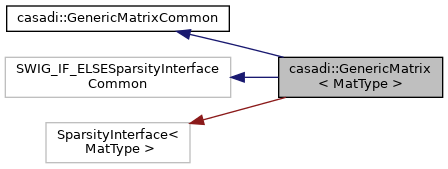
Public Member Functions | |
| casadi_int | nnz () const |
| Get the number of structural nonzeros. More... | |
| casadi_int | nnz_lower () const |
| Get the number of structural nonzeros on or below the diagonal. More... | |
| casadi_int | nnz_upper () const |
| Get the number of structural nonzeros on or above the diagonal. More... | |
| casadi_int | nnz_diag () const |
| Get the number of structural nonzeros on the diagonal. More... | |
| casadi_int | numel () const |
| Get the number of elements, size1()*size2() More... | |
| casadi_int | size1 () const |
| Get the first dimension (i.e. number of rows) More... | |
| casadi_int | rows () const |
| Get the number of rows, Octave-style syntax (same as size1()) More... | |
| casadi_int | size2 () const |
| Get the second dimension (i.e. number of columns) More... | |
| casadi_int | columns () const |
| Get the number of columns, Octave-style syntax (same as size2()) More... | |
| std::string | dim (bool with_nz=false) const |
| Get string representation of dimensions. More... | |
| std::pair< casadi_int, casadi_int > | size () const |
| Get the shape as a pair (number of rows, number of columns) More... | |
| casadi_int | size (casadi_int axis) const |
| Get the size along a particular dimension. More... | |
| bool | is_empty (bool both=false) const |
| Check if the matrix is empty, i.e. if one of the dimensions is zero. More... | |
| bool | is_dense () const |
| Check if the matrix is dense, i.e. nnz() equals numel() More... | |
| bool | is_scalar (bool scalar_and_dense=false) const |
| Check if the matrix is scalar, i.e. 1-by-1. More... | |
| bool | is_square () const |
| Check if the matrix is square, i.e. size1() equals size2() More... | |
| bool | is_vector () const |
| Check if the matrix is a row or column vector. More... | |
| bool | is_row () const |
| Check if the matrix is a row vector (i.e. size1()==1) More... | |
| bool | is_column () const |
| Check if the matrix is a column vector (i.e. size2()==1) More... | |
| bool | is_triu () const |
| Check if the matrix is upper triangular. More... | |
| bool | is_tril () const |
| Check if the matrix is lower triangular. More... | |
| Sparsity | sparsity () const |
| Get the sparsity pattern. More... | |
| std::vector< casadi_int > | get_row () const |
| Get the sparsity pattern. See the Sparsity class for details. More... | |
| std::vector< casadi_int > | get_colind () const |
| Get the sparsity pattern. See the Sparsity class for details. More... | |
| casadi_int | row (casadi_int el) const |
| Get the sparsity pattern. See the Sparsity class for details. More... | |
| casadi_int | colind (casadi_int col) const |
| Get the sparsity pattern. See the Sparsity class for details. More... | |
Static Public Member Functions | |
| static MatType | logsumexp (const MatType &x) |
| static MatType | jtimes (const MatType &ex, const MatType &arg, const MatType &v, bool tr=false, const Dict &opts=Dict()) |
| static MatType | gradient (const MatType &ex, const MatType &arg, const Dict &opts=Dict()) |
| static MatType | tangent (const MatType &ex, const MatType &arg, const Dict &opts=Dict()) |
| static MatType | linearize (const MatType &f, const MatType &x, const MatType &x0, const Dict &opts=Dict()) |
| static MatType | mpower (const MatType &x, const MatType &y) |
| static MatType | soc (const MatType &x, const MatType &y) |
Construct symbolic primitives | |
The "sym" function is intended to work in a similar way as "sym" used in the Symbolic Toolbox for Matlab but instead creating a CasADi symbolic primitive. | |
| static MatType | sym (const std::string &name, casadi_int nrow=1, casadi_int ncol=1) |
| Create an nrow-by-ncol symbolic primitive. More... | |
| static MatType | sym (const std::string &name, const std::pair< casadi_int, casadi_int > &rc) |
| Construct a symbolic primitive with given dimensions, as a pair (nrow, ncol) More... | |
| static MatType | sym (const std::string &name, const Sparsity &sp) |
| Create symbolic primitive with a given sparsity pattern. More... | |
| static std::vector< MatType > | sym (const std::string &name, const Sparsity &sp, casadi_int p) |
| Create a list of length p of symbolic primitives with a given sparsity. More... | |
| static std::vector< MatType > | sym (const std::string &name, casadi_int nrow, casadi_int ncol, casadi_int p) |
| Create a list of length p of nrow-by-ncol symbolic primitives. More... | |
| static std::vector< std::vector< MatType > > | sym (const std::string &name, const Sparsity &sp, casadi_int p, casadi_int r) |
| Create a list of length r of lists of length p of symbolic primitives. More... | |
| static std::vector< std::vector< MatType > > | sym (const std::string &name, casadi_int nrow, casadi_int ncol, casadi_int p, casadi_int r) |
| Create a list of length r of lists of length p of nrow-by-ncol symbolic primitives. More... | |
| static MatType | zeros (casadi_int nrow=1, casadi_int ncol=1) |
| Create a dense matrix or a matrix with specified sparsity with all entries zero. More... | |
| static MatType | zeros (const Sparsity &sp) |
| Create a dense matrix or a matrix with specified sparsity with all entries zero. More... | |
| static MatType | zeros (const std::pair< casadi_int, casadi_int > &rc) |
| Create a dense matrix or a matrix with specified sparsity with all entries zero. More... | |
| static MatType | ones (casadi_int nrow=1, casadi_int ncol=1) |
| Create a dense matrix or a matrix with specified sparsity with all entries one. More... | |
| static MatType | ones (const Sparsity &sp) |
| Create a dense matrix or a matrix with specified sparsity with all entries one. More... | |
| static MatType | ones (const std::pair< casadi_int, casadi_int > &rc) |
| Create a dense matrix or a matrix with specified sparsity with all entries one. More... | |
Friends | |
| MatType | interp1d (const std::vector< double > &x, const MatType &v, const std::vector< double > &xq, const std::string &mode, bool equidistant=false) |
| Performs 1d linear interpolation. More... | |
| MatType | mpower (const MatType &x, const MatType &n) |
| Matrix power x^n. More... | |
| MatType | soc (const MatType &x, const MatType &y) |
| Construct second-order-cone matrix. More... | |
| MatType | mrdivide (const MatType &x, const MatType &n) |
| Matrix right divide, x/A (cf. slash '/' in MATLAB) More... | |
| MatType | mldivide (const MatType &x, const MatType &n) |
| Matrix left divide, A\b (cf. backslash '\' in MATLAB) More... | |
| std::vector< MatType > | symvar (const MatType &x) |
| Get all symbolic primitives present in an expression. More... | |
| MatType | sumsqr (const MatType &x) |
| Calculate sum of squares: sum_ij X_ij^2. More... | |
| MatType | logsumexp (const MatType &x) |
| x -> log(sum_i exp(x_i)) More... | |
| MatType | logsumexp (const MatType &x, const MatType &margin) |
| Scaled version of logsumexp. More... | |
| MatType | linspace (const MatType &a, const MatType &b, casadi_int nsteps) |
Matlab's linspace command. More... | |
| MatType | cross (const MatType &a, const MatType &b, casadi_int dim=-1) |
Matlab's cross command. More... | |
| MatType | skew (const MatType &a) |
| Generate a skew symmetric matrix from a 3-vector. More... | |
| MatType | inv_skew (const MatType &a) |
| Generate the 3-vector progenitor of a skew symmetric matrix. More... | |
| MatType | det (const MatType &A) |
| Matrix determinant (experimental) More... | |
| MatType | det (const MatType &A, const std::string &lsolver, const Dict &dict=Dict()) |
| Matrix determinant through a linear solver factorization (experimental) More... | |
| MatType | inv_minor (const MatType &A) |
| Matrix inverse by the adjugate (experimental) More... | |
| MatType | inv (const MatType &A) |
| Matrix inverse. More... | |
| MatType | inv (const MatType &A, const std::string &lsolver, const Dict &options=Dict()) |
| Matrix inverse using a linear solver plugin. More... | |
| MatType | trace (const MatType &x) |
| Matrix trace. More... | |
| MatType | tril2symm (const MatType &a) |
| Convert a lower triangular matrix to a symmetric one. More... | |
| MatType | triu2symm (const MatType &a) |
| Convert a upper triangular matrix to a symmetric one. More... | |
| MatType | norm_fro (const MatType &x) |
| Frobenius norm. More... | |
| MatType | norm_2 (const MatType &x) |
| 2-norm More... | |
| MatType | norm_1 (const MatType &x) |
| 1-norm More... | |
| MatType | norm_inf (const MatType &x) |
| Infinity-norm. More... | |
| MatType | diff (const MatType &x, casadi_int n=1, casadi_int axis=-1) |
| Returns difference (n-th order) along given axis (MATLAB convention) More... | |
| MatType | cumsum (const MatType &x, casadi_int axis=-1) |
| Returns cumulative sum along given axis (MATLAB convention) More... | |
| MatType | dot (const MatType &x, const MatType &y) |
| Inner product of two matrices. More... | |
| MatType | nullspace (const MatType &A) |
| Computes the nullspace of a matrix A. More... | |
| MatType | polyval (const MatType &p, const MatType &x) |
| Evaluate a polynomial with coefficients p in x. More... | |
| MatType | diag (const MatType &A) |
| Get the diagonal of a matrix or construct a diagonal. More... | |
| MatType | unite (const MatType &A, const MatType &B) |
| Unite two matrices with non-overlapping sparsity patterns. More... | |
| MatType | densify (const MatType &x) |
| Make the matrix dense if not already. More... | |
| MatType | densify (const MatType &x, const MatType &val) |
| Make the matrix dense and assign nonzeros to a value. More... | |
| MatType | project (const MatType &A, const Sparsity &sp, bool intersect=false) |
| Create a new matrix with a given sparsity pattern but with the. More... | |
| MatType | if_else (const MatType &cond, const MatType &if_true, const MatType &if_false, bool short_circuit=false) |
| Branching on MX nodes. More... | |
| MatType | conditional (const MatType &ind, const std::vector< MatType > &x, const MatType &x_default, bool short_circuit=false) |
| Create a switch. More... | |
| bool | depends_on (const MatType &f, const MatType &arg) |
| Check if expression depends on the argument. More... | |
| MatType | substitute (const MatType &ex, const MatType &v, const MatType &vdef) |
| Substitute variable v with expression vdef in an expression ex. More... | |
| std::vector< MatType > | substitute (const std::vector< MatType > &ex, const std::vector< MatType > &v, const std::vector< MatType > &vdef) |
| Substitute variables v with expressions vdef in multiple expressions ex. More... | |
| void | substitute_inplace (const std::vector< MatType > &v, std::vector< MatType > &inout_vdef, std::vector< MatType > &inout_ex, bool reverse=false) |
| Inplace substitution with piggyback expressions. More... | |
| MatType | cse (const MatType &e) |
| Common subexpression elimination. More... | |
| std::vector< MatType > | cse (const std::vector< MatType > &e) |
| Common subexpression elimination over a list of expressions. More... | |
| MatType | solve (const MatType &A, const MatType &b) |
| Solve a system of equations: A*x = b. More... | |
| MatType | solve (const MatType &A, const MatType &b, const std::string &lsolver, const Dict &dict=Dict()) |
| Solve a system of equations: A*x = b, using a linear solver plugin. More... | |
| MatType | linearize (const MatType &f, const MatType &x, const MatType &x0, const Dict &opts=Dict()) |
| Linearize an expression. More... | |
| MatType | pinv (const MatType &A) |
| Computes the Moore-Penrose pseudo-inverse. More... | |
| MatType | pinv (const MatType &A, const std::string &lsolver, const Dict &dict=Dict()) |
| Computes the Moore-Penrose pseudo-inverse using a linear solver plugin. More... | |
| MatType | expm_const (const MatType &A, const MatType &t) |
| Calculate Matrix exponential. More... | |
| MatType | expm (const MatType &A) |
| Calculate Matrix exponential. More... | |
| MatType | jacobian (const MatType &ex, const MatType &arg, const Dict &opts=Dict()) |
| Calculate Jacobian. More... | |
| MatType | gradient (const MatType &ex, const MatType &arg, const Dict &opts=Dict()) |
| Calculate the gradient of an expression. More... | |
| MatType | tangent (const MatType &ex, const MatType &arg, const Dict &opts=Dict()) |
| Calculate the tangent of an expression. More... | |
| MatType | jtimes (const MatType &ex, const MatType &arg, const MatType &v, bool tr=false, const Dict &opts=Dict()) |
| Calculate the Jacobian and multiply by a vector from the right. More... | |
| std::vector< std::vector< MatType > > | forward (const std::vector< MatType > &ex, const std::vector< MatType > &arg, const std::vector< std::vector< MatType > > &v, const Dict &opts=Dict()) |
| Forward directional derivative. More... | |
| std::vector< std::vector< MatType > > | reverse (const std::vector< MatType > &ex, const std::vector< MatType > &arg, const std::vector< std::vector< MatType > > &v, const Dict &opts=Dict()) |
| Reverse directional derivative. More... | |
| std::vector< bool > | which_depends (const MatType &expr, const MatType &var, casadi_int order, bool tr) |
| Find out which variables enter with some order. More... | |
| Sparsity | jacobian_sparsity (const MatType &f, const MatType &x) |
| Get the sparsity pattern of a jacobian. More... | |
| bool | is_linear (const MatType &expr, const MatType &var) |
| Is expr linear in var? More... | |
| bool | is_quadratic (const MatType &expr, const MatType &var) |
| Is expr quadratic in var? More... | |
| void | quadratic_coeff (const MatType &expr, const MatType &var, MatType &A, MatType &b, MatType &c, bool check=true) |
| Recognizes quadratic form in scalar expression. More... | |
| void | linear_coeff (const MatType &expr, const MatType &var, MatType &A, MatType &b, bool check=true) |
| Recognizes linear form in vector expression. More... | |
| void | extract_parametric (const MatType &expr, const MatType &par, MatType &expr_ret, std::vector< MatType > &symbols, std::vector< MatType > ¶metric, const Dict &opts=Dict()) |
| Extract purely parametric parts from an expression graph. More... | |
| void | extract_parametric (const std::vector< MatType > &expr, const MatType &par, std::vector< MatType > &expr_ret, std::vector< MatType > &symbols, std::vector< MatType > ¶metric, const Dict &opts=Dict()) |
| void | extract_parametric (const std::vector< MatType > &expr, const std::vector< MatType > &par, std::vector< MatType > &expr_ret, std::vector< MatType > &symbols, std::vector< MatType > ¶metric, const Dict &opts=Dict()) |
| void | extract_parametric (const MatType &expr, const std::vector< MatType > &par, MatType &expr_ret, std::vector< MatType > &symbols, std::vector< MatType > ¶metric, const Dict &opts=Dict()) |
| void | separate_linear (const MatType &expr, const MatType &sym_lin, const MatType &sym_const, MatType &expr_const, MatType &expr_lin, MatType &expr_nonlin) |
| Separate an expression into subexpressions that are constant, linear and nonlinear. More... | |
| void | separate_linear (const MatType &expr, const std::vector< MatType > &sym_lin, const std::vector< MatType > &sym_const, MatType &expr_const, MatType &expr_lin, MatType &expr_nonlin) |
| casadi_int | n_nodes (const MatType &A) |
| Count the number of nodes in an expression graph. More... | |
| MatType | simplify (const MatType &x) |
| Simplify an expression. More... | |
| std::string | print_operator (const MatType &xb, const std::vector< std::string > &args) |
| Get a string representation for a binary MatType, using custom arguments. More... | |
| void | extract (std::vector< MatType > &ex, std::vector< MatType > &v, std::vector< MatType > &vdef, const Dict &opts=Dict()) |
| Introduce intermediate variables for selected nodes in a graph. More... | |
| void | shared (std::vector< MatType > &ex, std::vector< MatType > &v, std::vector< MatType > &vdef, const std::string &v_prefix="v_", const std::string &v_suffix="") |
| Extract shared subexpressions from an set of expressions. More... | |
| MatType | repsum (const MatType &A, casadi_int n, casadi_int m=1) |
| Given a repeated matrix, computes the sum of repeated parts. More... | |
| MatType | einstein (const MatType &A, const MatType &B, const MatType &C, const std::vector< casadi_int > &dim_a, const std::vector< casadi_int > &dim_b, const std::vector< casadi_int > &dim_c, const std::vector< casadi_int > &a, const std::vector< casadi_int > &b, const std::vector< casadi_int > &c) |
| Compute any contraction of two dense tensors, using index/einstein notation. More... | |
| MatType | einstein (const MatType &A, const MatType &B, const std::vector< casadi_int > &dim_a, const std::vector< casadi_int > &dim_b, const std::vector< casadi_int > &dim_c, const std::vector< casadi_int > &a, const std::vector< casadi_int > &b, const std::vector< casadi_int > &c) |
| Compute any contraction of two dense tensors, using index/einstein notation. More... | |
| bool | contains (const std::vector< MatType > &v, const MatType &n) |
| Check if expression n is listed in v. More... | |
| bool | contains_all (const std::vector< MatType > &v, const std::vector< MatType > &n) |
| Check if expression n is listed in v. More... | |
| bool | contains_any (const std::vector< MatType > &v, const std::vector< MatType > &n) |
| Check if expression n is listed in v. More... | |
| MatType | hessian (const MatType &ex, const MatType &arg, const Dict &opts=Dict()) |
| Hessian and (optionally) gradient. More... | |
| MatType | hessian (const MatType &ex, const MatType &arg, MatType &output_g, const Dict &opts=Dict()) |
| Hessian and (optionally) gradient. More... | |
| MatType | transform (const MatType &x, const Dict &opts=Dict()) |
| Apply transformation passes to an expression. More... | |
| MatType | transform (const MatType &x, const std::vector< std::vector< GenericType > > &passes, const Dict &opts=Dict()) |
| Apply transformation passes to an expression. More... | |
| std::vector< MatType > | transform (const std::vector< MatType > &x, const Dict &opts=Dict()) |
| Apply transformation passes to an expression. More... | |
| std::vector< MatType > | transform (const std::vector< MatType > &x, const std::vector< std::vector< GenericType > > &passes, const Dict &opts=Dict()) |
| Apply transformation passes to an expression. More... | |
| MatType | mmin (const MatType &x) |
| Smallest element in a matrix. More... | |
| MatType | mmax (const MatType &x) |
| Largest element in a matrix. More... | |
| MatType | bilin (const MatType &A, const MatType &x, const MatType &y) |
| Calculate bilinear/quadratic form x^T A y. More... | |
| MatType | bilin (const MatType &A, const MatType &x) |
| Calculate bilinear/quadratic form x^T A y. More... | |
| static MatType | bilin (const MatType &A, const MatType &x, const MatType &y) |
| Calculate bilinear/quadratic form x^T A y. More... | |
| MatType | rank1 (const MatType &A, const MatType &alpha, const MatType &x, const MatType &y) |
| Make a rank-1 update to a matrix A. More... | |
| static MatType | rank1 (const MatType &A, const MatType &alpha, const MatType &x, const MatType &y) |
| Make a rank-1 update to a matrix A. More... | |
|
inline |
The pattern is stored in compressed column format: colind has size2()+1 entries, the nonzeros of column j are the entries colind(j) up to colind(j+1) (exclusive), and row(el) is the row index of nonzero el. Without argument, the full vectors are returned. Out-of-range indices raise an error.
>>> x = DM(Sparsity.diag(2), [5, 6])
>>> x.row(), x.colind()
([0, 1], [0, 1, 2])
>>> x.row(1), x.colind(2)
(1, 2)
>> x = DM(Sparsity.diag(2), [5; 6]);
>> x.row(), x.colind()
0 1
0 1 2
>> fprintf('%d %d\n', x.row(1), x.colind(2))
1 2
julia> x = ca.DM(ca.Sparsity.diag(2), [5, 6]);
julia> ca.row(x), ca.colind(x)
([0, 1], [0, 1, 2])
julia> ca.row(x, 1), ca.colind(x, 2)
(1, 2)
Extra doc: https://github.com/casadi/casadi/wiki/L_1b8
Definition at line 609 of file generic_matrix.hpp.
|
inline |
Extra doc: https://github.com/casadi/casadi/wiki/L_1av
Definition at line 295 of file generic_matrix.hpp.
| std::string casadi::GenericMatrix< MatType >::dim | ( | bool | with_nz = false | ) | const |
The representation is e.g. "4x5" or, with with_nz true, "4x5,10nz".
>>> DM.eye(3).dim(), DM.eye(3).dim(True), DM.ones(3, 3).dim(True)
('3x3', '3x3,3nz', '3x3,9nz')
>> fprintf('%s %s %s\n', DM.eye(3).dim(), DM.eye(3).dim(true), DM.ones(3, 3).dim(true))
3x3 3x3,3nz 3x3,9nz
julia> ca.dim(ca.DM.eye(3)), ca.dim(ca.DM.eye(3), true), ca.dim(ca.DM.ones(3, 3), true)
("3x3", "3x3,3nz", "3x3,9nz")
Extra doc: https://github.com/casadi/casadi/wiki/L_1aw
|
inline |
The pattern is stored in compressed column format: colind has size2()+1 entries, the nonzeros of column j are the entries colind(j) up to colind(j+1) (exclusive), and row(el) is the row index of nonzero el. Without argument, the full vectors are returned. Out-of-range indices raise an error.
>>> x = DM(Sparsity.diag(2), [5, 6])
>>> x.row(), x.colind()
([0, 1], [0, 1, 2])
>>> x.row(1), x.colind(2)
(1, 2)
>> x = DM(Sparsity.diag(2), [5; 6]);
>> x.row(), x.colind()
0 1
0 1 2
>> fprintf('%d %d\n', x.row(1), x.colind(2))
1 2
julia> x = ca.DM(ca.Sparsity.diag(2), [5, 6]);
julia> ca.row(x), ca.colind(x)
([0, 1], [0, 1, 2])
julia> ca.row(x, 1), ca.colind(x, 2)
(1, 2)
Extra doc: https://github.com/casadi/casadi/wiki/L_1b8
Definition at line 603 of file generic_matrix.hpp.
|
inline |
The pattern is stored in compressed column format: colind has size2()+1 entries, the nonzeros of column j are the entries colind(j) up to colind(j+1) (exclusive), and row(el) is the row index of nonzero el. Without argument, the full vectors are returned. Out-of-range indices raise an error.
>>> x = DM(Sparsity.diag(2), [5, 6])
>>> x.row(), x.colind()
([0, 1], [0, 1, 2])
>>> x.row(1), x.colind(2)
(1, 2)
>> x = DM(Sparsity.diag(2), [5; 6]);
>> x.row(), x.colind()
0 1
0 1 2
>> fprintf('%d %d\n', x.row(1), x.colind(2))
1 2
julia> x = ca.DM(ca.Sparsity.diag(2), [5, 6]);
julia> ca.row(x), ca.colind(x)
([0, 1], [0, 1, 2])
julia> ca.row(x, 1), ca.colind(x, 2)
(1, 2)
Extra doc: https://github.com/casadi/casadi/wiki/L_1b8
Definition at line 602 of file generic_matrix.hpp.
|
inline |
Extra doc: https://github.com/casadi/casadi/wiki/L_1b5
Definition at line 517 of file generic_matrix.hpp.
|
inline |
Based on the sparsity pattern only: stored numerical zeros still count as nonzeros. Empty matrices are dense.
>>> DM.zeros(2, 2).is_dense(), DM(2, 2).is_dense(), DM(0, 3).is_dense()
(True, False, True)
>> Z = DM.zeros(2, 2);
>> fprintf('%d %d %d\n', Z.is_dense(), DM(2, 2).is_dense(), DM(0, 3).is_dense())
1 0 1
julia> ca.is_dense(ca.DM.zeros(2, 2)), ca.is_dense(ca.DM(2, 2)), ca.is_dense(ca.DM(0, 3))
(true, false, true)
Extra doc: https://github.com/casadi/casadi/wiki/L_1b0
Definition at line 434 of file generic_matrix.hpp.
|
inline |
With both true, only a 0-by-0 matrix counts as empty.
>>> DM(0, 3).is_empty(), DM(0, 3).is_empty(True), DM(0, 0).is_empty(True)
(True, False, True)
>>> DM(1, 1).is_empty()
False
>> E = DM(0, 3);
>> fprintf('%d %d %d\n', E.is_empty(), E.is_empty(true), DM(0, 0).is_empty(true))
1 0 1
>> DM(1, 1).is_empty()
0
julia> E = ca.DM(0, 3);
julia> ca.is_empty(E), ca.is_empty(E, true), ca.is_empty(ca.DM(0, 0), true)
(true, false, true)
julia> ca.is_empty(ca.DM(1, 1))
false
Extra doc: https://github.com/casadi/casadi/wiki/L_1az
Definition at line 402 of file generic_matrix.hpp.
|
inline |
Extra doc: https://github.com/casadi/casadi/wiki/L_1b4
Definition at line 512 of file generic_matrix.hpp.
| bool casadi::GenericMatrix< MatType >::is_scalar | ( | bool | scalar_and_dense = false | ) | const |
| scalar_and_dense | When true, a 1-by-1 matrix with a structural zero does not count |
>>> x = SX.sym("x", Sparsity(1, 1))
>>> x.is_scalar(), x.is_scalar(True), SX.sym("y").is_scalar(True)
(True, False, True)
>> x = SX.sym('x', Sparsity(1, 1));
>> fprintf('%d %d %d\n', x.is_scalar(), x.is_scalar(true), SX.sym('y').is_scalar(true))
1 0 1
julia> x = ca.SX.sym("x", ca.Sparsity(1, 1));
julia> ca.is_scalar(x), ca.is_scalar(x, true), ca.is_scalar(ca.SX.sym("y"), true)
(true, false, true)
Extra doc: https://github.com/casadi/casadi/wiki/L_1b1
|
inline |
Extra doc: https://github.com/casadi/casadi/wiki/L_1b2
Definition at line 470 of file generic_matrix.hpp.
|
inline |
Decided on the sparsity pattern alone, see is_triu.
Extra doc: https://github.com/casadi/casadi/wiki/L_1b7
Definition at line 560 of file generic_matrix.hpp.
|
inline |
Decided on the sparsity pattern alone: all structural nonzeros must lie on or above the diagonal. A dense matrix with numerical zeros below the diagonal is not upper triangular. Also defined for non-square matrices.
>>> DM(Sparsity.upper(3), 1).is_triu(), DM.zeros(2, 2).is_triu(), DM(2, 2).is_triu()
(True, False, True)
>> U = DM(Sparsity.upper(3), 1);
>> fprintf('%d %d %d\n', U.is_triu(), DM.zeros(2, 2).is_triu(), DM(2, 2).is_triu())
1 0 1
julia> U = ca.DM(ca.Sparsity.upper(3), 1);
julia> ca.is_triu(U), ca.is_triu(ca.DM.zeros(2, 2)), ca.is_triu(ca.DM(2, 2))
(true, false, true)
Extra doc: https://github.com/casadi/casadi/wiki/L_1b6
Definition at line 551 of file generic_matrix.hpp.
|
inline |
True when size1() or size2() is one, so scalars and n-by-1 or 1-by-n empties count. A 0-by-0 matrix does not.
>>> DM(3, 1).is_vector(), DM(1, 3).is_vector(), DM(1, 1).is_vector()
(True, True, True)
>>> DM(3, 3).is_vector(), DM(0, 1).is_vector(), DM(0, 0).is_vector()
(False, True, False)
>> fprintf('%d %d %d\n', DM(3, 1).is_vector(), DM(1, 3).is_vector(), DM(1, 1).is_vector())
1 1 1
>> fprintf('%d %d %d\n', DM(3, 3).is_vector(), DM(0, 1).is_vector(), DM(0, 0).is_vector())
0 1 0
julia> ca.is_vector(ca.DM(3, 1)), ca.is_vector(ca.DM(1, 3)), ca.is_vector(ca.DM(1, 1))
(true, true, true)
julia> ca.is_vector(ca.DM(3, 3)), ca.is_vector(ca.DM(0, 1)), ca.is_vector(ca.DM(0, 0))
(false, true, false)
Extra doc: https://github.com/casadi/casadi/wiki/L_1b3
Definition at line 507 of file generic_matrix.hpp.
| casadi_int casadi::GenericMatrix< MatType >::nnz | ( | ) | const |
Counts the entries present in the sparsity pattern. Entries that are stored but numerically zero still count; structural zeros (not stored) do not. For a dense matrix this equals numel().
>>> DM.eye(3).nnz(), DM.ones(3, 3).nnz(), DM(3, 3).nnz()
(3, 9, 0)
>>> DM([[1, 0], [0, 2]]).nnz()
4
>>> MX.sym("x", 2, 0).nnz()
0
>> fprintf('%d %d %d\n', DM.eye(3).nnz(), DM.ones(3, 3).nnz(), DM(3, 3).nnz())
3 9 0
>> DM([1 0; 0 2]).nnz()
4
>> MX.sym('x', 2, 0).nnz()
0
julia> ca.nnz(ca.DM.eye(3)), ca.nnz(ca.DM.ones(3, 3)), ca.nnz(ca.DM(3, 3))
(3, 9, 0)
julia> ca.nnz(ca.DM([1 0; 0 2]))
4
julia> ca.nnz(ca.MX.sym("x", 2, 0))
0
Extra doc: https://github.com/casadi/casadi/wiki/L_1an
| casadi_int casadi::GenericMatrix< MatType >::nnz_diag | ( | ) | const |
Also defined for non-square matrices.
>>> DM.ones(3, 3).nnz_diag(), DM.eye(3).nnz_diag(), DM.ones(2, 3).nnz_diag()
(3, 3, 2)
>> A = DM.ones(3, 3); I = DM.eye(3); B = DM.ones(2, 3);
>> fprintf('%d %d %d\n', A.nnz_diag(), I.nnz_diag(), B.nnz_diag())
3 3 2
julia> A = ca.DM.ones(3, 3); I = ca.DM.eye(3); B = ca.DM.ones(2, 3);
julia> ca.nnz_diag(A), ca.nnz_diag(I), ca.nnz_diag(B)
(3, 3, 2)
Extra doc: https://github.com/casadi/casadi/wiki/L_1aq
| casadi_int casadi::GenericMatrix< MatType >::nnz_lower | ( | ) | const |
>>> DM.ones(3, 3).nnz_lower(), DM.eye(3).nnz_lower(), DM.ones(2, 3).nnz_lower()
(6, 3, 3)
>> A = DM.ones(3, 3); I = DM.eye(3); B = DM.ones(2, 3);
>> fprintf('%d %d %d\n', A.nnz_lower(), I.nnz_lower(), B.nnz_lower())
6 3 3
julia> A = ca.DM.ones(3, 3); I = ca.DM.eye(3); B = ca.DM.ones(2, 3);
julia> ca.nnz_lower(A), ca.nnz_lower(I), ca.nnz_lower(B)
(6, 3, 3)
Extra doc: https://github.com/casadi/casadi/wiki/L_1ao
| casadi_int casadi::GenericMatrix< MatType >::nnz_upper | ( | ) | const |
>>> DM.ones(3, 3).nnz_upper(), DM.eye(3).nnz_upper(), DM.ones(2, 3).nnz_upper()
(6, 3, 5)
>> A = DM.ones(3, 3); I = DM.eye(3); B = DM.ones(2, 3);
>> fprintf('%d %d %d\n', A.nnz_upper(), I.nnz_upper(), B.nnz_upper())
6 3 5
julia> A = ca.DM.ones(3, 3); I = ca.DM.eye(3); B = ca.DM.ones(2, 3);
julia> ca.nnz_upper(A), ca.nnz_upper(I), ca.nnz_upper(B)
(6, 3, 5)
Extra doc: https://github.com/casadi/casadi/wiki/L_1ap
| casadi_int casadi::GenericMatrix< MatType >::numel | ( | ) | const |
Counts all entries, structural zeros included.
>>> DM.eye(3).numel(), MX.sym("x", 2, 0).numel(), SX.sym("x").numel()
(9, 0, 1)
>> fprintf('%d %d %d\n', DM.eye(3).numel(), MX.sym('x', 2, 0).numel(), SX.sym('x').numel())
9 0 1
julia> ca.numel(ca.DM.eye(3)), ca.numel(ca.MX.sym("x", 2, 0)), ca.numel(ca.SX.sym("x"))
(9, 0, 1)
julia> length(ca.DM.eye(3))
9
Extra doc: https://github.com/casadi/casadi/wiki/L_1ar
|
inlinestatic |
ones(sp) sets every structural nonzero of sp to one; other entries stay structurally zero.
>>> DM.ones(2, 3)
DM(
[[1, 1, 1],
 [1, 1, 1]])
>>> DM.ones(Sparsity.diag(2))
DM(
[[1, 00],
 [00, 1]])
>> DM.ones(2, 3)
[[1, 1, 1],
 [1, 1, 1]]
>> DM.ones(Sparsity.diag(2))
[[1, 00],
 [00, 1]]
julia> ca.DM.ones(2, 3)
DM(
[[1, 1, 1],
 [1, 1, 1]])
julia> ca.DM.ones(ca.Sparsity.diag(2))
DM(
[[1, 00],
 [00, 1]])
Extra doc: https://github.com/casadi/casadi/wiki/L_1di
Definition at line 5206 of file generic_matrix.hpp.
|
inlinestatic |
ones(sp) sets every structural nonzero of sp to one; other entries stay structurally zero.
>>> DM.ones(2, 3)
DM(
[[1, 1, 1],
 [1, 1, 1]])
>>> DM.ones(Sparsity.diag(2))
DM(
[[1, 00],
 [00, 1]])
>> DM.ones(2, 3)
[[1, 1, 1],
 [1, 1, 1]]
>> DM.ones(Sparsity.diag(2))
[[1, 00],
 [00, 1]]
julia> ca.DM.ones(2, 3)
DM(
[[1, 1, 1],
 [1, 1, 1]])
julia> ca.DM.ones(ca.Sparsity.diag(2))
DM(
[[1, 00],
 [00, 1]])
Extra doc: https://github.com/casadi/casadi/wiki/L_1di
Definition at line 5209 of file generic_matrix.hpp.
|
inlinestatic |
ones(sp) sets every structural nonzero of sp to one; other entries stay structurally zero.
>>> DM.ones(2, 3)
DM(
[[1, 1, 1],
 [1, 1, 1]])
>>> DM.ones(Sparsity.diag(2))
DM(
[[1, 00],
 [00, 1]])
>> DM.ones(2, 3)
[[1, 1, 1],
 [1, 1, 1]]
>> DM.ones(Sparsity.diag(2))
[[1, 00],
 [00, 1]]
julia> ca.DM.ones(2, 3)
DM(
[[1, 1, 1],
 [1, 1, 1]])
julia> ca.DM.ones(ca.Sparsity.diag(2))
DM(
[[1, 00],
 [00, 1]])
Extra doc: https://github.com/casadi/casadi/wiki/L_1di
Definition at line 5210 of file generic_matrix.hpp.
|
inline |
The pattern is stored in compressed column format: colind has size2()+1 entries, the nonzeros of column j are the entries colind(j) up to colind(j+1) (exclusive), and row(el) is the row index of nonzero el. Without argument, the full vectors are returned. Out-of-range indices raise an error.
>>> x = DM(Sparsity.diag(2), [5, 6])
>>> x.row(), x.colind()
([0, 1], [0, 1, 2])
>>> x.row(1), x.colind(2)
(1, 2)
>> x = DM(Sparsity.diag(2), [5; 6]);
>> x.row(), x.colind()
0 1
0 1 2
>> fprintf('%d %d\n', x.row(1), x.colind(2))
1 2
julia> x = ca.DM(ca.Sparsity.diag(2), [5, 6]);
julia> ca.row(x), ca.colind(x)
([0, 1], [0, 1, 2])
julia> ca.row(x, 1), ca.colind(x, 2)
(1, 2)
Extra doc: https://github.com/casadi/casadi/wiki/L_1b8
Definition at line 608 of file generic_matrix.hpp.
|
inline |
Extra doc: https://github.com/casadi/casadi/wiki/L_1at
Definition at line 283 of file generic_matrix.hpp.
| std::pair<casadi_int, casadi_int> casadi::GenericMatrix< MatType >::size | ( | ) | const |
>>> x = MX.sym("x", 2, 3)
>>> x.size(), x.size(1), x.size(2)
((2, 3), 2, 3)
>> x = MX.sym('x', 2, 3);
>> size(x)
2 3
>> fprintf('%d %d\n', size(x, 1), size(x, 2))
2 3
julia> x = ca.MX.sym("x", 2, 3);
julia> size(x), size(x, 1), size(x, 2)
((2, 3), 2, 3)
Extra doc: https://github.com/casadi/casadi/wiki/L_1ax
| casadi_int casadi::GenericMatrix< MatType >::size | ( | casadi_int | axis | ) | const |
| axis | 1 for the number of rows, 2 for the number of columns; any other value raises an error |
Extra doc: https://github.com/casadi/casadi/wiki/L_1ay
| casadi_int casadi::GenericMatrix< MatType >::size1 | ( | ) | const |
>>> x = MX.sym("x", 2, 3)
>>> x.size1(), x.size2()
(2, 3)
>> x = MX.sym('x', 2, 3);
>> fprintf('%d %d\n', x.size1(), x.size2())
2 3
julia> x = ca.MX.sym("x", 2, 3);
julia> ca.size1(x), ca.size2(x)
(2, 3)
Extra doc: https://github.com/casadi/casadi/wiki/L_1as
| casadi_int casadi::GenericMatrix< MatType >::size2 | ( | ) | const |
Extra doc: https://github.com/casadi/casadi/wiki/L_1au
| Sparsity casadi::GenericMatrix< MatType >::sparsity | ( | ) | const |
>>> DM.eye(2).sparsity()
Sparsity(2x2,2nz)
>>> DM.eye(2).sparsity() == Sparsity.diag(2)
True
>> DM.eye(2).sparsity()
2x2,2nz
>> DM.eye(2).sparsity() == Sparsity.diag(2)
1
julia> ca.sparsity(ca.DM.eye(2))
Sparsity(2x2,2nz)
julia> ca.is_equal(ca.sparsity(ca.DM.eye(2)), ca.Sparsity.diag(2))
true
Extra doc: https://github.com/casadi/casadi/wiki/L_1b9
|
inlinestatic |
>>> SX.sym("x", 1, 1, 2)
[SX(x0), SX(x1)]
>> v = SX.sym('x', 1, 1, 2);
>> v{1}, v{2}
x0
x1
julia> ca.SX.sym("x", 1, 1, 2)
2-element Vector{SX}:
 SX(x0)
 SX(x1)
Extra doc: https://github.com/casadi/casadi/wiki/L_1de
Definition at line 5063 of file generic_matrix.hpp.
|
inlinestatic |
>>> MX.sym("x", 1, 1, 2, 2)
[[MX(x_00), MX(x_01)], [MX(x_10), MX(x_11)]]
>> v = MX.sym('x', 1, 1, 2, 2);
>> numel(v), v{1}{2}, v{2}{1}
2
x_01
x_10
julia> ca.MX.sym("x", 1, 1, 2, 2)
2-element Vector{Vector{MX}}:
 MX[x_00, x_01]
 MX[x_10, x_11]
Extra doc: https://github.com/casadi/casadi/wiki/L_1dg
Definition at line 5107 of file generic_matrix.hpp.
|
inlinestatic |
Creates a new, dense symbol; two symbols with the same name are still different symbols. For SX each entry is a separate scalar symbol named name_k (k the column-major index), while an MX symbol is a single node with the given name. Only SX and MX have symbols; DM.sym raises an error.
| name | Name used for printing. For SX, a name of the form "[a,b,c]" assigns individual names to the numel() entries. |
| nrow | Number of rows, default 1 |
| ncol | Number of columns, default 1 |
>>> SX.sym("x"), MX.sym("x", 2, 3).dim()
(SX(x), '2x3')
>>> SX.sym("x", 2, 2)
SX(
[[x_0, x_2],
 [x_1, x_3]])
>>> SX.sym("[a,b,c]", 3)
SX([a, b, c])
>>> is_equal(SX.sym("x"), SX.sym("x"))
False
>> SX.sym('x'), MX.sym('x', 2, 3).dim()
x
2x3
>> SX.sym('x', 2, 2)
[[x_0, x_2],
 [x_1, x_3]]
>> SX.sym('[a,b,c]', 3)
[a, b, c]
>> is_equal(SX.sym('x'), SX.sym('x'))
0
julia> ca.SX.sym("x"), ca.dim(ca.MX.sym("x", 2, 3))
(x, "2x3")
julia> ca.SX.sym("x", 2, 2)
SX(
[[x_0, x_2],
 [x_1, x_3]])
julia> ca.SX.sym("[a,b,c]", 3)
SX([a, b, c])
julia> isequal(ca.SX.sym("x"), ca.SX.sym("x"))
false
Extra doc: https://github.com/casadi/casadi/wiki/L_1da
Definition at line 4948 of file generic_matrix.hpp.
|
inlinestatic |
Only the structural nonzeros of sp become symbolic entries; for SX they are numbered by nonzero index.
>>> SX.sym("p", Sparsity.diag(2))
SX(
[[p_0, 00],
 [00, p_1]])
>>> MX.sym("p", Sparsity.diag(2)).dim(True)
'2x2,2nz'
>> SX.sym('p', Sparsity.diag(2))
[[p_0, 00],
 [00, p_1]]
>> MX.sym('p', Sparsity.diag(2)).dim(true)
2x2,2nz
julia> ca.SX.sym("p", ca.Sparsity.diag(2))
SX(
[[p_0, 00],
 [00, p_1]])
julia> ca.dim(ca.MX.sym("p", ca.Sparsity.diag(2)), true)
"2x2,2nz"
Extra doc: https://github.com/casadi/casadi/wiki/L_1dc
Definition at line 4997 of file generic_matrix.hpp.
|
static |
The k-th symbol is named name followed by k (no separator).
>>> MX.sym("x", Sparsity.dense(2, 1), 3)
[MX(x0), MX(x1), MX(x2)]
>> v = MX.sym('x', Sparsity.dense(2, 1), 3);
>> numel(v), v{1}, v{3}
3
x0
x2
julia> ca.MX.sym("x", ca.Sparsity.dense(2, 1), 3)
3-element Vector{MX}:
 MX(x0)
 MX(x1)
 MX(x2)
Extra doc: https://github.com/casadi/casadi/wiki/L_1dd
Definition at line 5286 of file generic_matrix.hpp.
|
static |
with given sparsity. The symbol at outer index i and inner index k is named name_ik.
Extra doc: https://github.com/casadi/casadi/wiki/L_1df
Definition at line 5299 of file generic_matrix.hpp.
|
inlinestatic |
Extra doc: https://github.com/casadi/casadi/wiki/L_1db
Definition at line 4955 of file generic_matrix.hpp.
|
inlinestatic |
zeros(nrow, ncol) stores nrow*ncol numerical zeros; zeros(sp) stores a zero at every structural nonzero of sp. To get structural zeros instead, construct from a shape, e.g. DM(2, 2).
>>> DM.zeros(2, 2).nnz(), DM.zeros(Sparsity.diag(2)).nnz(), DM(2, 2).nnz()
(4, 2, 0)
>>> MX.zeros(2, 3)
MX(zeros(2x3))
>> Z = DM.zeros(Sparsity.diag(2));
>> fprintf('%d %d %d\n', DM.zeros(2, 2).nnz(), Z.nnz(), DM(2, 2).nnz())
4 2 0
>> MX.zeros(2, 3)
zeros(2x3)
julia> Z = ca.DM.zeros(ca.Sparsity.diag(2));
julia> ca.nnz(ca.DM.zeros(2, 2)), ca.nnz(Z), ca.nnz(ca.DM(2, 2))
(4, 2, 0)
julia> ca.MX.zeros(2, 3)
MX(zeros(2x3))
Extra doc: https://github.com/casadi/casadi/wiki/L_1dh
Definition at line 5151 of file generic_matrix.hpp.
|
inlinestatic |
zeros(nrow, ncol) stores nrow*ncol numerical zeros; zeros(sp) stores a zero at every structural nonzero of sp. To get structural zeros instead, construct from a shape, e.g. DM(2, 2).
>>> DM.zeros(2, 2).nnz(), DM.zeros(Sparsity.diag(2)).nnz(), DM(2, 2).nnz()
(4, 2, 0)
>>> MX.zeros(2, 3)
MX(zeros(2x3))
>> Z = DM.zeros(Sparsity.diag(2));
>> fprintf('%d %d %d\n', DM.zeros(2, 2).nnz(), Z.nnz(), DM(2, 2).nnz())
4 2 0
>> MX.zeros(2, 3)
zeros(2x3)
julia> Z = ca.DM.zeros(ca.Sparsity.diag(2));
julia> ca.nnz(ca.DM.zeros(2, 2)), ca.nnz(Z), ca.nnz(ca.DM(2, 2))
(4, 2, 0)
julia> ca.MX.zeros(2, 3)
MX(zeros(2x3))
Extra doc: https://github.com/casadi/casadi/wiki/L_1dh
Definition at line 5154 of file generic_matrix.hpp.
|
inlinestatic |
zeros(nrow, ncol) stores nrow*ncol numerical zeros; zeros(sp) stores a zero at every structural nonzero of sp. To get structural zeros instead, construct from a shape, e.g. DM(2, 2).
>>> DM.zeros(2, 2).nnz(), DM.zeros(Sparsity.diag(2)).nnz(), DM(2, 2).nnz()
(4, 2, 0)
>>> MX.zeros(2, 3)
MX(zeros(2x3))
>> Z = DM.zeros(Sparsity.diag(2));
>> fprintf('%d %d %d\n', DM.zeros(2, 2).nnz(), Z.nnz(), DM(2, 2).nnz())
4 2 0
>> MX.zeros(2, 3)
zeros(2x3)
julia> Z = ca.DM.zeros(ca.Sparsity.diag(2));
julia> ca.nnz(ca.DM.zeros(2, 2)), ca.nnz(Z), ca.nnz(ca.DM(2, 2))
(4, 2, 0)
julia> ca.MX.zeros(2, 3)
MX(zeros(2x3))
Extra doc: https://github.com/casadi/casadi/wiki/L_1dh
Definition at line 5155 of file generic_matrix.hpp.