A symbolic representation of a differential-algebraic equations model. More...
#include <dae_builder.hpp>
A DaeBuilder holds a list of uniquely named model variables with FMI-style meta data (causality, variability, type, start value, bounds, unit, ...) together with the model equations. The model is either built symbolically with add, eq, when and friends, or imported from an FMU / modelDescription.xml (constructor with a path, load_fmi_description). Numerical evaluation goes through the function factory create, which returns differentiable Function objects.
Every variable belongs to at most one CasADi category, derived from its causality, variability and defining equation:
t:      independent variable (usually time)
c:      constants
p:      parameters
d:      dependent parameters (time independent)
u:      controls
w:      dependent variables  (time dependent)
x:      differential states
z:      algebraic variables
q:      quadrature states
y:      outputs
differential equations: \dot{x} ==  ode(...)
algebraic equations:          0 ==  alg(...)
quadrature equations:   \dot{q} == quad(...)
dependent parameters:         d == ddef(d_prev,p)
dependent variables:          w == wdef(w_prev,x,z,u,p,t)
output equations:             y == ydef(...)
initial equations:     init_lhs == init_rhs(...)
events:      when when_cond < 0: when_lhs := when_rhs
The category names ("x", "ode", ...) are the strings accepted by all, inputs, outputs, create and the other category-based members. Internal helper variables (named der(x), __alg__0, __assign__.., __when__0, ...) are created as equations are added; they show up in all().
>>> dae = DaeBuilder("rocket")
>>> a = dae.add("a", "parameter", "tunable")
>>> u = dae.add("u", "input")
>>> h = dae.add("h", dict(start=0))
>>> v = dae.add("v", dict(start=0, unit="m/s"))
>>> m = dae.add("m", dict(start=1))
>>> dae.eq(dae.der(h), v)
>>> dae.eq(dae.der(v), (u - a*v**2)/m - 9.81)
>>> dae.eq(dae.der(m), -u**2)
>>> dae.x(), dae.u(), dae.p()
(['h', 'v', 'm'], ['u'], ['a'])
>>> f = dae.create("f", ["x", "u", "p"], ["ode"])
>>> f
Function(f:(x[3],u,p)->(ode[3]) MXFunction)
>>> f([0, 0, 1], 1, 0.5)
DM([0, -8.81, -1])
>> dae = DaeBuilder('rocket');
>> a = dae.add('a', 'parameter', 'tunable'); u = dae.add('u', 'input');
>> h = dae.add('h', struct('start', 0)); v = dae.add('v', struct('start', 0, 'unit', 'm/s'));
>> m = dae.add('m', struct('start', 1));
>> dae.eq(dae.der(h), v); dae.eq(dae.der(v), (u - a*v^2)/m - 9.81); dae.eq(dae.der(m), -u^2);
>> dae.x()
h
v
m
>> dae.u(), dae.p()
u
a
>> f = dae.create('f', {'x', 'u', 'p'}, {'ode'}); disp(f)
f:(x[3],u,p)->(ode[3]) MXFunction
>> f([0; 0; 1], 1, 0.5)
[0, -8.81, -1]
julia> dae = ca.DaeBuilder("rocket");
julia> a = ca.add(dae, "a", "parameter", "tunable");
julia> u = ca.add(dae, "u", "input");
julia> h = ca.add(dae, "h", Dict("start" => 0));
julia> v = ca.add(dae, "v", Dict("start" => 0, "unit" => "m/s"));
julia> m = ca.add(dae, "m", Dict("start" => 1));
julia> ca.eq(dae, ca.der(dae, h), v)
julia> ca.eq(dae, ca.der(dae, v), (u - a*v^2)/m - 9.81)
julia> ca.eq(dae, ca.der(dae, m), -u^2)
julia> ca.x(dae), ca.u(dae), ca.p(dae)
(["h", "v", "m"], ["u"], ["a"])
julia> f = ca.create(dae, "f", ["x", "u", "p"], ["ode"])
Function(f:(x[3],u,p)->(ode[3]) MXFunction)
julia> f([0, 0, 1], 1, 0.5)
DM([0, -8.81, -1])
Extra doc: https://github.com/casadi/casadi/wiki/L_5c
Definition at line 145 of file dae_builder.hpp.
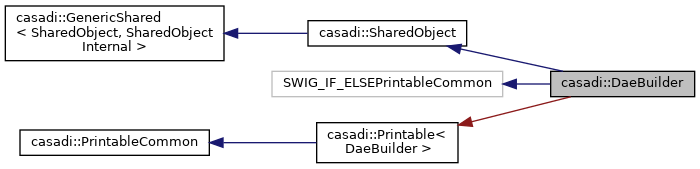
Public Types | |
| using | internal_base_type = SharedObjectInternal |
| using | base_type = SharedObject |
Public Member Functions | |
| std::string | type_name () const |
| Readable name of the class. More... | |
| DaeBuilder () | |
| Default constructor: a null instance, not usable until assigned. More... | |
| DaeBuilder (const std::string &name, const std::string &path="", const Dict &opts=Dict()) | |
| Construct a DaeBuilder instance. More... | |
| const std::string & | name () const |
| Name of instance. More... | |
| void | reorder (const std::string &cat, const std::vector< std::string > &v) |
| Reorder variables in a category. More... | |
| void | set_all (const std::string &v, const std::vector< std::string > &name) |
| Set all variables within a a category. More... | |
| Function | create (const std::string &fname, const Dict &opts=Dict()) const |
| Create a function with standard integrator DAE signature. More... | |
| Function | create () const |
| Create a function with standard integrator DAE signature, default naming. More... | |
| Function | dependent_fun (const std::string &fname, const std::vector< std::string > &s_in, const std::vector< std::string > &s_out) const |
| Construct a function for evaluating dependent parameters. More... | |
| Function | transition (const std::string &fname, casadi_int index) const |
| Construct a function describing transition at a specific events. More... | |
| Function | transition (const std::string &fname) const |
| Construct a function describing transition at any events. More... | |
| Function | transition () const |
| Construct an event transition function, default naming. More... | |
| std::vector< std::string > | der () const |
| Model structure: All time derivatives. More... | |
| std::vector< std::string > | der (const std::vector< std::string > &name) const |
| Get the time derivative of model variables. More... | |
| std::vector< std::string > | pre (const std::vector< std::string > &name) const |
| Get the pre-variables of model variables. More... | |
| MX | pre (const MX &v) const |
| Get the pre-expression given variable expression. More... | |
| bool | has_beq (const std::string &name) const |
| Does a variable have a binding equation? More... | |
| MX | beq (const std::string &name) const |
| Get the binding equation for a variable. More... | |
| std::string | causality (const std::string &name) const |
| Get the causality. More... | |
| std::vector< std::string > | categories (const std::string &name) const |
| Which categories are possible for a variable? More... | |
| void | set_causality (const std::string &name, const std::string &val) |
| Set the causality, if permitted. More... | |
| std::string | variability (const std::string &name) const |
| Get the variability. More... | |
| void | set_variability (const std::string &name, const std::string &val) |
| Set the variability, if permitted. More... | |
| std::string | category (const std::string &name) const |
| Get the variable category. More... | |
| void | set_category (const std::string &name, const std::string &val) |
| Set the variable category, if permitted. More... | |
| casadi_int | numel (const std::string &name) const |
| Get the number of elements of a variable. More... | |
| std::vector< casadi_int > | dimension (const std::string &name) const |
| Get the dimensions of a variable. More... | |
| double | start_time () const |
| Get the start time. More... | |
| void | set_start_time (double val) |
| Set the start time of the default experiment. More... | |
| double | stop_time () const |
| Get the stop time of the default experiment, nan when unknown. More... | |
| void | set_stop_time (double val) |
| Set the stop time of the default experiment. More... | |
| double | tolerance () const |
| Get the tolerance of the default experiment, nan when unknown. More... | |
| void | set_tolerance (double val) |
| Set the tolerance of the default experiment. More... | |
| double | step_size () const |
| Get the step size of the default experiment, nan when unknown. More... | |
| void | set_step_size (double val) |
| Set the step size of the default experiment. More... | |
| std::string | der (const std::string &name) const |
| Get the time derivative of model variables, single variable. More... | |
| std::string | pre (const std::string &name) const |
| Get the pre-variables of model variables, single variable (not implemented) More... | |
| double | attribute (const std::string &a, const std::string &name) const |
| Get an attribute, single variable. More... | |
| void | set_attribute (const std::string &a, const std::string &name, double val) |
| Set an attribute, single variable (vector-valued variables get all elements set) More... | |
| double | min (const std::string &name) const |
| Get the lower bound, single variable. More... | |
| void | set_min (const std::string &name, double val) |
| Set the lower bound, single variable. More... | |
| double | max (const std::string &name) const |
Get the upper bound, single variable (inf by default) More... | |
| void | set_max (const std::string &name, double val) |
| Set the upper bound, single variable. More... | |
| double | nominal (const std::string &name) const |
| Get the nominal value, single variable (1 by default) More... | |
| void | set_nominal (const std::string &name, double val) |
| Set the nominal value, single variable. More... | |
| std::vector< double > | start (const std::string &name) const |
| Get the start attribute, single variable. More... | |
| void | set_start (const std::string &name, double val) |
| Set the start attribute, single variable (all elements for a vector-valued variable) More... | |
| void | set_start (const std::string &name, const std::vector< double > &val) |
Set the start attribute, vector argument (length numel, or 1 to broadcast) More... | |
| void | reset () |
| Clear all set values. More... | |
| void | set (const std::string &name, double val) |
| Set the current value, single value. More... | |
| void | set (const std::string &name, const std::string &val) |
Set the current value, single value (string), for variables of type "String" More... | |
| GenericType | get (const std::string &name) const |
| Evaluate the values for a set of variables at the initial time, single value. More... | |
| bool | symbolic () const |
| Symbolic DAE instance? More... | |
| std::vector< double > | attribute (const std::string &a, const std::vector< std::string > &name) const |
Get an attribute for several variables, concatenated ("start"/"value" per element) More... | |
| void | set_attribute (const std::string &a, const std::vector< std::string > &name, const std::vector< double > &val) |
| Set an attribute, one value per variable or one value per element. More... | |
| std::vector< double > | min (const std::vector< std::string > &name) const |
| Get the lower bound for several (scalar) variables. More... | |
| void | set_min (const std::vector< std::string > &name, const std::vector< double > &val) |
| Set the lower bound for several variables. More... | |
| std::vector< double > | max (const std::vector< std::string > &name) const |
| Get the upper bound for several (scalar) variables. More... | |
| void | set_max (const std::vector< std::string > &name, const std::vector< double > &val) |
| Set the upper bound for several variables. More... | |
| std::vector< double > | nominal (const std::vector< std::string > &name) const |
| Get the nominal value for several (scalar) variables. More... | |
| void | set_nominal (const std::vector< std::string > &name, const std::vector< double > &val) |
| Set the nominal value for several variables. More... | |
| std::vector< double > | start (const std::vector< std::string > &name) const |
| Get the start attribute for several variables, concatenated. More... | |
| void | set_start (const std::vector< std::string > &name, const std::vector< double > &val) |
| Set the start attribute for several variables. More... | |
| void | set (const std::vector< std::string > &name, const std::vector< double > &val) |
| Set the current value for several variables (one per variable or one per element) More... | |
| void | set (const std::vector< std::string > &name, const std::vector< std::string > &val) |
| Set the current value (string) for several string variables. More... | |
| std::vector< GenericType > | get (const std::vector< std::string > &name) const |
| Evaluate the values for a set of variables at the initial time, one entry per name. More... | |
| bool | has (const std::string &name) const |
| Check if a particular variable exists. More... | |
| std::vector< std::string > | all () const |
| Get a list of all variables. More... | |
| std::vector< std::string > | all (const std::string &cat) const |
| Get a list of all variables of a particular category. More... | |
| Function | oracle (bool sx=false, bool elim_w=false, bool lifted_calls=false) const |
| Get the (cached) oracle, SX or MX. More... | |
| Sparsity | jac_sparsity (const std::vector< std::string > &onames, const std::vector< std::string > &inames) const |
| Get Jacobian sparsity. More... | |
| const DaeBuilderInternal * | operator-> () const |
| Access a member function or object. More... | |
| DaeBuilderInternal * | operator-> () |
| Access a member function or object. More... | |
| std::string | class_name () const |
| Get class name. More... | |
| void | disp (std::ostream &stream, bool more=false) const |
| Print a description of the object. More... | |
| std::string | get_str (bool more=false) const |
| Get string representation. More... | |
| void | print_ptr (std::ostream &stream=casadi::uout()) const |
| void | own (SharedObjectInternal *node) |
| void | assign (SharedObjectInternal *node) |
| Assign the node to a node class pointer without reference counting. More... | |
| SharedObjectInternal * | get () const |
| Get a const pointer to the node. More... | |
| casadi_int | getCount () const |
| Get the reference count. More... | |
| void | swap (GenericShared &other) |
| Swap content with another instance. More... | |
| std::string | debug_repr () const |
| bool | is_null () const |
| Is a null pointer? More... | |
| casadi_int | __hash__ () const |
| Returns a number that is unique for a given Node. More... | |
| GenericWeakRef< SharedObject, SharedObjectInternal > * | weak () |
| Get a weak reference to the object. More... | |
Variables and equations | |
| const MX & | time () const |
| Expression for independent variable (usually time) More... | |
| std::vector< std::string > | t_new () const |
| Independent variable (usually time) More... | |
| std::vector< std::string > | x () const |
| Differential states. More... | |
| std::vector< std::string > | y () const |
| Outputs. More... | |
| std::vector< std::string > | z () const |
| Algebraic variables. More... | |
| std::vector< std::string > | q () const |
| Quadrature states. More... | |
| std::vector< MX > | inputs (const std::string &cat) const |
| Input expressions for a specific category. More... | |
| std::vector< MX > | outputs (const std::string &cat) const |
| Output expressions for a specific category. More... | |
| std::vector< MX > | ode () const |
| [DEPRECATED] Replaced with outputs("ode") More... | |
| std::vector< MX > | alg () const |
| [DEPRECATED] Replaced with outputs("alg") More... | |
| std::vector< MX > | quad () const |
| [DEPRECATED] Replaced with outputs("quad") More... | |
| std::vector< MX > | zero () const |
| [DEPRECATED] Replaced with outputs("zero") More... | |
| std::vector< MX > | ydef () const |
| [DEPRECATED] Replaced with outputs("y") More... | |
| void | set_y (const std::vector< std::string > &name) |
| [DEPRECATED] Replaced with set_all("y", name) More... | |
| std::vector< std::string > | u () const |
| Free controls. More... | |
| std::vector< std::string > | p () const |
| Parameters. More... | |
| std::vector< std::string > | c () const |
| Named constants. More... | |
| std::vector< MX > | cdef () const |
| Definitions of named constants. More... | |
| std::vector< std::string > | d () const |
| Dependent parameters. More... | |
| std::vector< MX > | ddef () const |
| Definitions of dependent parameters. More... | |
| std::vector< std::string > | w () const |
| Dependent variables. More... | |
| std::vector< MX > | wdef () const |
| Dependent variables and corresponding definitions. More... | |
| std::vector< MX > | init_lhs () const |
| Initial conditions, left-hand-side. More... | |
| std::vector< MX > | init_rhs () const |
| Initial conditions, right-hand-side. More... | |
| std::vector< std::string > | outputs () const |
| [DEPRECATED] Renamed "y" More... | |
| std::vector< std::string > | derivatives () const |
| [DEPRECATED] Renamed "der" More... | |
| std::vector< std::string > | initial_unknowns () const |
| Model structure: initial unknowns. More... | |
| bool | has_t () const |
| Is there a time variable? More... | |
| casadi_int | nx () const |
| Differential states. More... | |
| casadi_int | nz () const |
| Algebraic variables. More... | |
| casadi_int | nq () const |
| Quadrature states. More... | |
| casadi_int | nzero () const |
| Zero-crossing functions. More... | |
| casadi_int | ny () const |
| Output variables. More... | |
| casadi_int | nu () const |
| Free controls. More... | |
| casadi_int | np () const |
| Parameters. More... | |
| casadi_int | nc () const |
| Named constants. More... | |
| casadi_int | nd () const |
| Dependent parameters. More... | |
| casadi_int | nw () const |
| Dependent variables. More... | |
Symbolic modeling | |
Formulate a dynamic system model | |
| MX | add (const std::string &name, const std::string &causality, const std::string &variability, const Dict &opts=Dict()) |
| Add a new model variable. More... | |
| MX | add (const std::string &name, const std::string &causality, const Dict &opts=Dict()) |
| Add a new model variable, default variability. More... | |
| MX | add (const std::string &name, const Dict &opts=Dict()) |
| Add a new model variable, default variability and causality. More... | |
| void | add (const std::string &name, const std::string &causality, const std::string &variability, const MX &expr, const Dict &opts=Dict()) |
| Add a new model variable, symbolic expression already available. More... | |
| void | eq (const MX &lhs, const MX &rhs, const Dict &opts=Dict()) |
| Add a simple equation. More... | |
| void | when (const MX &cond, const std::vector< std::string > &eqs, const Dict &opts=Dict()) |
| Add when equations. More... | |
| std::string | assign (const std::string &name, const MX &val) |
| Assignment inside a when-equation or if-else equation. More... | |
| std::string | reinit (const std::string &name, const MX &val) |
| Reinitialize a state inside when-equations. More... | |
| void | set_init (const std::string &name, const MX &init_rhs) |
| Specify the initial equation for a variable. More... | |
| void | sanity_check () const |
| Check if dimensions match. More... | |
Manipulation | |
Reformulate the dynamic optimization problem. | |
| void | eliminate (const std::string &cat) |
| Eliminate all dependent parameters. More... | |
| void | sort (const std::string &cat) |
| Sort dependent parameters. More... | |
| void | lift (bool lift_shared=true, bool lift_calls=true) |
| Lift problem formulation by extracting shared subexpressions. More... | |
| void | prune (bool prune_p=true, bool prune_u=true) |
| Prune unused controls. More... | |
| void | tear () |
| Identify iteration variables and residual equations using naming convention. More... | |
Functions | |
Add or load auxiliary functions | |
| Function | add_fun (const std::string &name, const std::vector< std::string > &arg, const std::vector< std::string > &res, const Dict &opts=Dict()) |
| Add a function from loaded expressions. More... | |
| Function | add_fun (const Function &f) |
| Add an already existing function. More... | |
| Function | add_fun (const std::string &name, const Importer &compiler, const Dict &opts=Dict()) |
| Add an external function. More... | |
| bool | has_fun (const std::string &name) const |
| Does a particular function already exist? More... | |
| Function | fun (const std::string &name) const |
| Get function by name. More... | |
| std::vector< Function > | fun () const |
| Get all functions. More... | |
| void | gather_fun (casadi_int max_depth=-1) |
| Collect embedded functions from the expression graph. More... | |
Import and export | |
| void | parse_fmi (const std::string &filename) |
| bool | provides_directional_derivatives () const |
| Does the FMU provide support for analytic derivatives. More... | |
| bool | provides_directional_derivative () const |
| Does the FMU provide support for analytic derivatives (FMI 2 naming) More... | |
| void | load_fmi_description (const std::string &filename) |
| Import problem description from FMI or XML. More... | |
| Dict | export_fmu (const Dict &opts=Dict()) |
| Export instance into an FMU. More... | |
| Dict | compile_fmu (const Dict &files, const Dict &opts=Dict()) |
| Compile the sources produced by export_fmu. More... | |
| std::string | pack_fmu (const Dict &files, const Dict &opts=Dict()) |
| Pack files from export_fmu / compile_fmu into a single .fmu archive. More... | |
| void | add_lc (const std::string &name, const std::vector< std::string > &f_out) |
| Add a named linear combination of output expressions. More... | |
| Function | create (const std::string &fname, const std::vector< std::string > &name_in, const std::vector< std::string > &name_out, bool sx, bool lifted_calls=false) const |
| Construct a function object, legacy syntax. More... | |
| Function | create (const std::string &name, const std::vector< std::string > &name_in, const std::vector< std::string > &name_out, const Dict &opts=Dict()) const |
| Construct a function object, names provided. More... | |
| MX | var (const std::string &name) const |
| Get variable expression by name. More... | |
| MX | operator() (const std::string &name) const |
| Get variable expression by name. More... | |
| MX | der (const MX &v) const |
| Differentiate an expression with respect to time. More... | |
| MX | der (const MX &v) |
| Differentiate an expression with respect to time. More... | |
| casadi_int | value_reference (const std::string &name) const |
| Get/set value reference. More... | |
| void | set_value_reference (const std::string &name, casadi_int val) |
| Get/set value reference. More... | |
| std::string | description (const std::string &name) const |
| Get/set description. More... | |
| void | set_description (const std::string &name, const std::string &val) |
| Get/set description. More... | |
| std::string | type (const std::string &name, casadi_int fmi_version=3) const |
| Get/set the type. More... | |
| void | set_type (const std::string &name, const std::string &val) |
| Get/set the type. More... | |
| std::string | initial (const std::string &name) const |
| Get/set the initial property. More... | |
| void | set_initial (const std::string &name, const std::string &val) |
| Get/set the initial property. More... | |
| std::string | unit (const std::string &name) const |
| Get/set the unit. More... | |
| void | set_unit (const std::string &name, const std::string &val) |
| Get/set the unit. More... | |
| std::string | display_unit (const std::string &name) const |
| Get/set the display unit. More... | |
| void | set_display_unit (const std::string &name, const std::string &val) |
| Get/set the display unit. More... | |
Static Public Member Functions | |
| static bool | test_cast (const SharedObjectInternal *ptr) |
| Check if a particular cast is allowed. More... | |
Protected Member Functions | |
| void | count_up () |
| void | count_down () |
|
inherited |
Definition at line 103 of file shared_object.hpp.
|
inherited |
Definition at line 102 of file shared_object.hpp.
| casadi::DaeBuilder::DaeBuilder | ( | ) |
Definition at line 51 of file dae_builder.cpp.
|
explicit |
Without path, the instance starts empty and the model is built symbolically with add and eq. With path, the model description is imported immediately:
modelDescription.xml (an unzipped FMU),.fmu archive (requires a build with WITH_GHC_FILESYSTEM=ON; it is unzipped to a temporary directory that is removed once nothing references it any more),.bmo Base Modelica file (requires the lacemodelica ModelicaParser plugin).An imported standard FMU is not symbolic (symbolic() is false): equations are evaluated by calling the FMU binary, so create is available but oracle, eq, eliminate etc. are not.
| name | Instance name; used as default function name prefix by create(), transition() and export_fmu |
| path | Model to import, see above; empty for a symbolic model |
| opts | Options (any other key is an error):
|
>>> dae = DaeBuilder("rocket")
>>> dae.name(), dae.symbolic(), dae.all()
('rocket', True, [])
>>> try:
...   DaeBuilder("m", "/nonexistent/path")
... except RuntimeError:
...   print("import failed")
import failed
>>> try:
...   DaeBuilder("m", "", dict(foo=True))
... except Exception as e:
...   print("No such option" in str(e))
True
>> dae = DaeBuilder('rocket');
>> dae.name(), isempty(dae.all())
rocket
1
>> try, DaeBuilder('m', '/nonexistent/path'); failed = false; catch e, failed = true; end
>> failed
1
>> try, DaeBuilder('m', '', struct('foo', true)); catch e, msg = e.message; end
>> contains(msg, 'No such option')
1
julia> dae = ca.DaeBuilder("rocket");
julia> ca.name(dae), ca.symbolic(dae), ca.all(dae)
("rocket", true, String[])
julia> try
           ca.DaeBuilder("m", "/nonexistent/path")
       catch e
           println("import failed")
       end
import failed
julia> try
           ca.DaeBuilder("m", "", Dict("foo" => true))
       catch e
           println(occursin("No such option", sprint(showerror, e)))
       end
true
Extra doc: https://github.com/casadi/casadi/wiki/L_2ko
Definition at line 54 of file dae_builder.cpp.
References load_fmi_description(), name(), casadi::GenericShared< SharedObject, SharedObjectInternal >::own(), and casadi::path().
|
inherited |
If the Object does not point to any node, "0" is returned.
Extra doc: https://github.com/casadi/casadi/wiki/L_av
Definition at line 123 of file generic_shared_impl.hpp.
The causality defaults to "local"; the variability follows from the type as above, so a plain add(name) gives a continuous local variable of category z.
Extra doc: https://github.com/casadi/casadi/wiki/L_2kr
Definition at line 361 of file dae_builder.cpp.
References name().
| MX casadi::DaeBuilder::add | ( | const std::string & | name, |
| const std::string & | causality, | ||
| const Dict & | opts = Dict() |
||
| ) |
The variability follows the FMI 3.0 default: "fixed" for parameters and calculated parameters, "continuous" for floating-point variables and "discrete" for any other type (see the "type" option).
Extra doc: https://github.com/casadi/casadi/wiki/L_2kq
Definition at line 352 of file dae_builder.cpp.
References causality(), and name().
| MX casadi::DaeBuilder::add | ( | const std::string & | name, |
| const std::string & | causality, | ||
| const std::string & | variability, | ||
| const Dict & | opts = Dict() |
||
| ) |
Creates a variable with FMI 3.0 causality and variability and returns its symbolic expression, a dense column vector with numel elements (the product of the dimensions). The category follows from causality and variability and may change later when equations are added:
"parameter": "tunable" gives p (c for non-floating-point types), "fixed" gives c; other variabilities are an error"calculatedParameter": d; requires "fixed" or "tunable""input": u; requires "continuous" or "discrete""output" and "local": "constant" gives c, "discrete" gives a state x with zero derivative, "continuous" gives z until an equation defines the variable (w) or its derivative (x); "local" also accepts "fixed" and "tunable" (d)"independent": t; requires "continuous", at most one per modelVariables with causality "output" are additionally listed in y(). Unless the first variable is the independent one, a hidden variable "time" is created first.
| name | Unique variable name; reusing a name is an error |
| causality | "parameter", "calculatedParameter", "input", "output", "local" or "independent" |
| variability | "constant", "fixed", "tunable", "discrete" or "continuous" |
| opts | Attributes (any other key is an error):
|
>>> dae = DaeBuilder("m")
>>> x = dae.add("x")
>>> x, x.shape, dae.category("x"), dae.causality("x"), dae.variability("x")
(MX(x), (1, 1), 'z', 'local', 'continuous')
>>> p = dae.add("p", "parameter", "tunable")
>>> dae.category("p"), dae.variability("p")
('p', 'tunable')
>>> b = dae.add("b", "input", dict(type="Boolean", start=False))
>>> dae.category("b"), dae.variability("b"), dae.type("b")
('u', 'discrete', 'Boolean')
>>> r = dae.add("r", dict(dimension=[3], start=[1, 2, 3], min=0, unit="m"))
>>> r.shape, dae.start("r"), dae.min("r"), dae.unit("r")
((3, 1), [1.0, 2.0, 3.0], 0.0, 'm')
>>> try:
...   dae.add("x")
... except Exception as e:
...   print("already exists" in str(e))
True
>>> try:
...   dae.add("q", "parameter", "continuous")
... except Exception as e:
...   print("requires 'fixed' or 'tunable'" in str(e))
True
>> dae = DaeBuilder('m'); x = dae.add('x');
>> x, size(x), dae.category('x'), dae.causality('x')
x
1 1
z
local
>> dae.variability('x')
continuous
>> p = dae.add('p', 'parameter', 'tunable');
>> dae.category('p'), dae.variability('p')
p
tunable
>> b = dae.add('b', 'input', struct('type', 'Boolean', 'start', false));
>> dae.category('b'), dae.variability('b'), dae.type('b')
u
discrete
Boolean
>> r = dae.add('r', struct('dimension', 3, 'start', [1 2 3], 'min', 0, 'unit', 'm'));
>> size(r), dae.start('r'), dae.unit('r')
3 1
1 2 3
m
>> try, dae.add('x'); catch e, disp(contains(e.message, 'already exists')); end
1
>> try, dae.add('q', 'parameter', 'continuous'); catch e, msg = e.message; end
>> contains(msg, 'requires ''fixed'' or ''tunable''')
1
julia> dae = ca.DaeBuilder("m");
julia> x = ca.add(dae, "x");
julia> x, size(x), ca.category(dae, "x"), ca.causality(dae, "x"), ca.variability(dae, "x")
(x, (1, 1), "z", "local", "continuous")
julia> p = ca.add(dae, "p", "parameter", "tunable");
julia> ca.category(dae, "p"), ca.variability(dae, "p")
("p", "tunable")
julia> b = ca.add(dae, "b", "input", Dict("type" => "Boolean", "start" => false));
julia> ca.category(dae, "b"), ca.variability(dae, "b"), ca.type(dae, "b")
("u", "discrete", "Boolean")
julia> opts = Dict("dimension" => [3], "start" => [1, 2, 3], "min" => 0, "unit" => "m");
julia> r = ca.add(dae, "r", opts);
julia> size(r), ca.start(dae, "r"), dae.min("r"), ca.unit(dae, "r")
((3, 1), [1.0, 2.0, 3.0], 0.0, "m")
julia> try
           ca.add(dae, "x")
       catch e
           println(occursin("already exists", sprint(showerror, e)))
       end
true
julia> try
           ca.add(dae, "q", "parameter", "continuous")
       catch e
           println(occursin("requires 'fixed' or 'tunable'", sprint(showerror, e)))
       end
true
Extra doc: https://github.com/casadi/casadi/wiki/L_2kp
Definition at line 341 of file dae_builder.cpp.
References causality(), name(), and variability().
| void casadi::DaeBuilder::add | ( | const std::string & | name, |
| const std::string & | causality, | ||
| const std::string & | variability, | ||
| const MX & | expr, | ||
| const Dict & | opts = Dict() |
||
| ) |
Registers an existing symbolic primitive instead of creating a new one. expr must be a pure symbol (is_symbolic()) whose name equals name; anything else is an error. The dimension attribute is not taken from the expression.
Extra doc: https://github.com/casadi/casadi/wiki/L_2ks
Definition at line 370 of file dae_builder.cpp.
References causality(), casadi::MX::is_symbolic(), name(), casadi::MX::name(), and variability().
Stores f under its own name; a stored function with the same name is an error.
>>> a = MX.sym("a")
>>> F = Function("F", [a], [a**2])
>>> dae = DaeBuilder("m")
>>> dae.add_fun(F)
Function(F:(i0)->(o0) MXFunction)
>>> [g.name() for g in dae.fun()]
['F']
>> a = MX.sym('a'); F = Function('F', {a}, {a^2});
>> dae = DaeBuilder('m');
>> dae.add_fun(F)
F:(i0)->(o0) MXFunction
>> cellfun(@(g) disp(g.name()), dae.fun())
F
julia> a = ca.MX.sym("a");
julia> F = ca.Function("F", [a], [a^2]);
julia> dae = ca.DaeBuilder("m");
julia> ca.add_fun(dae, F)
Function(F:(i0)->(o0) MXFunction)
julia> [ca.name(g) for g in ca.fun(dae)]
1-element Vector{String}:
 "F"
Extra doc: https://github.com/casadi/casadi/wiki/L_2l7
Definition at line 795 of file dae_builder.cpp.
| Function casadi::DaeBuilder::add_fun | ( | const std::string & | name, |
| const Importer & | compiler, | ||
| const Dict & | opts = Dict() |
||
| ) |
Loads the function name from the compiled sources or shared library behind compiler (see external) and stores it.
Extra doc: https://github.com/casadi/casadi/wiki/L_2l8
Definition at line 814 of file dae_builder.cpp.
References add_fun(), casadi::external(), has_fun(), and name().
| Function casadi::DaeBuilder::add_fun | ( | const std::string & | name, |
| const std::vector< std::string > & | arg, | ||
| const std::vector< std::string > & | res, | ||
| const Dict & | opts = Dict() |
||
| ) |
Creates a Function mapping the model variables arg to the binding expressions of the dependent variables res and stores it in the instance. Stored functions are listed by disp and retrieved with fun.
| name | Function name; must not exist yet |
| arg | Names of model variables used as inputs |
| res | Names of dependent variables w, whose definitions become the outputs; any other name is an error |
| opts | Function options |
>>> dae = DaeBuilder("m")
>>> x = dae.add("x")
>>> w = dae.add("w")
>>> dae.eq(w, sin(x))
>>> dae.eq(dae.der(x), -w)
>>> f = dae.add_fun("wfun", ["x"], ["w"])
>>> f
Function(wfun:(x)->(w) MXFunction)
>>> dae.has_fun("wfun"), dae.has_fun("nope")
(True, False)
>>> try:
...   dae.add_fun("bad", ["x"], ["x"])
... except Exception as e:
...   print("Cannot find dependent" in str(e))
True
>> dae = DaeBuilder('m'); x = dae.add('x'); w = dae.add('w');
>> dae.eq(w, sin(x)); dae.eq(dae.der(x), -w);
>> f = dae.add_fun('wfun', {'x'}, {'w'}); disp(f)
wfun:(x)->(w) MXFunction
>> dae.has_fun('wfun'), dae.has_fun('nope')
1
0
>> try, dae.add_fun('bad', {'x'}, {'x'}); catch e, msg = e.message; end
>> contains(msg, 'Cannot find dependent')
1
julia> dae = ca.DaeBuilder("m");
julia> x = ca.add(dae, "x");
julia> w = ca.add(dae, "w");
julia> ca.eq(dae, w, sin(x))
julia> f = ca.add_fun(dae, "wfun", ["x"], ["w"])
Function(wfun:(x)->(w) MXFunction)
julia> ca.has_fun(dae, "wfun"), ca.has_fun(dae, "nope")
(true, false)
julia> try
           ca.add_fun(dae, "bad", ["x"], ["x"])
       catch e
           println(occursin("Cannot find dependent", sprint(showerror, e)))
       end
true
Extra doc: https://github.com/casadi/casadi/wiki/L_2l6
Definition at line 804 of file dae_builder.cpp.
References name().
Referenced by add_fun(), and gather_fun().
| void casadi::DaeBuilder::add_lc | ( | const std::string & | name, |
| const std::vector< std::string > & | f_out | ||
| ) |
Declares the name of a linear combination of output categories, so that create can produce its Hessian blocks hess_<name>_<in1>_<in2> with the multipliers lam_<out> as extra inputs.
| name | Alphanumeric name |
| f_out | Output categories in the combination, e.g. ["ode", "alg"]; must be non-empty without duplicates |
>>> dae = DaeBuilder("m")
>>> x = dae.add("x")
>>> z = dae.add("z")
>>> dae.eq(dae.der(x), -x*z)
>>> dae.eq(0, z - x**2)
>>> dae.add_lc("gamma", ["ode", "alg"])
>>> H = dae.create("H", ["x", "z", "lam_ode", "lam_alg"],
...                ["hess_gamma_x_x", "hess_gamma_x_z"])
>>> H
Function(H:(x,z,lam_ode,lam_alg)->(hess_gamma_x_x,hess_gamma_x_z) MXFunction)
>>> H(1, 2, 1, 1)
(DM(2), DM(-1))
>> dae = DaeBuilder('m'); x = dae.add('x'); z = dae.add('z');
>> dae.eq(dae.der(x), -x*z); dae.eq(0, z - x^2);
>> dae.add_lc('gamma', {'ode', 'alg'});
>> out = {'hess_gamma_x_x', 'hess_gamma_x_z'};
>> H = dae.create('H', {'x', 'z', 'lam_ode', 'lam_alg'}, out); disp(H)
H:(x,z,lam_ode,lam_alg)->(hess_gamma_x_x,hess_gamma_x_z) MXFunction
>> [Hxx, Hxz] = H(1, 2, 1, 1); disp(Hxx), disp(Hxz)
2
-1
julia> dae = ca.DaeBuilder("m");
julia> x = ca.add(dae, "x");
julia> z = ca.add(dae, "z");
julia> ca.eq(dae, ca.der(dae, x), -x*z)
julia> ca.eq(dae, 0, z - x^2)
julia> ca.add_lc(dae, "gamma", ["ode", "alg"])
julia> H = ca.create(dae, "H", ["x", "z", "lam_ode", "lam_alg"],
                     ["hess_gamma_x_x", "hess_gamma_x_z"])
Function(H:(x,z,lam_ode,lam_alg)->(hess_gamma_x_x,hess_gamma_x_z) MXFunction)
julia> H(1, 2, 1, 1)
(2, -1)
Extra doc: https://github.com/casadi/casadi/wiki/L_2lf
Definition at line 755 of file dae_builder.cpp.
References name().
|
inline |
Definition at line 695 of file dae_builder.hpp.
| std::vector< std::string > casadi::DaeBuilder::all | ( | ) | const |
Names of all variables in creation order, including the hidden "time" variable and the internal helper variables created by eq, when, assign and reinit.
>>> dae = DaeBuilder("m")
>>> x = dae.add("x")
>>> dae.eq(dae.der(x), -x)
>>> dae.all()
['time', 'x', 'der(x)', '__assign__der(x)__']
>>> dae.all("x"), dae.all("w"), dae.all("calculated")
(['x'], ['der(x)'], ['__assign__der(x)__'])
>> dae = DaeBuilder('m'); x = dae.add('x'); dae.eq(dae.der(x), -x);
>> dae.all()
time
x
der(x)
__assign__der(x)__
>> dae.all('x'), dae.all('w'), dae.all('calculated')
x
der(x)
__assign__der(x)__
julia> dae = ca.DaeBuilder("m");
julia> x = ca.add(dae, "x");
julia> ca.eq(dae, ca.der(dae, x), -x)
julia> ca.all(dae)
4-element Vector{String}:
 "time"
 "x"
 "der(x)"
 "__assign__der(x)__"
julia> ca.all(dae, "x"), ca.all(dae, "w"), ca.all(dae, "calculated")
(["x"], ["der(x)"], ["__assign__der(x)__"])
Extra doc: https://github.com/casadi/casadi/wiki/L_2mf
Definition at line 263 of file dae_builder.cpp.
Referenced by set_all().
| std::vector< std::string > casadi::DaeBuilder::all | ( | const std::string & | cat | ) | const |
Names of the members of a category in category order; empty for an empty category, an unknown category name is an error. x(), z(), u() etc. are shorthands.
Extra doc: https://github.com/casadi/casadi/wiki/L_2mg
Definition at line 272 of file dae_builder.cpp.
| std::string casadi::DaeBuilder::assign | ( | const std::string & | name, |
| const MX & | val | ||
| ) |
Creates a helper variable holding the expression val assigned to the variable name when the event fires, and returns the helper's name for use in when. Intended for discrete-valued variables; reinit is the counterpart for continuous states.
| name | Model variable that receives the value |
| val | Expression in model variables |
__assign__b__
>>> dae = DaeBuilder("m")
>>> x = dae.add("x", dict(start=0))
>>> b = dae.add("b", dict(type="Boolean", start=False))
>>> dae.eq(dae.der(x), 1)
>>> dae.assign("b", True)
'__assign__b__'
>>> dae.when(x > 1, [dae.assign("b", True)])
>>> dae.disp(True)
nt = 0, nx = 2, nz = 0, nq = 0, ny = 0, np = 0, nc = 0, nd = 0, nw = 1, nu = 0
Model variables:
  x = [x, b]
  w = [der(x)]
List of dependent variables (w):
  der(x) := 1
Time derivatives of differential states (x):
  x: der(x)
  b: 0
When equations:
  when (1-x) < 0 :
    b := 1
>> dae = DaeBuilder('m'); x = dae.add('x', struct('start', 0));
>> b = dae.add('b', struct('type', 'Boolean', 'start', false));
>> dae.eq(dae.der(x), 1);
>> dae.assign('b', true)
__assign__b__
>> dae.when(x > 1, {dae.assign('b', true)});
>> dae.disp(true)
nt = 0, nx = 2, nz = 0, nq = 0, ny = 0, np = 0, nc = 0, nd = 0, nw = 1, nu = 0
Model variables:
  x = [x, b]
  w = [der(x)]
List of dependent variables (w):
  der(x) := 1
Time derivatives of differential states (x):
  x: der(x)
  b: 0
When equations:
  when (1-x) < 0 :
    b := 1
julia> dae = ca.DaeBuilder("m");
julia> x = ca.add(dae, "x", Dict("start" => 0));
julia> b = ca.add(dae, "b", Dict("type" => "Boolean", "start" => false));
julia> ca.eq(dae, ca.der(dae, x), 1)
julia> ca.assign(dae, "b", true)
"__assign__b__"
julia> ca.when(dae, x > 1, [ca.assign(dae, "b", true)])
julia> ca.disp(dae, true)
nt = 0, nx = 2, nz = 0, nq = 0, ny = 0, np = 0, nc = 0, nd = 0, nw = 1, nu = 0
Model variables:
  x = [x, b]
  w = [der(x)]
List of dependent variables (w):
  der(x) := 1
Time derivatives of differential states (x):
  x: der(x)
  b: 0
When equations:
  when (1-x) < 0 :
    b := 1
Extra doc: https://github.com/casadi/casadi/wiki/L_2kv
Definition at line 401 of file dae_builder.cpp.
References name().
|
inherited |
improper use will cause memory leaks!
Extra doc: https://github.com/casadi/casadi/wiki/L_at
Definition at line 96 of file generic_shared_impl.hpp.
| double casadi::DaeBuilder::attribute | ( | const std::string & | a, |
| const std::string & | name | ||
| ) | const |
Numerical attribute of a scalar variable, selected by name: "min", "max", "nominal", "start" or "value" (the current value, see get). Any other attribute name, or a non-scalar variable, is an error.
>>> dae = DaeBuilder("m")
>>> x = dae.add("x", dict(start=1, min=-2, nominal=10))
>>> v = dae.add("v", dict(dimension=[2], start=[1, 2]))
>>> dae.attribute("start", "x"), dae.attribute("min", "x")
(1.0, -2.0)
>>> dae.attribute("start", ["x", "v"]), dae.attribute("nominal", ["x"])
([1.0, 1.0, 2.0], [10.0])
>>> dae.set_attribute("min", "x", -1)
>>> dae.set_attribute("start", ["x", "v"], [9, 8, 7])
>>> dae.min("x"), dae.start("v")
(-1.0, [8.0, 7.0])
>>> try:
...   dae.attribute("unit", "x")
... except Exception as e:
...   print("No such enum" in str(e))
True
>> dae = DaeBuilder('m'); x = dae.add('x', struct('start', 1, 'min', -2, 'nominal', 10));
>> v = dae.add('v', struct('dimension', 2, 'start', [1 2]));
>> dae.attribute('start', 'x'), dae.attribute('min', 'x')
1
-2
>> dae.attribute('start', {'x', 'v'}), dae.attribute('nominal', {'x'})
1 1 2
10
>> dae.set_attribute('min', 'x', -1); dae.set_attribute('start', {'x', 'v'}, [9 8 7]);
>> dae.min('x'), dae.start('v')
-1
8 7
>> try, dae.attribute('unit', 'x'); catch e, disp(contains(e.message, 'No such enum')); end
1
julia> dae = ca.DaeBuilder("m");
julia> x = ca.add(dae, "x", Dict("start" => 1, "min" => -2, "nominal" => 10));
julia> v = ca.add(dae, "v", Dict("dimension" => [2], "start" => [1, 2]));
julia> ca.attribute(dae, "start", "x"), ca.attribute(dae, "min", "x")
(1.0, -2.0)
julia> ca.attribute(dae, "start", ["x", "v"]), ca.attribute(dae, "nominal", ["x"])
([1.0, 1.0, 2.0], [10.0])
julia> ca.set_attribute(dae, "min", "x", -1)
julia> ca.set_attribute(dae, "start", ["x", "v"], [9, 8, 7])
julia> dae.min("x"), ca.start(dae, "v")
(-1.0, [8.0, 7.0])
julia> try
           ca.attribute(dae, "unit", "x")
       catch e
           println(occursin("No such enum", sprint(showerror, e)))
       end
true
Extra doc: https://github.com/casadi/casadi/wiki/L_2m6
Definition at line 930 of file dae_builder.cpp.
References name().
| std::vector< double > casadi::DaeBuilder::attribute | ( | const std::string & | a, |
| const std::vector< std::string > & | name | ||
| ) | const |
| MX casadi::DaeBuilder::beq | ( | const std::string & | name | ) | const |
The right-hand side of the explicit equation defining the variable; a variable without binding equation is an error.
>>> dae = DaeBuilder("m")
>>> x = dae.add("x")
>>> w = dae.add("w")
>>> dae.eq(w, sin(x))
>>> dae.eq(dae.der(x), -w)
>>> dae.beq("w"), dae.beq("der(x)")
(MX(sin(x)), MX((-w)))
>> dae = DaeBuilder('m'); x = dae.add('x'); w = dae.add('w');
>> dae.eq(w, sin(x)); dae.eq(dae.der(x), -w);
>> dae.beq('w'), dae.beq('der(x)')
sin(x)
(-w)
julia> dae = ca.DaeBuilder("m");
julia> x = ca.add(dae, "x");
julia> w = ca.add(dae, "w");
julia> ca.eq(dae, w, sin(x))
julia> ca.beq(dae, "w")
MX(sin(x))
Extra doc: https://github.com/casadi/casadi/wiki/L_2lr
Definition at line 520 of file dae_builder.cpp.
References casadi::Variable::bind, name(), and casadi::Variable::v.
|
inline |
Names of the variables of category c (fixed parameters and constants), in category order. Equivalent to all("c"). Constants are never function inputs: create substitutes their current value, see set.
Extra doc: https://github.com/casadi/casadi/wiki/L_5p
Definition at line 772 of file dae_builder.hpp.
References casadi::all().
| std::vector< std::string > casadi::DaeBuilder::categories | ( | const std::string & | name | ) | const |
The categories set_category accepts for the variable given its current category and usage; an empty string stands for "no category". Controls, parameters and constants can be exchanged freely; states not used in any right-hand side can become quadrature states or lose their category.
>>> dae = DaeBuilder("m")
>>> u = dae.add("u", "input")
>>> x = dae.add("x")
>>> q = dae.add("q")
>>> dae.eq(dae.der(x), -x)
>>> dae.eq(dae.der(q), x**2)
>>> dae.categories("u"), dae.categories("x"), dae.categories("q")
(['p', 'u', 'c'], ['x'], ['x', 'q', ''])
>> dae = DaeBuilder('m'); u = dae.add('u', 'input'); x = dae.add('x'); q = dae.add('q');
>> dae.eq(dae.der(x), -x); dae.eq(dae.der(q), x^2);
>> dae.categories('u'), dae.categories('x')
p
u
c
x
>> strjoin(cellstr(dae.categories('q')), ',')
x,q,
julia> dae = ca.DaeBuilder("m");
julia> u = ca.add(dae, "u", "input");
julia> x = ca.add(dae, "x");
julia> q = ca.add(dae, "q");
julia> ca.eq(dae, ca.der(dae, x), -x)
julia> ca.eq(dae, ca.der(dae, q), x^2)
julia> ca.categories(dae, "u"), ca.categories(dae, "x"), ca.categories(dae, "q")
(["p", "u", "c"], ["x"], ["x", "q", ""])
Extra doc: https://github.com/casadi/casadi/wiki/L_2lw
Definition at line 599 of file dae_builder.cpp.
References name(), and casadi::to_string().
| std::string casadi::DaeBuilder::category | ( | const std::string & | name | ) | const |
One of "t", "c", "p", "d", "w", "u", "x", "z", "q", "calculated" (internal helper variables), or an empty string for no category.
Extra doc: https://github.com/casadi/casadi/wiki/L_2ly
Definition at line 637 of file dae_builder.cpp.
References name(), and casadi::to_string().
| std::string casadi::DaeBuilder::causality | ( | const std::string & | name | ) | const |
One of "parameter", "calculatedParameter", "input", "output", "local", "independent".
>>> dae = DaeBuilder("m")
>>> t = dae.add("t", "independent")
>>> u = dae.add("u", "input")
>>> x = dae.add("x")
>>> dae.causality("t"), dae.causality("u"), dae.causality("x")
('independent', 'input', 'local')
>> dae = DaeBuilder('m'); t = dae.add('t', 'independent'); u = dae.add('u', 'input');
>> x = dae.add('x');
>> dae.causality('t'), dae.causality('u'), dae.causality('x')
independent
input
local
julia> dae = ca.DaeBuilder("m");
julia> t = ca.add(dae, "t", "independent");
julia> u = ca.add(dae, "u", "input");
julia> x = ca.add(dae, "x");
julia> ca.causality(dae, "t"), ca.causality(dae, "u"), ca.causality(dae, "x")
("independent", "input", "local")
Extra doc: https://github.com/casadi/casadi/wiki/L_2lv
Definition at line 590 of file dae_builder.cpp.
References name(), and casadi::to_string().
Referenced by add().
| std::vector< MX > casadi::DaeBuilder::cdef | ( | ) | const |
The binding expressions of the constants c, one per entry of c(). Only constants that have a binding equation (imported from a symbolic model description) are supported; a constant without one raises an error.
Extra doc: https://github.com/casadi/casadi/wiki/L_5q
Definition at line 91 of file dae_builder.cpp.
|
inherited |
Extra doc: https://github.com/casadi/casadi/wiki/L_au
Definition at line 31 of file shared_object.cpp.
Referenced by casadi::FmuFunction::check_mem_count(), casadi::MXFunction::export_code_body(), and casadi::BlazingSplineFunction::merge().
Compiles all .c entries of files (through one amalgamation translation unit) into a shared library <name>.<ext> in the current directory using an Importer plugin, and returns the map extended with the binary at its FMI 3 archive location binaries/<platform>/. The FMI 3 headers must be on the include path.
| files | the {local_file -> archive path} map returned by export_fmu |
| opts | compile options: "compiler" (Importer plugin, default "shell"), "compiler_options" (options for that plugin), "include_dirs" (list of directories) |
Extra doc: https://github.com/casadi/casadi/wiki/L_2iq
Definition at line 220 of file dae_builder.cpp.
|
protectedinherited |
Definition at line 133 of file generic_shared_impl.hpp.
|
protectedinherited |
Definition at line 132 of file generic_shared_impl.hpp.
|
inline |
The function is named <name>_dae.
Extra doc: https://github.com/casadi/casadi/wiki/L_2c1
Definition at line 2787 of file dae_builder.hpp.
References create().
Shorthand for create(fname, ["t", "x", "z", "p", "u"], ["ode", "alg", "quad", "zero"], opts): a function that can be passed directly to integrator. Empty categories give empty inputs or outputs.
| name | Name assigned to the resulting function object |
| opts | Optional settings |
>>> dae = DaeBuilder("m")
>>> x = dae.add("x")
>>> u = dae.add("u", "input")
>>> dae.eq(dae.der(x), -x + u)
>>> f = dae.create("mydae")
>>> f
Function(mydae:(t[0],x,z[0],p[0],u)->(ode,alg[0],quad[0],zero[0]) MXFunction)
>>> f(0, 1, [], [], 3)
(DM(2), DM(0x1), DM(0x1), DM(0x1))
>> dae = DaeBuilder('m'); x = dae.add('x'); u = dae.add('u', 'input');
>> dae.eq(dae.der(x), -x + u);
>> f = dae.create('mydae'); disp(f)
mydae:(t[0],x,z[0],p[0],u)->(ode,alg[0],quad[0],zero[0]) MXFunction
>> [ode, alg, quad, zero] = f(0, 1, [], [], 3); disp(ode), disp(alg), disp(quad), disp(zero)
2
0x1
0x1
0x1
>> res = f('t', 0, 'x', 1, 'u', 3); disp(res.ode)
2
julia> dae = ca.DaeBuilder("m");
julia> x = ca.add(dae, "x");
julia> u = ca.add(dae, "u", "input");
julia> ca.eq(dae, ca.der(dae, x), -x + u)
julia> f = ca.create(dae, "mydae")
Function(mydae:(t[0],x,z[0],p[0],u)->(ode,alg[0],quad[0],zero[0]) MXFunction)
julia> f(0, 1, [], [], 3)
(2, 0x1, 0x1, 0x1)
julia> f(t=0, x=1, u=3)["ode"]
DM(2)
Extra doc: https://github.com/casadi/casadi/wiki/L_2c0
Definition at line 786 of file dae_builder.cpp.
References casadi::dyn_in(), casadi::dyn_out(), and name().
| Function casadi::DaeBuilder::create | ( | const std::string & | fname, |
| const std::vector< std::string > & | name_in, | ||
| const std::vector< std::string > & | name_out, | ||
| bool | sx, | ||
| bool | lifted_calls = false |
||
| ) | const |
Same as the overload with options, but with the flags sx (expand to an SX function) and lifted_calls (account for function calls lifted into w, see lift) instead; neither is available for an imported FMU.
Extra doc: https://github.com/casadi/casadi/wiki/L_2lg
Definition at line 764 of file dae_builder.cpp.
| Function casadi::DaeBuilder::create | ( | const std::string & | name, |
| const std::vector< std::string > & | name_in, | ||
| const std::vector< std::string > & | name_out, | ||
| const Dict & | opts = Dict() |
||
| ) | const |
The function factory: builds a Function whose inputs are variable categories and whose outputs are equation categories or derivatives of them. Inputs are any of t, p, d, u, x, z, q, w; constants c are never inputs, their current values (see set) are substituted. Outputs are ode, alg, quad, zero, ddef, wdef, y. Dependent variables w and parameters d not given as inputs are substituted out. Derivative outputs use the Function factory naming with underscores: jac_ode_x (Jacobian block) or hess_<lc>_x_x for a linear combination declared with add_lc, with the multipliers lam_ode, lam_alg, ... as inputs. The created function is a snapshot: later changes to the instance do not affect it. For an imported FMU the function evaluates the FMU binary.
| name | Name assigned to the resulting function object |
| name_in | Names of all the inputs |
| name_out | Names of all the outputs |
| opts | Optional settings: Function options for a symbolic model; for an FMU also "aux" (names of variables reported in stats() after evaluation), "enable_ad", "parallelization" and the other FmuFunction options |
>>> dae = DaeBuilder("m")
>>> x = dae.add("x")
>>> z = dae.add("z")
>>> u = dae.add("u", "input")
>>> p = dae.add("p", "parameter", "tunable")
>>> c = dae.add("c", "parameter", "fixed", dict(start=3))
>>> w = dae.add("w")
>>> y = dae.add("y", "output")
>>> dae.eq(dae.der(x), -c*x + z*u)
>>> dae.eq(0, x - p*z**2)
>>> dae.eq(w, x + z)
>>> dae.eq(y, w**2)
>>> f = dae.create("f", ["x", "z", "u", "p"], ["ode", "alg", "y"])
>>> f
Function(f:(x,z,u,p)->(ode,alg,y) MXFunction)
>>> f(1, 2, 3, 4)
(DM(3), DM(15), DM(9))
>>> J = dae.create("J", ["x", "z", "u", "p"], ["jac_ode_x", "jac_alg_z"])
>>> J(1, 2, 3, 4)
(DM(-3), DM(16))
>>> dae.create("g", ["x", "z", "w"], ["ode", "wdef"])
Function(g:(x,z,w[3])->(ode,wdef[3]) MXFunction)
>>> dae.create("s", ["x", "z", "u", "p"], ["ode"], True)
Function(s:(x,z,u,p)->(ode) SXFunction)
>>> try:
...   dae.create("f", ["x", "z", "c"], ["ode"])
... except Exception as e:
...   print('Cannot process "c" as input' in str(e))
True
>>> try:
...   dae.create("f", ["x", "z"], ["w"])
... except Exception as e:
...   print('Cannot process "w" as output' in str(e))
True
>> dae = DaeBuilder('m'); x = dae.add('x'); z = dae.add('z'); u = dae.add('u', 'input');
>> p = dae.add('p', 'parameter', 'tunable');
>> c = dae.add('c', 'parameter', 'fixed', struct('start', 3));
>> w = dae.add('w'); y = dae.add('y', 'output');
>> dae.eq(dae.der(x), -c*x + z*u); dae.eq(0, x - p*z^2);
>> dae.eq(w, x + z); dae.eq(y, w^2);
>> f = dae.create('f', {'x', 'z', 'u', 'p'}, {'ode', 'alg', 'y'}); disp(f)
f:(x,z,u,p)->(ode,alg,y) MXFunction
>> [ode, alg, yval] = f(1, 2, 3, 4); disp(ode), disp(alg), disp(yval)
3
15
9
>> J = dae.create('J', {'x', 'z', 'u', 'p'}, {'jac_ode_x', 'jac_alg_z'});
>> [J_ode_x, J_alg_z] = J(1, 2, 3, 4); disp(J_ode_x), disp(J_alg_z)
-3
16
>> dae.create('g', {'x', 'z', 'w'}, {'ode', 'wdef'})
g:(x,z,w[3])->(ode,wdef[3]) MXFunction
>> dae.create('s', {'x', 'z', 'u', 'p'}, {'ode'}, true)
s:(x,z,u,p)->(ode) SXFunction
>> try, dae.create('f', {'x', 'z', 'c'}, {'ode'}); catch e, msg = e.message; end
>> contains(msg, 'Cannot process "c" as input')
1
>> try, dae.create('f', {'x', 'z'}, {'w'}); catch e, msg = e.message; end
>> contains(msg, 'Cannot process "w" as output')
1
julia> dae = ca.DaeBuilder("m");
julia> x = ca.add(dae, "x");
julia> z = ca.add(dae, "z");
julia> u = ca.add(dae, "u", "input");
julia> p = ca.add(dae, "p", "parameter", "tunable");
julia> c = ca.add(dae, "c", "parameter", "fixed", Dict("start" => 3));
julia> w = ca.add(dae, "w");
julia> y = ca.add(dae, "y", "output");
julia> ca.eq(dae, ca.der(dae, x), -c*x + z*u)
julia> ca.eq(dae, 0, x - p*z^2)
julia> ca.eq(dae, w, x + z)
julia> ca.eq(dae, y, w^2)
julia> f = ca.create(dae, "f", ["x", "z", "u", "p"], ["ode", "alg", "y"])
Function(f:(x,z,u,p)->(ode,alg,y) MXFunction)
julia> f(1, 2, 3, 4)
(3, 15, 9)
julia> J = ca.create(dae, "J", ["x", "z", "u", "p"], ["jac_ode_x", "jac_alg_z"]);
julia> J(1, 2, 3, 4)
(-3, 16)
julia> ca.create(dae, "g", ["x", "z", "w"], ["ode", "wdef"])
Function(g:(x,z,w[3])->(ode,wdef[3]) MXFunction)
julia> ca.create(dae, "s", ["x", "z", "u", "p"], ["ode"], true)
Function(s:(x,z,u,p)->(ode) SXFunction)
julia> try
           ca.create(dae, "f", ["x", "z", "c"], ["ode"])
       catch e
           println(occursin("Cannot process \"c\" as input", sprint(showerror, e)))
       end
true
julia> try
           ca.create(dae, "f", ["x", "z"], ["w"])
       catch e
           println(occursin("Cannot process \"w\" as output", sprint(showerror, e)))
       end
true
Extra doc: https://github.com/casadi/casadi/wiki/L_6e
Definition at line 775 of file dae_builder.cpp.
|
inline |
Names of the variables of category d (causality "calculatedParameter", or "local" with "fixed"/"tunable" variability), in category order. Equivalent to all("d"). They are defined by binding equations and are calculated by dependent_fun.
Extra doc: https://github.com/casadi/casadi/wiki/L_5r
Definition at line 795 of file dae_builder.hpp.
References casadi::all().
| std::vector< MX > casadi::DaeBuilder::ddef | ( | ) | const |
The binding expressions of the dependent parameters, one per entry of d(). Interdependencies are allowed but must be non-cyclic (see sort). Equivalent to outputs("ddef"). A dependent parameter without a binding equation raises an error.
Extra doc: https://github.com/casadi/casadi/wiki/L_5s
Definition at line 100 of file dae_builder.cpp.
References casadi::DDEF.
|
inherited |
Definition at line 112 of file generic_shared_impl.hpp.
| Function casadi::DaeBuilder::dependent_fun | ( | const std::string & | fname, |
| const std::vector< std::string > & | s_in, | ||
| const std::vector< std::string > & | s_out | ||
| ) | const |
Builds a Function that calculates the dependent parameters d and/or dependent variables w from their binding equations, substituting the interdependencies out, with the given categories as inputs.
| fname | Function name |
| s_in | Input categories; a category that is also an output is an error, and every variable the definitions depend on must be covered |
| s_out | "d", "w" or both; anything else is an error |
s_out
>>> dae = DaeBuilder("m")
>>> x = dae.add("x")
>>> w1 = dae.add("w1")
>>> w2 = dae.add("w2")
>>> p = dae.add("p", "parameter", "tunable")
>>> dae.eq(w1, 2*x)
>>> dae.eq(w2, w1**2 + p)
>>> dae.eq(dae.der(x), -w2)
>>> f = dae.dependent_fun("f", ["x", "p"], ["w"])
>>> f
Function(f:(x,p)->(w[3]) MXFunction)
>>> f(1, 3)
DM([2, 7, -7])
>>> try:
...   dae.dependent_fun("f", ["x", "w"], ["w"])
... except Exception as e:
...   print("cannot be both input and output" in str(e))
True
>> dae = DaeBuilder('m'); x = dae.add('x'); w1 = dae.add('w1'); w2 = dae.add('w2');
>> p = dae.add('p', 'parameter', 'tunable');
>> dae.eq(w1, 2*x); dae.eq(w2, w1^2 + p); dae.eq(dae.der(x), -w2);
>> f = dae.dependent_fun('f', {'x', 'p'}, {'w'}); disp(f)
f:(x,p)->(w[3]) MXFunction
>> f(1, 3)
[2, 7, -7]
>> try, dae.dependent_fun('f', {'x', 'w'}, {'w'}); catch e, msg = e.message; end
>> contains(msg, 'cannot be both input and output')
1
julia> dae = ca.DaeBuilder("m");
julia> x = ca.add(dae, "x");
julia> w1 = ca.add(dae, "w1");
julia> w2 = ca.add(dae, "w2");
julia> p = ca.add(dae, "p", "parameter", "tunable");
julia> ca.eq(dae, w1, 2*x)
julia> ca.eq(dae, w2, w1^2 + p)
julia> ca.eq(dae, ca.der(dae, x), -w2)
julia> f = ca.dependent_fun(dae, "f", ["x", "p"], ["w"])
Function(f:(x,p)->(w[3]) MXFunction)
julia> f(1, 3)
DM([2, 7, -7])
julia> try
           ca.dependent_fun(dae, "f", ["x", "w"], ["w"])
       catch e
           println(occursin("cannot be both input and output", sprint(showerror, e)))
       end
true
Extra doc: https://github.com/casadi/casadi/wiki/L_2lh
Definition at line 871 of file dae_builder.cpp.
| std::vector< std::string > casadi::DaeBuilder::der | ( | ) | const |
Names of all derivative variables, in creation order: the der(x) variables created by der for a symbolic model, or the variables marked as derivatives in an imported model structure.
>>> dae = DaeBuilder("m")
>>> x = dae.add("x")
>>> y = dae.add("y")
>>> dae.der()
[]
>>> dae.eq(dae.der(x), -y)
>>> dae.eq(dae.der(y), x)
>>> dae.der()
['der(x)', 'der(y)']
>> dae = DaeBuilder('m'); x = dae.add('x'); y = dae.add('y');
>> isempty(dae.der())
1
>> dae.eq(dae.der(x), -y); dae.eq(dae.der(y), x);
>> dae.der()
der(x)
der(y)
julia> dae = ca.DaeBuilder("m");
julia> x = ca.add(dae, "x");
julia> y = ca.add(dae, "y");
julia> ca.der(dae)
String[]
julia> ca.eq(dae, ca.der(dae, x), -y)
julia> ca.eq(dae, ca.der(dae, y), x)
julia> ca.der(dae)
2-element Vector{String}:
 "der(x)"
 "der(y)"
Extra doc: https://github.com/casadi/casadi/wiki/L_2fz
Definition at line 126 of file dae_builder.cpp.
Referenced by der().
For a model variable x the derivative variable der(x) is returned, created on first use (as an algebraic variable until eq gives it a defining equation). For a concatenation of variables the derivatives are concatenated; for a general expression the chain rule is applied through the derivatives of the variables it depends on. The derivative of the independent variable is 1 and that of parameters, constants, inputs and discrete variables is 0. The expression must be a column vector in model variables.
>>> dae = DaeBuilder("m")
>>> x = dae.add("x")
>>> y = dae.add("y")
>>> p = dae.add("p", "parameter", "tunable")
>>> dae.der(x)
MX(der(x))
>>> dae.der(vertcat(x, y))
MX(vertcat(der(x), der(y)))
>>> dae.der(x*y + p)
MX(((y*der(x))+(x*der(y))))
>>> dae.der(p)
MX(0)
>>> dae.z()
['x', 'y', 'der(x)', 'der(y)']
>>> try:
...   dae.der(vertcat(x, y).T)
... except Exception as e:
...   print("must be a vector" in str(e))
True
>>> try:
...   dae.der(MX.sym("foo"))
... except Exception as e:
...   print("No such variable" in str(e))
True
>> dae = DaeBuilder('m'); x = dae.add('x'); y = dae.add('y');
>> p = dae.add('p', 'parameter', 'tunable');
>> dae.der(x)
der(x)
>> dae.der([x; y])
vertcat(der(x), der(y))
>> dae.der(x*y + p)
((y*der(x))+(x*der(y)))
>> dae.der(p)
0
>> dae.z()
x
y
der(x)
der(y)
>> try, dae.der([x; y]'); catch e, disp(contains(e.message, 'must be a vector')); end
1
>> try, dae.der(MX.sym('foo')); catch e, disp(contains(e.message, 'No such variable')); end
1
julia> dae = ca.DaeBuilder("m");
julia> x = ca.add(dae, "x");
julia> y = ca.add(dae, "y");
julia> p = ca.add(dae, "p", "parameter", "tunable");
julia> ca.der(dae, x)
MX(der(x))
julia> ca.der(dae, [x; y])
MX(vertcat(der(x), der(y)))
julia> ca.der(dae, x*y + p)
MX(((y*der(x))+(x*der(y))))
julia> ca.der(dae, p)
MX(0)
julia> ca.z(dae)
4-element Vector{String}:
 "x"
 "y"
 "der(x)"
 "der(y)"
julia> try
           ca.der(dae, [x; y]')
       catch e
           println(occursin("must be a vector", sprint(showerror, e)))
       end
true
julia> try
           ca.der(dae, ca.MX.sym("foo"))
       catch e
           println(occursin("No such variable", sprint(showerror, e)))
       end
true
Extra doc: https://github.com/casadi/casadi/wiki/L_2ln
Definition at line 921 of file dae_builder.cpp.
For a model variable x the derivative variable der(x) is returned, created on first use (as an algebraic variable until eq gives it a defining equation). For a concatenation of variables the derivatives are concatenated; for a general expression the chain rule is applied through the derivatives of the variables it depends on. The derivative of the independent variable is 1 and that of parameters, constants, inputs and discrete variables is 0. The expression must be a column vector in model variables.
>>> dae = DaeBuilder("m")
>>> x = dae.add("x")
>>> y = dae.add("y")
>>> p = dae.add("p", "parameter", "tunable")
>>> dae.der(x)
MX(der(x))
>>> dae.der(vertcat(x, y))
MX(vertcat(der(x), der(y)))
>>> dae.der(x*y + p)
MX(((y*der(x))+(x*der(y))))
>>> dae.der(p)
MX(0)
>>> dae.z()
['x', 'y', 'der(x)', 'der(y)']
>>> try:
...   dae.der(vertcat(x, y).T)
... except Exception as e:
...   print("must be a vector" in str(e))
True
>>> try:
...   dae.der(MX.sym("foo"))
... except Exception as e:
...   print("No such variable" in str(e))
True
>> dae = DaeBuilder('m'); x = dae.add('x'); y = dae.add('y');
>> p = dae.add('p', 'parameter', 'tunable');
>> dae.der(x)
der(x)
>> dae.der([x; y])
vertcat(der(x), der(y))
>> dae.der(x*y + p)
((y*der(x))+(x*der(y)))
>> dae.der(p)
0
>> dae.z()
x
y
der(x)
der(y)
>> try, dae.der([x; y]'); catch e, disp(contains(e.message, 'must be a vector')); end
1
>> try, dae.der(MX.sym('foo')); catch e, disp(contains(e.message, 'No such variable')); end
1
julia> dae = ca.DaeBuilder("m");
julia> x = ca.add(dae, "x");
julia> y = ca.add(dae, "y");
julia> p = ca.add(dae, "p", "parameter", "tunable");
julia> ca.der(dae, x)
MX(der(x))
julia> ca.der(dae, [x; y])
MX(vertcat(der(x), der(y)))
julia> ca.der(dae, x*y + p)
MX(((y*der(x))+(x*der(y))))
julia> ca.der(dae, p)
MX(0)
julia> ca.z(dae)
4-element Vector{String}:
 "x"
 "y"
 "der(x)"
 "der(y)"
julia> try
           ca.der(dae, [x; y]')
       catch e
           println(occursin("must be a vector", sprint(showerror, e)))
       end
true
julia> try
           ca.der(dae, ca.MX.sym("foo"))
       catch e
           println(occursin("No such variable", sprint(showerror, e)))
       end
true
Extra doc: https://github.com/casadi/casadi/wiki/L_2ln
Definition at line 912 of file dae_builder.cpp.
| std::string casadi::DaeBuilder::der | ( | const std::string & | name | ) | const |
The name of the derivative variable of a single variable, e.g. der(x) for x.
Extra doc: https://github.com/casadi/casadi/wiki/L_2m5
Definition at line 444 of file dae_builder.cpp.
References name().
| std::vector< std::string > casadi::DaeBuilder::der | ( | const std::vector< std::string > & | name | ) | const |
The names of the derivative variables of the given variables; a variable without a derivative variable is an error.
>>> dae = DaeBuilder("m")
>>> x = dae.add("x")
>>> y = dae.add("y")
>>> p = dae.add("p", "parameter", "tunable")
>>> dae.eq(dae.der(x), -y)
>>> dae.eq(dae.der(y), x)
>>> dae.der("x"), dae.der(["x", "y"])
('der(x)', ['der(x)', 'der(y)'])
>>> try:
...   dae.der("p")
... except Exception as e:
...   print("No derivative expression" in str(e))
True
>> dae = DaeBuilder('m'); x = dae.add('x'); y = dae.add('y');
>> p = dae.add('p', 'parameter', 'tunable');
>> dae.eq(dae.der(x), -y); dae.eq(dae.der(y), x);
>> dae.der('x'), dae.der({'x', 'y'})
der(x)
der(x)
der(y)
>> try, dae.der('p'); catch e, disp(contains(e.message, 'No derivative expression')); end
1
julia> dae = ca.DaeBuilder("m");
julia> x = ca.add(dae, "x");
julia> y = ca.add(dae, "y");
julia> p = ca.add(dae, "p", "parameter", "tunable");
julia> ca.eq(dae, ca.der(dae, x), -y)
julia> ca.eq(dae, ca.der(dae, y), x)
julia> ca.der(dae, "x"), ca.der(dae, ["x", "y"])
("der(x)", ["der(x)", "der(y)"])
julia> try
           ca.der(dae, "p")
       catch e
           println(occursin("No derivative expression", sprint(showerror, e)))
       end
true
Extra doc: https://github.com/casadi/casadi/wiki/L_2lm
Definition at line 489 of file dae_builder.cpp.
|
inline |
Definition at line 933 of file dae_builder.hpp.
| std::string casadi::DaeBuilder::description | ( | const std::string & | name | ) | const |
Free-text description of a variable, also settable with the "description" option of add.
>>> dae = DaeBuilder("m")
>>> x = dae.add("x", dict(description="position"))
>>> dae.description("x")
'position'
>>> dae.set_description("x", "height")
>>> dae.description("x")
'height'
>> dae = DaeBuilder('m'); x = dae.add('x', struct('description', 'position'));
>> dae.description('x')
position
>> dae.set_description('x', 'height');
>> dae.description('x')
height
julia> dae = ca.DaeBuilder("m");
julia> x = ca.add(dae, "x", Dict("description" => "position"));
julia> ca.description(dae, "x")
"position"
julia> ca.set_description(dae, "x", "height")
julia> ca.description(dae, "x")
"height"
Extra doc: https://github.com/casadi/casadi/wiki/L_2lt
Definition at line 562 of file dae_builder.cpp.
References name().
| std::vector< casadi_int > casadi::DaeBuilder::dimension | ( | const std::string & | name | ) | const |
The "dimension" list given to add (default [1]). The expression is always flattened to a column vector.
Extra doc: https://github.com/casadi/casadi/wiki/L_2m3
Definition at line 683 of file dae_builder.cpp.
References name().
|
inherited |
Definition at line 35 of file shared_object.cpp.
References casadi::GenericShared< SharedObject, SharedObjectInternal >::is_null().
Referenced by casadi::WeakRefInternal::disp(), casadi::Nlpsol::disp_more(), and casadi::CsparseInterface::nfact().
| std::string casadi::DaeBuilder::display_unit | ( | const std::string & | name | ) | const |
Display unit string of a variable; empty by default. Also settable with the "display_unit" option of add.
Extra doc: https://github.com/casadi/casadi/wiki/L_2m1
Definition at line 671 of file dae_builder.cpp.
References name().
| void casadi::DaeBuilder::eliminate | ( | const std::string & | cat | ) |
Substitutes the variables of an acyclic category out of all model expressions: "c", "d" or "w" (sorted first with sort). The variables keep existing but become calculated and the category is left empty. For "q" the quadrature states are turned into regular states x instead. Any other category is an error.
| cat | "c", "d", "w" or "q" |
>>> dae = DaeBuilder("m")
>>> x = dae.add("x")
>>> w1 = dae.add("w1")
>>> w2 = dae.add("w2")
>>> dae.eq(w2, w1**2)
>>> dae.eq(w1, 2*x)
>>> dae.eq(dae.der(x), -w2)
>>> dae.eliminate("w")
>>> dae.w(), dae.outputs("ode"), dae.category("w1")
([], [MX((-sq((2.*x))))], 'calculated')
>>> try:
...   dae.eliminate("x")
... except Exception as e:
...   print("Elimination not supported" in str(e))
True
>> dae = DaeBuilder('m'); x = dae.add('x'); w1 = dae.add('w1'); w2 = dae.add('w2');
>> dae.eq(w2, w1^2); dae.eq(w1, 2*x); dae.eq(dae.der(x), -w2);
>> dae.eliminate('w');
>> disp(isempty(dae.w())), cellfun(@disp, dae.outputs('ode')), disp(dae.category('w1'))
1
(-sq((2.*x)))
calculated
>> try, dae.eliminate('x'); catch e, msg = e.message; end
>> contains(msg, 'Elimination not supported')
1
julia> dae = ca.DaeBuilder("m");
julia> x = ca.add(dae, "x");
julia> w1 = ca.add(dae, "w1");
julia> w2 = ca.add(dae, "w2");
julia> ca.eq(dae, w2, w1^2)
julia> ca.eq(dae, w1, 2*x)
julia> ca.eq(dae, ca.der(dae, x), -w2)
julia> ca.eliminate(dae, "w")
julia> ca.w(dae), ca.outputs(dae, "ode"), ca.category(dae, "w1")
(String[], MX[(-sq((2.*x)))], "calculated")
julia> try
           ca.eliminate(dae, "x")
       catch e
           println(occursin("Elimination not supported", sprint(showerror, e)))
       end
true
Extra doc: https://github.com/casadi/casadi/wiki/L_2l1
Definition at line 530 of file dae_builder.cpp.
Adds the equation lhs == rhs and reclassifies variables accordingly:
lhs is the derivative of a state (der(x)): the equation becomes the ODE of x, which moves from z to x; der(x) becomes a dependent variable wlhs is a variable of category z: the equation is its binding equation and the variable moves to w; it must not have a binding equation alreadylhs is a concatenation of such variables: split into one equation per componentlhs is anything else, typically 0: an implicit (algebraic) equation 0 == lhs - rhs is added to outputs("alg"); a second equation for a variable that already has a binding equation is treated this way tooA derivative der(x) that appears in rhs before it was defined is replaced by a new algebraic variable der_x with the trivial ODE der(x) == der_x, keeping the DAE semi-explicit. Scalar sides are broadcast to the length of the other side; sparse sides are densified. Variables appearing in rhs are marked as used, so a quadrature state q referenced there becomes a regular state x.
| lhs | Column vector expression; a parameter, constant or state as left-hand side is an error |
| rhs | Column vector expression in model variables only; dimensions must match after broadcasting |
| opts | Must be empty |
>>> dae = DaeBuilder("m")
>>> x = dae.add("x")
>>> y = dae.add("y")
>>> z = dae.add("z")
>>> w = dae.add("w")
>>> dae.x(), dae.z(), dae.w()
([], ['x', 'y', 'z', 'w'], [])
>>> dae.eq(dae.der(x), -x + z)
>>> dae.x(), dae.z(), dae.w()
(['x'], ['y', 'z', 'w'], ['der(x)'])
>>> dae.eq(0, x - 2*z)
>>> dae.z(), dae.outputs("alg")
(['y', 'z', 'w'], [MX((-(x-(2.*z))))])
>>> dae.eq(w, x*z)
>>> dae.w(), dae.wdef()
(['der(x)', 'w'], [MX((z-x)), MX((x*z))])
>>> dae.eq(vertcat(dae.der(y), w), vertcat(w, 1))
>>> dae.x(), dae.outputs("ode"), dae.outputs("alg")
(['x', 'y'], [MX((z-x)), MX(w)], [MX((-(x-(2.*z)))), MX((-(w-1)))])
>>> try:
...   dae.eq(x, 1)
... except Exception as e:
...   print("Cannot handle left-hand-side" in str(e))
True
>>> try:
...   dae.eq(vertcat(dae.der(x), dae.der(y)), vertcat(1, 2, 3))
... except Exception as e:
...   print("Mismatched dimensions" in str(e))
True
>> dae = DaeBuilder('m'); x = dae.add('x'); y = dae.add('y');
>> z = dae.add('z'); w = dae.add('w');
>> isempty(dae.x()), dae.z(), isempty(dae.w())
1
x
y
z
w
1
>> dae.eq(dae.der(x), -x + z);
>> dae.x(), dae.z(), dae.w()
x
y
z
w
der(x)
>> dae.eq(0, x - 2*z);
>> disp(dae.z()), cellfun(@disp, dae.outputs('alg'))
y
z
w
(-(x-(2.*z)))
>> dae.eq(w, x*z);
>> disp(dae.w()), cellfun(@disp, dae.wdef())
der(x)
w
(z-x)
(x*z)
>> dae.eq([dae.der(y); w], [w; 1]);
>> disp(dae.x()), cellfun(@disp, dae.outputs('ode')), cellfun(@disp, dae.outputs('alg'))
x
y
(z-x)
w
(-(x-(2.*z)))
(-(w-1))
>> try, dae.eq(x, 1); catch e, disp(contains(e.message, 'Cannot handle left-hand-side')); end
1
>> try, dae.eq([dae.der(x); dae.der(y)], [1; 2; 3]); catch e, msg = e.message; end
>> contains(msg, 'Mismatched dimensions')
1
julia> dae = ca.DaeBuilder("m");
julia> x = ca.add(dae, "x");
julia> y = ca.add(dae, "y");
julia> z = ca.add(dae, "z");
julia> w = ca.add(dae, "w");
julia> ca.x(dae), ca.z(dae), ca.w(dae)
(String[], ["x", "y", "z", "w"], String[])
julia> ca.eq(dae, ca.der(dae, x), -x + z)
julia> ca.x(dae), ca.z(dae), ca.w(dae)
(["x"], ["y", "z", "w"], ["der(x)"])
julia> ca.eq(dae, 0, x - 2*z)
julia> ca.z(dae), ca.outputs(dae, "alg")
(["y", "z", "w"], MX[(-(x-(2.*z)))])
julia> ca.eq(dae, w, x*z)
julia> ca.w(dae), ca.wdef(dae)
(["der(x)", "w"], MX[(z-x), (x*z)])
julia> ca.eq(dae, [ca.der(dae, y); w], [w; 1])
julia> ca.x(dae), ca.outputs(dae, "ode"), ca.outputs(dae, "alg")
(["x", "y"], MX[(z-x), w], MX[(-(x-(2.*z))), (-(w-1))])
julia> try
           ca.eq(dae, x, 1)
       catch e
           println(occursin("Cannot handle left-hand-side", sprint(showerror, e)))
       end
true
julia> try
           ca.eq(dae, [ca.der(dae, x); ca.der(dae, y)], [1, 2, 3])
       catch e
           println(occursin("Mismatched dimensions", sprint(showerror, e)))
       end
true
Extra doc: https://github.com/casadi/casadi/wiki/L_2kt
Definition at line 385 of file dae_builder.cpp.
Generates the files of an FMI 3.0 model exchange FMU in the current directory: C code for the model equations and their derivatives (<name>.c, <name>.h), the FMI wrapper <name>_wrap.c, buildDescription.xml, modelDescription.xml and, with serialization, the oracle as oracle.casadi plus a layered-standard manifest. Quadrature states are not supported. The result maps each local file name to its path inside the FMU archive, ready for compile_fmu and pack_fmu.
| opts | Options (any other key is an error):
|
Extra doc: https://github.com/casadi/casadi/wiki/L_2le
Definition at line 211 of file dae_builder.cpp.
| std::vector< Function > casadi::DaeBuilder::fun | ( | ) | const |
Definition at line 858 of file dae_builder.cpp.
| Function casadi::DaeBuilder::fun | ( | const std::string & | name | ) | const |
Returns the stored function with this name; an unknown name is an error.
>>> a = MX.sym("a")
>>> dae = DaeBuilder("m")
>>> f = dae.add_fun(Function("F", [a], [a**2]))
>>> dae.fun("F")
Function(F:(i0)->(o0) MXFunction)
>>> try:
...   dae.fun("nope")
... except Exception as e:
...   print("No such function" in str(e))
True
>> a = MX.sym('a'); dae = DaeBuilder('m');
>> f = dae.add_fun(Function('F', {a}, {a^2}));
>> dae.fun('F')
F:(i0)->(o0) MXFunction
>> try, dae.fun('nope'); catch e, disp(contains(e.message, 'No such function')); end
1
julia> a = ca.MX.sym("a");
julia> dae = ca.DaeBuilder("m");
julia> f = ca.add_fun(dae, ca.Function("F", [a], [a^2]));
julia> ca.fun(dae, "F")
Function(F:(i0)->(o0) MXFunction)
julia> try
           ca.fun(dae, "nope")
       catch e
           println(occursin("No such function", sprint(showerror, e)))
       end
true
Extra doc: https://github.com/casadi/casadi/wiki/L_2la
Definition at line 828 of file dae_builder.cpp.
References name().
| void casadi::DaeBuilder::gather_fun | ( | casadi_int | max_depth = -1 | ) |
Finds the Function objects called inside the model equations and stores them, so that they are listed by fun(). Functions whose name is already stored are skipped with a warning.
| max_depth | How deep to look into nested function calls; -1 for unlimited |
>>> a = MX.sym("a")
>>> F = Function("F", [a], [a**2])
>>> dae = DaeBuilder("m")
>>> x = dae.add("x")
>>> dae.eq(dae.der(x), F(x))
>>> [g.name() for g in dae.fun()]
[]
>>> dae.gather_fun()
>>> [g.name() for g in dae.fun()]
['F']
>> a = MX.sym('a'); F = Function('F', {a}, {a^2});
>> dae = DaeBuilder('m'); x = dae.add('x');
>> dae.eq(dae.der(x), F(x));
>> numel(dae.fun())
0
>> dae.gather_fun();
>> cellfun(@(g) disp(g.name()), dae.fun())
F
julia> a = ca.MX.sym("a");
julia> F = ca.Function("F", [a], [a^2]);
julia> dae = ca.DaeBuilder("m");
julia> x = ca.add(dae, "x");
julia> ca.eq(dae, ca.der(dae, x), F(x))
julia> [ca.name(g) for g in ca.fun(dae)]
String[]
julia> ca.gather_fun(dae)
julia> [ca.name(g) for g in ca.fun(dae)]
1-element Vector{String}:
 "F"
Extra doc: https://github.com/casadi/casadi/wiki/L_2lb
Definition at line 837 of file dae_builder.cpp.
References add_fun(), casadi::Function::find_functions(), and has_fun().
|
inherited |
Definition at line 99 of file generic_shared_impl.hpp.
| GenericType casadi::DaeBuilder::get | ( | const std::string & | name | ) | const |
For a symbolic model the current value (see set): a number for a scalar, a list for a vector-valued variable, a string for a string variable; nan when unset. For an imported FMU the value is obtained by evaluating the FMU.
Extra doc: https://github.com/casadi/casadi/wiki/L_2mb
Definition at line 1151 of file dae_builder.cpp.
References casadi::GenericShared< SharedObject, SharedObjectInternal >::get(), and name().
| std::vector< GenericType > casadi::DaeBuilder::get | ( | const std::vector< std::string > & | name | ) | const |
Definition at line 1155 of file dae_builder.cpp.
References create(), casadi::Variable::get_attribute(), name(), casadi::Variable::numel, casadi::Function::stats(), casadi::STRING, casadi::STRINGVALUE, symbolic(), casadi::Variable::type, and casadi::VALUE.
|
inlineinherited |
Definition at line 91 of file shared_object.hpp.
|
inherited |
Definition at line 102 of file generic_shared_impl.hpp.
| bool casadi::DaeBuilder::has | ( | const std::string & | name | ) | const |
>>> dae = DaeBuilder("m")
>>> x = dae.add("x")
>>> dae.has("x"), dae.has("der(x)"), dae.has("time")
(True, False, True)
>>> dae.der(x), dae.has("der(x)")
(MX(der(x)), True)
>> dae = DaeBuilder('m'); x = dae.add('x');
>> dae.has('x'), dae.has('der(x)'), dae.has('time')
1
0
1
>> dae.der(x), dae.has('der(x)')
der(x)
1
julia> dae = ca.DaeBuilder("m");
julia> x = ca.add(dae, "x");
julia> ca.has(dae, "x"), ca.has(dae, "der(x)"), ca.has(dae, "time")
(true, false, true)
julia> ca.der(dae, x), ca.has(dae, "der(x)")
(der(x), true)
Extra doc: https://github.com/casadi/casadi/wiki/L_2me
Definition at line 254 of file dae_builder.cpp.
References name().
| bool casadi::DaeBuilder::has_beq | ( | const std::string & | name | ) | const |
A binding equation is the right-hand side of an explicit equation eq(v, expr) (or an imported one); dependent variables, dependent parameters and defined derivatives have one.
Extra doc: https://github.com/casadi/casadi/wiki/L_2lq
Definition at line 511 of file dae_builder.cpp.
References name().
| bool casadi::DaeBuilder::has_fun | ( | const std::string & | name | ) | const |
True when a function with this name has been stored with add_fun or gather_fun.
Extra doc: https://github.com/casadi/casadi/wiki/L_2l9
Definition at line 819 of file dae_builder.cpp.
References name().
Referenced by add_fun(), and gather_fun().
| bool casadi::DaeBuilder::has_t | ( | ) | const |
True when an independent variable has been declared explicitly (or imported), i.e. when t_new() is non-empty.
Extra doc: https://github.com/casadi/casadi/wiki/L_64
Definition at line 144 of file dae_builder.cpp.
| std::vector< MX > casadi::DaeBuilder::init_lhs | ( | ) | const |
The variable expressions that have an initial equation, in the order the equations were set with set_init; init_rhs() holds the matching right-hand sides.
>>> dae = DaeBuilder("m")
>>> x = dae.add("x")
>>> p = dae.add("p", "parameter", "tunable")
>>> dae.eq(dae.der(x), -x)
>>> dae.set_init("x", 2*p)
>>> dae.init_lhs(), dae.init_rhs()
([MX(x)], [MX((2.*p))])
>> dae = DaeBuilder('m'); x = dae.add('x'); p = dae.add('p', 'parameter', 'tunable');
>> dae.eq(dae.der(x), -x); dae.set_init('x', 2*p);
>> cellfun(@disp, dae.init_lhs()), cellfun(@disp, dae.init_rhs())
x
(2.*p)
julia> dae = ca.DaeBuilder("m");
julia> x = ca.add(dae, "x");
julia> p = ca.add(dae, "p", "parameter", "tunable");
julia> ca.set_init(dae, "x", 2*p)
julia> ca.init_lhs(dae), ca.init_rhs(dae)
(MX[x], MX[(2.*p)])
Extra doc: https://github.com/casadi/casadi/wiki/L_2b1
Definition at line 118 of file dae_builder.cpp.
| std::vector< MX > casadi::DaeBuilder::init_rhs | ( | ) | const |
The right-hand sides of the initial equations, matching init_lhs().
Extra doc: https://github.com/casadi/casadi/wiki/L_2b2
Definition at line 122 of file dae_builder.cpp.
Referenced by set_init().
| std::string casadi::DaeBuilder::initial | ( | const std::string & | name | ) | const |
The FMI initial attribute: "exact", "approx", "calculated" or "na". The default follows from causality and variability per the FMI specification; it can be given with the "initial" option of add. Other values are an error.
>>> dae = DaeBuilder("m")
>>> x = dae.add("x", dict(initial="approx"))
>>> p = dae.add("p", "parameter", "tunable")
>>> u = dae.add("u", "input")
>>> dae.initial("x"), dae.initial("p"), dae.initial("u")
('approx', 'exact', 'na')
>>> dae.set_initial("x", "exact")
>>> dae.initial("x")
'exact'
>> dae = DaeBuilder('m'); x = dae.add('x', struct('initial', 'approx'));
>> p = dae.add('p', 'parameter', 'tunable'); u = dae.add('u', 'input');
>> dae.initial('x'), dae.initial('p'), dae.initial('u')
approx
exact
na
>> dae.set_initial('x', 'exact');
>> dae.initial('x')
exact
julia> dae = ca.DaeBuilder("m");
julia> x = ca.add(dae, "x", Dict("initial" => "approx"));
julia> p = ca.add(dae, "p", "parameter", "tunable");
julia> u = ca.add(dae, "u", "input");
julia> ca.initial(dae, "x"), ca.initial(dae, "p"), ca.initial(dae, "u")
("approx", "exact", "na")
julia> dae.set_initial("x", "exact")
julia> ca.initial(dae, "x")
"exact"
Extra doc: https://github.com/casadi/casadi/wiki/L_2lz
Definition at line 655 of file dae_builder.cpp.
References name(), and casadi::to_string().
| std::vector< std::string > casadi::DaeBuilder::initial_unknowns | ( | ) | const |
Names of the variables listed under InitialUnknowns in the model structure of an imported model description. Empty for a symbolically constructed model.
Extra doc: https://github.com/casadi/casadi/wiki/L_63
Definition at line 135 of file dae_builder.cpp.
| std::vector< MX > casadi::DaeBuilder::inputs | ( | const std::string & | cat | ) | const |
The symbolic expressions of the variables of an input category, in category order.
| cat | One of "t", "c", "p", "d", "w", "u", "x", "z", "q"; an output category such as "ode" is an error |
>>> dae = DaeBuilder("m")
>>> x = dae.add("x")
>>> z = dae.add("z")
>>> u = dae.add("u", "input")
>>> dae.eq(dae.der(x), -x + z*u)
>>> dae.eq(0, x - 2*z)
>>> dae.inputs("x"), dae.inputs("z"), dae.inputs("u"), dae.inputs("p")
([MX(x)], [MX(z)], [MX(u)], [])
>>> try:
...   dae.inputs("ode")
... except Exception as e:
...   print("not an input category" in str(e))
True
>> dae = DaeBuilder('m'); x = dae.add('x'); z = dae.add('z'); u = dae.add('u', 'input');
>> dae.eq(dae.der(x), -x + z*u); dae.eq(0, x - 2*z);
>> cellfun(@disp, dae.inputs('x')), cellfun(@disp, dae.inputs('z'))
x
z
>> cellfun(@disp, dae.inputs('u')), disp(numel(dae.inputs('p')))
u
0
>> try, dae.inputs('ode'); catch e, disp(contains(e.message, 'not an input category')); end
1
julia> dae = ca.DaeBuilder("m");
julia> x = ca.add(dae, "x");
julia> z = ca.add(dae, "z");
julia> u = ca.add(dae, "u", "input");
julia> ca.eq(dae, ca.der(dae, x), -x + z*u)
julia> ca.eq(dae, 0, x - 2*z)
julia> ca.inputs(dae, "x"), ca.inputs(dae, "z"), ca.inputs(dae, "u"), ca.inputs(dae, "p")
(MX[x], MX[z], MX[u], MX[])
julia> try
           ca.inputs(dae, "ode")
       catch e
           println(occursin("not an input category", sprint(showerror, e)))
       end
true
Extra doc: https://github.com/casadi/casadi/wiki/L_2fx
Definition at line 73 of file dae_builder.cpp.
|
inherited |
Definition at line 116 of file generic_shared_impl.hpp.
| Sparsity casadi::DaeBuilder::jac_sparsity | ( | const std::vector< std::string > & | onames, |
| const std::vector< std::string > & | inames | ||
| ) | const |
Structural dependency pattern of the variables onames with respect to inames, one row per output name and one column per input name, taken from the dependency information of the model structure. This information comes from an imported model description or is computed by export_fmu; for a symbolically constructed model it is otherwise absent and the pattern has no nonzeros.
| onames | Names of (derivative or output) variables |
| inames | Names of variables to differentiate with respect to |
len(onames) by len(inames)
>>> dae = DaeBuilder("m")
>>> x = dae.add("x")
>>> u = dae.add("u", "input")
>>> dae.eq(dae.der(x), -x*u)
>>> dae.jac_sparsity(["der(x)"], ["x", "u"])
Sparsity(1x2,0nz)
>> dae = DaeBuilder('m'); x = dae.add('x'); u = dae.add('u', 'input');
>> dae.eq(dae.der(x), -x*u);
>> dae.jac_sparsity({'der(x)'}, {'x', 'u'})
1x2,0nz
julia> dae = ca.DaeBuilder("m");
julia> x = ca.add(dae, "x");
julia> u = ca.add(dae, "u", "input");
julia> ca.eq(dae, ca.der(dae, x), -x*u)
julia> ca.jac_sparsity(dae, ["der(x)"], ["x", "u"])
Sparsity(1x2,0nz)
Extra doc: https://github.com/casadi/casadi/wiki/L_6g
Definition at line 1207 of file dae_builder.cpp.
| void casadi::DaeBuilder::lift | ( | bool | lift_shared = true, |
| bool | lift_calls = true |
||
| ) |
Scans the right-hand sides of the ODEs, quadratures and algebraic equations and replaces shared subexpressions and/or embedded function calls by new dependent variables named w_<k>, appended to w with their definitions. The lifted definitions become part of wdef; create with "w" as input then exposes them, and create with lifted_calls accounts for the calls in jac_wdef_w and Hessians. A warning is issued when w is non-empty already, which is the case as soon as a state has an ODE.
| lift_shared | Lift subexpressions that are used more than once |
| lift_calls | Lift calls to embedded Function objects, including their arguments |
>>> a = MX.sym("a")
>>> F = Function("F", [a], [sin(a) + a**2])
>>> dae = DaeBuilder("m")
>>> x = dae.add("x")
>>> y = dae.add("y")
>>> dae.eq(0, x - F(y))
>>> dae.eq(0, y - F(x)**2 - F(y))
>>> dae.lift()
>>> dae.w()
['w_0', 'w_1', 'w_2', 'w_3', 'w_4']
>>> dae.wdef()
[MX(x), MX(y), MX(F(w_1){0}), MX(F(w_0){0}), MX(F(w_1){0})]
>>> dae.outputs("alg")
[MX((-(w_0-w_2))), MX((-((w_1-sq(w_3))-w_4)))]
>>> dae.create("f", ["z", "w"], ["alg", "wdef"])
Function(f:(z[2],w[5])->(alg[2],wdef[5]) MXFunction)
>> a = MX.sym('a'); F = Function('F', {a}, {sin(a) + a^2});
>> dae = DaeBuilder('m'); x = dae.add('x'); y = dae.add('y');
>> dae.eq(0, x - F(y)); dae.eq(0, y - F(x)^2 - F(y));
>> dae.lift();
>> dae.w()
w_0
w_1
w_2
w_3
w_4
>> cellfun(@disp, dae.wdef())
x
y
F(w_1){0}
F(w_0){0}
F(w_1){0}
>> cellfun(@disp, dae.outputs('alg'))
(-(w_0-w_2))
(-((w_1-sq(w_3))-w_4))
>> dae.create('f', {'z', 'w'}, {'alg', 'wdef'})
f:(z[2],w[5])->(alg[2],wdef[5]) MXFunction
julia> a = ca.MX.sym("a");
julia> F = ca.Function("F", [a], [sin(a) + a^2]);
julia> dae = ca.DaeBuilder("m");
julia> x = ca.add(dae, "x");
julia> y = ca.add(dae, "y");
julia> ca.eq(dae, 0, x - F(y))
julia> ca.eq(dae, 0, y - F(x)^2 - F(y))
julia> ca.lift(dae)
julia> ca.w(dae)
5-element Vector{String}:
 "w_0"
 "w_1"
 "w_2"
 "w_3"
 "w_4"
julia> ca.wdef(dae)
5-element Vector{MX}:
 MX(x)
 MX(y)
 MX(F(w_1){0})
 MX(F(w_0){0})
 MX(F(w_1){0})
julia> ca.outputs(dae, "alg")
2-element Vector{MX}:
 MX((-(w_0-w_2)))
 MX((-((w_1-sq(w_3))-w_4)))
julia> ca.create(dae, "f", ["z", "w"], ["alg", "wdef"])
Function(f:(z[2],w[5])->(alg[2],wdef[5]) MXFunction)
Extra doc: https://github.com/casadi/casadi/wiki/L_2l3
Definition at line 546 of file dae_builder.cpp.
| void casadi::DaeBuilder::load_fmi_description | ( | const std::string & | filename | ) |
Reads a modelDescription.xml (FMI 1.0, 2.0 or 3.0) into an empty instance: model variables with their attributes, the default experiment (start_time etc.), the model structure (der, initial_unknowns, dependencies used by jac_sparsity) and, for symbolic model descriptions, the equations. A standard FMU results in a non-symbolic instance whose functions call the FMU binary found in the FMU directory. The constructor with a path calls this for <path>/modelDescription.xml. An instance that already has variables, or a missing file, is an error.
| filename | Path to the XML file |
Extra doc: https://github.com/casadi/casadi/wiki/L_2ld
Definition at line 193 of file dae_builder.cpp.
References casadi::filename().
Referenced by DaeBuilder().
| double casadi::DaeBuilder::max | ( | const std::string & | name | ) | const |
| std::vector< double > casadi::DaeBuilder::max | ( | const std::vector< std::string > & | name | ) | const |
| double casadi::DaeBuilder::min | ( | const std::string & | name | ) | const |
The "min" attribute; -inf by default. Only scalar variables are supported.
>>> dae = DaeBuilder("m")
>>> x = dae.add("x", dict(min=-2, max=2, nominal=10))
>>> dae.min("x"), dae.max("x"), dae.nominal("x")
(-2.0, 2.0, 10.0)
>>> dae.set_min("x", 0)
>>> dae.set_max(["x"], [5])
>>> dae.set_nominal("x", 2)
>>> dae.min(["x"]), dae.max("x"), dae.nominal(["x"])
([0.0], 5.0, [2.0])
>> dae = DaeBuilder('m'); x = dae.add('x', struct('min', -2, 'max', 2, 'nominal', 10));
>> dae.min('x'), dae.max('x'), dae.nominal('x')
-2
2
10
>> dae.set_min('x', 0); dae.set_max({'x'}, 5); dae.set_nominal('x', 2);
>> dae.min({'x'}), dae.max('x'), dae.nominal({'x'})
0
5
2
julia> dae = ca.DaeBuilder("m");
julia> x = ca.add(dae, "x", Dict("min" => -2, "max" => 2, "nominal" => 10));
julia> dae.min("x"), dae.max("x"), ca.nominal(dae, "x")
(-2.0, 2.0, 10.0)
julia> ca.set_min(dae, "x", 0)
julia> ca.set_max(dae, ["x"], [5])
julia> ca.set_nominal(dae, "x", 2)
julia> dae.min(["x"]), dae.max("x"), ca.nominal(dae, ["x"])
([0.0], 5.0, [2.0])
Extra doc: https://github.com/casadi/casadi/wiki/L_2m7
Definition at line 966 of file dae_builder.cpp.
References name().
| std::vector< double > casadi::DaeBuilder::min | ( | const std::vector< std::string > & | name | ) | const |
| const std::string & casadi::DaeBuilder::name | ( | ) | const |
>>> dae = DaeBuilder("rocket")
>>> dae.name()
'rocket'
>>> dae.create()
Function(rocket_dae:(t[0],x[0],z[0],p[0],u[0])->(ode[0],alg[0],quad[0],zero[0]) MXFunction)
>> dae = DaeBuilder('rocket');
>> dae.name()
rocket
>> dae.create()
rocket_dae:(t[0],x[0],z[0],p[0],u[0])->(ode[0],alg[0],quad[0],zero[0]) MXFunction
julia> dae = ca.DaeBuilder("rocket");
julia> ca.name(dae)
"rocket"
julia> ca.create(dae)
Function(rocket_dae:(t[0],x[0],z[0],p[0],u[0])->(ode[0],alg[0],quad[0],zero[0]) MXFunction)
Extra doc: https://github.com/casadi/casadi/wiki/L_5d
Definition at line 59 of file dae_builder.cpp.
Referenced by add(), add_fun(), add_lc(), assign(), attribute(), beq(), categories(), category(), causality(), create(), DaeBuilder(), der(), description(), dimension(), display_unit(), fun(), get(), has(), has_beq(), has_fun(), initial(), max(), min(), nominal(), numel(), pre(), reinit(), set(), set_all(), set_attribute(), set_category(), set_causality(), set_description(), set_display_unit(), set_init(), set_initial(), set_max(), set_min(), set_nominal(), set_start(), set_type(), set_unit(), set_value_reference(), set_variability(), start(), type(), unit(), value_reference(), var(), and variability().
| casadi_int casadi::DaeBuilder::nc | ( | ) | const |
Number of variables of category c, i.e. the length of c().
Extra doc: https://github.com/casadi/casadi/wiki/L_6b
Definition at line 181 of file dae_builder.cpp.
References casadi::C.
| casadi_int casadi::DaeBuilder::nd | ( | ) | const |
Number of variables of category d, i.e. the length of d().
Extra doc: https://github.com/casadi/casadi/wiki/L_6c
Definition at line 185 of file dae_builder.cpp.
References casadi::D.
| double casadi::DaeBuilder::nominal | ( | const std::string & | name | ) | const |
| std::vector< double > casadi::DaeBuilder::nominal | ( | const std::vector< std::string > & | name | ) | const |
| casadi_int casadi::DaeBuilder::np | ( | ) | const |
Number of variables of category p, i.e. the length of p().
Extra doc: https://github.com/casadi/casadi/wiki/L_6a
Definition at line 177 of file dae_builder.cpp.
References casadi::P.
| casadi_int casadi::DaeBuilder::nq | ( | ) | const |
Number of variables of category q, i.e. the length of q().
Extra doc: https://github.com/casadi/casadi/wiki/L_67
Definition at line 161 of file dae_builder.cpp.
References casadi::Q.
| casadi_int casadi::DaeBuilder::nu | ( | ) | const |
Number of variables of category u, i.e. the length of u().
Extra doc: https://github.com/casadi/casadi/wiki/L_69
Definition at line 173 of file dae_builder.cpp.
References casadi::U.
| casadi_int casadi::DaeBuilder::numel | ( | const std::string & | name | ) | const |
Product of the dimensions, i.e. the length of the variable's column vector expression.
>>> dae = DaeBuilder("m")
>>> x = dae.add("x")
>>> m = dae.add("m", dict(dimension=[2, 3]))
>>> dae.numel("x"), dae.numel("m"), dae.dimension("m"), dae.var("m").shape
(1, 6, [2, 3], (6, 1))
>> dae = DaeBuilder('m'); x = dae.add('x'); m = dae.add('m', struct('dimension', [2 3]));
>> dae.numel('x'), dae.numel('m')
1
6
>> dae.dimension('m'), size(dae.var('m'))
2 3
6 1
julia> dae = ca.DaeBuilder("m");
julia> x = ca.add(dae, "x");
julia> m = ca.add(dae, "m", Dict("dimension" => [2, 3]));
julia> ca.numel(dae, "x"), ca.numel(dae, "m"), ca.dimension(dae, "m"), size(ca.var(dae, "m"))
(1, 6, [2, 3], (6, 1))
Extra doc: https://github.com/casadi/casadi/wiki/L_2m2
Definition at line 679 of file dae_builder.cpp.
References name().
| casadi_int casadi::DaeBuilder::nw | ( | ) | const |
Number of variables of category w, i.e. the length of w().
Extra doc: https://github.com/casadi/casadi/wiki/L_6d
Definition at line 189 of file dae_builder.cpp.
References casadi::W.
| casadi_int casadi::DaeBuilder::nx | ( | ) | const |
Number of variables of category x, i.e. the length of x(). Vector-valued variables count once.
>>> dae = DaeBuilder("m")
>>> pos = dae.add("pos", dict(dimension=[3]))
>>> dae.eq(dae.der(pos), -pos)
>>> dae.nx(), dae.create()
(1, Function(m_dae:(t[0],x[3],z[0],p[0],u[0])->(ode[3],alg[0],quad[0],zero[0]) MXFunction))
>> dae = DaeBuilder('m'); pos = dae.add('pos', struct('dimension', 3));
>> dae.eq(dae.der(pos), -pos);
>> dae.nx(), dae.create()
1
m_dae:(t[0],x[3],z[0],p[0],u[0])->(ode[3],alg[0],quad[0],zero[0]) MXFunction
julia> dae = ca.DaeBuilder("m");
julia> pos = ca.add(dae, "pos", Dict("dimension" => [3]));
julia> ca.eq(dae, ca.der(dae, pos), -pos)
julia> ca.nx(dae), ca.create(dae)
(1, m_dae:(t[0],x[3],z[0],p[0],u[0])->(ode[3],alg[0],quad[0],zero[0]) MXFunction)
Extra doc: https://github.com/casadi/casadi/wiki/L_65
Definition at line 153 of file dae_builder.cpp.
References casadi::X.
| casadi_int casadi::DaeBuilder::ny | ( | ) | const |
Number of output variables, i.e. the length of y().
Extra doc: https://github.com/casadi/casadi/wiki/L_68
Definition at line 169 of file dae_builder.cpp.
References casadi::Y.
Referenced by set_all().
| casadi_int casadi::DaeBuilder::nz | ( | ) | const |
Number of variables of category z, i.e. the length of z().
Extra doc: https://github.com/casadi/casadi/wiki/L_66
Definition at line 157 of file dae_builder.cpp.
References casadi::Z.
| casadi_int casadi::DaeBuilder::nzero | ( | ) | const |
Number of event indicators, one per when equation; the length of outputs("zero").
Extra doc: https://github.com/casadi/casadi/wiki/L_2cb
Definition at line 165 of file dae_builder.cpp.
References casadi::ZERO.
|
inline |
Definition at line 692 of file dae_builder.hpp.
|
inline |
The symbolic expression of a model variable: a dense column vector with numel entries, named after the variable. An unknown name is an error. Also available via the call operator.
>>> dae = DaeBuilder("m")
>>> x = dae.add("x", dict(dimension=[2]))
>>> dae.var("x"), dae.var("x").shape
(MX(x), (2, 1))
>>> dae.has("x"), dae.has("y")
(True, False)
>>> try:
...   dae.var("y")
... except Exception as e:
...   print("No such variable" in str(e))
True
>> dae = DaeBuilder('m'); x = dae.add('x', struct('dimension', 2));
>> dae.var('x'), size(dae.var('x'))
x
2 1
>> dae.has('x'), dae.has('y')
1
0
>> try, dae.var('y'); catch e, disp(contains(e.message, 'No such variable')); end
1
julia> dae = ca.DaeBuilder("m");
julia> x = ca.add(dae, "x", Dict("dimension" => [2]));
julia> ca.var(dae, "x"), size(ca.var(dae, "x"))
(x, (2, 1))
julia> ca.has(dae, "x"), ca.has(dae, "y")
(true, false)
julia> try
           ca.var(dae, "y")
       catch e
           println(occursin("No such variable", sprint(showerror, e)))
       end
true
Extra doc: https://github.com/casadi/casadi/wiki/L_2ll
Definition at line 3062 of file dae_builder.hpp.
| DaeBuilderInternal * casadi::DaeBuilder::operator-> | ( | ) |
Definition at line 904 of file dae_builder.cpp.
References casadi::GenericShared< SharedObject, SharedObjectInternal >::operator->().
| const DaeBuilderInternal * casadi::DaeBuilder::operator-> | ( | ) | const |
Definition at line 908 of file dae_builder.cpp.
References casadi::GenericShared< SharedObject, SharedObjectInternal >::operator->().
| Function casadi::DaeBuilder::oracle | ( | bool | sx = false, |
| bool | elim_w = false, |
||
| bool | lifted_calls = false |
||
| ) | const |
The Function behind create for a symbolic model: inputs are all input categories except c (whose current values are substituted), outputs are all output categories, each as one concatenated vector (empty vectors for empty categories). The oracle is cached and rebuilt when variables or equations change. Not available for an imported FMU.
| sx | Return the SX expansion of the oracle instead of the MX graph |
| elim_w | Substitute the dependent variables w out and drop them as input |
| lifted_calls | Replace embedded function calls in wdef by zeros, for use with create with lifted_calls; incompatible with elim_w |
>>> dae = DaeBuilder("m")
>>> x = dae.add("x")
>>> w = dae.add("w")
>>> dae.eq(w, sin(x))
>>> dae.eq(dae.der(x), -w)
>>> f = dae.oracle()
>>> f.name(), f.name_in()
('mx_oracle', ['t', 'p', 'd', 'w', 'u', 'x', 'z', 'q'])
>>> f.name_out()
['ode', 'alg', 'quad', 'zero', 'ddef', 'wdef', 'y']
>>> f.size1_in("w"), f.size1_in("p")
(2, 0)
>>> dae.oracle(True).class_name(), dae.oracle(False, True).name_in()
('SXFunction', ['t', 'p', 'd', 'u', 'x', 'z', 'q'])
>> dae = DaeBuilder('m'); x = dae.add('x'); w = dae.add('w');
>> dae.eq(w, sin(x)); dae.eq(dae.der(x), -w);
>> f = dae.oracle();
>> f.name(), strjoin(cellstr(f.name_in()), ' ')
mx_oracle
t p d w u x z q
>> strjoin(cellstr(f.name_out()), ' ')
ode alg quad zero ddef wdef y
>> f.size1_in('w'), f.size1_in('p')
2
0
>> g = dae.oracle(true); disp(g.class_name())
SXFunction
>> g = dae.oracle(false, true); disp(strjoin(cellstr(g.name_in()), ' '))
t p d u x z q
julia> dae = ca.DaeBuilder("m");
julia> x = ca.add(dae, "x");
julia> w = ca.add(dae, "w");
julia> ca.eq(dae, w, sin(x))
julia> ca.eq(dae, ca.der(dae, x), -w)
julia> f = ca.oracle(dae);
julia> ca.name(f), ca.name_in(f)
("mx_oracle", ["t", "p", "d", "w", "u", "x", "z", "q"])
julia> ca.name_out(f)
7-element Vector{String}:
 "ode"
 "alg"
 "quad"
 "zero"
 "ddef"
 "wdef"
 "y"
julia> ca.size1_in(f, "w"), ca.size1_in(f, "p")
(2, 0)
julia> ca.class_name(ca.oracle(dae, true)), ca.name_in(ca.oracle(dae, false, true))
("SXFunction", ["t", "p", "d", "u", "x", "z", "q"])
Extra doc: https://github.com/casadi/casadi/wiki/L_2mh
Definition at line 862 of file dae_builder.cpp.
References casadi::FunctionInternal::oracle().
|
inline |
Definition at line 930 of file dae_builder.hpp.
| std::vector< MX > casadi::DaeBuilder::outputs | ( | const std::string & | cat | ) | const |
The defining expressions of an equation category, in the order of the corresponding input category: "ode" (right-hand sides of the states x), "alg" (residuals), "quad" (right-hand sides of q), "zero" (zero-crossing functions of the when equations), "ddef" and "wdef" (binding expressions of d and w), "y" (expressions of the outputs).
| cat | One of the output categories above; an input category is an error |
>>> dae = DaeBuilder("m")
>>> x = dae.add("x")
>>> z = dae.add("z")
>>> u = dae.add("u", "input")
>>> dae.eq(dae.der(x), -x + z*u)
>>> dae.eq(0, x - 2*z)
>>> dae.outputs("ode"), dae.outputs("alg"), dae.outputs("y")
([MX(((z*u)-x))], [MX((-(x-(2.*z))))], [])
>>> try:
...   dae.outputs("x")
... except Exception as e:
...   print("No input category" in str(e))
True
>> dae = DaeBuilder('m'); x = dae.add('x'); z = dae.add('z'); u = dae.add('u', 'input');
>> dae.eq(dae.der(x), -x + z*u); dae.eq(0, x - 2*z);
>> cellfun(@disp, dae.outputs('ode')), cellfun(@disp, dae.outputs('alg'))
((z*u)-x)
(-(x-(2.*z)))
>> numel(dae.outputs('y'))
0
>> try, dae.outputs('x'); catch e, disp(contains(e.message, 'No input category')); end
1
julia> dae = ca.DaeBuilder("m");
julia> x = ca.add(dae, "x");
julia> z = ca.add(dae, "z");
julia> u = ca.add(dae, "u", "input");
julia> ca.eq(dae, ca.der(dae, x), -x + z*u)
julia> ca.eq(dae, 0, x - 2*z)
julia> ca.outputs(dae, "ode"), ca.outputs(dae, "alg"), ca.outputs(dae, "y")
(MX[((z*u)-x)], MX[(-(x-(2.*z)))], MX[])
julia> try
           ca.outputs(dae, "x")
       catch e
           println(occursin("No input category", sprint(showerror, e)))
       end
true
Extra doc: https://github.com/casadi/casadi/wiki/L_2fy
Definition at line 82 of file dae_builder.cpp.
|
inherited |
Assign the node to a node class pointer (or null)
Definition at line 89 of file generic_shared_impl.hpp.
|
inline |
Names of the variables of category p (causality "parameter", variability "tunable", floating-point type), in category order. Equivalent to all("p").
>>> dae = DaeBuilder("m")
>>> p = dae.add("p", "parameter", "tunable")
>>> c = dae.add("c", "parameter", "fixed")
>>> u = dae.add("u", "input")
>>> dae.p(), dae.c(), dae.u()
(['p'], ['c'], ['u'])
>> dae = DaeBuilder('m'); p = dae.add('p', 'parameter', 'tunable');
>> c = dae.add('c', 'parameter', 'fixed'); u = dae.add('u', 'input');
>> dae.p(), dae.c(), dae.u()
p
c
u
julia> dae = ca.DaeBuilder("m");
julia> p = ca.add(dae, "p", "parameter", "tunable");
julia> c = ca.add(dae, "c", "parameter", "fixed");
julia> u = ca.add(dae, "u", "input");
julia> ca.p(dae), ca.c(dae), ca.u(dae)
(["p"], ["c"], ["u"])
Extra doc: https://github.com/casadi/casadi/wiki/L_5o
Definition at line 761 of file dae_builder.hpp.
References casadi::all().
Zips the entries of files at their archive paths and removes the local files afterwards. Requires a build with WITH_LIBZIP=ON.
| files | the {local_file -> archive path} map to pack |
| opts | packaging options: path (default '<name>.fmu') |
Extra doc: https://github.com/casadi/casadi/wiki/L_2ir
Definition at line 229 of file dae_builder.cpp.
|
inline |
Import existing problem from FMI/XML, alias of load_fmi_description
Definition at line 2427 of file dae_builder.hpp.
References casadi::filename().
Not implemented: returns the expression unchanged, with a warning the first time. Meant for the value of a variable just before an event, as in reinit("v", -0.8*pre(v)).
Extra doc: https://github.com/casadi/casadi/wiki/L_2lp
Definition at line 474 of file dae_builder.cpp.
| std::string casadi::DaeBuilder::pre | ( | const std::string & | name | ) | const |
| std::vector< std::string > casadi::DaeBuilder::pre | ( | const std::vector< std::string > & | name | ) | const |
Not implemented: returns the names unchanged, with a warning the first time.
Extra doc: https://github.com/casadi/casadi/wiki/L_2lo
Definition at line 500 of file dae_builder.cpp.
References name().
|
inherited |
Print the pointer to the internal class
Definition at line 43 of file shared_object.cpp.
References casadi::GenericShared< SharedObject, SharedObjectInternal >::get().
|
inline |
Definition at line 2440 of file dae_builder.hpp.
| bool casadi::DaeBuilder::provides_directional_derivatives | ( | ) | const |
Reads the providesDirectionalDerivatives flag of an imported FMU. Calling it on a symbolic instance is an error.
Extra doc: https://github.com/casadi/casadi/wiki/L_2lc
Definition at line 201 of file dae_builder.cpp.
References symbolic().
| void casadi::DaeBuilder::prune | ( | bool | prune_p = true, |
| bool | prune_u = true |
||
| ) |
Intended to drop the parameters p and/or controls u that do not appear in any model equation from their categories (the variables themselves remain).
| prune_p | Consider the parameters p |
| prune_u | Consider the controls u |
Extra doc: https://github.com/casadi/casadi/wiki/L_2l4
Definition at line 238 of file dae_builder.cpp.
|
inline |
Names of the variables of category q: differential states that do not appear in any right-hand side. Equivalent to all("q"). A state is only placed here by set_category(name, "q") or automatically with the constructor option "detect_quad".
>>> dae = DaeBuilder("m")
>>> x = dae.add("x")
>>> q = dae.add("q")
>>> dae.eq(dae.der(x), -x)
>>> dae.eq(dae.der(q), x**2)
>>> dae.x(), dae.q()
(['x', 'q'], [])
>>> dae.set_category("q", "q")
>>> dae.x(), dae.q(), dae.outputs("quad")
(['x'], ['q'], [MX(sq(x))])
>> dae = DaeBuilder('m'); x = dae.add('x'); q = dae.add('q');
>> dae.eq(dae.der(x), -x); dae.eq(dae.der(q), x^2);
>> dae.x(), isempty(dae.q())
x
q
1
>> dae.set_category('q', 'q');
>> disp(dae.x()), disp(dae.q()), cellfun(@disp, dae.outputs('quad'))
x
q
sq(x)
julia> dae = ca.DaeBuilder("m");
julia> x = ca.add(dae, "x");
julia> q = ca.add(dae, "q");
julia> ca.eq(dae, ca.der(dae, x), -x)
julia> ca.eq(dae, ca.der(dae, q), x^2)
julia> ca.x(dae), ca.q(dae)
(["x", "q"], String[])
julia> ca.set_category(dae, "q", "q")
julia> ca.x(dae), ca.q(dae), ca.outputs(dae, "quad")
(["x"], ["q"], MX[sq(x)])
Extra doc: https://github.com/casadi/casadi/wiki/L_2fw
Definition at line 555 of file dae_builder.hpp.
References casadi::all().
|
inline |
Definition at line 698 of file dae_builder.hpp.
| std::string casadi::DaeBuilder::reinit | ( | const std::string & | name, |
| const MX & | val | ||
| ) |
Creates a helper variable holding the new value val of the state name after the event, and returns the helper's name for use in when. Use pre(v) for the value before the event (currently an identity mapping).
| name | Model variable that is reinitialized |
| val | Expression in model variables |
__reinit__v__0
>>> dae = DaeBuilder("ball")
>>> h = dae.add("h", dict(start=5))
>>> v = dae.add("v", dict(start=0))
>>> dae.eq(dae.der(h), v)
>>> dae.eq(dae.der(v), -9.81)
>>> r = dae.reinit("v", -0.8*v)
>>> r, dae.category(r)
('__reinit__v__0', 'calculated')
>>> dae.when(h < 0, [r])
>>> dae.nzero()
1
>> dae = DaeBuilder('ball');
>> h = dae.add('h', struct('start', 5)); v = dae.add('v', struct('start', 0));
>> dae.eq(dae.der(h), v); dae.eq(dae.der(v), -9.81);
>> r = dae.reinit('v', -0.8*v); disp(r), disp(dae.category(r))
__reinit__v__0
calculated
>> dae.when(h < 0, {r}); disp(dae.nzero())
1
julia> dae = ca.DaeBuilder("ball");
julia> h = ca.add(dae, "h", Dict("start" => 5));
julia> v = ca.add(dae, "v", Dict("start" => 0));
julia> ca.eq(dae, ca.der(dae, h), v)
julia> ca.eq(dae, ca.der(dae, v), -9.81)
julia> r = ca.reinit(dae, "v", -0.8*v);
julia> r, ca.category(dae, r)
("__reinit__v__0", "calculated")
julia> ca.when(dae, h < 0, [r])
julia> ca.nzero(dae)
1
Extra doc: https://github.com/casadi/casadi/wiki/L_2kw
Definition at line 410 of file dae_builder.cpp.
References name().
| void casadi::DaeBuilder::reorder | ( | const std::string & | cat, |
| const std::vector< std::string > & | v | ||
| ) |
Replaces the ordering of a category by v, which must be a permutation of the current members: a missing or extra name is an error. The ordering determines the order of the entries in the vectors used by create (e.g. of x and ode).
| cat | Category name, e.g. "x" |
| v | All current members of the category, in the new order |
>>> dae = DaeBuilder("m")
>>> x = dae.add("x")
>>> y = dae.add("y")
>>> dae.eq(dae.der(x), -y)
>>> dae.eq(dae.der(y), x)
>>> dae.x(), dae.outputs("ode")
(['x', 'y'], [MX((-y)), MX(x)])
>>> dae.reorder("x", ["y", "x"])
>>> dae.x(), dae.outputs("ode")
(['y', 'x'], [MX(x), MX((-y))])
>>> try:
...   dae.reorder("x", ["y"])
... except Exception as e:
...   print("1 elements provided for 2 components" in str(e))
True
>> dae = DaeBuilder('m'); x = dae.add('x'); y = dae.add('y');
>> dae.eq(dae.der(x), -y); dae.eq(dae.der(y), x);
>> disp(dae.x()), cellfun(@disp, dae.outputs('ode'))
x
y
(-y)
x
>> dae.reorder('x', {'y', 'x'});
>> disp(dae.x()), cellfun(@disp, dae.outputs('ode'))
y
x
x
(-y)
>> try, dae.reorder('x', {'y'}); catch e, msg = e.message; end
>> contains(msg, '1 elements provided for 2 components')
1
julia> dae = ca.DaeBuilder("m");
julia> x = ca.add(dae, "x");
julia> y = ca.add(dae, "y");
julia> ca.eq(dae, ca.der(dae, x), -y)
julia> ca.eq(dae, ca.der(dae, y), x)
julia> ca.x(dae), ca.outputs(dae, "ode")
(["x", "y"], MX[(-y), x])
julia> ca.reorder(dae, "x", ["y", "x"])
julia> ca.x(dae), ca.outputs(dae, "ode")
(["y", "x"], MX[x, (-y)])
julia> try
           ca.reorder(dae, "x", ["y"])
       catch e
           println(occursin("1 elements provided for 2 components", sprint(showerror, e)))
       end
true
Extra doc: https://github.com/casadi/casadi/wiki/L_2kz
Definition at line 333 of file dae_builder.cpp.
Referenced by set_all().
| void casadi::DaeBuilder::reset | ( | ) |
Resets the current value of every variable to nan (empty for string variables); the start attributes are kept.
Extra doc: https://github.com/casadi/casadi/wiki/L_2m9
Definition at line 1110 of file dae_builder.cpp.
| void casadi::DaeBuilder::sanity_check | ( | ) | const |
Raises an error if there is more than one independent variable or if it is not scalar. Called by disp with more set and by add_lc.
>>> dae = DaeBuilder("m")
>>> dae.sanity_check()
>> dae = DaeBuilder('m');
>> dae.sanity_check()
julia> dae = ca.DaeBuilder("m");
julia> ca.sanity_check(dae)
Extra doc: https://github.com/casadi/casadi/wiki/L_2ky
Definition at line 427 of file dae_builder.cpp.
| void casadi::DaeBuilder::set | ( | const std::string & | name, |
| const std::string & | val | ||
| ) |
| void casadi::DaeBuilder::set | ( | const std::string & | name, |
| double | val | ||
| ) |
The current value is what get returns and what create substitutes for the constants c; set it before creating functions. A variable's current value is initialized from its "start" option and is nan when unset. A vector-valued variable gets all elements set.
>>> dae = DaeBuilder("m")
>>> c = dae.add("c", "parameter", "fixed")
>>> x = dae.add("x", dict(start=1))
>>> v = dae.add("v", dict(dimension=[2]))
>>> s = dae.add("s", dict(type="String"))
>>> dae.get("c"), dae.get("x"), dae.get("v"), repr(dae.get("s"))
(nan, 1.0, [nan, nan], "''")
>>> dae.set("c", 2.5)
>>> dae.set("v", 1)
>>> dae.set("s", "hello")
>>> dae.get(["c", "v", "s"])
[2.5, [1.0, 1.0], 'hello']
>>> dae.set(["c", "x"], [3, 4])
>>> dae.set(["v"], [5, 6])
>>> dae.get(["c", "x", "v"])
[3.0, 4.0, [5.0, 6.0]]
>>> dae.reset()
>>> dae.get(["c", "x"])
[nan, nan]
>> dae = DaeBuilder('m'); c = dae.add('c', 'parameter', 'fixed');
>> x = dae.add('x', struct('start', 1)); v = dae.add('v', struct('dimension', 2));
>> s = dae.add('s', struct('type', 'String'));
>> val = dae.get({'c', 'x', 'v', 's'});
>> val{1}, val{2}, val{3}, isempty(val{4})
NaN
1
NaN NaN
1
>> dae.set('c', 2.5); dae.set('v', 1); dae.set('s', 'hello');
>> val = dae.get({'c', 'v', 's'}); disp(val{1}), disp(val{2}), disp(val{3})
2.5000
1 1
hello
>> dae.set({'c', 'x'}, [3 4]); dae.set({'v'}, [5 6]);
>> val = dae.get({'c', 'x', 'v'}); disp(val{1}), disp(val{2}), disp(val{3})
3
4
5 6
julia> dae = ca.DaeBuilder("m");
julia> c = ca.add(dae, "c", "parameter", "fixed");
julia> x = ca.add(dae, "x", Dict("start" => 1));
julia> v = ca.add(dae, "v", Dict("dimension" => [2]));
julia> s = ca.add(dae, "s", Dict("type" => "String"));
julia> ca.get(dae, "c"), ca.get(dae, "x"), ca.get(dae, "v"), ca.get(dae, "s")
(NaN, 1.0, [NaN, NaN], "")
julia> ca.set(dae, "c", 2.5)
julia> ca.set(dae, "v", 1)
julia> ca.set(dae, "s", "hello")
julia> ca.get(dae, ["c", "v", "s"])
3-element Vector{Any}:
 2.5
  [1.0, 1.0]
  "hello"
julia> ca.set(dae, ["c", "x"], [3, 4])
julia> ca.set(dae, ["v"], [5, 6])
julia> ca.get(dae, ["c", "x", "v"])
3-element Vector{Any}:
 3.0
 4.0
  [5.0, 6.0]
julia> ca.reset(dae)
julia> ca.get(dae, ["c", "x"])
2-element Vector{Any}:
 NaN
 NaN
The value of a constant is baked into the functions created afterwards:
>>> dae = DaeBuilder("m")
>>> c = dae.add("c", "parameter", "fixed")
>>> x = dae.add("x")
>>> dae.eq(dae.der(x), -c*x)
>>> dae.set("c", 3)
>>> dae.create("f", ["x"], ["ode"])(2)
DM(-6)
>> dae = DaeBuilder('m'); c = dae.add('c', 'parameter', 'fixed'); x = dae.add('x');
>> dae.eq(dae.der(x), -c*x);
>> dae.set('c', 3);
>> f = dae.create('f', {'x'}, {'ode'}); disp(f(2))
-6
julia> dae = ca.DaeBuilder("m");
julia> c = ca.add(dae, "c", "parameter", "fixed");
julia> x = ca.add(dae, "x");
julia> ca.eq(dae, ca.der(dae, x), -c*x)
julia> ca.set(dae, "c", 3)
julia> ca.create(dae, "f", ["x"], ["ode"])(2)
DM(-6)
Extra doc: https://github.com/casadi/casadi/wiki/L_2ma
Definition at line 1118 of file dae_builder.cpp.
References name(), and casadi::VALUE.
| void casadi::DaeBuilder::set | ( | const std::vector< std::string > & | name, |
| const std::vector< double > & | val | ||
| ) |
| void casadi::DaeBuilder::set | ( | const std::vector< std::string > & | name, |
| const std::vector< std::string > & | val | ||
| ) |
| void casadi::DaeBuilder::set_all | ( | const std::string & | v, |
| const std::vector< std::string > & | name | ||
| ) |
Makes name the complete, ordered content of category v, moving variables in and out as needed:
"y": the listed variables get causality "output", all other outputs become "local""u", "p", "c": the listed variables are moved into the category with set_category; members not listed become constants c (for "u" and "p")"x", "q": the listed states are moved in; members not listed lose their category (they must not appear in any right-hand side)Other categories and duplicate names are an error. Names not permitted in the category raise the error of set_category.
| v | Category name |
| name | Variables that should form the category, in order |
>>> dae = DaeBuilder("m")
>>> x = dae.add("x")
>>> u1 = dae.add("u1", "input")
>>> p1 = dae.add("p1", "parameter", "tunable")
>>> dae.eq(dae.der(x), -x + u1*p1)
>>> dae.set_all("u", ["p1", "u1"])
>>> dae.u(), dae.p(), dae.c()
(['p1', 'u1'], [], [])
>>> dae.set_all("p", ["u1"])
>>> dae.u(), dae.p(), dae.c()
(['p1'], ['u1'], [])
>>> dae.set_all("y", ["x"])
>>> dae.y(), dae.causality("x")
(['x'], 'output')
>>> try:
...   dae.set_all("x", ["x", "x"])
... except Exception as e:
...   print("Duplicate names" in str(e))
True
>> dae = DaeBuilder('m'); x = dae.add('x'); u1 = dae.add('u1', 'input');
>> p1 = dae.add('p1', 'parameter', 'tunable');
>> dae.eq(dae.der(x), -x + u1*p1);
>> dae.set_all('u', {'p1', 'u1'});
>> dae.u(), isempty(dae.p()), isempty(dae.c())
p1
u1
1
1
>> dae.set_all('p', {'u1'});
>> dae.u(), dae.p()
p1
u1
>> dae.set_all('y', {'x'});
>> dae.y(), dae.causality('x')
x
output
>> try, dae.set_all('x', {'x', 'x'}); catch e, msg = e.message; end
>> contains(msg, 'Duplicate names')
1
julia> dae = ca.DaeBuilder("m");
julia> x = ca.add(dae, "x");
julia> u1 = ca.add(dae, "u1", "input");
julia> p1 = ca.add(dae, "p1", "parameter", "tunable");
julia> ca.set_all(dae, "u", ["p1", "u1"])
julia> ca.u(dae), ca.p(dae), ca.c(dae)
(["p1", "u1"], String[], String[])
julia> ca.set_all(dae, "p", ["u1"])
julia> ca.u(dae), ca.p(dae), ca.c(dae)
(["p1"], ["u1"], String[])
julia> ca.set_all(dae, "y", ["x"])
julia> ca.y(dae), ca.causality(dae, "x")
(["x"], "output")
julia> try
           ca.set_all(dae, "x", ["x", "x"])
       catch e
           println(occursin("Duplicate names", sprint(showerror, e)))
       end
true
Extra doc: https://github.com/casadi/casadi/wiki/L_2l0
Definition at line 281 of file dae_builder.cpp.
References all(), casadi::is_input_category(), casadi::is_output_category(), name(), ny(), reorder(), set_category(), set_causality(), y(), and casadi::Y.
| void casadi::DaeBuilder::set_attribute | ( | const std::string & | a, |
| const std::string & | name, | ||
| double | val | ||
| ) |
| void casadi::DaeBuilder::set_attribute | ( | const std::string & | a, |
| const std::vector< std::string > & | name, | ||
| const std::vector< double > & | val | ||
| ) |
| void casadi::DaeBuilder::set_category | ( | const std::string & | name, |
| const std::string & | val | ||
| ) |
The following changes are permitted:
u can be changed to/from tunable parameters p or fixed parameters cx, quadrature states q and no category (empty string)t, replacing the current oneOther changes are not permitted. Causality and variability is updated accordingly.
>>> dae = DaeBuilder("m")
>>> u = dae.add("u", "input")
>>> x = dae.add("x")
>>> q = dae.add("q")
>>> dae.eq(dae.der(x), -x)
>>> dae.eq(dae.der(q), x**2)
>>> dae.set_category("q", "q")
>>> dae.x(), dae.q()
(['x'], ['q'])
>>> dae.set_category("q", "")
>>> dae.x(), dae.q(), dae.category("q")
(['x'], [], '')
>>> dae.set_category("u", "p")
>>> dae.u(), dae.p(), dae.causality("u"), dae.variability("u")
([], ['u'], 'parameter', 'tunable')
>>> try:
...   dae.set_category("x", "q")
... except Exception as e:
...   print("Cannot change category of x from 'x' to 'q'" in str(e))
True
>> dae = DaeBuilder('m'); u = dae.add('u', 'input'); x = dae.add('x'); q = dae.add('q');
>> dae.eq(dae.der(x), -x); dae.eq(dae.der(q), x^2);
>> dae.set_category('q', 'q');
>> dae.x(), dae.q()
x
q
>> dae.set_category('q', '');
>> dae.x(), isempty(dae.q()), isempty(dae.category('q'))
x
1
1
>> dae.set_category('u', 'p');
>> isempty(dae.u()), dae.p()
1
u
>> dae.causality('u'), dae.variability('u')
parameter
tunable
>> try, dae.set_category('x', 'q'); catch e, msg = e.message; end
>> contains(msg, 'Cannot change category of x from ''x'' to ''q''')
1
julia> dae = ca.DaeBuilder("m");
julia> u = ca.add(dae, "u", "input");
julia> x = ca.add(dae, "x");
julia> q = ca.add(dae, "q");
julia> ca.eq(dae, ca.der(dae, x), -x)
julia> ca.eq(dae, ca.der(dae, q), x^2)
julia> ca.set_category(dae, "q", "q")
julia> ca.x(dae), ca.q(dae)
(["x"], ["q"])
julia> ca.set_category(dae, "q", "")
julia> ca.x(dae), ca.q(dae), ca.category(dae, "q")
(["x"], String[], "")
julia> ca.set_category(dae, "u", "p")
julia> ca.u(dae), ca.p(dae), ca.causality(dae, "u"), ca.variability(dae, "u")
(String[], ["u"], "parameter", "tunable")
julia> try
           ca.set_category(dae, "x", "q")
       catch e
           println(occursin("Cannot change category of x from 'x' to 'q'", sprint(showerror, e)))
       end
true
Extra doc: https://github.com/casadi/casadi/wiki/L_2c4
Definition at line 646 of file dae_builder.cpp.
References name(), and casadi::NUMEL.
Referenced by set_all().
| void casadi::DaeBuilder::set_causality | ( | const std::string & | name, |
| const std::string & | val | ||
| ) |
The following changes are permitted:
u (variability "continuous", causality "input"), free parameters p (variability "tunable", causality "parameter") and fixed parameters c (variability "fixed", causality "parameter"), causality can only be changed indirectly, by updating the variabilityy by setting the causality to "output" or "local", respectivelyNo other changes are permitted.
>>> dae = DaeBuilder("m")
>>> x = dae.add("x")
>>> y = dae.add("y", "output")
>>> dae.eq(dae.der(x), -x)
>>> dae.eq(y, 2*x)
>>> dae.set_causality("y", "local")
>>> dae.set_causality("x", "output")
>>> dae.y(), dae.causality("y")
(['x'], 'local')
>>> try:
...   dae.set_causality("x", "input")
... except Exception as e:
...   print("Cannot change causality" in str(e))
True
>> dae = DaeBuilder('m'); x = dae.add('x'); y = dae.add('y', 'output');
>> dae.eq(dae.der(x), -x); dae.eq(y, 2*x);
>> dae.set_causality('y', 'local'); dae.set_causality('x', 'output');
>> dae.y(), dae.causality('y')
x
local
>> try, dae.set_causality('x', 'input'); catch e, msg = e.message; end
>> contains(msg, 'Cannot change causality')
1
julia> dae = ca.DaeBuilder("m");
julia> x = ca.add(dae, "x");
julia> y = ca.add(dae, "y", "output");
julia> ca.eq(dae, y, 2*x)
julia> ca.set_causality(dae, "y", "local")
julia> ca.set_causality(dae, "x", "output")
julia> ca.y(dae), ca.causality(dae, "y")
(["x"], "local")
julia> try
           ca.set_causality(dae, "x", "input")
       catch e
           println(occursin("Cannot change causality", sprint(showerror, e)))
       end
true
Extra doc: https://github.com/casadi/casadi/wiki/L_2c2
Definition at line 612 of file dae_builder.cpp.
References name().
Referenced by set_all().
| void casadi::DaeBuilder::set_description | ( | const std::string & | name, |
| const std::string & | val | ||
| ) |
Free-text description of a variable, also settable with the "description" option of add.
>>> dae = DaeBuilder("m")
>>> x = dae.add("x", dict(description="position"))
>>> dae.description("x")
'position'
>>> dae.set_description("x", "height")
>>> dae.description("x")
'height'
>> dae = DaeBuilder('m'); x = dae.add('x', struct('description', 'position'));
>> dae.description('x')
position
>> dae.set_description('x', 'height');
>> dae.description('x')
height
julia> dae = ca.DaeBuilder("m");
julia> x = ca.add(dae, "x", Dict("description" => "position"));
julia> ca.description(dae, "x")
"position"
julia> ca.set_description(dae, "x", "height")
julia> ca.description(dae, "x")
"height"
Extra doc: https://github.com/casadi/casadi/wiki/L_2lt
Definition at line 566 of file dae_builder.cpp.
References name().
| void casadi::DaeBuilder::set_display_unit | ( | const std::string & | name, |
| const std::string & | val | ||
| ) |
Display unit string of a variable; empty by default. Also settable with the "display_unit" option of add.
Extra doc: https://github.com/casadi/casadi/wiki/L_2m1
Definition at line 675 of file dae_builder.cpp.
References name().
| void casadi::DaeBuilder::set_init | ( | const std::string & | name, |
| const MX & | init_rhs | ||
| ) |
Sets name == init_rhs as initial equation, replacing any previous one for the same variable. An empty init_rhs removes the initial equation.
| name | Model variable |
| init_rhs | Expression in model variables, or an empty expression to remove |
>>> dae = DaeBuilder("m")
>>> x = dae.add("x")
>>> p = dae.add("p", "parameter", "tunable")
>>> dae.eq(dae.der(x), -x)
>>> dae.init_lhs(), dae.init_rhs()
([], [])
>>> dae.set_init("x", 2*p)
>>> dae.init_lhs(), dae.init_rhs()
([MX(x)], [MX((2.*p))])
>>> dae.set_init("x", MX())
>>> dae.init_lhs(), dae.init_rhs()
([], [])
>> dae = DaeBuilder('m'); x = dae.add('x'); p = dae.add('p', 'parameter', 'tunable');
>> dae.eq(dae.der(x), -x);
>> numel(dae.init_lhs()), numel(dae.init_rhs())
0
0
>> dae.set_init('x', 2*p);
>> cellfun(@disp, dae.init_lhs()), cellfun(@disp, dae.init_rhs())
x
(2.*p)
>> dae.set_init('x', MX());
>> numel(dae.init_lhs()), numel(dae.init_rhs())
0
0
julia> dae = ca.DaeBuilder("m");
julia> x = ca.add(dae, "x");
julia> p = ca.add(dae, "p", "parameter", "tunable");
julia> ca.init_lhs(dae), ca.init_rhs(dae)
(MX[], MX[])
julia> ca.set_init(dae, "x", 2*p)
julia> ca.init_lhs(dae), ca.init_rhs(dae)
(MX[x], MX[(2.*p)])
julia> ca.set_init(dae, "x", ca.MX())
julia> ca.init_lhs(dae), ca.init_rhs(dae)
(MX[], MX[])
Extra doc: https://github.com/casadi/casadi/wiki/L_2kx
Definition at line 419 of file dae_builder.cpp.
References init_rhs(), and name().
| void casadi::DaeBuilder::set_initial | ( | const std::string & | name, |
| const std::string & | val | ||
| ) |
The FMI initial attribute: "exact", "approx", "calculated" or "na". The default follows from causality and variability per the FMI specification; it can be given with the "initial" option of add. Other values are an error.
>>> dae = DaeBuilder("m")
>>> x = dae.add("x", dict(initial="approx"))
>>> p = dae.add("p", "parameter", "tunable")
>>> u = dae.add("u", "input")
>>> dae.initial("x"), dae.initial("p"), dae.initial("u")
('approx', 'exact', 'na')
>>> dae.set_initial("x", "exact")
>>> dae.initial("x")
'exact'
>> dae = DaeBuilder('m'); x = dae.add('x', struct('initial', 'approx'));
>> p = dae.add('p', 'parameter', 'tunable'); u = dae.add('u', 'input');
>> dae.initial('x'), dae.initial('p'), dae.initial('u')
approx
exact
na
>> dae.set_initial('x', 'exact');
>> dae.initial('x')
exact
julia> dae = ca.DaeBuilder("m");
julia> x = ca.add(dae, "x", Dict("initial" => "approx"));
julia> p = ca.add(dae, "p", "parameter", "tunable");
julia> u = ca.add(dae, "u", "input");
julia> ca.initial(dae, "x"), ca.initial(dae, "p"), ca.initial(dae, "u")
("approx", "exact", "na")
julia> dae.set_initial("x", "exact")
julia> ca.initial(dae, "x")
"exact"
Extra doc: https://github.com/casadi/casadi/wiki/L_2lz
Definition at line 659 of file dae_builder.cpp.
References name().
| void casadi::DaeBuilder::set_max | ( | const std::string & | name, |
| double | val | ||
| ) |
| void casadi::DaeBuilder::set_max | ( | const std::vector< std::string > & | name, |
| const std::vector< double > & | val | ||
| ) |
| void casadi::DaeBuilder::set_min | ( | const std::string & | name, |
| double | val | ||
| ) |
| void casadi::DaeBuilder::set_min | ( | const std::vector< std::string > & | name, |
| const std::vector< double > & | val | ||
| ) |
| void casadi::DaeBuilder::set_nominal | ( | const std::string & | name, |
| double | val | ||
| ) |
| void casadi::DaeBuilder::set_nominal | ( | const std::vector< std::string > & | name, |
| const std::vector< double > & | val | ||
| ) |
| void casadi::DaeBuilder::set_start | ( | const std::string & | name, |
| const std::vector< double > & | val | ||
| ) |
| void casadi::DaeBuilder::set_start | ( | const std::string & | name, |
| double | val | ||
| ) |
| void casadi::DaeBuilder::set_start | ( | const std::vector< std::string > & | name, |
| const std::vector< double > & | val | ||
| ) |
val holds either one value per variable (broadcast over the elements) or one value per element of all variables concatenated; any other length is an error.
Extra doc: https://github.com/casadi/casadi/wiki/L_2md
Definition at line 1102 of file dae_builder.cpp.
References name(), and casadi::START.
| void casadi::DaeBuilder::set_start_time | ( | double | val | ) |
Definition at line 696 of file dae_builder.cpp.
| void casadi::DaeBuilder::set_step_size | ( | double | val | ) |
Definition at line 747 of file dae_builder.cpp.
| void casadi::DaeBuilder::set_stop_time | ( | double | val | ) |
Definition at line 713 of file dae_builder.cpp.
| void casadi::DaeBuilder::set_tolerance | ( | double | val | ) |
Definition at line 730 of file dae_builder.cpp.
| void casadi::DaeBuilder::set_type | ( | const std::string & | name, |
| const std::string & | val | ||
| ) |
The variable type in FMI 3 naming ("Float64", "Float32", "Int32", "Boolean", "String", ...) or, with fmi_version 2, in FMI 2 naming ("real", "integer", "boolean", "string", "enum"). Setting accepts FMI 3 names; other versions or names are an error.
>>> dae = DaeBuilder("m")
>>> x = dae.add("x")
>>> n = dae.add("n", dict(type="Int32"))
>>> dae.type("x"), dae.type("x", 2), dae.type("n"), dae.type("n", 2)
('Float64', 'real', 'Int32', 'integer')
>>> dae.set_type("x", "Float32")
>>> dae.type("x")
'Float32'
>>> try:
...   dae.set_type("x", "bogus")
... except Exception as e:
...   print("No such enum" in str(e))
True
>> dae = DaeBuilder('m'); x = dae.add('x'); n = dae.add('n', struct('type', 'Int32'));
>> dae.type('x'), dae.type('x', 2), dae.type('n'), dae.type('n', 2)
Float64
real
Int32
integer
>> dae.set_type('x', 'Float32');
>> dae.type('x')
Float32
>> try, dae.set_type('x', 'bogus'); catch e, disp(contains(e.message, 'No such enum')); end
1
julia> dae = ca.DaeBuilder("m");
julia> x = ca.add(dae, "x");
julia> n = ca.add(dae, "n", Dict("type" => "Int32"));
julia> ca.type(dae, "x"), ca.type(dae, "x", 2), ca.type(dae, "n"), ca.type(dae, "n", 2)
("Float64", "real", "Int32", "integer")
julia> ca.set_type(dae, "x", "Float32")
julia> ca.type(dae, "x")
"Float32"
julia> try
           ca.set_type(dae, "x", "bogus")
       catch e
           println(occursin("No such enum", sprint(showerror, e)))
       end
true
Extra doc: https://github.com/casadi/casadi/wiki/L_2lu
Definition at line 581 of file dae_builder.cpp.
References casadi::from_fmi2(), and name().
| void casadi::DaeBuilder::set_unit | ( | const std::string & | name, |
| const std::string & | val | ||
| ) |
Unit string of a variable, e.g. "m/s"; empty by default. Also settable with the "unit" option of add.
>>> dae = DaeBuilder("m")
>>> v = dae.add("v", dict(unit="m/s"))
>>> dae.unit("v")
'm/s'
>>> dae.set_unit("v", "km/h")
>>> dae.unit("v")
'km/h'
>> dae = DaeBuilder('m'); v = dae.add('v', struct('unit', 'm/s'));
>> dae.unit('v')
m/s
>> dae.set_unit('v', 'km/h');
>> dae.unit('v')
km/h
julia> dae = ca.DaeBuilder("m");
julia> v = ca.add(dae, "v", Dict("unit" => "m/s"));
julia> ca.unit(dae, "v")
"m/s"
julia> ca.set_unit(dae, "v", "km/h")
julia> ca.unit(dae, "v")
"km/h"
Extra doc: https://github.com/casadi/casadi/wiki/L_2m0
Definition at line 667 of file dae_builder.cpp.
References name().
| void casadi::DaeBuilder::set_value_reference | ( | const std::string & | name, |
| casadi_int | val | ||
| ) |
The FMI value reference of a variable: imported from the model description, or by default the index of the variable in the instance.
>>> dae = DaeBuilder("m")
>>> x = dae.add("x")
>>> y = dae.add("y")
>>> dae.value_reference("x"), dae.value_reference("y")
(1, 2)
>>> dae.set_value_reference("x", 100)
>>> dae.value_reference("x")
100
>> dae = DaeBuilder('m'); x = dae.add('x'); y = dae.add('y');
>> dae.value_reference('x'), dae.value_reference('y')
1
2
>> dae.set_value_reference('x', 100);
>> dae.value_reference('x')
100
julia> dae = ca.DaeBuilder("m");
julia> x = ca.add(dae, "x");
julia> y = ca.add(dae, "y");
julia> ca.value_reference(dae, "x"), ca.value_reference(dae, "y")
(1, 2)
julia> ca.set_value_reference(dae, "x", 100)
julia> ca.value_reference(dae, "x")
100
Extra doc: https://github.com/casadi/casadi/wiki/L_2ls
Definition at line 558 of file dae_builder.cpp.
References name().
| void casadi::DaeBuilder::set_variability | ( | const std::string & | name, |
| const std::string & | val | ||
| ) |
For controls u (variability "continuous", causality "input"), free parameters p (variability "tunable", causality "parameter") and fixed parameters c (variability "fixed", causality "parameter"), update variability in order to change the category. Causality is updated accordingly.
Other changes are not permitted.
>>> dae = DaeBuilder("m")
>>> u = dae.add("u", "input")
>>> x = dae.add("x")
>>> dae.eq(dae.der(x), -u*x)
>>> dae.set_variability("u", "fixed")
>>> dae.u(), dae.c(), dae.causality("u")
([], ['u'], 'parameter')
>>> dae.set_variability("u", "tunable")
>>> dae.p(), dae.causality("u")
(['u'], 'parameter')
>>> dae.set_variability("u", "continuous")
>>> dae.u(), dae.causality("u")
(['u'], 'input')
>>> try:
...   dae.set_variability("x", "discrete")
... except Exception as e:
...   print("Cannot change variability" in str(e))
True
>> dae = DaeBuilder('m'); u = dae.add('u', 'input'); x = dae.add('x');
>> dae.eq(dae.der(x), -u*x);
>> dae.set_variability('u', 'fixed');
>> isempty(dae.u()), dae.c(), dae.causality('u')
1
u
parameter
>> dae.set_variability('u', 'tunable');
>> dae.p(), dae.causality('u')
u
parameter
>> dae.set_variability('u', 'continuous');
>> dae.u(), dae.causality('u')
u
input
>> try, dae.set_variability('x', 'discrete'); catch e, msg = e.message; end
>> contains(msg, 'Cannot change variability')
1
julia> dae = ca.DaeBuilder("m");
julia> u = ca.add(dae, "u", "input");
julia> x = ca.add(dae, "x");
julia> ca.set_variability(dae, "u", "fixed")
julia> ca.u(dae), ca.c(dae), ca.causality(dae, "u")
(String[], ["u"], "parameter")
julia> ca.set_variability(dae, "u", "tunable")
julia> ca.p(dae), ca.causality(dae, "u")
(["u"], "parameter")
julia> ca.set_variability(dae, "u", "continuous")
julia> ca.u(dae), ca.causality(dae, "u")
(["u"], "input")
julia> try
           ca.set_variability(dae, "x", "discrete")
       catch e
           println(occursin("Cannot change variability", sprint(showerror, e)))
       end
true
Extra doc: https://github.com/casadi/casadi/wiki/L_2c3
Definition at line 629 of file dae_builder.cpp.
References name().
|
inline |
Definition at line 707 of file dae_builder.hpp.
| void casadi::DaeBuilder::sort | ( | const std::string & | cat | ) |
Reorders an acyclic category ("c", "d" or "w") so that every variable comes after the ones it depends on, using a block triangular (Dulmage-Mendelsohn) decomposition of the dependency pattern. Vector-valued variables are treated as a unit. Other categories are an error.
| cat | "c", "d" or "w" |
>>> dae = DaeBuilder("m")
>>> x = dae.add("x")
>>> w1 = dae.add("w1")
>>> w2 = dae.add("w2")
>>> dae.eq(w2, w1**2)
>>> dae.eq(w1, 2*x)
>>> dae.eq(dae.der(x), -w2)
>>> dae.w(), dae.wdef()
(['w2', 'w1', 'der(x)'], [MX(sq(w1)), MX((2.*x)), MX((-w2))])
>>> dae.sort("w")
>>> dae.w(), dae.wdef()
(['w1', 'w2', 'der(x)'], [MX((2.*x)), MX(sq(w1)), MX((-w2))])
>> dae = DaeBuilder('m'); x = dae.add('x'); w1 = dae.add('w1'); w2 = dae.add('w2');
>> dae.eq(w2, w1^2); dae.eq(w1, 2*x); dae.eq(dae.der(x), -w2);
>> disp(dae.w()), cellfun(@disp, dae.wdef())
w2
w1
der(x)
sq(w1)
(2.*x)
(-w2)
>> dae.sort('w');
>> disp(dae.w()), cellfun(@disp, dae.wdef())
w1
w2
der(x)
(2.*x)
sq(w1)
(-w2)
julia> dae = ca.DaeBuilder("m");
julia> x = ca.add(dae, "x");
julia> w1 = ca.add(dae, "w1");
julia> w2 = ca.add(dae, "w2");
julia> ca.eq(dae, w2, w1^2)
julia> ca.eq(dae, w1, 2*x)
julia> ca.eq(dae, ca.der(dae, x), -w2)
julia> ca.w(dae), ca.wdef(dae)
(["w2", "w1", "der(x)"], MX[sq(w1), (2.*x), (-w2)])
julia> ca.sort(dae, "w")
julia> ca.w(dae), ca.wdef(dae)
(["w1", "w2", "der(x)"], MX[(2.*x), sq(w1), (-w2)])
Extra doc: https://github.com/casadi/casadi/wiki/L_2l2
Definition at line 538 of file dae_builder.cpp.
| std::vector< double > casadi::DaeBuilder::start | ( | const std::string & | name | ) | const |
The start values of a variable as a list with numel entries, also for scalars.
>>> dae = DaeBuilder("m")
>>> x = dae.add("x", dict(start=1))
>>> v = dae.add("v", dict(dimension=[2]))
>>> dae.start("x"), dae.start("v"), dae.start(["x", "v"])
([1.0], [0.0, 0.0], [1.0, 0.0, 0.0])
>>> dae.set_start("v", [3, 4])
>>> dae.set_start(["x", "v"], [0, 1])
>>> dae.start(["x", "v"])
[0.0, 1.0, 1.0]
>>> dae.set_start(["x", "v"], [1, 2, 3])
>>> dae.start(["x", "v"])
[1.0, 2.0, 3.0]
>>> try:
...   dae.set_start("v", [1, 2, 3])
... except Exception as e:
...   print("expected number of elements (2) or number of variables (1)" in str(e))
True
>> dae = DaeBuilder('m'); x = dae.add('x', struct('start', 1));
>> v = dae.add('v', struct('dimension', 2));
>> dae.start('x'), dae.start('v'), dae.start({'x', 'v'})
1
0 0
1 0 0
>> dae.set_start('v', [3 4]); dae.set_start({'x', 'v'}, [0 1]);
>> dae.start({'x', 'v'})
0 1 1
>> dae.set_start({'x', 'v'}, [1 2 3]);
>> dae.start({'x', 'v'})
1 2 3
>> try, dae.set_start('v', [1 2 3]); catch e, msg = e.message; end
>> contains(msg, 'expected number of elements (2) or number of variables (1)')
1
julia> dae = ca.DaeBuilder("m");
julia> x = ca.add(dae, "x", Dict("start" => 1));
julia> v = ca.add(dae, "v", Dict("dimension" => [2]));
julia> ca.start(dae, "x"), ca.start(dae, "v"), ca.start(dae, ["x", "v"])
([1.0], [0.0, 0.0], [1.0, 0.0, 0.0])
julia> ca.set_start(dae, "v", [3, 4])
julia> ca.set_start(dae, ["x", "v"], [0, 1])
julia> ca.start(dae, ["x", "v"])
3-element Vector{Float64}:
 0.0
 1.0
 1.0
julia> ca.set_start(dae, ["x", "v"], [1, 2, 3])
julia> ca.start(dae, ["x", "v"])
3-element Vector{Float64}:
 1.0
 2.0
 3.0
julia> try
           ca.set_start(dae, "v", [1, 2, 3])
       catch e
           msg = "expected number of elements (2) or number of variables (1)"
           println(occursin(msg, sprint(showerror, e)))
       end
true
Extra doc: https://github.com/casadi/casadi/wiki/L_2m8
Definition at line 1068 of file dae_builder.cpp.
References casadi::START.
| std::vector< double > casadi::DaeBuilder::start | ( | const std::vector< std::string > & | name | ) | const |
| double casadi::DaeBuilder::start_time | ( | ) | const |
Start time of the default experiment: imported from the model description or set with set_start_time; nan when unknown.
>>> dae = DaeBuilder("m")
>>> dae.start_time(), dae.stop_time(), dae.tolerance(), dae.step_size()
(nan, nan, nan, nan)
>>> dae.set_start_time(0)
>>> dae.set_stop_time(10)
>>> dae.set_tolerance(1e-6)
>>> dae.set_step_size(0.01)
>>> dae.start_time(), dae.stop_time(), dae.tolerance(), dae.step_size()
(0.0, 10.0, 1e-06, 0.01)
>> dae = DaeBuilder('m');
>> fprintf('%g %g %g %g\n', dae.start_time, dae.stop_time, dae.tolerance, dae.step_size)
NaN NaN NaN NaN
>> dae.set_start_time(0); dae.set_stop_time(10);
>> dae.set_tolerance(1e-6); dae.set_step_size(0.01);
>> fprintf('%g %g %g %g\n', dae.start_time, dae.stop_time, dae.tolerance, dae.step_size)
0 10 1e-06 0.01
julia> dae = ca.DaeBuilder("m");
julia> ca.start_time(dae), ca.stop_time(dae), ca.tolerance(dae), ca.step_size(dae)
(NaN, NaN, NaN, NaN)
julia> ca.set_start_time(dae, 0)
julia> ca.set_stop_time(dae, 10)
julia> ca.set_tolerance(dae, 1e-6)
julia> ca.set_step_size(dae, 0.01)
julia> ca.start_time(dae), ca.stop_time(dae), ca.tolerance(dae), ca.step_size(dae)
(0.0, 10.0, 1.0e-6, 0.01)
Extra doc: https://github.com/casadi/casadi/wiki/L_2m4
Definition at line 687 of file dae_builder.cpp.
References casadi::nan.
| double casadi::DaeBuilder::step_size | ( | ) | const |
| double casadi::DaeBuilder::stop_time | ( | ) | const |
|
inherited |
Definition at line 105 of file generic_shared_impl.hpp.
| bool casadi::DaeBuilder::symbolic | ( | ) | const |
True for a symbolically constructed model (or a symbolic model description), false for an imported standard FMU whose equations live in a binary.
>>> DaeBuilder("m").symbolic()
True
julia> ca.symbolic(ca.DaeBuilder("m"))
true
Extra doc: https://github.com/casadi/casadi/wiki/L_2mc
Definition at line 1198 of file dae_builder.cpp.
Referenced by get(), and provides_directional_derivatives().
|
inline |
Name of the independent variable as a list: empty when none has been declared, otherwise a single name. Equivalent to all("t").
Extra doc: https://github.com/casadi/casadi/wiki/L_2bz
Definition at line 360 of file dae_builder.hpp.
References casadi::all().
| void casadi::DaeBuilder::tear | ( | ) |
Variables named res__<iv> are interpreted as residual equations with iteration variable <iv> (optionally followed by __<hold> markers). The iteration variables are removed from z and u and appended to z, so that z and alg match up. Hold markers are not implemented and only produce a warning.
Extra doc: https://github.com/casadi/casadi/wiki/L_2l5
Definition at line 246 of file dae_builder.cpp.
|
static |
Definition at line 900 of file dae_builder.cpp.
| const MX & casadi::DaeBuilder::time | ( | ) | const |
Only available when an independent variable has been declared explicitly with add(name, "independent") or imported from the model description; otherwise an error is raised. Without an explicit declaration a hidden variable named "time" exists in all() but is not categorized as t.
>>> dae = DaeBuilder("m")
>>> t = dae.add("t", "independent")
>>> x = dae.add("x")
>>> dae.time(), dae.has_t(), dae.t_new()
(MX(t), True, ['t'])
>>> dae = DaeBuilder("m")
>>> x = dae.add("x")
>>> dae.all(), dae.has_t(), dae.t_new()
(['time', 'x'], False, [])
>>> try:
...   dae.time()
... except Exception as e:
...   print("No explicit time variable" in str(e))
True
>> dae = DaeBuilder('m'); t = dae.add('t', 'independent'); x = dae.add('x');
>> dae.time(), dae.has_t(), dae.t_new()
t
1
t
>> dae = DaeBuilder('m'); x = dae.add('x');
>> dae.all(), dae.has_t(), isempty(dae.t_new())
time
x
0
1
>> try, dae.time(); catch e, disp(contains(e.message, 'No explicit time variable')); end
1
julia> dae = ca.DaeBuilder("m");
julia> t = ca.add(dae, "t", "independent");
julia> x = ca.add(dae, "x");
julia> dae.time(), ca.has_t(dae), ca.t_new(dae)
(t, true, ["t"])
julia> dae = ca.DaeBuilder("m");
julia> x = ca.add(dae, "x");
julia> ca.all(dae), ca.has_t(dae), ca.t_new(dae)
(["time", "x"], false, String[])
julia> try
           dae.time()
       catch e
           println(occursin("No explicit time variable", sprint(showerror, e)))
       end
true
Extra doc: https://github.com/casadi/casadi/wiki/L_2by
Definition at line 63 of file dae_builder.cpp.
| double casadi::DaeBuilder::tolerance | ( | ) | const |
|
inline |
The function is named <name>_transition.
Extra doc: https://github.com/casadi/casadi/wiki/L_2lk
Definition at line 3002 of file dae_builder.hpp.
References transition().
Referenced by transition().
| Function casadi::DaeBuilder::transition | ( | const std::string & | fname | ) | const |
Builds the event function expected by the "transition" option of integrator, with an event index as first input: for a single event the function of transition(fname, 0) with a dummy index input, for several events a switch over the per-event functions. Without when equations a null Function is returned.
>>> dae = DaeBuilder("ball")
>>> h = dae.add("h", dict(start=5))
>>> v = dae.add("v", dict(start=0))
>>> dae.eq(dae.der(h), v)
>>> dae.eq(dae.der(v), -9.81)
>>> dae.transition().is_null()
True
>>> dae.when(h < 0, [dae.reinit("v", -0.8*v)])
>>> dae.transition("tr")
Function(tr:(index[],t[0],x[2],z[0],p[0],u[0])->(post_x[2],post_z[0]) MXFunction)
>> dae = DaeBuilder('ball');
>> h = dae.add('h', struct('start', 5)); v = dae.add('v', struct('start', 0));
>> dae.eq(dae.der(h), v); dae.eq(dae.der(v), -9.81);
>> dae.transition().is_null()
1
>> dae.when(h < 0, {dae.reinit('v', -0.8*v)});
>> dae.transition('tr')
tr:(index[],t[0],x[2],z[0],p[0],u[0])->(post_x[2],post_z[0]) MXFunction
julia> dae = ca.DaeBuilder("ball");
julia> h = ca.add(dae, "h", Dict("start" => 5));
julia> v = ca.add(dae, "v", Dict("start" => 0));
julia> ca.eq(dae, ca.der(dae, h), v)
julia> ca.eq(dae, ca.der(dae, v), -9.81)
julia> ca.is_null(ca.transition(dae))
true
julia> ca.when(dae, h < 0, [ca.reinit(dae, "v", -0.8*v)])
julia> ca.transition(dae, "tr")
Function(tr:(index[],t[0],x[2],z[0],p[0],u[0])->(post_x[2],post_z[0]) MXFunction)
Extra doc: https://github.com/casadi/casadi/wiki/L_2lj
Definition at line 891 of file dae_builder.cpp.
| Function casadi::DaeBuilder::transition | ( | const std::string & | fname, |
| casadi_int | index | ||
| ) | const |
Builds a Function with inputs t, x, z, p, u and outputs post_x, post_z: the states after the event with index index (0-based, in the order the when equations were added). Dependent variables are substituted out.
| fname | Function name |
| index | Event index; out of range is an error |
>>> dae = DaeBuilder("ball")
>>> h = dae.add("h", dict(start=5))
>>> v = dae.add("v", dict(start=0))
>>> dae.eq(dae.der(h), v)
>>> dae.eq(dae.der(v), -9.81)
>>> dae.when(h < 0, [dae.reinit("v", -0.8*v)])
>>> T = dae.transition("tr", 0)
>>> T
Function(tr:(t[0],x[2],z[0],p[0],u[0])->(post_x[2],post_z[0]) MXFunction)
>>> T(0, [-0.1, -3], [], [], [])
(DM([-0.1, 2.4]), DM(0x1))
>>> try:
...   dae.transition("tr", 1)
... except Exception as e:
...   print("Illegal event index" in str(e))
True
>> dae = DaeBuilder('ball');
>> h = dae.add('h', struct('start', 5)); v = dae.add('v', struct('start', 0));
>> dae.eq(dae.der(h), v); dae.eq(dae.der(v), -9.81);
>> dae.when(h < 0, {dae.reinit('v', -0.8*v)});
>> T = dae.transition('tr', 0); disp(T)
tr:(t[0],x[2],z[0],p[0],u[0])->(post_x[2],post_z[0]) MXFunction
>> [post_x, post_z] = T(0, [-0.1; -3], [], [], []); disp(post_x), disp(post_z)
[-0.1, 2.4]
0x1
>> try, dae.transition('tr', 1); catch e, msg = e.message; end
>> contains(msg, 'Illegal event index')
1
julia> dae = ca.DaeBuilder("ball");
julia> h = ca.add(dae, "h", Dict("start" => 5));
julia> v = ca.add(dae, "v", Dict("start" => 0));
julia> ca.eq(dae, ca.der(dae, h), v)
julia> ca.eq(dae, ca.der(dae, v), -9.81)
julia> ca.when(dae, h < 0, [ca.reinit(dae, "v", -0.8*v)])
julia> T = ca.transition(dae, "tr", 0)
Function(tr:(t[0],x[2],z[0],p[0],u[0])->(post_x[2],post_z[0]) MXFunction)
julia> T(0, [-0.1, -3], [], [], [])
([-0.1, 2.4], 0x1)
julia> try
           ca.transition(dae, "tr", 1)
       catch e
           println(occursin("Illegal event index", sprint(showerror, e)))
       end
true
Extra doc: https://github.com/casadi/casadi/wiki/L_2li
Definition at line 882 of file dae_builder.cpp.
| std::string casadi::DaeBuilder::type | ( | const std::string & | name, |
| casadi_int | fmi_version = 3 |
||
| ) | const |
The variable type in FMI 3 naming ("Float64", "Float32", "Int32", "Boolean", "String", ...) or, with fmi_version 2, in FMI 2 naming ("real", "integer", "boolean", "string", "enum"). Setting accepts FMI 3 names; other versions or names are an error.
>>> dae = DaeBuilder("m")
>>> x = dae.add("x")
>>> n = dae.add("n", dict(type="Int32"))
>>> dae.type("x"), dae.type("x", 2), dae.type("n"), dae.type("n", 2)
('Float64', 'real', 'Int32', 'integer')
>>> dae.set_type("x", "Float32")
>>> dae.type("x")
'Float32'
>>> try:
...   dae.set_type("x", "bogus")
... except Exception as e:
...   print("No such enum" in str(e))
True
>> dae = DaeBuilder('m'); x = dae.add('x'); n = dae.add('n', struct('type', 'Int32'));
>> dae.type('x'), dae.type('x', 2), dae.type('n'), dae.type('n', 2)
Float64
real
Int32
integer
>> dae.set_type('x', 'Float32');
>> dae.type('x')
Float32
>> try, dae.set_type('x', 'bogus'); catch e, disp(contains(e.message, 'No such enum')); end
1
julia> dae = ca.DaeBuilder("m");
julia> x = ca.add(dae, "x");
julia> n = ca.add(dae, "n", Dict("type" => "Int32"));
julia> ca.type(dae, "x"), ca.type(dae, "x", 2), ca.type(dae, "n"), ca.type(dae, "n", 2)
("Float64", "real", "Int32", "integer")
julia> ca.set_type(dae, "x", "Float32")
julia> ca.type(dae, "x")
"Float32"
julia> try
           ca.set_type(dae, "x", "bogus")
       catch e
           println(occursin("No such enum", sprint(showerror, e)))
       end
true
Extra doc: https://github.com/casadi/casadi/wiki/L_2lu
Definition at line 570 of file dae_builder.cpp.
References name(), casadi::to_fmi2(), and casadi::to_string().
|
inline |
Definition at line 151 of file dae_builder.hpp.
|
inline |
Names of the variables of category u (causality "input"), in category order. Equivalent to all("u").
Extra doc: https://github.com/casadi/casadi/wiki/L_5n
Definition at line 718 of file dae_builder.hpp.
References casadi::all().
| std::string casadi::DaeBuilder::unit | ( | const std::string & | name | ) | const |
Unit string of a variable, e.g. "m/s"; empty by default. Also settable with the "unit" option of add.
>>> dae = DaeBuilder("m")
>>> v = dae.add("v", dict(unit="m/s"))
>>> dae.unit("v")
'm/s'
>>> dae.set_unit("v", "km/h")
>>> dae.unit("v")
'km/h'
>> dae = DaeBuilder('m'); v = dae.add('v', struct('unit', 'm/s'));
>> dae.unit('v')
m/s
>> dae.set_unit('v', 'km/h');
>> dae.unit('v')
km/h
julia> dae = ca.DaeBuilder("m");
julia> v = ca.add(dae, "v", Dict("unit" => "m/s"));
julia> ca.unit(dae, "v")
"m/s"
julia> ca.set_unit(dae, "v", "km/h")
julia> ca.unit(dae, "v")
"km/h"
Extra doc: https://github.com/casadi/casadi/wiki/L_2m0
Definition at line 663 of file dae_builder.cpp.
References name().
| casadi_int casadi::DaeBuilder::value_reference | ( | const std::string & | name | ) | const |
The FMI value reference of a variable: imported from the model description, or by default the index of the variable in the instance.
>>> dae = DaeBuilder("m")
>>> x = dae.add("x")
>>> y = dae.add("y")
>>> dae.value_reference("x"), dae.value_reference("y")
(1, 2)
>>> dae.set_value_reference("x", 100)
>>> dae.value_reference("x")
100
>> dae = DaeBuilder('m'); x = dae.add('x'); y = dae.add('y');
>> dae.value_reference('x'), dae.value_reference('y')
1
2
>> dae.set_value_reference('x', 100);
>> dae.value_reference('x')
100
julia> dae = ca.DaeBuilder("m");
julia> x = ca.add(dae, "x");
julia> y = ca.add(dae, "y");
julia> ca.value_reference(dae, "x"), ca.value_reference(dae, "y")
(1, 2)
julia> ca.set_value_reference(dae, "x", 100)
julia> ca.value_reference(dae, "x")
100
Extra doc: https://github.com/casadi/casadi/wiki/L_2ls
Definition at line 554 of file dae_builder.cpp.
References name().
| MX casadi::DaeBuilder::var | ( | const std::string & | name | ) | const |
The symbolic expression of a model variable: a dense column vector with numel entries, named after the variable. An unknown name is an error. Also available via the call operator.
>>> dae = DaeBuilder("m")
>>> x = dae.add("x", dict(dimension=[2]))
>>> dae.var("x"), dae.var("x").shape
(MX(x), (2, 1))
>>> dae.has("x"), dae.has("y")
(True, False)
>>> try:
...   dae.var("y")
... except Exception as e:
...   print("No such variable" in str(e))
True
>> dae = DaeBuilder('m'); x = dae.add('x', struct('dimension', 2));
>> dae.var('x'), size(dae.var('x'))
x
2 1
>> dae.has('x'), dae.has('y')
1
0
>> try, dae.var('y'); catch e, disp(contains(e.message, 'No such variable')); end
1
julia> dae = ca.DaeBuilder("m");
julia> x = ca.add(dae, "x", Dict("dimension" => [2]));
julia> ca.var(dae, "x"), size(ca.var(dae, "x"))
(x, (2, 1))
julia> ca.has(dae, "x"), ca.has(dae, "y")
(true, false)
julia> try
           ca.var(dae, "y")
       catch e
           println(occursin("No such variable", sprint(showerror, e)))
       end
true
Extra doc: https://github.com/casadi/casadi/wiki/L_2ll
Definition at line 435 of file dae_builder.cpp.
References name().
| std::string casadi::DaeBuilder::variability | ( | const std::string & | name | ) | const |
One of "constant", "fixed", "tunable", "discrete", "continuous".
Extra doc: https://github.com/casadi/casadi/wiki/L_2lx
Definition at line 620 of file dae_builder.cpp.
References name(), and casadi::to_string().
Referenced by add().
|
inline |
Names of the variables of category w, in category order. Equivalent to all("w"). A variable becomes dependent when it is the left-hand side of an explicit equation eq(v, expr); the derivative variables der(x) of the states are dependent variables too.
>>> dae = DaeBuilder("m")
>>> x = dae.add("x")
>>> w = dae.add("w")
>>> dae.eq(w, sin(x))
>>> dae.eq(dae.der(x), -w)
>>> dae.w()
['w', 'der(x)']
>>> dae.wdef()
[MX(sin(x)), MX((-w))]
>> dae = DaeBuilder('m'); x = dae.add('x'); w = dae.add('w');
>> dae.eq(w, sin(x)); dae.eq(dae.der(x), -w);
>> dae.w()
w
der(x)
>> cellfun(@disp, dae.wdef())
sin(x)
(-w)
julia> dae = ca.DaeBuilder("m");
julia> x = ca.add(dae, "x");
julia> w = ca.add(dae, "w");
julia> ca.eq(dae, w, sin(x))
julia> ca.eq(dae, ca.der(dae, x), -w)
julia> ca.w(dae)
2-element Vector{String}:
 "w"
 "der(x)"
julia> ca.wdef(dae)
2-element Vector{MX}:
 MX(sin(x))
 MX((-w))
Extra doc: https://github.com/casadi/casadi/wiki/L_5t
Definition at line 863 of file dae_builder.hpp.
References casadi::all().
| std::vector< MX > casadi::DaeBuilder::wdef | ( | ) | const |
The binding expressions of the dependent variables, one per entry of w(). Interdependencies are allowed but must be non-cyclic (see sort). Equivalent to outputs("wdef").
Extra doc: https://github.com/casadi/casadi/wiki/L_5u
Definition at line 109 of file dae_builder.cpp.
References casadi::WDEF.
|
inherited |
Extra doc: https://github.com/casadi/casadi/wiki/L_aw
Definition at line 130 of file generic_shared_impl.hpp.
| void casadi::DaeBuilder::when | ( | const MX & | cond, |
| const std::vector< std::string > & | eqs, | ||
| const Dict & | opts = Dict() |
||
| ) |
Adds an event: whenever the zero-crossing function of cond becomes negative, the assignments in eqs are executed. The condition must be a strict inequality a < b (or a > b); it is stored as the zero-crossing function a - b in outputs("zero"). The event transition can be obtained with transition.
| cond | Strict inequality between model expressions; <= or any other expression is an error |
| eqs | Names returned by reinit or assign; may be empty |
| opts | Must be empty |
>>> dae = DaeBuilder("ball")
>>> h = dae.add("h", dict(start=5))
>>> v = dae.add("v", dict(start=0))
>>> dae.eq(dae.der(h), v)
>>> dae.eq(dae.der(v), -9.81)
>>> dae.when(h < 0, [dae.reinit("v", -0.8*v)])
>>> dae.nzero(), dae.outputs("zero")
(1, [MX(h)])
>>> T = dae.transition()
>>> T
Function(ball_transition:(index[],t[0],x[2],z[0],p[0],u[0])->(post_x[2],post_z[0]) MXFunction)
>>> T(0, 0, [-0.1, -3], [], [], [])
(DM([-0.1, 2.4]), DM(0x1))
>>> try:
...   dae.when(h <= 0, [])
... except Exception as e:
...   print("Only strict inequality" in str(e))
True
>> dae = DaeBuilder('ball');
>> h = dae.add('h', struct('start', 5)); v = dae.add('v', struct('start', 0));
>> dae.eq(dae.der(h), v); dae.eq(dae.der(v), -9.81);
>> dae.when(h < 0, {dae.reinit('v', -0.8*v)});
>> disp(dae.nzero()), cellfun(@disp, dae.outputs('zero'))
1
h
>> T = dae.transition(); disp(T)
ball_transition:(index[],t[0],x[2],z[0],p[0],u[0])->(post_x[2],post_z[0]) MXFunction
>> [post_x, post_z] = T(0, 0, [-0.1; -3], [], [], []); disp(post_x), disp(post_z)
[-0.1, 2.4]
0x1
>> try, dae.when(h <= 0, {}); catch e, msg = e.message; end
>> contains(msg, 'Only strict inequality')
1
julia> dae = ca.DaeBuilder("ball");
julia> h = ca.add(dae, "h", Dict("start" => 5));
julia> v = ca.add(dae, "v", Dict("start" => 0));
julia> ca.eq(dae, ca.der(dae, h), v)
julia> ca.eq(dae, ca.der(dae, v), -9.81)
julia> ca.when(dae, h < 0, [ca.reinit(dae, "v", -0.8*v)])
julia> ca.nzero(dae), ca.outputs(dae, "zero")
(1, MX[h])
julia> T = ca.transition(dae)
Function(ball_transition:(index[],t[0],x[2],z[0],p[0],u[0])->(post_x[2],post_z[0]) MXFunction)
julia> T(0, 0, [-0.1, -3], [], [], [])
([-0.1, 2.4], 0x1)
julia> try
ca.when(dae, h <= 0, String[])
catch e
println(occursin("Only strict inequality", sprint(showerror, e)))
end
true
Extra doc: https://github.com/casadi/casadi/wiki/L_2ku
Definition at line 393 of file dae_builder.cpp.
|
inline |
Names of the variables of category x, in category order. Equivalent to all("x"). A continuous variable becomes a differential state once its time derivative is given a defining equation with eq; it is an algebraic variable z before that.
>>> dae = DaeBuilder("m")
>>> x = dae.add("x")
>>> y = dae.add("y")
>>> dae.x(), dae.z()
([], ['x', 'y'])
>>> dae.eq(dae.der(x), -y)
>>> dae.x(), dae.z(), dae.nx()
(['x'], ['y'], 1)
>> dae = DaeBuilder('m'); x = dae.add('x'); y = dae.add('y');
>> isempty(dae.x()), dae.z()
1
x
y
>> dae.eq(dae.der(x), -y);
>> dae.x(), dae.z(), dae.nx()
x
y
1
julia> dae = ca.DaeBuilder("m");
julia> x = ca.add(dae, "x");
julia> y = ca.add(dae, "y");
julia> ca.x(dae), ca.z(dae)
(String[], ["x", "y"])
julia> ca.eq(dae, ca.der(dae, x), -y)
julia> ca.x(dae), ca.z(dae), ca.nx(dae)
(["x"], ["y"], 1)
Extra doc: https://github.com/casadi/casadi/wiki/L_5f
Definition at line 412 of file dae_builder.hpp.
References casadi::all().
|
inline |
Names of the variables with causality "output", in category order. Equivalent to all("y"). Outputs are also members of another category (x, w, z, ...); outputs("y") gives their expressions.
>>> dae = DaeBuilder("m")
>>> x = dae.add("x", "output")
>>> y = dae.add("y", "output")
>>> w = dae.add("w")
>>> dae.eq(dae.der(x), -w)
>>> dae.eq(w, x**2)
>>> dae.eq(y, 2*x)
>>> dae.y(), dae.x(), dae.w()
(['x', 'y'], ['x'], ['der(x)', 'w', 'y'])
>>> dae.outputs("y")
[MX(x), MX(y)]
>>> dae.set_causality("y", "local")
>>> dae.y(), dae.ny()
(['x'], 1)
>> dae = DaeBuilder('m'); x = dae.add('x', 'output'); y = dae.add('y', 'output');
>> w = dae.add('w');
>> dae.eq(dae.der(x), -w); dae.eq(w, x^2); dae.eq(y, 2*x);
>> dae.y()
x
y
>> dae.x(), dae.w()
x
der(x)
w
y
>> cellfun(@disp, dae.outputs('y'))
x
y
>> dae.set_causality('y', 'local');
>> dae.y(), dae.ny()
x
1
julia> dae = ca.DaeBuilder("m");
julia> x = ca.add(dae, "x", "output");
julia> y = ca.add(dae, "y", "output");
julia> w = ca.add(dae, "w");
julia> ca.eq(dae, ca.der(dae, x), -w)
julia> ca.eq(dae, w, x^2)
julia> ca.eq(dae, y, 2*x)
julia> ca.y(dae), ca.x(dae), ca.w(dae)
(["x", "y"], ["x"], ["der(x)", "w", "y"])
julia> ca.outputs(dae, "y")
2-element Vector{MX}:
MX(x)
MX(y)
julia> ca.set_causality(dae, "y", "local")
julia> ca.y(dae), ca.ny(dae)
(["x"], 1)
Extra doc: https://github.com/casadi/casadi/wiki/L_2fu
Definition at line 486 of file dae_builder.hpp.
References casadi::all().
Referenced by set_all().
|
inline |
Definition at line 704 of file dae_builder.hpp.
|
inline |
Names of the variables of category z, in category order. Equivalent to all("z"). Every continuous local or output variable starts in this category and leaves it when it gets a defining equation (w) or an equation for its derivative (x).
Extra doc: https://github.com/casadi/casadi/wiki/L_2fv
Definition at line 497 of file dae_builder.hpp.
References casadi::all().
|
inline |
Definition at line 701 of file dae_builder.hpp.